
Target-Related Searches
- core drilling near load-bearing walls
- shear wall reinforcement and drilling
- structural risks of core cutting
- concrete core drilling safety guidelines
- core cutting near RCC walls
- diamond core drilling services india
- structural engineer approval for core drilling
- core drilling for MEP penetrations
People Also Ask
- Can you core drill through a shear wall?
- How close can you drill to a load-bearing wall?
- What happens if you drill into a structural wall incorrectly?
- Do you need a structural engineer's approval for core drilling?
- What is the difference between a shear wall and a load-bearing wall?
- How is core drilling different from regular drilling?
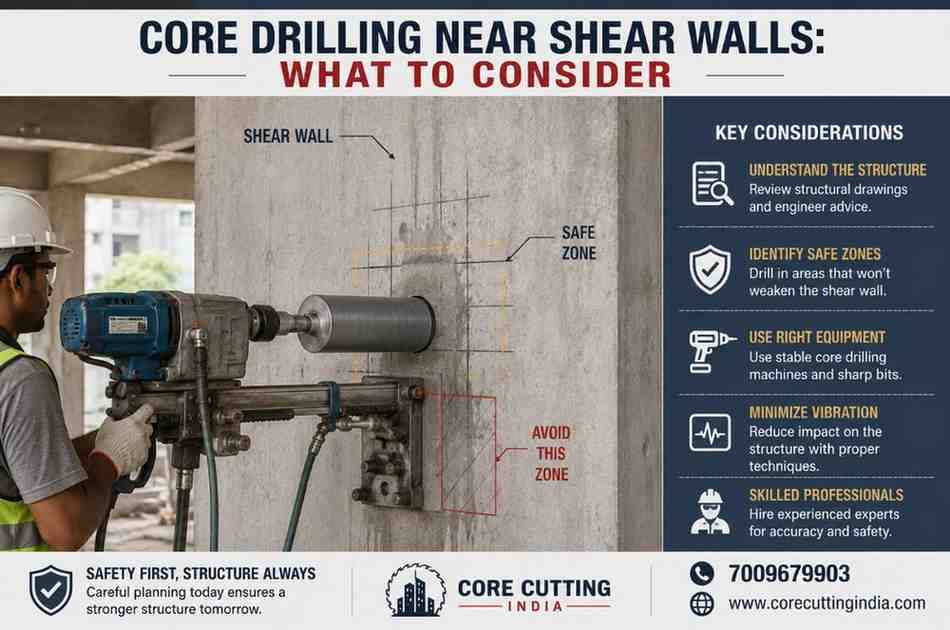
Shear walls are among the most critical structural elements in any building. They resist lateral forces caused by wind, seismic activity, and other dynamic loads, keeping a structure stable and upright. Because of this critical role, any construction or renovation activity near a shear wall — especially core drilling — demands careful planning, technical knowledge, and strict adherence to safety protocols.
Core drilling is a common requirement in modern construction and renovation projects. Whether it's for installing plumbing lines, electrical conduits, HVAC ducts, or structural anchors, core drilling allows contractors to create precise, clean openings through concrete and masonry. However, when this activity takes place near or through a shear wall, the stakes are considerably higher. A poorly planned cut can compromise the wall's ability to perform its primary function, potentially endangering the entire structure.
In this article, we'll explore what shear walls are, why drilling near them requires special consideration, and the best practices that should guide every project involving core drilling in structurally sensitive zones.
Understanding Shear Walls and Their Structural Role
A shear wall is a vertical structural element designed specifically to resist in-plane lateral forces — the sideways forces generated by wind pressure or seismic ground movement. Unlike partition walls, which serve only to divide space, shear walls are integral to a building's load path. They work alongside columns, beams, and foundations to transfer lateral loads safely down to the ground.
Shear walls are typically constructed from reinforced concrete (RCC) and are reinforced internally with a dense network of steel rebar. This reinforcement is carefully calculated by structural engineers to handle specific load combinations. Because the wall's strength depends on the continuity and placement of this reinforcement, any unplanned interference — such as cutting through rebar during drilling — can significantly reduce the wall's load-carrying capacity.
In high-rise buildings, shear walls are often concentrated around stairwells, elevator shafts, and building cores, since these areas benefit from continuous, uninterrupted vertical structural elements. This is precisely why core drilling activities in these zones require far more scrutiny than drilling in a standard partition wall.
Why Core Drilling Near Shear Walls Is Different
Regular core drilling — say, through a non-structural partition or a slab in a low-risk zone — mainly involves selecting the right drill bit, controlling dust and water runoff, and ensuring a clean, accurate hole. Core drilling near shear walls introduces several additional layers of complexity:
1. Structural Load-Bearing Sensitivity Shear walls are engineered to specific thickness and reinforcement patterns. Removing even a small section of concrete can alter stress distribution within the wall, especially if the drilled opening intersects with reinforcement bars or is placed too close to the wall's edge.
2. Reinforcement Interference Unlike drilling through plain concrete, shear walls contain closely spaced rebar grids. Cutting through main reinforcement bars without engineering approval can create localized weak points, leading to cracking, reduced ductility, or in severe cases, partial failure under lateral load.
3. Regulatory and Code Compliance Most building codes and structural design standards require that any modification to a primary structural element — including shear walls — be reviewed and approved by a licensed structural engineer. Skipping this step can result in code violations, insurance complications, and legal liability.
4. Cumulative Effect of Multiple Penetrations A single small core hole may seem harmless, but in buildings undergoing extensive MEP (mechanical, electrical, plumbing) retrofits, multiple penetrations across the same wall section can accumulate into a significant reduction of effective wall area, even if no individual hole appears large.
5. Vibration and Micro-Cracking Risks Core drilling, when done incorrectly or with poor equipment control, can introduce vibration-induced micro-cracks into adjacent concrete. In a shear wall, such micro-cracking can propagate over time under cyclic loading, especially in seismic zones.
Key Factors to Consider Before Drilling Near a Shear Wall
1. Structural Engineering Assessment
Before any drilling begins, a structural engineer should review the building's original drawings to identify the exact location, thickness, and reinforcement layout of the shear wall. This assessment determines whether drilling is permissible at all, and if so, where the safest locations are.
2. Rebar Detection and Mapping
Using tools such as ground-penetrating radar (GPR) or rebar scanners, contractors should map the internal reinforcement layout before marking any drilling points. This step helps avoid cutting through primary structural steel and allows drilling to be repositioned slightly if needed.
3. Hole Size and Location Restrictions
Structural engineers often specify maximum allowable hole diameters and minimum edge distances from the wall boundary or from existing openings. These restrictions are based on load calculations specific to that wall segment and should never be estimated informally on-site.
4. Sequencing and Load Redistribution
In some cases, temporary shoring or load redistribution measures may be required before drilling, particularly if the wall is actively carrying significant load during the construction phase. This is especially relevant in occupied buildings or phased renovation projects.
5. Drilling Technique and Equipment Precision
Diamond core drilling is the preferred method for structural concrete because it produces clean, vibration-minimized cuts compared to impact-based methods. Using calibrated, well-maintained equipment reduces the risk of unintended stress on surrounding concrete.
6. Dust, Water, and Debris Management
Wet core drilling helps control dust and reduces heat buildup on the drill bit, but water management becomes especially important near structural elements, where prolonged moisture exposure could affect rebar corrosion over time if not properly sealed post-drilling.
7. Post-Drilling Inspection and Sealing
After drilling, the opening should be inspected for any signs of exposed or damaged reinforcement. Appropriate repair methods — such as epoxy injection for minor cracks or supplementary reinforcement for larger openings — may be required before the penetration is finalized.
Common Mistakes to Avoid
Skipping Engineering Review: One of the most frequent and costly mistakes is proceeding with drilling based solely on architectural or MEP drawings, without cross-referencing structural drawings. Architectural plans often don't indicate reinforcement details.
Assuming Uniform Wall Thickness: Shear walls can vary in thickness at different building levels or sections, particularly near openings, corners, or transfer zones. Assuming uniformity across the wall can lead to unexpected structural exposure.
Ignoring Cumulative Penetration Effects: Even when individual holes are within approved limits, failing to track cumulative penetrations across a project can result in an overall weakened wall section without any single violation being obvious.
Using Improper Drilling Equipment: Impact drilling or oversized bits used out of convenience can cause unnecessary vibration and concrete spalling, especially problematic in reinforced structural elements.
Delaying Repairs: Leaving drilled openings unsealed or unreinforced for extended periods — especially in exposed or exterior shear walls — can invite moisture ingress and long-term durability issues.
Best Practices for Safe Core Drilling Near Shear Walls
- Always begin with a review of as-built structural drawings, not just architectural plans.
- Engage a structural engineer for sign-off before any drilling near primary structural elements.
- Use non-destructive testing methods, such as rebar scanning, to confirm actual reinforcement locations on-site.
- Maintain a detailed drilling log for buildings undergoing multiple penetrations, tracking location, size, and depth of each hole.
- Choose diamond core drilling for precision and reduced vibration impact.
- Coordinate with MEP teams early to minimize the total number of penetrations required near sensitive structural zones.
- Plan for post-drilling repair and sealing as part of the original project scope, not as an afterthought.
- Ensure drilling crews are trained specifically in structural-sensitive drilling, not just general concrete cutting.
The Role of Experienced Core Cutting Contractors
Given the technical and safety considerations involved, core drilling near shear walls should never be treated as a routine task handled without specialized expertise. Experienced core cutting contractors bring a combination of the right equipment, technical know-how, and coordination experience with structural engineers to ensure that every penetration is planned, executed, and documented correctly.
At Core Cutting India, projects involving structurally sensitive drilling are approached with a methodical process: reviewing structural drawings, coordinating rebar detection, confirming engineering approvals, and using precision diamond core drilling equipment suited for reinforced concrete. This structured approach minimizes risk while still meeting the practical needs of MEP installations, retrofits, and renovation projects.
Conclusion
Core drilling near shear walls is a task that sits at the intersection of construction practicality and structural safety. While the drilling process itself may appear straightforward, the presence of a shear wall changes the entire risk profile of the operation. From reinforcement interference to cumulative penetration effects, every factor must be carefully evaluated before any cutting begins.
The safest and most reliable approach is one grounded in proper planning: structural engineering review, accurate rebar mapping, adherence to code-specified limits, and execution by contractors experienced in structurally sensitive core cutting. Skipping these steps in favor of speed or convenience can introduce risks that are far costlier — both financially and structurally — than the time saved.
For any project involving core drilling near shear walls or other critical structural elements, consulting with experienced professionals is not just a best practice — it's a necessity for ensuring long-term building safety and performance.
Need expert guidance on core drilling near structural walls? Contact Core Cutting India at [email protected] for a professional assessment and safe, precise core cutting solutions tailored to your project.