
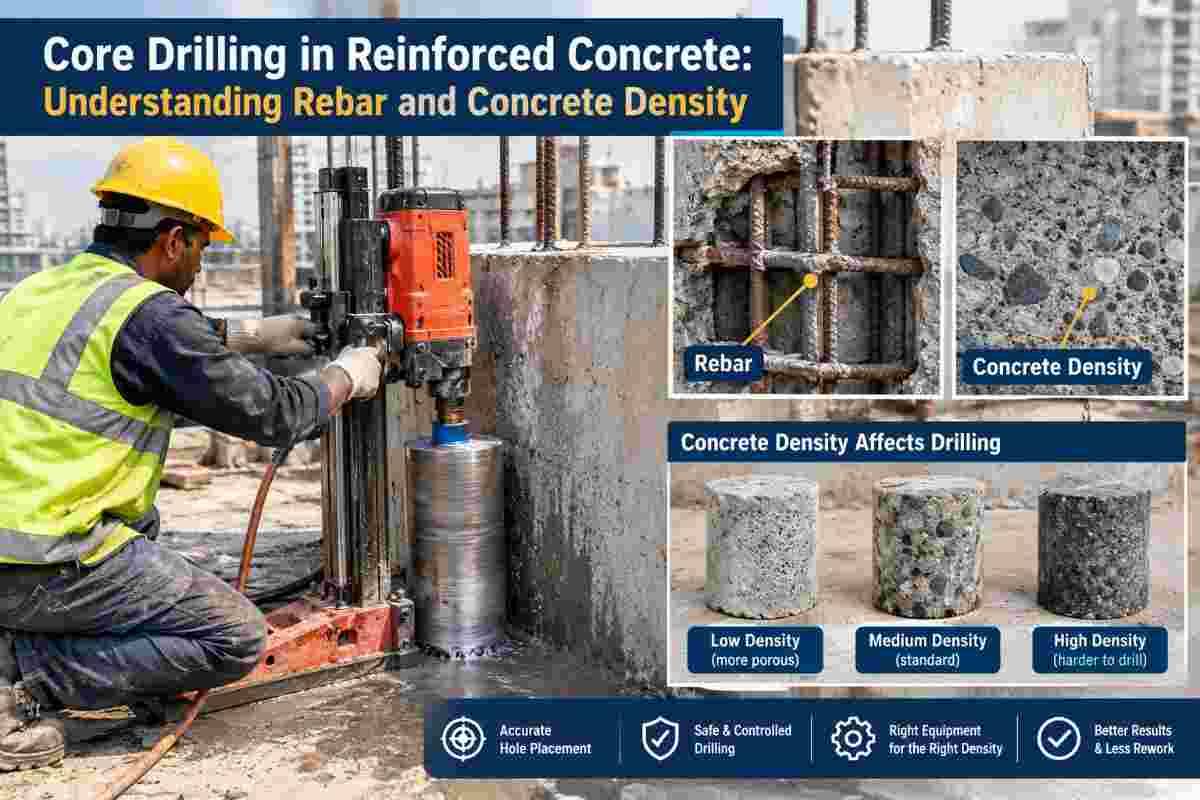
Drilling a clean, accurate hole through reinforced concrete looks simple from the outside. A diamond bit spins, water flows, and a cylinder of concrete comes out. In practice, every job depends on two hidden variables: the density of the concrete and the steel reinforcement buried inside it. Misjudge either one and you risk slow progress, glazed bits, damaged rebar, or a compromised structure.
At Core Cutting India, we work with RCC slabs, beams, columns, shear walls, bridge decks and industrial floors across projects of every size. This guide explains how rebar and concrete density affect core drilling, and how to plan the job properly before the rig starts.
What Is Core Drilling in Reinforced Concrete?
Core drilling, also called diamond core drilling or concrete core cutting, uses a hollow cylindrical bit with diamond segments on its cutting edge. The bit rotates at controlled speed, usually with water as coolant, and grinds through the material to leave a precise, round hole.
It is widely used for:
- Passing plumbing, drainage, HVAC, electrical and fire-fighting services through slabs and walls
- Installing anchor bolts, dowel bars and structural fixings
- Extracting concrete core samples for strength testing and quality audits
- Creating openings for ducts, cable trays and ventilation
- Retrofitting and renovation work where demolition is not an option
Unlike hammer drilling or breaking, core drilling creates minimal vibration and no micro-cracking around the hole. That makes it the preferred method for post-tensioned slabs, heritage buildings, hospitals and occupied premises.
Reinforced concrete is where the challenge begins. Plain concrete is abrasive but uniform. Reinforced concrete combines an abrasive matrix with steel bars, which cut in a completely different way. Your bit must handle both.
Understanding Concrete Density and Why It Matters
Density is the mass of concrete per unit volume, usually expressed in kg/m³. It strongly influences how a diamond bit behaves.
Typical density ranges:
- Lightweight concrete: roughly 1,200 to 1,800 kg/m³, using aggregates such as expanded clay or pumice
- Normal-weight concrete: roughly 2,200 to 2,500 kg/m³, the standard for most buildings, with reinforced concrete commonly taken at about 2,500 kg/m³
- Heavyweight concrete: above 3,000 kg/m³, using barite, magnetite or iron ore, typically for radiation shielding in hospitals and nuclear facilities
How Density Affects Drilling
Hardness and abrasiveness. Higher density usually means more compact material with a harder aggregate. Dense concrete made with granite, basalt or quartzite aggregate wears the diamond matrix more slowly in some cases but demands more power and a well-matched bond.
Cutting speed. Dense, high-strength concrete generally drills more slowly. Porous, lightweight concrete cuts quickly but can crumble at the hole edges and cause spalling on the exit side.
Bit wear. Abrasive aggregates such as river gravel and quartz wear down the metal bond quickly, exposing fresh diamonds. Very hard, dense aggregates can polish the diamonds, a problem known as glazing, so the bit stops cutting efficiently.
Concrete grade and age. Density is only part of the picture. A freshly cast M20 slab behaves differently from a 30-year-old M40 structural member. Older concrete is often harder and more carbonated at the surface, while young concrete may still be green and soft.
Why Aggregate Type Matters
Aggregate makes up around 60 to 75 percent of concrete volume, so it largely determines how the concrete drills. Crushed granite and basalt are hard and angular. River gravel is rounded and often siliceous. Limestone is softer. Knowing the aggregate lets you pick the right bit and avoid trial and error on site.
Understanding Rebar: The Real Challenge
Steel reinforcement is what gives RCC its tensile strength, and it is also what turns a routine drilling job into a technical one.
Common Rebar Characteristics
In India, reinforcement is typically TMT bars of grades such as Fe 500 and Fe 500D, conforming to IS 1786. Bar diameters commonly range from 8 mm to 32 mm in building work, and heavier bars appear in bridges and industrial structures. Spacing is usually between 100 and 200 mm in slabs and beams, with denser layouts at columns, beam-column joints and support zones.
A 100 mm core hole can easily intersect several bars, and larger cores almost always do.
Why Rebar Is Difficult for Diamond Bits
Diamond bits are optimised to grind abrasive mineral material. Steel behaves differently. It is ductile, so it smears and work-hardens rather than fracturing cleanly. Cutting it generates heat, and it clogs the bit’s cutting face if the wrong bond is used.
Cutting through rebar typically leads to:
- Slower penetration and higher power draw
- Faster segment wear
- Risk of bit jamming or binding if the bar twists
- Possible damage to the core barrel if the rig is not rigid
Rebar Is Not Always Cuttable
This is the most important point of the article. Rebar carries structural loads. Before cutting any bar, a qualified structural engineer should confirm that the hole location and size will not compromise the member. In general:
- Avoid cutting main tension reinforcement in beams and slabs wherever possible
- Avoid columns, beam-column joints and shear zones
- Never cut post-tensioned tendons without specialist assessment, because they hold stored energy and cutting them can cause serious injury and structural failure
- Prefer shifting the hole position slightly to pass between bars
Where cutting rebar is unavoidable, it should be documented and approved, and the hole location should be marked on drawings.
Scanning Before You Drill
The best way to deal with rebar is to know exactly where it is. Professional contractors scan the concrete before every critical hole.
Ground Penetrating Radar (GPR) detects embedded objects, including rebar, conduits and voids, and can estimate depth and spacing. It works well for slabs and walls.
Electromagnetic rebar locators such as cover meters detect steel and estimate cover depth and bar diameter. They are quick and effective for surface-level reinforcement.
X-ray imaging, used on high-risk jobs, gives detailed images but needs strict safety controls.
Scanning also helps locate electrical conduits, water pipes and post-tension cables, which are even more dangerous to hit than rebar. At Core Cutting India, scanning and marking are part of our standard process for structural and service-critical work.
Choosing the Right Diamond Core Bit
Bit selection is where density and rebar come together.
Bond Hardness
The bond is the metal matrix holding the diamonds. It must wear at a rate that keeps fresh diamonds exposed.
- Soft bond suits very hard, dense, low-abrasive concrete. It wears quickly and keeps releasing new diamonds.
- Hard bond suits abrasive, softer aggregate such as river gravel, where a soft bond would wear out too fast.
- Medium bond is a versatile compromise for general RCC.
Diamond Quality and Concentration
Diamond size, concentration and quality all influence life and speed. Bits designed for reinforced concrete often use specific segment designs and diamond distributions to cope with the mix of steel and abrasive material.
Segment Technology
Laser-welded segments are common for wet drilling and dry-capable bits. Silver-brazed or sintered segments can offer better heat tolerance for heavy-duty work. Segment height matters too, since taller segments give more drilling life.
Dedicated Rebar-Cutting Bits
Some bits are engineered specifically for reinforced concrete, with segment shapes and bond formulations that handle steel better. These cost more, but they save time on rebar-heavy jobs.
Bit Diameter and Length
Larger diameters remove more material and encounter more rebar, so they need more powerful rigs and lower rotation speeds. Core barrel length should suit the depth of the member, with extension rods used where needed.
Equipment, Speed and Water Management
Rig Selection
Handheld machines are suitable only for small diameters in light work. For reinforced concrete, especially above 50 to 75 mm, a rig-mounted machine on a stand is far safer and more accurate. Rigs are anchored with expansion bolts or held with a vacuum base on smooth, sound surfaces. A stable rig prevents bit wobble, reduces wear and improves hole quality.
Rotation Speed and Feed Pressure
Core drilling follows a general rule: the larger the bit diameter, the lower the RPM. Small bits spin fast, while large bits rotate slowly to keep a sensible peripheral speed. Feed pressure should be firm but not forced. Too little pressure polishes the diamonds, while too much can overload the motor and damage the bit.
When the bit meets rebar, an experienced operator reduces speed and keeps a steady, moderate feed rather than pushing hard. Listening to the machine and watching the amp meter help catch trouble early.
Water: The Unsung Hero
Water cools the bit, flushes out slurry and extends tool life. Insufficient water causes overheating, glazing and segment loss. Too much can create site messes, which is why slurry control matters in occupied buildings. Wet vacuums and slurry collection systems keep the work area clean and protect finished surfaces and electricals.
Where water is a concern, such as near sensitive equipment, dry drilling with specialised bits is possible but is slower and generates heat and dust that must be controlled.
Step-by-Step Approach to Core Drilling Reinforced Concrete
- Review drawings and get structural approval for the hole location and size.
- Scan the area to detect rebar, conduits and post-tension cables.
- Mark the hole and adjust its position to avoid critical reinforcement.
- Choose the bit and rig based on concrete grade, aggregate and diameter.
- Secure the rig with an anchor or vacuum base, and check alignment.
- Start the hole carefully, with light pressure to establish a groove.
- Maintain steady water flow and moderate, consistent feed.
- Reduce speed through rebar and avoid forcing the bit.
- Remove the core, clean the hole and inspect the finish.
- Manage slurry and restore the site.
Common Problems and How to Avoid Them
Bit glazing. Caused by a bond that is too hard for the concrete or too little pressure. Fix it by selecting a softer bond or dressing the bit on an abrasive block.
Bit jamming. Often the result of rebar twisting or a core breaking inside the barrel. Reduce feed, back out gently and avoid sudden force.
Spalling at the exit side. Common in lightweight or weak concrete. Support the exit side or reduce speed near the breakthrough.
Off-line or oval holes. Usually from an unstable rig or loose anchoring. Always secure the stand firmly.
Hitting hidden services. Prevented by proper scanning and, where possible, reviewing as-built drawings.
Excessive bit wear. Often linked to wrong bit selection, poor water supply or operator inexperience.
Safety Considerations
Core drilling in reinforced concrete involves electricity, water, heavy machinery and structural risk. Good practice includes:
- Using RCD-protected power supply and well-maintained cables
- Wearing PPE: safety glasses, gloves, hearing protection, boots and a hard hat
- Barricading the area below when drilling through floors, so falling cores do not injure anyone
- Securing cores and slurry so they do not drop onto occupied spaces
- Using trained operators who understand both the equipment and the structure
Safety is not only about the operator. It also protects the structure, the occupants and the project schedule.
Core Drilling Cost: What Influences It
Many clients ask how pricing is determined. Core drilling cost in reinforced concrete generally depends on:
- Hole diameter and depth
- Rebar density and whether steel must be cut
- Concrete grade and aggregate hardness
- Access conditions, such as height, confined spaces or outdoor work
- Number of holes and project location
- Scanning, slurry management and any special safety requirements
Heavily reinforced or very dense concrete takes longer and consumes more bits, so it naturally costs more than drilling plain or lightly reinforced sections.
Frequently Asked Questions
Can you core drill through rebar?
Yes, diamond core bits can cut through rebar, but it slows the job and wears the bit faster. Cutting should only be done after structural approval, and avoiding rebar altogether by adjusting the hole position is usually preferable.
How do you know if there is rebar in concrete before drilling?
Use GPR or an electromagnetic rebar locator to scan the surface. These tools show the position and approximate depth of steel, conduits and other embedded items.
What is the density of reinforced concrete?
Reinforced concrete is commonly taken as about 2,500 kg/m³, slightly higher than plain normal-weight concrete because of the steel content. Lightweight and heavyweight mixes fall well outside this range.
What is the best core bit for reinforced concrete?
It depends on the aggregate and rebar content. A bit with a suitable bond, quality diamonds and a segment design intended for reinforced concrete generally performs best.
Does core drilling weaken a concrete structure?
Done correctly and in approved locations, core drilling causes minimal damage. Problems arise when main reinforcement is cut or too many holes are placed close together without engineering input.
Is wet or dry core drilling better for reinforced concrete?
Wet drilling is generally preferred because water cools the bit, controls dust and extends life. Dry drilling is used only where water cannot be tolerated, with suitable bits and dust control.
How long does it take to core drill a hole in RCC?
Time varies widely with diameter, depth, concrete hardness and rebar. A small hole in a normal slab may take only minutes, while a large core through thick, heavily reinforced concrete can take considerably longer.
Why Choose Professional Core Drilling Services
Reinforced concrete punishes shortcuts. The wrong bit, an unscanned wall or an untrained operator can lead to damaged structures, hit services, broken equipment and costly rework. Professional contractors bring the right combination of equipment, bit selection, scanning tools and experience to manage density and rebar variables on every job.
At Core Cutting India, our approach is built around precision, safety and structural responsibility. We assess the concrete, scan for reinforcement and services, select the correct tooling and carry out the work with minimal disruption to your site. Whether you need a few service openings in a commercial building or hundreds of holes in an industrial project, planning around concrete density and rebar is what makes the result clean and reliable.
Conclusion
Core drilling in reinforced concrete is a balance of science and skill. Concrete density shapes how quickly a bit cuts and wears. Rebar changes how the bit behaves and, more importantly, affects how the structure carries load. Understanding both lets you choose the right diamond bit, scan before drilling, protect structural integrity and finish the job safely.
Before any drilling begins, remember the essentials: check the drawings, scan the concrete, involve a structural engineer where reinforcement may be cut, match the bit to the material and keep water flowing. Follow these principles and your holes will be precise, your tools will last longer and your structure will stay sound.
Planning a core drilling project? Visit https://corecuttingindia.com/ to discuss your requirements with our team.