
Introduction: The Hidden World Beneath Our Feet
Imagine stepping out onto the bustling streets of Connaught Place in New Delhi or Bandra in Mumbai. Beneath the seamless asphalt and concrete walkways lies a complex, invisible labyrinth: a dense network of water supply lines, sewage systems, storm drainage, fiber-optic telecom cables, and electrical grids. These underground utilities are the absolute lifeline of modern urbanization.
However, time, geological shifts, heavy traffic loads, and aging structures inevitably take their toll. Pipes burst, cables degrade, and drainage systems clog or collapse. Traditionally, fixing these issues meant deploying heavy excavators to rip open miles of roads, causing massive traffic snarls, commercial paralysis, and public inconvenience.
Enter core drilling—a precision engineering marvel that has fundamentally transformed how engineers approach underground utility repair. By combining diamond-tipped technology with modern non-destructive evaluation methods, specialists at [email protected] are helping cities across India repair, upgrade, and maintain their subterranean lifelines with minimal surface disruption.
What is Core Drilling in the Context of Underground Utilities?
At its core, core drilling is the process of using a specialized rotary drill equipped with a diamond-impregnated bit to extract a precisely measured, cylindrical sample of material (known as a "core") or to create clean, circular openings through dense media such as reinforced cement concrete (RCC), asphalt, brickwork, and bedrock.
When applied to underground utilities, core drilling serves two primary functions:
-
Exploratory & Access Sampling: Drilling down to evaluate subsurface soil profiles, check the exact depth and condition of buried assets, or test the structural integrity of surrounding concrete encasements.
-
Access Port Creation: Cutting neat, structural entry and exit holes through thick concrete vaults, manhole walls, retaining barriers, and roadway slabs to allow technicians to thread new utility lines or deploy rehabilitation equipment without structural compromise.
The Indian Infrastructure Landscape: Challenges and Realities
India is undergoing an unprecedented infrastructure boom. Mega-cities like Mumbai, Bengaluru, Delhi, Hyderabad, and Chennai are expanding vertically and horizontally at a blistering pace. Concurrently, historical underground networks—some dating back several decades—are buckling under pressure.
1. Urban Congestion and Dense Footprints
Indian metropolitan areas are characterized by narrow lanes, tightly packed commercial zones, and overlapping utilities laid down over generations without proper digital mapping. Traditional "open-cut" trenching is often physically impossible or economically unviable in these areas.
2. Mixed Geological Strata
From the hard Deccan basalt rock formations in Maharashtra and soft alluvial soils in the Indo-Gangetic plains to rocky terrain down south, Indian soil and sub-surface profiles vary dramatically. Core drilling and geological coring allow engineers to analyze these strata accurately before driving trenchless equipment through them.
3. Monsoon Pressures
During the monsoon season, poorly maintained or blocked underground drainage and stormwater lines lead to severe urban flooding. Rapid, precision repairs are mandatory, leaving zero room for prolonged road excavation projects that stall traffic for months.
How Core Drilling Facilitates Underground Utility Repairs
The integration of core drilling into utility management bridges the gap between surface access and underground restoration. Here is how the process works in practice:
[Site Assessment & Utility Mapping]
       ↓
[Precise Diamond Core Drilling (Access / Sampling)]
       ↓
[Non-Destructive Inspection & Clearance]
       ↓
[Trenchless Rehabilitation / Pipe Insertion]
       ↓
[Clean Restoration & Sealing]
Step 1: Subsurface Detection and Marking
Before any drill bit touches concrete or asphalt, Ground Penetrating Radar (GPR) and electromagnetic locators scan the area to map existing live utilities, preventing accidental strikes on high-voltage power lines or gas pipelines.
Step 2: Diamond Core Cutting
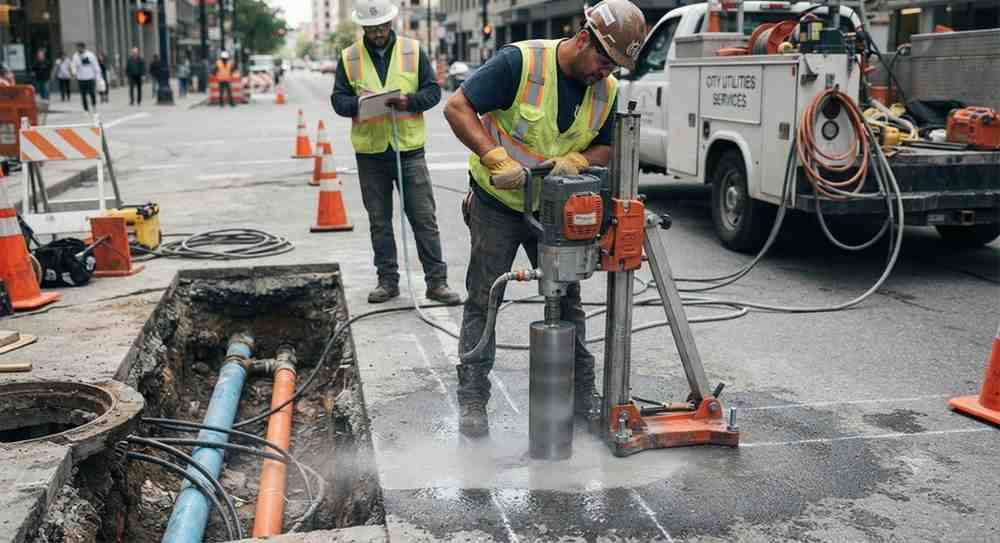
Using heavy-duty hydraulic or electric core drills, technicians create precise entry ports. Diamond cutting is favored because it produces zero vibration shockwaves, ensuring that surrounding fragile brickwork, old sewer lines, or historic building foundations remain completely crack-free.
Step 3: Inspection and Insertion
Through the cored opening, high-definition robotic cameras are lowered into the pipeline or void. Once the damage is assessed, trenchless rehabilitation methods—such as Cured-in-Place Pipe (CIPP) lining or horizontal directional drilling (HDD)—are deployed through these access points.
Key Advantages of Core Drilling Over Traditional Open-Cut Methods
Traditional excavation is rapidly becoming obsolete in modern urban planning due to high social and economic costs. Core drilling, paired with trenchless technology, offers profound advantages:
-
Minimal Surface Disruption: Traffic keeps moving, pedestrian walkways remain open, and local businesses do not suffer from blocked storefronts.
-
Structural Precision: Unlike brute-force jackhammering, which creates jagged edges and weakens surrounding concrete, core drilling delivers smooth, laser-accurate circular apertures.
-
Time and Cost Efficiency: While heavy trenching requires massive labor forces for prolonged excavation, road rebuilding, and repaving, core drilling projects are completed in a fraction of the time, lowering overall municipal expenditures.
-
Environmental Safety: Reduced soil displacement, lower carbon emissions from heavy earthmovers, and minimal dust pollution make core drilling an eco-friendly engineering choice.
Real-World Indian Applications and Case Scenarios
Case Study A: Metro Rail Utility Shifts in Bengaluru and Delhi
During the expansion of underground Metro rail networks, pre-existing municipal water mains and electrical trunks frequently cross the path of tunneling operations. Engineers use heavy-duty core drilling rigs to sample concrete encasements and create diversion entry points, allowing utilities to be rerouted seamlessly without halting metro construction.
Case Study B: Stormwater Drainage Overhauls in Mumbai
Mumbai’s British-era storm water drains require constant rehabilitation. Contractors utilize diamond core cutting to punch through thick street-level RCC slabs, introducing slip-lining materials directly into damaged brick sewers without digging up arterial roads during peak seasons.
Expert Insight: “In densely populated urban sectors, precision is everything. Core drilling allows us to treat underground infrastructure surgery like keyhole medical procedures—effective, targeted, and causing minimal trauma to the city above.” — Engineering Lead, [email protected]
Best Practices and Safety Protocols in Core Drilling
Executing core drilling operations for underground utilities demands strict adherence to engineering standards and safety codes:
-
Mandatory Utility Clearance: Never drill blindly. Always cross-verify utility blueprints with physical GPR scans.
-
Wet Drilling Techniques: Continuous water feed must be maintained during diamond core cutting to suppress silica dust, cool the diamond segments, and extend equipment lifespan.
-
PPE and Operator Safety: Technicians must wear specialized heavy-duty gear, hearing protection, and harness systems, particularly when working in deep utility vaults or manholes.
-
Core Waste Management: Slurry generated during wet cutting must be vacuumed and managed properly to prevent choking local drainage systems.
Future Trends: The Evolution of Subterranean Maintenance in India
As smart cities take shape across India under initiatives like the AMRUT and Smart Cities Mission, the demand for non-destructive utility maintenance is skyrocketing. Future developments include:
-
Automated Robotic Core Rigs: Remote-controlled core drills capable of operating in hazardous or confined underground spaces.
-
AI-Powered Subsurface Mapping: Integrating real-time sensor data with core sample analytics to predict pipe failures before they occur.
-
Eco-Friendly Synthetic Diamond Bits: Enhancing cutting speeds while reducing energy consumption on site.
Conclusion
The health of a nation's economy is mirrored in the reliability of its infrastructure. While what happens deep beneath our roads often goes unseen, its impact on daily life is absolute. Core drilling for repairing underground utilities has shifted from a specialized construction niche into an absolute necessity for modern, fast-growing Indian cities.
By ensuring surgical precision, structural preservation, and minimal public disruption, advanced core cutting keeps our cities running smoothly, safely, and sustainably.
For professional, reliable, and technologically advanced core drilling and utility support services tailored to India's challenging urban landscapes, connect with the experts at [email protected].