
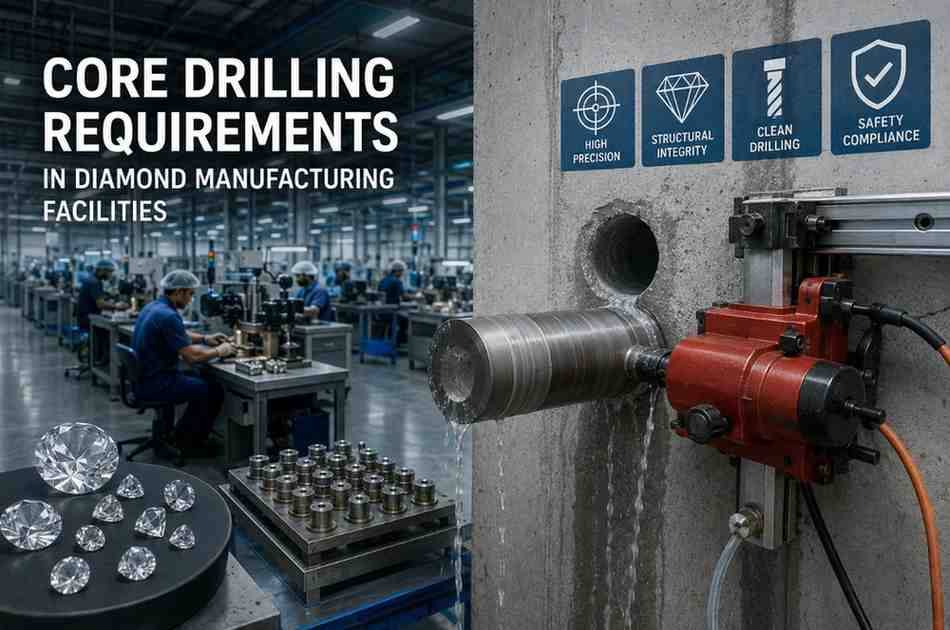
Diamond manufacturing is one of the most precision-driven industries in the world. From rough stone processing to the final stages of shaping and finishing, every step demands equipment that can deliver accuracy, consistency, and durability. Among the many processes involved, core drilling plays a foundational role — not just in the diamond cutting and polishing chain, but also in the broader infrastructure, tooling, and material-handling systems that keep a diamond manufacturing facility running efficiently.
At Core Cutting India ([email protected]), we work with diamond processing units, gemstone manufacturers, and industrial facilities across India to supply core drilling machines and solutions built for high-precision, high-durability environments. In this blog, we break down exactly what core drilling requirements look like in a diamond manufacturing facility — from machine selection to safety compliance — so that facility owners, procurement teams, and plant engineers can make informed decisions.
What is Core Drilling in the Context of Diamond Manufacturing?
Core drilling is a machining process that uses a hollow, cylindrical drill bit — typically tipped or embedded with diamond particles — to bore into hard materials and extract a solid cylindrical core. Unlike conventional drilling, which destroys the material it passes through, core drilling preserves a cylindrical sample or creates a precise circular void, depending on the application.
In diamond manufacturing facilities, core drilling is used in several distinct but related ways:
- Structural and foundation work — drilling into concrete, granite, or reinforced flooring during facility construction or equipment installation.
- Machine base and mounting preparation — creating precise holes for anchoring heavy cutting, polishing, and grading equipment.
- Material testing — extracting core samples from raw stone or composite materials to assess density, hardness, and structural integrity before processing.
- Tooling and fixture manufacturing — producing precision-bored components used in jigs, fixtures, and machine parts within the facility.
- Utility and service installations — drilling for pipe runs, cable conduits, ventilation ducts, and drainage systems required in a diamond processing environment.
Because diamond manufacturing facilities operate with extremely tight tolerances and handle materials that are either very hard or very high in value, the drilling equipment used must meet a different standard than what's acceptable in general construction or light industrial work.
Why Core Drilling Requirements Are Different in Diamond Facilities
A diamond manufacturing facility isn't a typical industrial site. Several factors make the core drilling requirements here more stringent than in standard commercial or construction settings:
1. Precision tolerances are extremely tight. Diamond cutting and polishing machines operate at micron-level accuracy. If the mounting holes, floor anchors, or structural bores drilled for this equipment are even slightly off-center or inconsistent in depth, it can introduce vibration, misalignment, or calibration drift in machines that are supposed to shape one of the hardest materials on Earth.
2. Vibration control is critical. Diamond processing equipment — bruting machines, faceting machines, polishing laps — is sensitive to vibration. Core drilling done with underpowered or poorly calibrated machines can transmit micro-vibrations into the surrounding floor and structure, which can affect nearby precision equipment even after the drilling work is complete.
3. Material hardness demands specialized bits. Diamond facilities are often built with reinforced concrete, granite flooring, or hardened composite surfaces designed to withstand heavy machinery and long-term wear. Standard drill bits wear out quickly or fail to maintain a clean bore in these materials, making diamond-tipped or diamond-impregnated core bits a necessity rather than an option.
4. Dust and contamination control. Diamond processing areas — particularly cutting, sawing, and polishing zones — require strict contamination control. Dry core drilling generates significant dust, which can interfere with sensitive optical and grading equipment. Wet or dust-extraction core drilling systems are often mandatory in or near these zones.
5. Downtime is expensive. Diamond manufacturing runs on tight production schedules with high-value inventory. Drilling work — whether for new equipment installation, facility expansion, or maintenance — needs to be fast, clean, and minimally disruptive to ongoing operations.
Core Drilling Machine Requirements for Diamond Manufacturing Facilities
When selecting a core drilling machine for use in or around a diamond manufacturing facility, several technical requirements should guide the decision.
Motor Power and Torque
Core drilling into reinforced concrete, granite, or dense composite flooring requires a machine with sufficient motor power to maintain consistent torque under load. Underpowered machines tend to overheat, stall, or produce inconsistent bore quality — all of which are unacceptable in a precision facility. Industrial-grade core drilling machines typically range from 1.5 kW to over 4 kW, depending on the bore diameter and material hardness.
Variable Speed Control
Different materials and bit diameters require different rotational speeds. A machine with variable speed control allows operators to match RPM to the specific job — slower speeds for larger diameter bores, higher speeds for smaller, precision holes — reducing bit wear and improving bore accuracy.
Wet Drilling Capability
For facilities where dust control is a priority, wet core drilling systems (which feed water through the drill bit to cool it and suppress dust) are strongly recommended. This also extends bit life significantly by reducing heat buildup during extended drilling sessions.
Rig Stability and Mounting Options
Precision core drilling requires the machine to be completely stable during operation. Facilities should invest in drilling rigs with secure base-plate anchoring, vacuum-mounting options for smooth floors, and adjustable angle drilling capability for non-vertical bores.
Diamond Core Bit Compatibility
The machine should be compatible with a range of diamond-segmented or diamond-impregnated core bits, since diamond facilities often need to drill into varied materials — from reinforced concrete during construction to granite or engineered stone surfaces used in equipment bases.
Depth and Diameter Range
Facility requirements vary — from small-diameter bores for cable routing to large-diameter bores for structural or utility installation. A versatile core drilling machine should support a wide diameter range (typically from 10mm to over 500mm, depending on the rig) and adjustable depth stops for repeatable accuracy.
Diamond Core Bit Specifications to Consider
The drill bit itself is just as important as the machine. Key specifications to evaluate include:
- Diamond concentration and grit — Higher diamond concentration improves cutting speed and bit longevity but comes at a higher cost. Facilities should match concentration to the hardness of the material being drilled.
- Segment type — Segmented, turbo, or continuous-rim bits each perform differently depending on whether the priority is speed, edge finish, or dust control.
- Bit diameter and core barrel length — Should match the exact specification needed for the application, whether it's a mounting hole, utility bore, or material sample extraction.
- Bond hardness — The metal bond holding the diamond particles should be matched to the material hardness; a bond that's too hard won't expose new diamond particles as it wears, while a bond that's too soft wears away too quickly.
Safety Requirements for Core Drilling in Diamond Facilities
Given the value of the materials and equipment involved, safety compliance is non-negotiable in diamond manufacturing environments.
Personal protective equipment (PPE) — Operators should use hearing protection, eye protection, dust masks or respirators (for dry drilling), and cut-resistant gloves.
Utility scanning before drilling — Facilities should conduct ground-penetrating radar (GPR) or utility scans before any structural core drilling to avoid hitting embedded electrical conduits, plumbing, or reinforcement bars.
Water and electrical safety — When using wet drilling methods, proper grounding and water containment systems (such as vacuum shrouds or water collection rings) are essential to prevent slip hazards and electrical risk.
Machine anchoring checks — Before any drilling operation begins, the rig should be checked for secure anchoring to prevent movement or kickback, which can cause both equipment damage and operator injury.
Trained operators only — Core drilling near sensitive diamond processing equipment should only be performed by trained personnel familiar with both the drilling equipment and the precision requirements of the facility.
Choosing the Right Core Drilling Partner for Your Diamond Facility
Given the technical and precision demands outlined above, sourcing core drilling machines and consumables from a specialized, experienced supplier — rather than a general industrial equipment vendor — makes a significant difference in long-term facility performance.
At Core Cutting India, we specialize in supplying core drilling machines, diamond core bits, and related equipment tailored to industries where precision and material hardness are critical factors — including diamond and gemstone manufacturing facilities. Our team works directly with facility engineers and procurement teams to recommend the right combination of machine power, bit specification, and drilling method for each specific application, whether it's structural installation, equipment mounting, or material testing.
If your facility is planning new construction, equipment installation, or an upgrade to your existing drilling capability, our team can help you evaluate your requirements and recommend the right solution.
Contact us at [email protected] to discuss your core drilling requirements.
People Also Ask
1. What is core drilling used for in diamond manufacturing? Core drilling is used for structural work (drilling into concrete or granite flooring), mounting precision cutting and polishing equipment, extracting material samples for testing, and installing utilities like cable conduits and plumbing within a diamond processing facility.
2. What equipment is required for a diamond processing facility? Beyond core drilling machines, a diamond processing facility typically requires cutting and sawing equipment, bruting and faceting machines, polishing laps, grading and sorting stations, dust extraction systems, and precision measurement tools — all supported by a stable, vibration-controlled facility structure.
3. How do you choose the right core drilling machine? Consider the material you're drilling (concrete, granite, composite), the required bore diameter and depth, whether wet or dry drilling is needed, motor power and torque requirements, and whether the machine offers variable speed control and secure rig mounting.
4. What safety measures are required during core drilling operations? Key safety measures include using appropriate PPE, scanning for embedded utilities before drilling, ensuring proper rig anchoring, managing water and electrical hazards during wet drilling, and having trained operators handle the equipment.
5. How often should core drilling bits be replaced? Bit lifespan depends on diamond concentration, bond hardness, material hardness, and drilling frequency. Facilities should monitor cutting speed and bore quality — a noticeable drop in either is usually the signal that a bit needs replacement or resharpening.
Core Cutting India provides industrial core drilling machines and diamond core bit solutions for manufacturing and processing facilities across India. For technical consultation or product inquiries, reach out to [email protected].