
Related Keywords (Target-Related Searches)
-
Diamond core cutting services in India
-
Seismic retrofitting of RCC columns and beams
-
Non-destructive testing (NDT) and core drilling
-
Concrete jacketing preparation via core drilling
-
Rebar anchoring and chemical fastening in old structures
People Also Ask (PAA) Questions
-
Why is core drilling necessary during building retrofitting?
-
How does core drilling help in the seismic retrofitting of old RCC structures?
-
What are the primary techniques used for retrofitting old buildings in India?
-
Can core drilling weaken existing reinforced concrete columns or beams?
As urban landscapes across India rapidly expand, the fate of millions of aging reinforced cement concrete (RCC) structures hangs in the balance. From colonial-era architecture retrofitted for modern use to multi-storey residential and commercial complexes built decades ago, structural degradation is a growing concern. Decades of exposure to India’s diverse monsoonal climates, carbonation, chemical attacks, and revised seismic safety codes (such as IS 1893) mean that tearing down and rebuilding is rarely economically or environmentally viable.
Instead, structural retrofitting has emerged as the premier engineering solution. At the heart of successful retrofitting lies a precision technique that dictates structural integrity: core drilling. Executed meticulously by specialists like [email protected], core drilling provides the surgical accuracy needed to upgrade old buildings without compromising their remaining structural skeleton.
1. Understanding the Need for Retrofitting in Indian RCC Buildings
India’s construction boom accelerated massively following key regulatory and structural milestones, particularly after landmark seismic events like the 2001 Bhuj earthquake. Many existing buildings across metropolitan hubs like Mumbai, Delhi, Bengaluru, and Chennai were constructed under older, less stringent building codes.
Over time, these structures suffer from:
-
Steel Corrosion: Ingress of moisture and chlorides leads to the rusting of internal rebar, causing concrete spalling.
-
Increased Load Demands: Changing building usages (e.g., converting a residential apartment into a commercial office space) increase live loads.
-
Seismic Vulnerability: Soft-storey configurations (such as open ground-floor parking lots) leave columns critically under-designed for modern lateral shear demands.
Retrofitting extends a building's lifespan by enhancing its load-carrying capacity, ductility, and stiffness. However, introducing new structural elements—such as steel bracing, external shear walls, or concrete jackets—requires meticulous mechanical intervention. This is where diamond core drilling becomes indispensable.
2. What is Core Drilling and Why is it Crucial for Retrofitting?
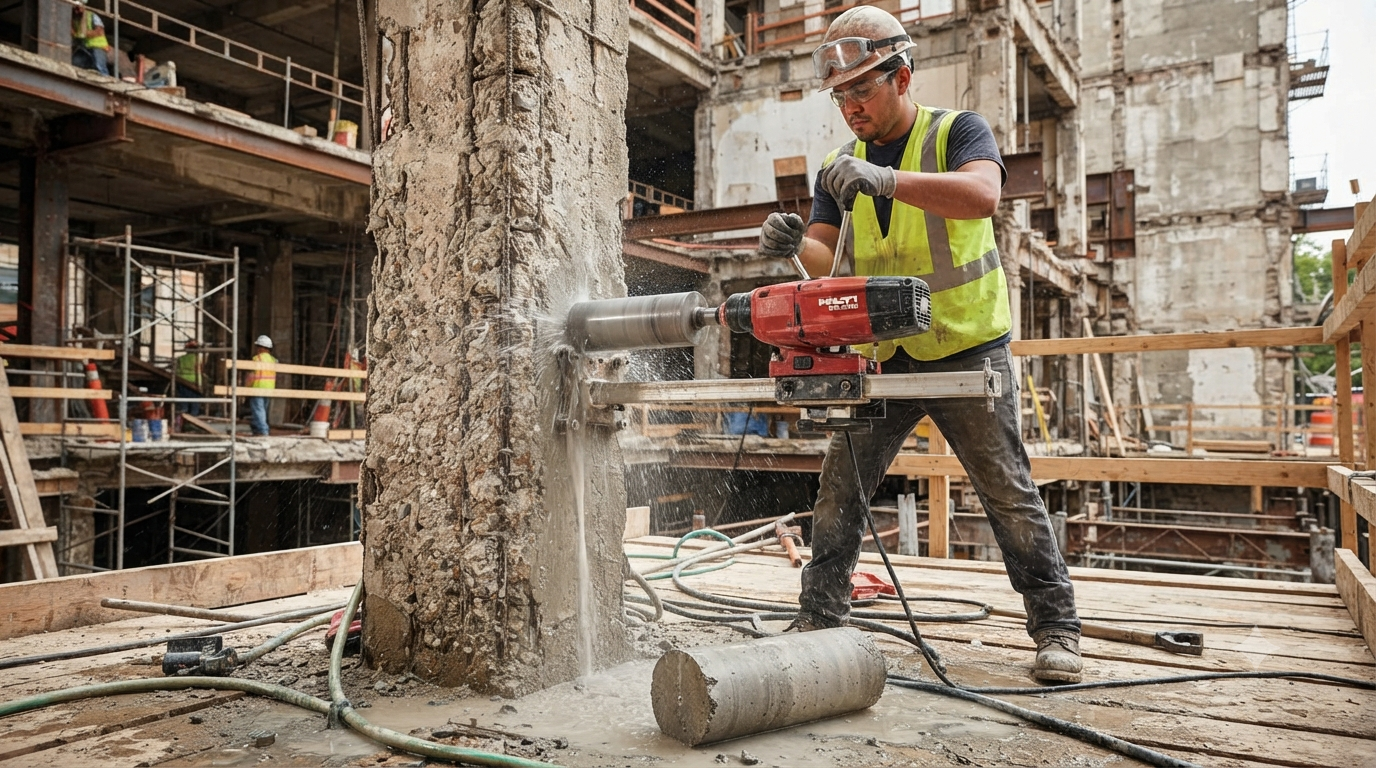
Core drilling (often synonymous with diamond core cutting) is the process of drilling clean, circular holes through hard materials like reinforced concrete, brick masonry, and stone using diamond-impregnated drill bits. Unlike traditional percussion hammering, which shatters concrete and induces micro-cracks throughout the member, core drilling utilizes rotary action with water cooling to extract a precise solid cylinder of concrete (core) or leave behind a smooth, perfectly dimensioned aperture.
Why It Matters for Retrofitting:
-
Vibration-Free Operation: Old RCC structures have delicate, fatigued bonding between concrete and steel. Percussive demolition can trigger structural collapse or progressive micro-cracking. Core drilling is virtually vibration-free.
-
Flawless Rebar Doweling: Retrofitting techniques like column jacketing, beam strengthening, and slab extensions require inserting new steel dowels and shear connectors. Core-drilled holes ensure uniform adhesive bonding for chemical anchors.
-
Material Testing Access: Before retrofitting design begins, core drilling extracts cylindrical concrete samples for compressive strength testing, validating structural health compliance.
3. Core Drilling Applications in Major Retrofitting Techniques
When retrofitting old RCC frames, engineers rely on specific local and global strengthening strategies. Core drilling plays an active role across all of them:
A. Column and Beam Jacketing
To upgrade deficient columns or beams, engineers often apply a concrete or micro-concrete jacket reinforced with new longitudinal bars and closed stirrups (Kaliyaperumal, n.d.). Passing these new structural ties through existing slabs, footings, or congested beam-column joints requires accurate core drilling to avoid slicing through existing primary reinforcement bars (Narayanan, n.d.).
B. Installation of External Shear Walls and Steel Bracings
To combat lateral wind and seismic loads, rigid elements like steel bracings or RCC shear walls are anchored to the existing skeleton. Heavy-duty anchor bolts must be embedded deep into primary load-bearing members. Core drilling creates precise pockets and anchor channels to tie the new seismic resistance system securely to the old frame.
C. Post-Installed Rebar Connections
Expanding floor plates or adding cantilevers to historic or old commercial structures necessitates post-installed rebar connections. Core drills create deep holes into existing columns and walls, into which high-strength epoxy or chemical grouts are injected alongside new reinforcement bars.
4. Indian Case Studies and Engineering Realities
The execution of core drilling in Indian retrofitting projects presents unique operational challenges.
-
High-Density Urban Environments: In congested commercial districts like Fort in Mumbai or Chandni Chowk in Delhi, heavy demolition is heavily restricted due to noise pollution, space constraints, and safety regulations. Silent diamond core drilling allows contractors to execute complex retrofitting inside active commercial buildings with minimal disruption to occupants.
-
Infrastructure and Bridge Retrofitting: Across national highways and urban flyovers managed by authorities like the National Highways Authority of India (NHAI) and state public works departments, old RCC piers and deck slabs undergo routine structural audits. Core drilling is deployed to install cathodic protection systems and external post-tensioning tendons.
For expert execution tailored to Indian site conditions, consulting professional teams via [email protected] ensures that structural audits and subsequent core-cutting activities adhere to rigorous safety and structural standards.
5. Best Practices for Executing Core Drilling on Aged Structures
Executing core drilling on an old structure requires a systematic engineering approach to prevent accidental damage:
-
Non-Destructive Testing (NDT) Prior to Drilling: Before a single hole is marked, technicians must use a Ferroscan or Rebar Locator to map out existing internal reinforcement layouts. Drilling blindly can sever primary load-bearing rebar, worsening structural vulnerability.
-
Water Management & Slurry Control: Core drilling requires continuous water flow to cool the diamond bits. On retrofit sites, vacuum collection rings and wet-vac systems must be deployed to manage slurry, preventing water seepage into aged, porous concrete floors.
-
Optimized Core Diameters: Selecting the correct core bit diameter ensures that chemical anchors receive the exact annular gap recommended by structural adhesive manufacturers, guaranteeing maximum pull-out strength.
Conclusion
Retrofitting old RCC buildings is a delicate balance of art and structural engineering. As India continues to prioritize sustainable infrastructure development and urban renewal, preserving existing assets through retrofitting is far superior to demolition.
At the center of this engineering discipline is precision execution. From initial material sampling to advanced rebar doweling and seismic upgrading, clean core drilling safeguards the structural integrity of aging buildings. To consult on professional diamond core cutting, structural core sampling, and retrofitting preparation services for your next project, reach out to industry experts at [email protected].