
Target-Related Searches
-
Core drilling for structural retrofitting
-
Earthquake retrofitting techniques in India
-
RCC column jacketing and core drilling
-
Concrete core cutting services India
-
Seismic strengthening of multi-story buildings
People Also Ask (PAA)
-
What is seismic retrofitting in civil engineering?
-
Why is core drilling necessary during structural retrofitting?
-
How does concrete jacketing help in earthquake resistance?
-
Which Indian zones are most vulnerable to earthquakes?
As urban centers across India expand rapidly, structural safety has become a paramount concern for civil engineers, architects, and property owners. With major landmasses falling under Seismic Zones III, IV, and V—ranging from the high-risk Himalayan belt to the seismically active plains and peninsular faults—millions of existing residential, commercial, and industrial buildings require urgent intervention. Many older reinforced concrete (RC) structures were built before the enforcement of modern, stringent seismic design codes like IS 1893.
When upgrading these vulnerable structures to withstand future tremors, traditional demolition and reconstruction are rarely feasible due to economic, logistical, and historical constraints. Instead, seismic retrofitting offers a reliable, cost-effective solution. At the heart of many advanced retrofitting techniques—such as RCC jacketing, shear wall integration, and steel bracing—lies a precise, non-destructive enabler: core drilling.
Understanding Seismic Retrofitting in the Indian Context
Seismic retrofitting is the modification of existing structures to make them more resistant to seismic activity, ground motion, or soil failure. In India, tragic historical events like the 2001 Bhuj earthquake exposed severe structural vulnerabilities, prompting a radical overhaul of Indian seismic standards.
Typical vulnerabilities found in Indian buildings include:
-
Soft Storeys: Open ground storeys designed for parking in apartment complexes, which lack adequate lateral stiffness.
-
Inadequate Detailing: Poor lap-splicing of column bars and insufficient transverse tie spacing leading to brittle shear failures.
-
Material Degradation: Carbonation, corrosion of rebar, and environmental weathering over decades.
Retrofitting aims to enhance structural stiffness, strength, and ductility. However, tying new structural elements to old concrete without causing micro-cracking or structural destabilization requires surgical precision. This is where specialized diamond core drilling becomes indispensable.
Why Core Drilling is Critical for Seismic Retrofitting
Retrofitting strategies—such as column jacketing, beam strengthening, or the installation of external steel bracing—rely heavily on transferring loads between existing members and newly added reinforcement. This requires embedding steel dowels, anchor bolts, and shear connectors into hardened, high-strength concrete.
+-------------------------------------------------------+
|              SEISMIC RETROFIT WORKFLOW                |
+-------------------------------------------------------+
|  1. Structural Audit & NDT Testing                    |
|  2. Marking Anchor & Dowel Locations                  |
|  3. Precision Diamond Core Drilling                   |
|  4. Chemical/Epoxy Anchoring & Doweling               |
|  5. Rebar Placement & Concrete/Steel Jacketing        |
+-------------------------------------------------------+
1. Precision Doweling and Chemical Anchoring
To execute column or beam jacketing, new longitudinal and transverse reinforcement bars must be anchored securely into existing slabs, footings, and beam-column junctions. Core drilling allows engineers to create clean, accurate holes to precise depths without inducing shockwaves or micro-fractures that conventional hammer drills often cause.
2. Shear Transfer at the Old-New Concrete Interface
When adding concrete jackets, shear friction must be maintained between the parent concrete and the newly poured layer. Core-drilled dowel holes filled with high-performance epoxy grout ensure monolithic load transfer during lateral seismic loading.
3. Utility Routing and Structural Modifications
Retrofitting often requires the introduction of service ducts, tie-rods, or post-tensioned cables. Diamond core drilling ensures that these penetrations can be cleanly executed through thick RCC walls and floor plates without compromising structural integrity.
Key Applications of Core Drilling in Seismic Upgrades
-
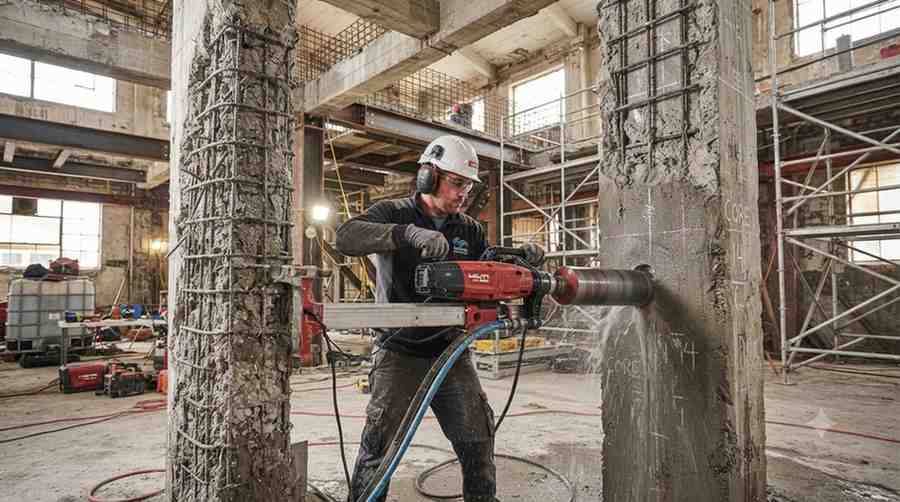
RCC Column Jacketing: Drilling holes through floor slabs allows continuous vertical reinforcement bars to pass uninterrupted from the foundation to upper floors, significantly boosting flexural and shear capacities (Kaliyaperumal, IIT Kanpur).
-
Steel Bracings and Shear Walls: Installing external steel frames or infill shear walls requires deep anchor penetrations into existing perimeter columns and foundation footings. Core drilling guarantees the precise hole diameters needed for heavy-duty structural anchors.
-
Beam-Column Joint Strengthening: Joints are critical stress-concentration zones during earthquakes. Core drilling permits the insertion of cross-ties and confinement plates to prevent brittle joint shear failures.
Indian Case Studies and Practical Engineering Insights
Across major Indian metropolises like Delhi-NCR, Mumbai, and Chennai, structural consultants routinely deploy core drilling alongside non-destructive testing (NDT) to upgrade aging infrastructure.
For instance, multi-story residential complexes in Delhi experiencing excessive inter-storey drift during seismic checks have been successfully retrofitted using steel bracing systems. Contractors utilized advanced diamond core drilling rigs to anchor heavy gusset plates into existing RC frame members cleanly and efficiently. Similarly, heritage structures and institutional buildings requiring retrofitting benefit immensely from core drilling because it minimizes vibration, protecting delicate historical masonry and decorative elements from shock-induced spalling.
For professional execution, structural auditing, and specialized diamond cutting solutions, engineering teams rely on trusted industry experts like [email protected] to deliver vibration-free, precision core drilling services tailored to complex seismic retrofit specifications.
Advantages of Professional Diamond Core Drilling in Retrofitting
-
Vibration-Free Operation: Protects the existing structural matrix from micro-cracking and progressive degradation.
-
Dimensional Accuracy: Delivers exact hole diameters and depths required for high-strength structural epoxies and chemical anchors.
-
Dust and Noise Control: Modern wet-core drilling rigs minimize airborne silica dust, making them ideal for occupied residential and commercial buildings undergoing live retrofitting.
-
Speed and Efficiency: Accelerates project timelines, reducing overall downtime for building occupants.
Conclusion
Seismic retrofitting is no longer an optional luxury in earthquake-prone regions of India; it is a vital engineering necessity for life safety and asset preservation. By bridging the gap between old structural elements and modern reinforcement systems, core drilling serves as the literal and figurative anchor of earthquake resilience.
To safeguard structures against unpredictable seismic forces with minimal disruption, partnering with certified professionals ensures that every core hole, anchor installation, and structural upgrade meets the highest standards of safety and engineering excellence. For expert guidance and execution, reach out to [email protected].