
Introduction
India's built environment is aging rapidly. From colonial-era structures in Mumbai and Kolkata to multi-storey residential towers built during the real estate boom of the early 2000s, thousands of buildings, bridges, and industrial facilities across the country now show visible signs of distress — cracks, spalling, water seepage, and corrosion. When such symptoms appear, engineers and building owners need more than a visual inspection to understand what's really happening beneath the surface. This is where core drilling becomes an indispensable diagnostic tool.
Core drilling for structural damage assessment is a precise, semi-destructive testing method used to extract cylindrical concrete samples from an existing structure. These samples are then tested in a laboratory to determine the actual strength, density, and composition of the concrete, offering engineers real, measurable data rather than assumptions. At Core Cutting India ([email protected]), this technique forms the backbone of many structural audits carried out for residential societies, commercial complexes, bridges, and industrial plants across the country.
This blog explains what core drilling is, why it matters, how it is performed, and how it is being used in real Indian contexts to keep our infrastructure safe.
What Is Core Drilling?
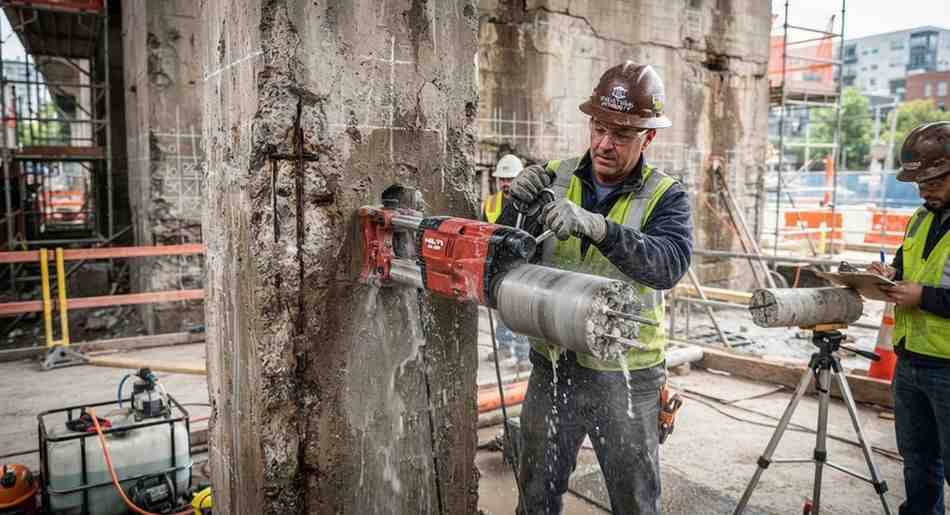
Core drilling is a technique that uses a diamond-tipped hollow drill bit, mounted on a specialized rig, to bore into concrete and extract a cylindrical sample — known as a "core" — without causing significant disturbance to the surrounding structure. Unlike destructive testing methods that damage large sections of a structure, core drilling is targeted and controlled, making it ideal for assessing existing buildings that are still in use.
The extracted core is sent to a laboratory where it undergoes compressive strength testing, along with other tests such as carbonation depth analysis, chloride content testing, and petrographic examination. The results give structural engineers a clear, evidence-based picture of the concrete's current condition — something that visual inspection alone simply cannot provide.
Why Core Drilling Matters for Structural Damage Assessment
Buildings and infrastructure deteriorate for many reasons: poor construction quality, use of substandard materials, environmental exposure, seismic activity, fire damage, or simply the passage of time. In India's diverse climate — coastal humidity in Mumbai and Chennai, extreme heat in Rajasthan, and heavy monsoon rainfall across much of the country — concrete structures are especially vulnerable to issues like carbonation, chloride-induced corrosion of reinforcement bars, and sulphate attack.
Core drilling helps answer critical questions that visual inspection cannot:
- Is the concrete strength sufficient to support the current or intended load?
- Has the concrete degraded due to chemical attack, fire, or age?
- Are there voids, honeycombing, or poor compaction hidden within the structural member?
- What is the actual depth of carbonation, which affects reinforcement corrosion?
- Is the structure safe for continued occupation, or does it require retrofitting or demolition?
By providing hard data instead of estimates, core drilling allows structural engineers to make informed, defensible decisions about repair, retrofitting, or demolition — decisions that carry significant financial and safety implications.
When Is Core Drilling Recommended?
Core drilling is typically recommended in the following scenarios common across Indian construction and infrastructure management:
- Post-earthquake or post-disaster assessment — After seismic events, such as those experienced in parts of Gujarat, Jammu & Kashmir, and the Northeast, core drilling helps determine whether structures have sustained internal damage not visible on the surface.
- Ageing building audits — Many housing societies in cities like Mumbai and Pune, some over 40–50 years old, are required by municipal corporations to undergo structural audits. The Brihanmumbai Municipal Corporation (BMC), for instance, mandates periodic structural audits for buildings older than 30 years, and core drilling is often part of this process when initial findings suggest concrete degradation.
- Pre-purchase or pre-renovation due diligence — Before purchasing an older commercial property or undertaking a major renovation, owners often commission core sampling to verify the building's structural soundness.
- Fire-damaged structures — Concrete exposed to high temperatures during a fire can lose significant strength even if it appears visually intact. Core samples help quantify the extent of thermal damage.
- Bridge and flyover assessment — India's National Highways Authority of India (NHAI) and various state PWDs regularly commission core testing on ageing bridges and flyovers to evaluate load-bearing capacity, especially on heavily trafficked corridors.
- Industrial and factory structures — Chemical plants, cement factories, and manufacturing units, where structures are exposed to corrosive environments, often require core testing to assess deterioration of RCC columns, slabs, and foundations.
- Litigation and insurance claims — In cases of construction disputes or insurance claims following structural damage, core drilling provides objective, lab-verified evidence.
The Core Drilling Process: Step by Step
A professional core drilling exercise for structural assessment generally follows these stages:
1. Site Survey and Planning
Engineers first conduct a visual inspection and review structural drawings to identify locations for core extraction. Locations are chosen to avoid critical reinforcement while still providing representative samples of the structural element being assessed — columns, beams, slabs, or foundations.
2. Rebar Detection
Before drilling, a rebar scanner or covermeter is used to map the location of steel reinforcement within the concrete. This prevents accidental cutting of load-bearing rebar, which could compromise the very structure being assessed.
3. Core Extraction
A diamond core drilling machine, fitted with a hollow cylindrical bit, is used to bore into the concrete at the marked location. Water is typically used during drilling to cool the bit and reduce dust. Standard core diameters range from 50mm to 150mm, depending on the aggregate size and testing requirements specified under IS 516 (Indian Standard for concrete testing).
4. Sample Labelling and Documentation
Each extracted core is labelled with its location, depth, orientation, and date of extraction. Photographs and site notes are recorded for traceability, which is especially important for legal or insurance purposes.
5. Hole Reinstatement
After extraction, the drilled hole is filled with a suitable repair mortar or non-shrink grout to restore the structural integrity and prevent water ingress at the sampled location.
6. Laboratory Testing
The core samples are transported to a NABL-accredited or equivalent laboratory, where they undergo:
- Compressive strength testing (as per IS 516)
- Carbonation depth testing
- Chloride and sulphate content analysis
- Petrographic examination for identifying alkali-silica reaction, sulphate attack, or poor mix design
7. Reporting and Recommendations
The final report correlates lab results with the visual condition of the structure, providing engineers and owners with a clear assessment: whether the structure is safe, needs repair, requires retrofitting, or is beyond economical repair.
Indian Case Contexts Where Core Drilling Plays a Critical Role
Mumbai's Ageing Housing Stock: With thousands of buildings in the city over three decades old, many falling under BMC's structural audit mandate, core drilling has become a routine part of redevelopment and repair planning, particularly in areas like Girgaon, Dadar, and Parel where older chawls and housing societies are common.
Coastal Corrosion in Chennai and Kochi: Structures near the coast face accelerated reinforcement corrosion due to chloride ingress from sea air. Core samples from such buildings often reveal carbonation depths and chloride levels far exceeding safe limits, prompting early intervention.
Bridge Infrastructure Across River Networks: With India's extensive network of bridges over rivers like the Ganga, Yamuna, and Godavari, many constructed decades ago, periodic core testing helps authorities decide between rehabilitation and reconstruction, balancing safety with the high cost of new construction.
Industrial Corridors in Gujarat and Maharashtra: Chemical and manufacturing units in industrial belts often deal with structures exposed to acidic or alkaline environments. Core drilling here helps quantify the rate of concrete degradation and plan preventive maintenance before structural failure occurs.
Advantages of Core Drilling Over Other Testing Methods
- Accuracy: Provides direct, measurable data on concrete strength rather than estimates from indirect methods like the rebound hammer test.
- Minimally invasive: Causes limited, localized damage compared to destructive load testing.
- Versatile: Applicable to buildings, bridges, dams, industrial structures, and pavements.
- Standardized: Testing follows well-established codes (IS 516, IS 1199), ensuring reliable and comparable results.
- Supports decision-making: Findings directly inform repair strategies, retrofitting designs, or demolition decisions.
Limitations to Keep in Mind
While core drilling is highly reliable, it does have limitations. It is localized — a small number of samples cannot fully represent an entire large structure, so sampling locations must be carefully chosen. It also causes minor, localized damage that must be properly reinstated. Additionally, results can be affected by the presence of aggregate at the cutting edge or by improper drilling technique, which is why engaging experienced professionals is essential.
Choosing the Right Core Drilling Partner
Given the technical precision required — from rebar detection to lab-accredited testing — structural damage assessment through core drilling should only be entrusted to experienced specialists with proper equipment and adherence to Indian standards. A reliable partner will not just extract samples but will also guide site selection, ensure minimal disruption to occupied buildings, and deliver clear, actionable reports.
Core Cutting India brings this expertise to structural audits, redevelopment projects, and infrastructure assessments across the country, combining precise core extraction with professional reporting that structural engineers and building authorities can rely on.
Conclusion
As India's buildings, bridges, and industrial structures continue to age, the need for accurate, science-based structural assessment has never been greater. Core drilling offers a proven, standards-compliant way to look beneath the surface and understand the true condition of concrete structures — empowering engineers, building owners, and authorities to make safe, informed decisions.
Whether it's a decades-old housing society in Mumbai, a heavily trafficked flyover, or an industrial facility exposed to corrosive elements, core drilling remains one of the most trusted tools in structural damage assessment.
For professional core drilling and structural assessment services across India, reach out to Core Cutting India at [email protected].
Target-Related Searches: core drilling cost in India, concrete core cutting services near me, structural audit companies India, core sampling test for concrete, diamond core drilling machine, non-destructive testing methods for buildings, RCC structural assessment, building health audit India, core drilling for bridges, concrete strength testing methods
People Also Ask:
- What is core drilling used for in structural assessment?
- How is concrete core sample tested for strength?
- Is core drilling harmful to a building's structure?
- What is the cost of core drilling in India?
- How deep should a concrete core sample be drilled?
- What is the difference between core drilling and destructive testing?
- How long does core drilling take for a structural audit?