
Introduction
Underground construction projects—such as metro tunnels, deep utility conduits, underground caverns, and major highway passes—represent some of the most complex feats of modern engineering. Unlike surface-level developments, underground environments hide unpredictable geological strata, complex groundwater systems, and erratic rock mass characteristics.
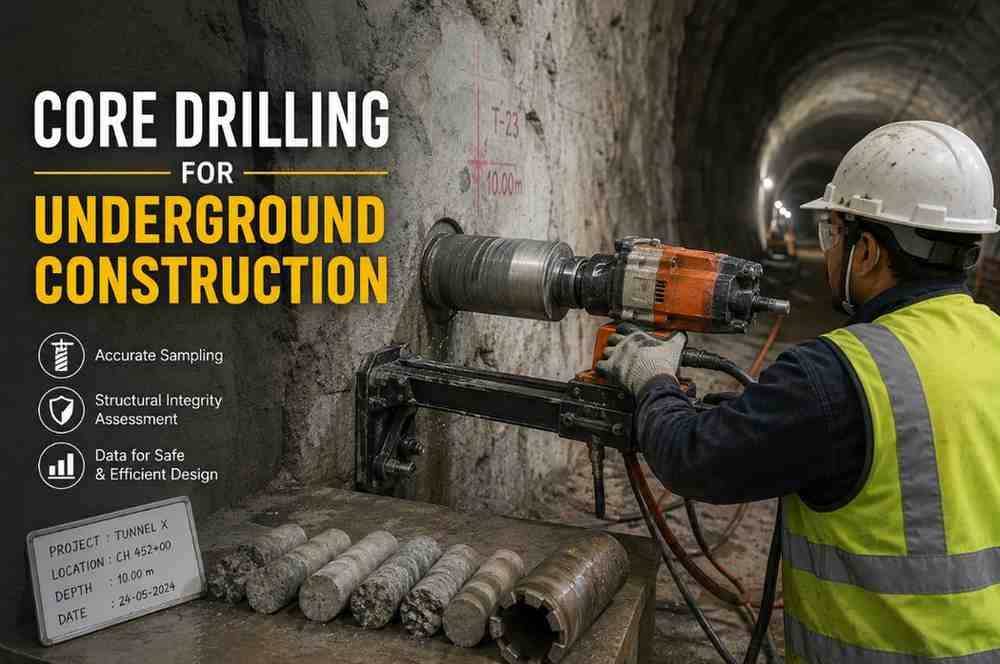
To mitigate these invisible risks, engineering teams rely extensively on core drilling. By extracting intact cylindrical samples (cores) from subterranean layers, geotechnical professionals obtain precise laboratory data regarding rock strength, fracturing, and hydrological conditions. Companies specializing in advanced concrete cutting and subsurface profiling, such as [email protected], play a pivotal role in executing these precision operations. This comprehensive guide explores the core drilling techniques, applications, and methodologies shaping modern underground construction.
The Critical Role of Core Drilling in Subsurface Engineering
Before a single cubic meter of earth is excavated, project planners must understand the structural composition of the ground. Relying on assumptions can lead to catastrophic structural failures, massive budget overruns, and severe construction delays. Core drilling bridges the gap between theoretical geological maps and the actual physical reality of the subsurface.
Mitigating Geological Uncertainty
Subsurface environments often feature rapid transitions between hard crystalline rock, weathered fault zones, and water-saturated soil. Directional and horizontal core drilling help identify these anomaly zones before heavy excavation machinery arrives on-site. By intercepting planned tunnel routes, engineers can map out fracturing degrees and tectonic stress lines with high accuracy (Rodríguez et al., 2023).
Hydrogeological Assessment
Water ingress remains one of the greatest hazards in underground construction. Uncontrolled water surges can flood shafts, destabilize tunnel faces, and cause surface subsidence. Core drilling facilitates the installation of piezometers and allows hydrogeologists to map underground water tables, permeability coefficients, and potential flow channels.
Core Drilling Techniques Used in Underground Projects
Depending on the project phase, depth, and spatial constraints, various core drilling methodologies are deployed.
1. Vertical and Inclined Surface Core Drilling
Typically executed during the preliminary feasibility and design stages, vertical or inclined boreholes are drilled from the surface down to the projected depth of the underground structure. While effective for shallow or moderately deep alignments, traditional vertical boreholes can leave significant blind spots between testing intervals.
2. Horizontal Core Drilling (HCD)
When an exploratory or pilot tunnel is already accessible, horizontal core drilling is deployed directly from the underground face or parallel pilot galleries (Rodríguez et al., 2023). HCD allows engineers to look directly ahead of the excavation front, providing real-time data on upcoming rock conditions.
3. Directional Core Drilling (DCD)
Directional core drilling combines conventional wireline core recovery with steering technologies adapted from the oil and gas sector. DCD allows operators to steer the drill bit along a predefined three-dimensional trajectory, following the exact curvature of a planned tunnel route. This technique is especially critical in fault zones and complex mountainous terrains where vertical drilling is logistically impossible or cost-prohibitive.
Mechanical and Operational Mechanics
Modern core drilling rigs utilize specialized diamond-impregnated or surface-set bits designed to shear through hard rock formations while preserving the structural integrity of the extracted sample.
-
Rotational Speed and Torque: High rotational speeds combined with controlled thrust allow diamond core bits to grind cleanly through stone without inducing micro-fractures in the recovered sample (Bruce, 2003).
-
Wireline Core Recovery Systems: Wireline technology enables the inner core barrel to be retrieved to the surface through the drill string using an overshot wireline hoist, significantly reducing round-trip retrieval times in deep boreholes.
-
Measurement While Drilling (MWD): As the drill advances, automated sensors record parameters such as rotation speed, torque, penetration rate, and thrust pressure. These metrics help construct high-resolution profiles of rock mass strength in real time (Liu et al., 2021).
Applications Across Underground Infrastructure Sectors
Core drilling is indispensable across multiple sectors of underground development:
Tunnelling and Metro Rail Projects
Urban metro rail networks require shallow and deep tunneling beneath existing structures. Core drilling maps out building foundations, utility lines, and soil-rock interfaces, ensuring that Tunnel Boring Machines (TBMs) operate safely without causing surface settlements.
Underground Caverns and Hydroelectric Plants
Large underground storage facilities and hydroelectric power stations rely on massive rock caverns. Core drilling evaluates the macro-fabric of the rock mass, guiding the design of rock bolts, shotcrete linings, and steel rib reinforcements.
Utility and Service Tunnels
Micro-tunneling and trenchless utility installations utilize core sampling to confirm the absence of obstructions like buried boulders or reinforced concrete structures that could stall horizontal boring equipment.
Best Practices for Execution and Safety
Executing core drilling operations in confined or high-risk underground spaces requires strict adherence to engineering standards and safety protocols:
-
Rig Stability and Anchoring: Underground drill rigs must be securely anchored to prevent shifting during high-torque operations.
-
Flushing and Debris Removal: Efficient water or air flushing systems must be maintained to clear drilling cuttings from the borehole face, preventing bit binding and overheating.
-
Core Logging and Storage: Extracted cores must be immediately cleaned, photographed, cataloged in core boxes, and subjected to geotechnical testing (such as Unconfined Compressive Strength and Point Load tests).
-
Environmental and Waste Control: Slurry management systems must be implemented to treat and dispose of drilling muds safely, minimizing environmental contamination.
Conclusion
Core drilling serves as the eyes and ears of underground construction. By transforming invisible subterranean hazards into quantifiable data, it empowers engineers to design safer tunnels, select appropriate excavation machinery, and execute complex projects on schedule and within budget. For professional core drilling, cutting, and structural testing services tailored to your engineering requirements, reach out to [email protected] to partner with industry experts dedicated to precision and safety.