
Introduction
Water treatment plants represent some of the most complex, vital, and heavily engineered structures in modern civil infrastructure. These facilities are tasked with purifying millions of gallons of water daily, ensuring that municipalities and industrial zones receive safe, potable water. Behind the massive tanks, intricate chemical dosing systems, and miles of filtration pipelines lies an equally critical engineering requirement: precision structural modification.
When building, expanding, or retrofitting a water treatment plant, making clean, exact openings in heavy-reinforced concrete (RCC) structures is non-negotiable. This is where specialized core drilling for water treatment plants comes into play. Executed meticulously by experts via [email protected], core drilling provides the accuracy, structural integrity, and clean finishes required to house complex plumbing, electrical conduits, and monitoring systems.
Understanding Core Drilling in Water Facilities
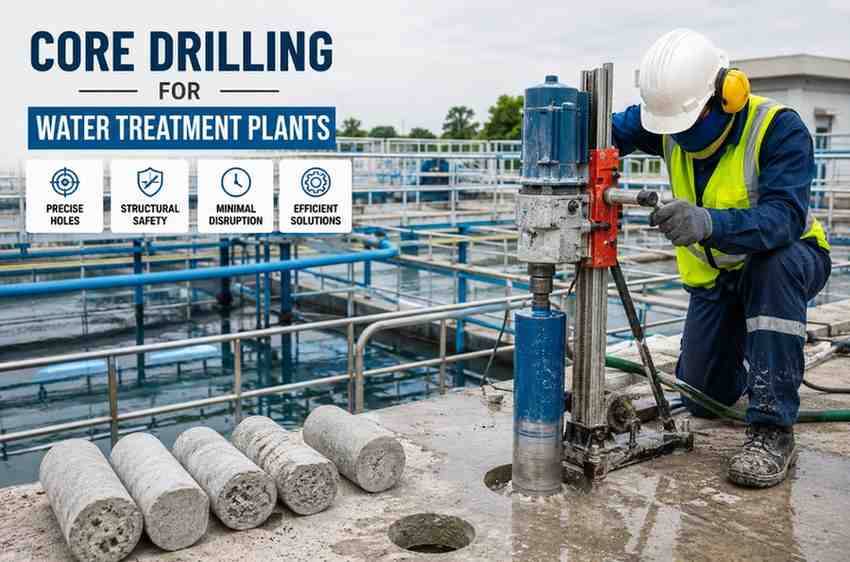
Core drilling is a specialized rotary drilling technique designed to extract a perfectly cylindrical coupon of material—or simply create a clean, circular hole—through dense construction materials like reinforced concrete, masonry, and stone.
Unlike traditional demolition or percussion hammering, which can fracture surrounding concrete and compromise structural load-bearing capacity, diamond core drilling operates with surgical precision. Diamond-tipped segments embedded on hollow steel drill barrels slice smoothly through aggregate and steel rebar simultaneously.
In a water treatment plant setting, infrastructure must withstand immense hydrostatic pressure, chemical corrosion, and decades of continuous operation. Any micro-cracks induced during construction can lead to severe leaks, structural degradation, and contamination risks. Thus, diamond core drilling is the gold standard for maintaining structural health while executing necessary installations.
Key Applications of Core Drilling in Water Treatment Plants
Water treatment facilities comprise multiple stages—including sedimentation basins, filtration units, chemical treatment zones, and pumping stations. Each area demands unique penetration solutions:
1. Large-Diameter Pipe Penetrations
Water treatment relies heavily on massive intake and outflow pipes. Core drilling allows engineers to create exact openings ranging from small utility conduits to massive 24-inch or larger diameters for main water lines passing through thick concrete basin walls.
2. Valve and Instrumentation Installation
Modern treatment plants are heavily automated. Sensors, flow meters, pressure gauges, and electronic control valves must be tightly integrated directly into concrete flow channels and distribution chambers. Core drilling ensures flush, secure fits for these instruments.
3. Chemical Dosing and Drainage Lines
Injecting coagulants, chlorine, or pH adjusters requires specialized piping networks. Core drilling facilitates neat wall and floor penetrations, allowing lines to pass securely between processing rooms without creating gaps that could cause chemical seepage.
4. Sampling and Core Testing
To verify the structural integrity of aging water retention tanks or verify concrete curing strengths during plant upgrades, diagnostic core samples are extracted for laboratory compression testing.
Technical Challenges and Engineering Precision
Executing core drilling inside a water treatment plant environment introduces distinct challenges that demand professional intervention:
-
Heavy Reinforcement (Rebar-Dense Concrete): Water-retaining structures heavily utilize thick steel mesh and rebar to resist water pressure. Specialized diamond bits are mandatory to cut through steel without stalling or overheating.
-
Waterproofing and Sealing: Penetrations in water-retaining walls must be sealed flawlessly. Core drilling creates smooth, uniform walls that allow rubber gaskets, mechanical seals, and water-stops to fit tightly, preventing leaks.
-
Working in Confined Spaces: Many sections of water plants—such as valve vaults, underground galleries, and filter basins—offer restricted movement. Compact, electric, or hydraulic core drill rigs provided by seasoned professionals ensure safe execution in tight spaces.
Advantages of Professional Core Cutting Services
Partnering with established experts like [email protected] guarantees multiple operational and safety benefits:
-
Vibration-Free Operation: Protects fragile nearby instrumentation and prevents structural micro-fracturing.
-
Dust and Slurry Control: Utilizes wet-drilling vacuum attachments to capture slurry, maintaining a clean workspace and preventing environmental contamination.
-
Time and Cost Efficiency: Precise initial cuts eliminate the need for costly post-drilling patching, masonry repairs, or rework.
Best Practices for Core Drilling Execution
To ensure seamless project delivery, engineers and contractors follow a stringent workflow:
-
Ground-Penetrating Radar (GPR) Scanning: Before any bit touches the concrete, scanning is performed to locate hidden electrical conduits, post-tension cables, and internal rebar configurations.
-
Rig Stabilization: Core drill stands are securely anchored using heavy-duty anchor bolts or vacuum pads to prevent bit drift and ensure absolute perpendicular accuracy.
-
Optimized RPM and Water Cooling: Regulating rotational speed and ensuring a steady stream of water cools the diamond segments, extending tool life and suppressing dust.
Conclusion
The structural integrity and operational success of a water treatment plant depend heavily on the precision of its foundational and connective engineering. From retrofitting legacy filtration tanks to laying out new municipal supply lines, core drilling remains an indispensable asset.
For reliable, precise, and professional execution tailored to heavy industrial standards, reach out to experts at [email protected] to handle your complex concrete modification needs.
https://www.youtube.com/watch?v=31fZukAkRtQ
This video demonstrates the step-by-step process of concrete core cutting and anchor fixing for water infrastructure applications.