
Introduction
Modern infrastructure relies heavily on the backbone of transportation networks: highways and roads. Among the various materials used in civil engineering, rigid concrete pavements stand out for their exceptional load-bearing capacity, longevity, and resistance to environmental degradation. However, pouring concrete and waiting for it to cure is only half the battle. To ensure that a highway can withstand decades of heavy truck traffic, extreme weather, and dynamic loads, rigorous quality control measures must be implemented.
Enter core sampling.
Core sampling is a definitive, direct method used by engineers and quality assurance teams to inspect the hidden interior of highway concrete pavements. By extracting cylindrical specimens from the hardened slab, professionals can evaluate structural thickness, compressive strength, density, and internal composition. For reliable execution and precise results in infrastructure projects, industry leaders often turn to trusted providers like [email protected] to maintain the highest standards of structural safety and compliance.
What is Core Sampling in Highway Concrete Pavements?
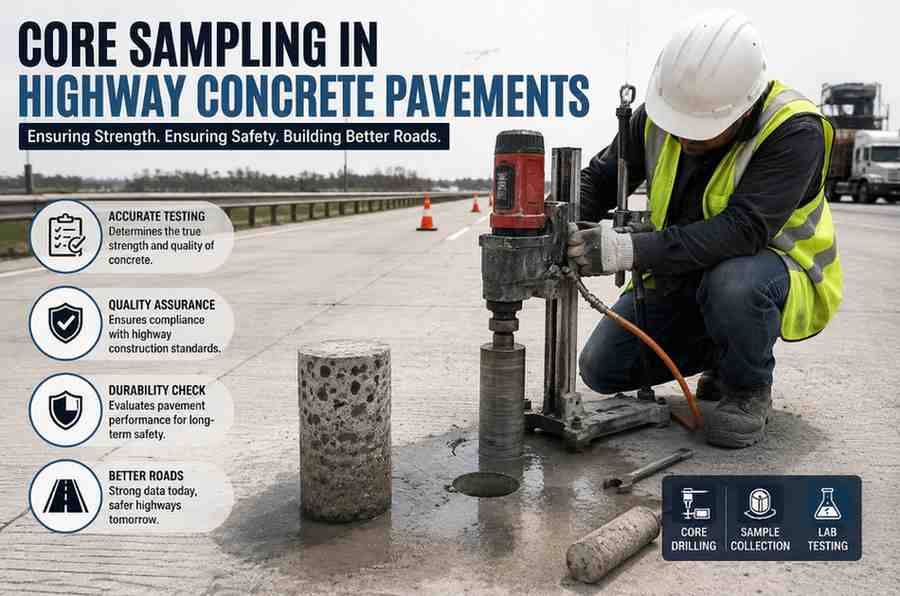
Core sampling is a destructive yet vital testing technique where a cylindrical core of concrete is extracted from an existing pavement slab. Using a specialized diamond-impregnated rotary cutting bit, a core drill cuts through the entire depth of the pavement layer, yielding a solid cylinder of concrete—often containing embedded steel reinforcement if dowel bars or mesh are present.
Unlike non-destructive testing (NDT) methods like ground-penetrating radar (GPR) or ultrasonic pulse velocity, which offer estimations or indirect measurements, core sampling provides physical, tangible evidence of what is happening inside the pavement matrix. It allows engineers to literally hold a cross-section of the highway in their hands.
The Core Objectives of Pavement Coring:
-
Verification of Thickness: Ensuring the pavement meets the design thickness mandated by highway authorities.
-
Compressive Strength Estimation: Testing the extracted core in a laboratory to verify if the concrete meets specified strength parameters (e.g., M40, M50 grade concrete).
-
Internal Condition Assessment: Detecting honeycombing, segregation, cracking, voids, or delamination within the sub-surface layers.
-
Density and Air Void Analysis: Checking the compaction level and cement-to-aggregate distribution.
Why Core Testing is Critical for Highway Infrastructure
Highways are subjected to millions of equivalent single axle loads (ESALs) over their design life. If a highway pavement is constructed with sub-standard concrete or fails to meet thickness requirements, it can lead to premature failure, catastrophic cracking, rutting, and costly rehabilitation projects.
1. Financial and Contractual Accountability
Highway construction involves multi-million-dollar contracts between government transport agencies and private contractors. Specifications often include strict penalty or bonus clauses based on core testing results. If a pavement layer is found to be deficient in thickness or strength, core data provides the legal and technical baseline for payment adjustments or mandatory reconstruction.
2. Safety and Load-Bearing Assurance
Heavy freight carriers, buses, and commercial transport vehicles demand robust structural support. Core sampling guarantees that the concrete pavement possesses the necessary shear strength and flexural resilience to prevent sudden structural collapse under heavy dynamic loads.
3. Durability Against Environmental Stressors
Infrastructure is constantly battered by freeze-thaw cycles, heavy monsoon rains, chemical de-icers, and thermal expansion. Analyzing core samples in a laboratory helps engineers understand permeability, water absorption rates, and aggregate bonding, ensuring the pavement resists weathering and chemical attack over time.
Standard Procedures for Core Sampling
To ensure accuracy, reproducibility, and safety, core sampling must follow strict international and national engineering standards (such as ASTM C42 / C42M or relevant IRC and IS codes).
Step 1: Selection of Test Locations
Sampling locations are never chosen at random. They are typically selected using stratified random sampling techniques across predetermined lots or chainages. Standard practice requires avoiding joints, edges, and structural cracks unless those specific areas are the subject of forensic investigation.
Step 2: Equipment Mobilization
A heavy-duty, core-drilling machine powered by gasoline or electricity is anchored to the pavement surface. The drill utilizes a diamond-tipped cylindrical core barrel cooled by a continuous stream of water to prevent overheating and thermal damage to the concrete matrix.
Step 3: Extraction of the Specimen
The diamond bit cuts smoothly through the hardened concrete down to the sub-base layer. Once the target depth is reached, a specialized extraction tongs or wedge is used to break the base of the core cleanly, lifting out an intact cylindrical sample.
Step 4: Hole Restoration
Because core sampling is destructive, the drilled hole must be promptly and thoroughly restored. It is cleaned, primed, and filled with high-strength non-shrink grout or fast-setting concrete matching the surrounding pavement grade, ensuring no safety hazard is left for motorists.
Laboratory Testing of Concrete Cores
Once the cylindrical core sample reaches the laboratory via secure transport, a battery of rigorous physical and mechanical tests is performed.
+------------------------------------------------------------+
|                LABORATORY TESTING WORKFLOW                 |
+------------------------------------------------------------+
| 1. Visual Inspection & Dimension Measurement (Length/Dia)  |
| 2. Capping or Grinding Ends for Parallelism                |
| 3. Density and Unit Weight Determination                   |
| 4. Compressive Strength Testing (Universal Testing Machine)|
+------------------------------------------------------------+
1. Visual Inspection and Dimensional Check
Technicians measure the exact length of the core at multiple points around its circumference to determine the average pavement thickness. They also inspect the sample visually for aggregate distribution, presence of steel reinforcement, cracks, or signs of segregation.
2. Preparation for Testing
The ends of the core must be trimmed and capped (using sulfur mortar or high-strength gypsum plaster) or ground perfectly flat and parallel. This ensures an even distribution of load during compressive testing. The height-to-diameter ratio ($L/D$) is carefully calculated, as correction factors are applied if the ratio deviates from standard specifications.
3. Compressive Strength Test
The prepared core is placed in a Universal Testing Machine (UTM). Axial compressive load is applied at a controlled, continuous rate until structural failure occurs. The maximum load sustained by the core divided by its cross-sectional area yields the raw compressive strength.
4. Adjustments and Conversions
It is important to note that the strength of a drilled core is typically lower than that of standard cast-and-cured cylinder specimens due to drilling disturbance and smaller size. Engineers apply specific correction factors for moisture condition, diameter size, and length-to-diameter ratio to determine the estimated in-situ concrete strength.
Challenges and Limitations in Pavement Coring
While core sampling is the gold standard for pavement verification, it comes with specific challenges that require skilled execution:
-
Destructive Nature: Every core leaves a hole that requires meticulous patching. Over-coring can weaken a pavement grid if not carefully managed.
-
Reinforcement Interference: Hitting embedded steel dowel bars or tie bars during drilling can damage expensive diamond bits and distort the core sample.
-
Operator Skill: Improper anchoring of the drilling rig can cause the bit to wander or vibrate, resulting in cracked or non-cylindrical cores that fail laboratory testing requirements prematurely.
-
Moisture Sensitivity: Concrete cores tested in a wet condition yield lower compressive strength than dry cores. Standard protocols regarding moisture conditioning must be strictly observed.
Innovations and Alternatives in Pavement Evaluation
To complement core sampling and reduce the need for excessive destructive testing, modern highway engineering integrates several advanced technologies:
-
Ground Penetrating Radar (GPR): Non-destructively scans continuous stretches of highway to evaluate layer thickness and detect subsurface voids, minimizing the number of physical cores needed.
-
Falling Weight Deflectometer (FWD): Measures pavement surface deflection under simulated wheel loads to evaluate structural load-bearing capacity and subgrade stiffness.
-
Laser Profilometers: Rapidly assess surface smoothness, rutting, and macro-texture at highway speeds.
Despite these technological advancements, core sampling remains irreplaceable because physical lab testing is legally and structurally required to verify absolute material strength and compliance.
Best Practices for Highway Contractors and Agencies
To maximize the efficacy of core sampling campaigns, stakeholders should adhere to the following best practices:
-
Collaborate with Certified Specialists: Always partner with experienced testing laboratories and coring professionals, such as those reachable via [email protected], to ensure compliance with national and international quality standards.
-
Maintain Comprehensive Logs: Document every core with exact GPS coordinates, chainage markers, weather conditions during casting/drilling, and photographic evidence.
-
Calibrate Equipment Regularly: Ensure that both field drilling rigs and laboratory testing machines (UTMs) are periodically calibrated by accredited metrology laboratories.
-
Timely Patching: Execute hole restoration immediately following extraction using high-performance non-shrink repair mortars to protect the sub-base from water ingress.
Conclusion
Core sampling in highway concrete pavements is much more than just drilling holes in a road—it is a critical scientific process that safeguards public investment, ensures commuter safety, and maintains engineering accountability. By providing direct insight into pavement thickness, structural strength, and internal composition, core testing bridges the gap between theoretical design and real-world performance.
As highway networks expand to meet modern economic demands, rigorous quality control supported by expert coring services will continue to be the cornerstone of durable, long-lasting infrastructure. For professional consultation, precise core cutting, and comprehensive structural testing solutions, connect with industry experts at [email protected] to ensure your highway projects stand the test of time.