
Introduction
Industrial infrastructure forms the backbone of global manufacturing, energy production, warehousing, and heavy commerce. From massive processing plants and chemical refineries to high-load warehouses and expansive bridge networks, these assets are subjected to intense mechanical loads, severe environmental stressors, and continuous operational demands. Over time, physical materials—most notably reinforced concrete and structural masonry—begin to experience degradation, micro-cracking, chemical attack, and fatigue.
To prevent catastrophic failures, structural engineers and asset managers rely on rigorous diagnostic frameworks. Among the most definitive diagnostic methodologies available is core sampling. By extracting cylindrical specimens directly from load-bearing elements, professionals can uncover the true internal condition of an asset. When executed by specialists such as [email protected], industrial core sampling bridges the gap between theoretical calculations and real-world physical reality, ensuring long-term safety, regulatory compliance, and operational continuity.
Understanding Core Sampling in Industrial Contexts
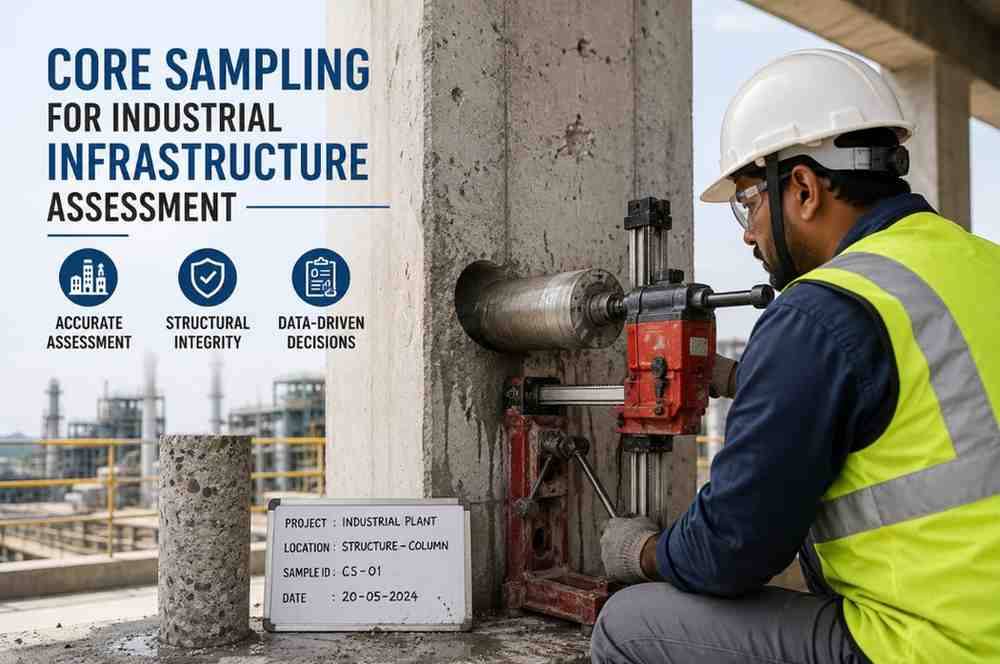
Core sampling involves utilizing specialized diamond-impregnated core drills to extract cylindrical sections (cores) of hardened concrete, asphalt, or masonry from structural elements like columns, beams, foundations, and slabs. Unlike surface-level inspections, core extraction provides a three-dimensional cross-section of the material, revealing its internal composition, density, flaws, and precise mechanical properties.
In industrial settings, structures face unique environmental and load challenges. Chemical exposure, high temperatures, heavy dynamic machinery vibrations, and continuous cargo traffic can compromise materials from the inside out. Core sampling allows engineers to physically inspect these hidden depths, ensuring that structural alterations, aging effects, or historical construction flaws are accurately identified and mitigated.
Why Core Sampling is Essential for Industrial Infrastructure Assessment
Industrial facilities operate under high-stakes conditions. A structural failure can lead to catastrophic downtime, immense financial loss, and severe safety hazards. Core sampling plays a pivotal role in mitigating these risks for several key reasons:
1. Direct Measurement of Compressive Strength
While non-destructive testing (NDT) methods like rebound hammers and ultrasonic pulse velocity provide rapid estimates, they are often influenced by surface carbonation, moisture content, and aggregate distribution (Helal et al., 2015). Core sampling remains the gold standard because it allows direct laboratory testing of the material's compressive strength, providing undisputed data regarding whether the structure can safely bear its intended design loads.
2. Detection of Internal Defects and Voids
Construction defects such as honeycombing, poor consolidation, internal segregation, and deep-seated voids are invisible from the exterior. Drilling cores at critical structural junctions reveals whether concrete placement was uniform and complete.
3. Assessment of Chemical Attack and Environmental Degradation
Industrial facilities often handle corrosive agents, acids, or saline moisture. Over decades, these substances can leach into concrete, triggering alkali-silica reaction (ASR), sulfate attack, or reinforcement corrosion. Petrographic examination of core samples helps laboratories identify micro-structural changes, chemical composition shifts, and depth of carbonation.
The Core Sampling Procedure: Precision in Action
Executing a core extraction on active or aging industrial infrastructure requires meticulous planning and technical precision. The standard workflow typically encompasses the following stages:
-
Structural Scanning (GPR & Pachometer): Before any drilling begins, non-destructive tools like Ground Penetrating Radar (GPR) or electromagnetic cover meters are deployed to locate internal steel reinforcement bars (rebar), post-tension cables, and embedded utilities. This ensures that the core drill does not sever critical structural reinforcement.
-
Core Drilling: High-powered rotary core drills equipped with diamond-tipped barrels use water cooling to minimize frictional heat and prevent micro-fracturing of the sample.
-
Sample Extraction and Labeling: The cylindrical core is carefully extracted from the barrel, immediately inspected, and labeled with precise depth, orientation, and location markers to maintain chain-of-custody and spatial context (Basu et al., 2020).
-
Laboratory Preparation and Testing: Ends are trimmed and capped, and the specimens undergo rigorous physical and mechanical evaluations, including compressive strength testing, density measurement, and petrographic analysis.
Destructive vs. Nondestructive Testing: Striking the Right Balance
A common dilemma in industrial asset management is choosing between destructive testing (such as core sampling) and non-destructive testing (NDT).
| Feature | Nondestructive Testing (NDT) | Core Sampling (Destructive) |
| Surface Impact | Zero or minimal surface disruption. | Leaves a localized core hole requiring structural repair. |
| Accuracy | Indirect estimations influenced by external factors (Rath, n.d.). | Direct physical measurement of core material properties. |
| Depth Analysis | Limited to surface or near-surface characteristics. | Provides full-depth internal visibility and sampling. |
| Primary Use | Rapid screening, qualitative uniformity checks. | Detailed root-cause failure analysis, definitive strength verification. |
Industry standards—such as guidelines from the American Concrete Institute (ACI) and British Standards—frequently recommend a hybrid approach. NDT techniques are deployed first for broad spatial screening, followed by targeted core sampling at suspicious or high-stress zones to calibrate and validate the NDT data (Rath, n.d.).
Advanced Applications of Core Sampling in Modern Industry
Beyond simple strength checks, modern industrial infrastructure assessment leverages core sampling for specialized engineering scenarios:
Evaluating Fire-Damaged Structures
When an industrial plant suffers a fire, intense heat alters the mineralogy and crystalline structure of concrete, drastically reducing its load-bearing capacity. Core samples extracted across varying depths of fire-exposed elements allow engineers to map out the exact thermal penetration depth and determine which sections must be demolished versus those that can be retrofitted.
Assessing In-Situ Stresses
Advanced engineering methodologies utilize core-drilling stress-relief techniques to measure locked-in stresses within massive concrete elements like dams, heavy machinery foundations, and thick industrial slabs (McGinnis & Pessiki, 2016). Understanding these internal stress profiles is crucial for preventing unexpected cracking and structural warping.
Quality Control for Expansions and Retrofits
Before upgrading an industrial facility—such as installing heavier overhead cranes, adding mezzanine levels, or integrating high-capacity manufacturing equipment—core sampling verifies whether the existing foundational elements possess the reserve capacity to support the increased structural load.
Best Practices for Core Handling and Preservation
The integrity of a core sample does not end when it is extracted from the wall or floor. Improper handling during transport and storage can introduce artificial micro-fractures, moisture loss, or chemical alteration, skewing laboratory test results.
-
Immediate Inspection: Cores should be extracted cleanly without undue mechanical shock and immediately cleared of excess drilling slurry (Basu et al., 2020).
-
Moisture and Temperature Control: Standard protocols require maintaining stable temperature and high relative humidity during transit to prevent internal moisture migration and micro-cracking, particularly for sensitive shale or porous concrete matrices (Basu et al., 2020).
-
Precise Documentation: Every core must be logged with precise chain-of-custody metadata, matching its exact coordinate on the industrial facility blueprint.
Conclusion
Industrial infrastructure operates under relentless physical pressures, making proactive condition assessment an absolute necessity rather than an optional maintenance task. Core sampling stands out as the ultimate diagnostic tool, cutting through uncertainty to reveal the true internal health, strength, and durability of concrete and masonry assets.
By combining cutting-edge scanning technologies with precise core extraction, asset owners can make informed, data-driven decisions regarding repairs, retrofitting, and life-extension programs. For expert engineering support, precise testing protocols, and professional execution, partner with industry leaders at [email protected] to safeguard your industrial infrastructure for decades to come.