
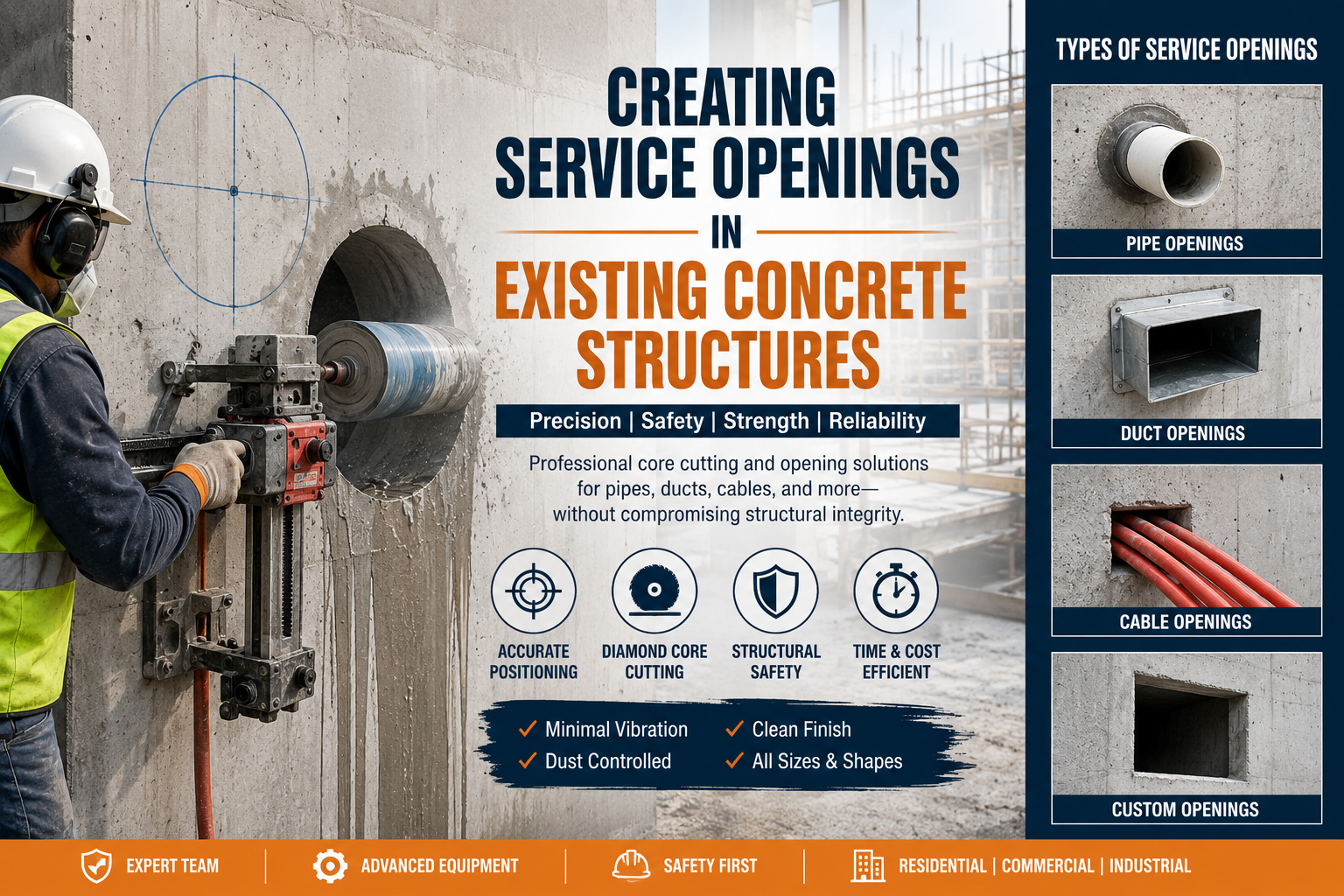
When a building is already standing — walls poured, slabs cured, columns load-bearing and immovable — how do you run a new drainage pipe through a basement wall, add a duct for an HVAC system, or install an elevator shaft opening without bringing the whole structure down? This is where service openings in existing concrete structures come in, and it's a specialised skill that combines precision engineering with the right cutting technology.
At Core Cutting India ([email protected]), we've spent years helping architects, MEP contractors, and building owners across the country cut clean, accurate openings into concrete without compromising structural integrity. This blog walks through what service openings are, why they're needed, the methods used to create them, and how the process plays out on real Indian job sites.
What Are Service Openings in Concrete Structures?
Service openings are holes or cutouts made in concrete walls, slabs, beams, or foundations to allow the passage of building services — plumbing pipes, electrical conduits, HVAC ducts, fire-sprinkler lines, data cabling, and drainage systems. Unlike openings planned during original construction, these are cut into concrete that has already hardened and, in many cases, is already carrying load or already part of a functioning building.
This makes the work fundamentally different from formwork-stage openings. There's no flexibility to simply "leave a gap" — the concrete is solid, reinforced, and often structurally active. Every cut has to be planned around rebar location, load paths, and the building's ongoing use.
Why Are Service Openings Needed After Construction?
In an ideal world, every opening would be planned at the design stage. In practice, that rarely happens for a few common reasons:
1. Renovation and retrofitting. Older buildings — especially commercial complexes and residential societies built 20–40 years ago — were never designed for modern HVAC, fibre-optic networks, or additional plumbing risers. Retrofitting means cutting new paths through existing concrete.
2. Change of building use. A structure originally built as a warehouse might later be converted into an office or retail space, requiring new service routes for lifts, restrooms, and ducting that weren't part of the original design.
3. Design changes mid-project. Even in new builds, service layouts sometimes change after the concrete has already been poured — a shifted duct route, a relocated drainage line, or a last-minute addition of a service riser.
4. Infrastructure upgrades. Metro stations, IT parks, and hospitals frequently need new cable runs, additional plumbing, or fire-safety upgrades years after commissioning.
5. Repair and maintenance access. Sometimes an opening is needed simply to inspect or repair something behind or beneath existing concrete — a buried pipe, a foundation crack, or an electrical conduit.
Methods Used to Create Openings in Existing Concrete
There isn't a single "correct" method — the right technique depends on the size, shape, location, and structural sensitivity of the opening.
1. Diamond Core Drilling
Core drilling uses a hollow, diamond-tipped drill bit that rotates at high speed to bore a clean, round hole through concrete, brick, or stone. It's the go-to method for circular service openings — pipe penetrations, conduit routes, or small duct passages.
Core drilling is prized because it's vibration-free, low-noise, and dust-controlled (especially when done with water-cooled bits), which makes it suitable for occupied buildings, hospitals, and heritage structures where disturbance has to be minimised. Cores can typically be cut anywhere from 12mm up to over 1,000mm in diameter, and through slabs well over a metre thick when needed.
2. Wall Sawing
For rectangular or larger openings — such as a new doorway, window, or duct chase — wall saws with diamond blades are used to make straight, controlled cuts along a marked outline. The wall saw is typically mounted on a track for accuracy, allowing contractors to cut through reinforced concrete walls in a single, clean pass.
3. Wire Sawing
When openings are very large, irregularly shaped, or in locations a wall saw can't reach — such as thick foundation walls, bridge piers, or heavily reinforced structural elements — diamond wire sawing is used. A diamond-embedded wire loop is threaded around the section and pulled through the concrete under tension, slicing through even dense, heavily reinforced sections.
4. Track-Mounted Slab Sawing
For horizontal openings in floors or roof slabs — for instance, cutting a shaft for a new staircase or elevator — a flat/slab saw on a track cuts straight lines across the floor, after which the cut sections are lifted out.
5. Hand-Held and Ring Saws
For smaller, tighter spaces where mounted equipment can't be positioned — like a compact utility duct in a narrow service shaft — hand-held diamond saws and ring saws offer manoeuvrability while still delivering a precise cut.
The Process: How a Service Opening Is Actually Cut
A professional core cutting job in an existing structure typically follows this sequence:
Step 1 — Site Survey and Scanning Before any cutting begins, the area is scanned using ground-penetrating radar (GPR) or rebar detectors to map the location of reinforcement bars, embedded conduits, and post-tensioned cables. This step is non-negotiable — cutting blindly through a live electrical conduit or a post-tensioned cable can be dangerous and structurally damaging.
Step 2 — Structural Assessment For any opening in a load-bearing wall, column, or slab, a structural engineer typically reviews the location and size of the proposed cut. In many Indian cities, this is also a compliance requirement, especially for RCC-framed buildings governed by local municipal building codes.
Step 3 — Marking and Layout The exact opening — whether a 100mm pipe penetration or a 2-metre duct opening — is marked out on-site based on approved drawings.
Step 4 — Cutting The appropriate method (core drilling, wall sawing, or wire sawing) is used to make the cut. Water-fed diamond tooling keeps dust down and extends blade life, which matters a great deal when working inside occupied buildings.
Step 5 — Debris Removal and Finishing Cut sections are removed, edges are cleaned up, and if required, temporary supports or lintels are installed before the service (pipe, duct, or cable) is routed through.
Step 6 — Sealing and Fire-Stopping Once services pass through, the opening is sealed — often with fire-rated sealant if the wall or slab has a fire-rating requirement, which is standard in commercial and high-rise construction.
Indian Examples: Where This Work Happens
Metro Rail Projects. As Indian metro networks have expanded — Delhi, Mumbai, Bengaluru, Pune, and Kochi among them — contractors have regularly needed to cut openings in existing station structures, tunnel walls, and viaducts to accommodate signalling cables, drainage, and ventilation ducts added after the original concrete pour.
Residential Society Retrofits. In cities like Mumbai and Pune, older housing societies built in the 1980s and 90s are frequently retrofitted with new plumbing risers, additional bathroom drainage, or split-AC piping. Since these buildings were never designed with today's number of AC units or modern plumbing standards, core cutting through RCC slabs and walls has become a routine part of society renovation work.
IT Parks and Commercial Buildings. Business parks in Bengaluru, Gurugram, and Hyderabad often undergo tenant-driven interior fit-outs, where each new occupant needs custom HVAC ducting, data cabling routes, and fire-sprinkler modifications — all requiring openings cut into existing concrete floors and walls between fit-out cycles.
Hospitals. Healthcare facilities frequently expand or upgrade medical gas lines, additional plumbing, and electrical capacity. Because hospitals can't shut down operations, low-noise, low-vibration diamond core drilling is essential to avoid disturbing patients and sensitive equipment during these upgrades.
Industrial and Warehouse Conversions. As e-commerce and logistics have grown, many older industrial sheds across NCR, Pune, and Chennai have been converted into modern fulfilment centres, requiring new floor openings for conveyor systems, drainage, and utility trenches cut directly into existing concrete flooring.
Why Precision and Expertise Matter
Cutting into existing concrete isn't just a matter of making a hole — it's an engineering decision. A poorly planned cut can:
- Sever load-bearing reinforcement, weakening the structure
- Damage embedded electrical or plumbing lines
- Create cracks that propagate beyond the intended opening
- Compromise fire-rating or waterproofing integrity
- Trigger costly remedial structural work
This is why experienced core cutting contractors combine scanning technology, structural coordination, and the right tooling for each job — rather than relying on generic demolition methods like jackhammering, which is imprecise, noisy, and far more likely to cause collateral damage to surrounding concrete and reinforcement.
Choosing the Right Contractor
When selecting a team for service opening work in existing concrete, a few things are worth checking:
- Do they use GPR scanning or rebar detection before cutting?
- Do they have experience across core drilling, wall sawing, and wire sawing — not just one method?
- Can they work in occupied or operational buildings with minimal disruption?
- Do they coordinate with structural engineers for load-bearing elements?
- Do they offer dust and water management suited to indoor environments like hospitals or IT offices?
Conclusion
Creating service openings in existing concrete structures is a precise, technical process — not a demolition job. Whether it's a small pipe penetration in a residential society, a large duct opening in a commercial fit-out, or structural coring for a metro station upgrade, the right combination of scanning, planning, and diamond-cutting technology ensures the work gets done safely, cleanly, and without compromising the structure.
If you're planning a renovation, retrofit, or MEP upgrade that requires cutting into existing concrete, Core Cutting India brings the equipment and expertise to do it right. Reach out to us at [email protected] to discuss your project requirements.