
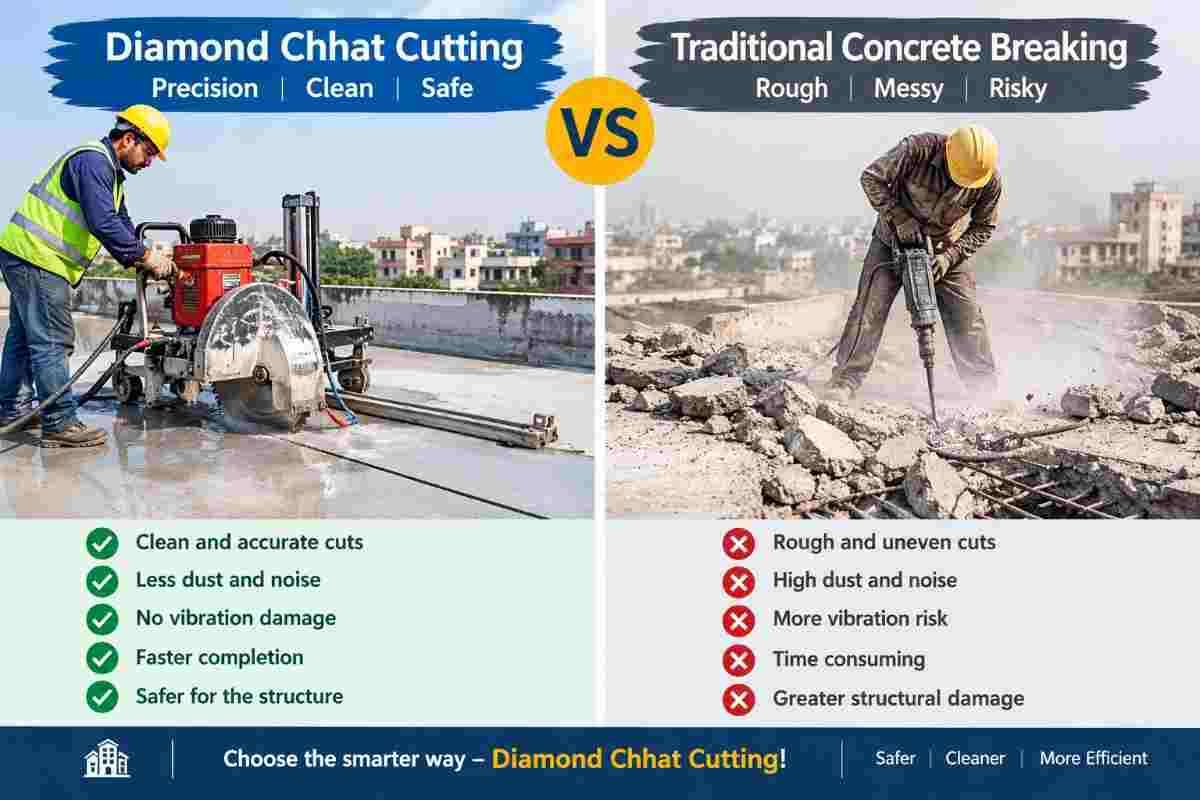
If you own or manage a building in India, sooner or later you will face the same question: how do you open a hole in a chhat (roof slab) or remove a section of reinforced concrete without ruining everything around it? Maybe you need a new staircase opening, a lift shaft, a skylight, a duct passage, or a full slab removal during renovation. For decades the default answer was simple: bring in labourers with hammers and jackhammers and break it. Today there is a smarter option, diamond chhat cutting.
In this guide from Core Cutting India, we compare diamond chhat cutting with traditional concrete breaking in plain terms. We look at how each method works, where each one shines, and how they differ on noise, dust, vibration, safety, speed, precision and total cost. By the end, you will know which method suits your project.
What Is Diamond Chhat Cutting?
Diamond chhat cutting is a precision method of cutting roof slabs, floors, beams and walls using tools fitted with industrial diamond segments. Because diamond is the hardest known material, these tools slice through concrete and the steel reinforcement inside it, leaving clean, straight edges.
The main equipment used includes:
- Slab saws and floor saws: Walk-behind machines with a large diamond blade, ideal for cutting floors and flat roof surfaces.
- Wall saws: Rail-mounted saws that cut vertical or horizontal lines in walls and slabs, useful for deep cuts.
- Wire saws: A diamond-impregnated wire loops around the element and cuts through very thick or awkward sections.
- Core drills: Hollow diamond bits that drill perfectly round holes for pipes, ducts and cables.
Most of these machines use water to cool the blade and to bind the dust, which is why the process is far cleaner than breaking. The cut is guided by a marked line, so the finished opening matches the drawing, whether it is a rectangle, a circle or an L-shape.
What Is Traditional Concrete Breaking?
Traditional concrete breaking relies on impact. Workers use sledgehammers, chisels, hand-held demolition hammers or heavy breakers to crack the concrete into pieces. Once the concrete is broken, the exposed reinforcement bars are cut with gas cutters or grinders and the debris is cleared.
This method is familiar, needs little specialised equipment, and the upfront quotation can look low. That is why many contractors still use it for small, non-critical jobs. The trouble starts when the job is near a structure you want to keep intact, because impact does not respect boundaries.
How the Two Methods Work: The Core Difference
The fundamental difference is simple. Traditional breaking destroys concrete by applying repeated shock until it fractures. Diamond cutting removes concrete by grinding a thin, controlled groove through it.
Shock travels. When you hammer one spot on a slab, vibration moves through the slab into beams, columns and walls. Diamond cutting works only along the line of the blade, so the force stays where you want it. This one difference explains almost every advantage and disadvantage that follows.
Diamond Chhat Cutting vs Traditional Concrete Breaking: Head-to-Head Comparison
1. Precision and Finish
Precision is where diamond cutting wins most clearly. A diamond saw follows a marked line and produces smooth, straight, dimensionally accurate edges. A new staircase opening, for example, will have clean sides that are ready for framing or finishing with minimal repair.
Breaking is imprecise by nature. Edges end up ragged and uneven, the opening is usually larger than planned, and extra plastering and patching are required afterwards. If the design has tight tolerances, such as a lift shaft or a precast insert, breaking can lead to rework.
2. Vibration and Structural Safety
This is the most important factor for existing buildings. Jackhammers send heavy vibration through the structure. In old or already stressed buildings, this can cause micro-cracks in neighbouring slabs, beams and walls, loosen plaster and tiles, and damage the bond between concrete and steel in adjacent areas.
Diamond cutting produces very low vibration. The blade removes material by abrasion rather than impact, so the rest of the structure is left undisturbed. When you are cutting an opening in a roof slab of a building that people will keep using, this is a major safety advantage. For any structural cutting, it is always wise to have the work planned with a qualified structural engineer so that the load path is protected.
3. Noise Levels
Breaking concrete with hammers and breakers is loud, and the noise is continuous and sharp. In residential societies, hospitals, schools, offices and shops, this causes real disturbance, and many housing societies restrict hours for such work.
Diamond cutting is considerably quieter. It is not silent, but the sound is a steady hum and the machines can often be used in occupied buildings with far fewer complaints. If you are working in a busy city like Delhi NCR, where neighbours and local rules matter, this makes planning easier.
4. Dust and Cleanliness
Dry breaking throws out heavy dust and flying fragments. Silica dust from concrete is a recognised health hazard when inhaled over time, so uncontrolled dust is not just untidy, it is unhealthy for workers and occupants.
Wet diamond cutting captures most of the dust in the cooling water, leaving a slurry that is collected and removed. The site stays far cleaner, there is less need for sealing off rooms, and cleanup time drops. Proper protective equipment is still essential, but the exposure is much lower.
5. Speed and Productivity
For large or thick sections, diamond cutting is usually faster than people expect. Cutting a slab into manageable panels and lifting them out can be quicker than breaking everything into small pieces, then removing the heavy rubble. Because the cut sections can be removed in one piece, the debris handling is simpler.
For tiny jobs, such as knocking out a small patch of plaster-thick concrete, breaking by hand may still be quicker to set up. As the thickness, depth and size of the cut increase, the advantage moves firmly to diamond cutting.
6. Handling Reinforcement Steel
RCC slabs contain steel bars. In traditional breaking, the concrete is shattered first and the bars are then cut separately, which is slow, messy and sometimes dangerous because bars spring and shift as concrete is removed. Diamond tools cut through concrete and steel together in a single controlled pass, keeping the bars neat and trimmed exactly at the cut line.
7. Safety for Workers and Occupants
Breaking exposes workers to flying chips, heavy hand-arm vibration, noise and dust. Over long hours, this raises the risk of injury and long-term health problems. There is also a greater chance of an uncontrolled fall of broken material.
Diamond cutting is a more controlled process. The cut section is planned, supported and lowered or lifted out deliberately. With trained operators and proper safety planning, the risk to people below and around the work area is much lower.
8. Cost: Upfront vs Total
It is true that diamond cutting often has a higher upfront rate per running metre or per job than basic breaking. But looking only at the quotation is misleading. Total cost includes:
- Repair of damaged adjacent structure
- Extra plastering, finishing and rework
- Debris removal and cleaning
- Delays caused by noise complaints or society restrictions
- Labour time and supervision
- Risk of structural damage claims
When these are counted, diamond chhat cutting is frequently the more economical choice for medium and large jobs, and especially for any work in finished or occupied buildings. Breaking tends to stay cheaper only for small, isolated, low-risk tasks.
9. Environmental Impact
Breaking creates a large volume of small rubble and airborne dust. Diamond cutting produces less waste because only the thin kerf of the blade is lost, and the removed slab sections can sometimes be reused or disposed of more efficiently. Wet cutting slurry should be collected and handled responsibly, but overall the footprint is smaller.
Quick Comparison Table
|
Factor |
Diamond Chhat Cutting |
Traditional Concrete Breaking |
|---|---|---|
|
Precision |
Very high, clean edges |
Low, ragged edges |
|
Vibration |
Very low |
High |
|
Noise |
Moderate, steady |
Very loud |
|
Dust |
Controlled with water |
Heavy and widespread |
|
Structural impact |
Minimal |
Risk of micro-cracks |
|
Rebar cutting |
Cut in the same pass |
Separate, slower step |
|
Finishing work |
Minimal |
Extensive repair |
|
Upfront cost |
Higher |
Lower |
|
Overall value |
Strong for most projects |
Best for small, simple jobs |
When Should You Choose Diamond Chhat Cutting?
Diamond cutting is the better choice in the following situations:
- Staircase, lift or duct openings in an existing roof slab or floor where the dimensions must be exact.
- Renovation of occupied buildings such as homes, offices, hospitals and malls where noise, dust and vibration must be minimised.
- Old or sensitive structures where hammering could damage the remaining building.
- Thick or heavily reinforced slabs that are slow and hazardous to break.
- Partial slab removal for adding a floor, a terrace opening or a skylight.
- Industrial and commercial work where downtime is expensive and the schedule is tight.
- Round holes for plumbing, HVAC, electrical and drainage, which are best done with core drilling.
When Is Traditional Breaking Still Acceptable?
It would be unfair to say breaking has no place. It can make sense when:
- The structure is being fully demolished and nothing nearby needs protection.
- The area to be removed is small and shallow, with no strict dimensional requirements.
- The site is isolated, with no neighbours or occupied spaces nearby.
- Access is so limited that large cutting equipment cannot be positioned.
- The budget is extremely tight and the quality of edges is not important.
Even then, it is wise to consider a hybrid approach: use diamond cutting to define the clean boundary and use breakers only inside the marked area. This protects the structure you are keeping while still saving time.
Common Mistakes to Avoid
Choosing only on price. A cheaper quotation that damages a beam or leads to months of repair is not a saving.
Skipping structural assessment. Cutting any slab changes how loads travel. Always confirm with a structural engineer whether supports, props or additional beams are needed before work begins.
Ignoring site preparation. Check for hidden electrical conduits, water lines, post-tensioned cables and gas lines before cutting. Scanning the area first prevents expensive accidents.
Underestimating water and slurry management. Plan for water supply and a way to collect and dispose of slurry so your floors below stay clean.
Hiring untrained operators. Diamond cutting equipment is powerful. Experienced operators, correct blade selection and proper safety practices make the difference between a flawless cut and a costly mistake.
How to Choose the Right Concrete Cutting Partner
Whether you are in Delhi NCR or elsewhere in India, look for a contractor who offers:
- A full range of equipment: slab saws, wall saws, wire saws and core drills.
- Trained, experienced operators with a record of similar projects.
- A site visit and clear quotation that explains the method, timeline and what is included.
- Safety practices including protective gear, scanning, propping and controlled removal.
- Clean working methods with water control and debris management.
- Clear communication about what could change the cost or schedule.
Core Cutting India specialises in exactly this kind of precision work, from chhat and slab cutting to wall sawing, wire sawing and core drilling. Their approach is built around protecting the structure you want to keep while delivering clean, accurate openings.
Frequently Asked Questions
What is chhat cutting? Chhat cutting means cutting an opening or a section out of a roof slab (chhat). It is done for staircases, lift shafts, skylights, terrace access, ducts and renovation work, and the best method for it today is diamond cutting.
Is diamond cutting better than breaking concrete? For most projects, yes. It offers greater accuracy, lower vibration, less noise and cleaner results, and it protects the surrounding structure. Breaking is better suited to full demolition or very small, simple tasks.
Is diamond cutting more expensive than breaking? The upfront cost is usually higher, but the total cost is often lower once you include repairs, finishing, cleanup and delays. The right comparison is total project cost, not just the quotation.
Can diamond cutting be done in an occupied building? Yes. Because it creates low vibration, lower noise and controlled dust, it is widely used in homes, offices, hospitals and commercial buildings that must stay in use.
Can diamond tools cut reinforced concrete and steel bars? Yes. Diamond blades and wires cut through concrete and embedded reinforcement in a single process, leaving neat edges.
Does cutting a roof slab weaken the building? It can if done without planning, since a slab carries load. With a proper structural assessment and, where required, extra support or framing around the opening, the building can remain safe. Always involve a structural engineer.
How thick a slab can diamond cutting handle? Wall saws and wire saws can cut through very thick concrete sections, far beyond what hand-held tools can manage. The right equipment depends on the thickness and access, which a site inspection will confirm.
How long does diamond chhat cutting take? It depends on the size of the opening, the slab thickness and the amount of reinforcement. Many standard openings can be completed in a day or two, and a contractor can give a realistic estimate after seeing the site.
Conclusion
The choice between diamond chhat cutting and traditional concrete breaking comes down to what you value. If you need a quick, rough removal in an isolated area and do not mind the mess, breaking can do the job. But if you care about accuracy, structural safety, a quieter and cleaner site, and fewer repairs later, diamond cutting is the clear winner.
For most modern renovation, extension and infrastructure work, diamond chhat cutting delivers better results with less risk. If you are planning a slab opening, wall cutting or core drilling project, speak to the specialists at Core Cutting India for a site-specific recommendation and a clear quotation.