
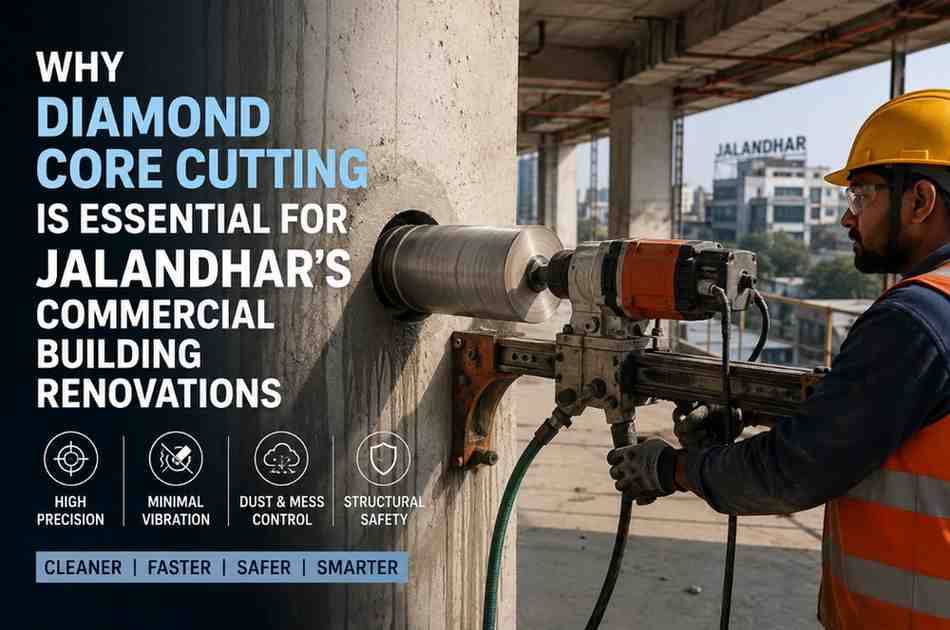
Jalandhar's skyline is changing fast. Old showrooms are becoming modern retail outlets, decades-old office blocks are being retrofitted with new wiring and HVAC systems, and industrial units across the city's manufacturing belt are being upgraded to meet current safety codes. Behind almost every one of these transformations sits a technique that rarely gets public credit but makes the entire renovation possible: diamond core cutting.
At Core Cutting India ([email protected]), we've spent years working inside commercial buildings across Jalandhar — cutting openings for pipes, ducts, cables, and structural modifications without cracking walls, disturbing neighbouring tenants, or delaying project timelines. In this article, we explain why diamond core cutting has become non-negotiable for commercial renovation projects in the city, and what building owners, contractors, and facility managers should know before their next project begins.
What Exactly Is Diamond Core Cutting?
Diamond core cutting is a precision drilling method that uses a hollow, diamond-tipped cylindrical bit to bore clean, round holes through concrete, brick, stone, and reinforced structures. Unlike traditional hammer drilling or chiselling, which relies on impact and vibration to break through material, core cutting uses rotational abrasion. The diamond segments on the bit grind through the surface smoothly, producing a perfectly circular hole with minimal stress on the surrounding structure.
This matters enormously in commercial buildings, where walls and slabs often carry structural loads, house embedded reinforcement bars, or sit adjacent to finished interiors that can't afford cosmetic damage. A clean, controlled cut protects the integrity of the building while still allowing contractors to route new utilities exactly where they're needed.
Why Jalandhar's Commercial Sector Is Driving Demand
Jalandhar has long been an industrial and commercial hub — known for sports goods manufacturing, leather and hosiery units, and a growing base of retail and office spaces around areas like Model Town, Civil Lines, and GT Road. As businesses modernize, several trends are pushing diamond core cutting into the spotlight.
Ageing commercial stock needs new infrastructure. Many commercial buildings in the city were constructed 15–30 years ago, long before modern electrical loads, centralized air conditioning, fire suppression systems, or structured cabling were standard requirements. Retrofitting these systems into existing concrete and brick structures requires clean penetrations that core cutting alone can reliably deliver.
Retail and office fit-outs are accelerating. As national and regional brands open outlets in Jalandhar, interior fit-out contractors need fast, precise openings for plumbing, electrical conduits, and ventilation — often on tight handover deadlines where cracked walls or dust-covered showrooms simply aren't an option.
Stricter fire and building safety compliance. Updated fire safety norms mean many older commercial properties need new sprinkler lines, fire-rated duct penetrations, and emergency exit modifications. These changes almost always involve cutting through existing reinforced concrete or masonry.
Industrial unit upgrades. Factories and warehouses across Jalandhar's industrial areas frequently need core-cut openings for machinery foundations, exhaust systems, and utility corridors as production lines are modernized.
The Core Reasons Diamond Core Cutting Is Essential
1. Precision Without Structural Compromise
Commercial buildings are engineered structures. Randomly hammering through a wall or slab can crack surrounding concrete, expose or sever embedded rebar, and weaken load-bearing elements in ways that aren't always visible immediately but surface as structural issues years later. Diamond core cutting removes only the material within the marked diameter, leaving the surrounding structure undisturbed. For commercial renovations — where structural engineers often have to sign off on any penetration — this precision is not a luxury, it's a requirement.
2. Minimal Dust and Debris
Traditional concrete breaking generates enormous amounts of dust, which is a serious problem in occupied commercial spaces. Whether it's a running retail store, an active office floor, or a hospital or clinic, uncontrolled dust disrupts business operations, damages equipment, and creates health hazards. Professional core cutting services use wet-cutting techniques or dust-extraction attachments that keep the worksite significantly cleaner, allowing renovations to proceed with minimal disruption to ongoing business activity.
3. Lower Noise and Vibration
Jackhammers and demolition breakers are loud and produce heavy vibration that can travel through a building's structure, disturbing tenants on other floors or in neighbouring units — a real concern in mixed-use commercial complexes and multi-tenant office buildings common across Jalandhar. Diamond core cutting is comparatively quiet and vibration-free, making it possible to carry out renovation work during business hours without major complaints or safety concerns.
4. Speed and Schedule Reliability
Commercial renovation projects run on tight schedules, often with financial penalties for delays. Core cutting is fast: a trained crew with the right equipment can complete multiple precise penetrations in the time it would take to manually break through a single wall with hand tools — and without the cleanup and rework that comes from damage caused by less controlled methods.
5. Versatility Across Materials and Applications
Diamond core cutting works effectively across a wide range of materials found in Jalandhar's commercial buildings — reinforced cement concrete (RCC), brick masonry, natural stone, and even certain metal-reinforced composite panels. This versatility makes it suitable for:
- HVAC duct and ventilation openings
- Electrical conduit and cable routing
- Plumbing and drainage pipe installation
- Fire sprinkler system installation
- Elevator shaft and staircase modifications
- Structural investigation and sampling for engineering assessments
- Installation of anchors, bolts, and mounting hardware for heavy equipment
6. Safety for Workers and Occupants
Manual demolition carries real safety risks — flying debris, structural instability, and prolonged exposure to dust and noise. Diamond core cutting equipment is designed with safety features and controlled cutting paths that reduce risk to the operating crew and to anyone working or occupying the building nearby. For commercial properties where liability and occupant safety are constant considerations, this reduced risk profile is a major advantage.
Common Commercial Renovation Scenarios in Jalandhar
Retail store conversions. When a commercial unit changes hands or brand identity, new plumbing for restrooms or pantries, new electrical distribution, and modified HVAC routing are almost always required — all of which typically involve core-cut penetrations through existing walls and slabs.
Office modernization. Structured cabling for networking, new server room cooling, and updated fire alarm wiring frequently require clean pass-throughs between floors and rooms, especially in older office buildings not originally designed for today's data and connectivity demands.
Hospitality and healthcare fit-outs. Hotels, clinics, and diagnostic centres opening in renovated commercial buildings across the city need precise openings for medical gas lines, specialized plumbing, and ventilation systems that meet regulatory standards — work that leaves no margin for structural error.
Industrial and warehouse upgrades. As Jalandhar's manufacturing units modernize equipment and expand utility infrastructure, diamond core cutting is used to create openings for new machine foundations, exhaust routing, and cable trenches without disrupting ongoing production.
What to Look for in a Core Cutting Contractor
Not all core cutting work is equal, and commercial projects carry higher stakes than residential jobs. Building owners and contractors in Jalandhar should look for a few essentials when hiring a core cutting service:
Experience with commercial and industrial structures. Cutting through post-tensioned slabs, heavily reinforced columns, or fire-rated walls requires different expertise than a simple residential wall opening.
Proper equipment and diamond bit selection. The right bit diameter, segment bond, and cutting speed vary depending on the material being cut — using the wrong setup can lead to slower work, poor finish quality, or unnecessary wear and cost.
Structural awareness. A good contractor checks drawings or consults with a structural engineer before cutting into load-bearing elements, especially in multi-storey commercial buildings.
Dust and water management. Especially important for occupied commercial spaces — wet cutting with proper containment prevents water damage and mess in finished interiors.
Clear scheduling and minimal disruption. Commercial clients need contractors who can work around business hours, coordinate with other trades on site, and stick to agreed timelines.
At Core Cutting India, our teams bring hands-on experience across Jalandhar's commercial, retail, industrial, and institutional projects. We work directly with architects, structural consultants, and renovation contractors to plan cuts that meet both design intent and structural safety requirements, using equipment suited to each specific job — from small-diameter holes for cabling to large openings for HVAC and structural modifications.
The Cost of Getting It Wrong
It's worth pausing on what happens when commercial renovation work skips proper core cutting in favour of cheaper, faster methods. Cracked slabs can compromise structural load paths. Severed rebar without engineering review can weaken a wall's capacity over time. Excessive dust can damage sensitive retail inventory or office equipment. And unpredictable, noisy demolition work can strain relationships with tenants, neighbouring businesses, or building management associations — all of which can be costly to repair, both financially and reputationally.
Diamond core cutting isn't simply a "nicer" way to make an opening in a wall. For commercial properties, it's often the difference between a renovation that stays on budget and schedule, and one that runs into structural complications, compliance issues, or business disruption that could have been avoided.
Final Thoughts
As Jalandhar's commercial real estate continues to evolve — from retrofitted retail units to modernized offices and upgraded industrial facilities — diamond core cutting has moved from a specialized technique to a foundational part of how renovation projects get done safely, cleanly, and on schedule. It protects structural integrity, reduces disruption to ongoing business operations, and gives contractors the precision they need to install modern building systems inside older structures.
If you're planning a commercial renovation in Jalandhar and need reliable, precise core cutting services, the team at Core Cutting India is ready to help. Reach out to us at [email protected] to discuss your project requirements, timelines, and the right cutting approach for your building.
People Also Ask
What is diamond core cutting used for in commercial buildings? It's primarily used to create precise openings in concrete, brick, or stone for plumbing, electrical conduits, HVAC ducts, fire sprinkler lines, and structural modifications — all without damaging the surrounding structure.
How much does diamond core cutting cost in Jalandhar? Costs vary depending on hole diameter, material thickness, reinforcement density, and site accessibility. It's best to get a site assessment from a contractor like Core Cutting India for an accurate quote tailored to your project.
Is diamond core cutting safe for load-bearing walls? Yes, when performed by experienced professionals who assess the structure beforehand — ideally in consultation with a structural engineer — diamond core cutting can safely create openings even in load-bearing elements, since it removes material with minimal stress on surrounding areas.
How long does a core cutting job take? Timelines depend on the number and size of penetrations and the material being cut, but diamond core cutting is generally much faster than manual demolition methods, often completing multiple cuts within a single working day.
What is the difference between core cutting and wall sawing? Core cutting creates round holes using a cylindrical drill bit, typically for pipes, cables, or ducts. Wall sawing uses a flat circular blade to make straight-line cuts, commonly used for doorways, windows, or larger structural openings.