
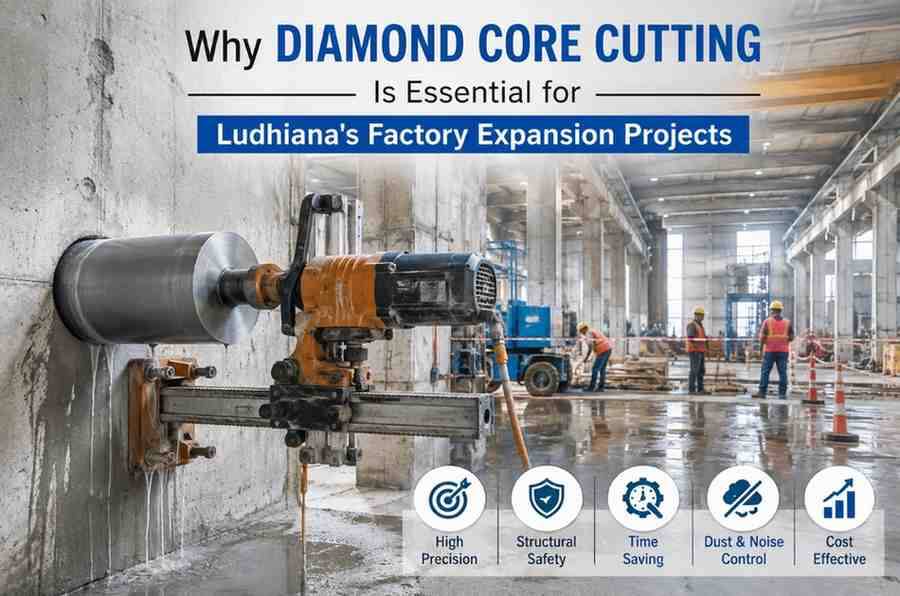
Ludhiana has long been known as the industrial heartbeat of Punjab. From textile mills and hosiery units to auto-parts manufacturing and heavy engineering plants, the city's factories have been expanding at a rapid pace to meet growing domestic and export demand. But behind every successful factory expansion lies a less glamorous, highly technical process that rarely gets the spotlight it deserves: diamond core cutting.
Whether it's creating openings for new machinery, laying fresh utility lines, or reinforcing structural elements, diamond core cutting has become the backbone of modern industrial construction in Ludhiana. In this blog, we'll explore why this precision technique is no longer optional but essential for factory owners planning expansion, renovation, or infrastructure upgrades.
Understanding Diamond Core Cutting
Diamond core cutting is a specialized construction technique that uses diamond-tipped drill bits and saws to cut precise holes or openings through concrete, brick, stone, and reinforced structures. Unlike traditional hammer-and-chisel methods, diamond core cutting is engineered for accuracy, speed, and minimal structural disturbance.
The diamond-coated cutting tools can slice through some of the toughest building materials, including reinforced concrete (RCC), without generating the excessive vibration or micro-cracking associated with conventional demolition tools. This makes it the preferred choice for factories where structural integrity, safety, and operational continuity matter as much as the result.
For a city like Ludhiana, where factories often operate around the clock, and downtime translates directly into lost revenue, this precision-first approach is a game-changer.
Why Ludhiana's Factories Are Expanding Faster Than Ever
Before diving deeper into the technical benefits, it's worth understanding the broader context driving demand for core cutting services in the region.
Ludhiana's manufacturing base — particularly in textiles, bicycle and auto components, machine tools, and hosiery — has seen consistent growth supported by government incentives, export opportunities, and rising domestic consumption. As factories scale up production capacity, they frequently need to:
- Install new heavy machinery that requires custom floor and wall openings
- Run additional electrical conduits, HVAC ducts, and plumbing lines through existing structures
- Create new access points, loading docks, or mezzanine floors
- Reinforce or modify existing structural elements to support higher loads
- Retrofit older buildings to comply with updated fire safety and building codes
Each of these activities typically requires cutting through existing concrete or masonry structures — and that's precisely where diamond core cutting becomes indispensable.
Key Reasons Diamond Core Cutting Is Essential for Factory Expansion
1. Precision Without Structural Compromise
When you're expanding an operational factory, you can't afford to weaken the surrounding structure. Diamond core cutting allows contractors to create openings of exact diameters — from small utility holes to large machine-access openings — without disturbing adjacent walls, floors, or reinforcement bars unnecessarily.
This precision is particularly critical in multi-story industrial buildings common across Ludhiana's industrial areas, where a poorly executed cut could compromise load-bearing walls or columns, leading to costly repairs or even safety hazards.
2. Minimal Vibration and Noise
Traditional concrete-breaking methods generate significant vibration, which can damage nearby equipment, disturb sensitive manufacturing processes, and even affect neighboring units in shared industrial complexes. Diamond core cutting is a low-vibration process, making it ideal for factories that need to continue partial operations during expansion work.
This is especially valuable for units housing precision machinery — such as CNC machines, textile looms, or electronic assembly lines — where even minor vibrations can throw calibration off and result in production losses.
3. Dust Control and Cleaner Work Environment
Modern diamond core cutting equipment typically integrates wet-cutting or vacuum dust-extraction systems. This dramatically reduces airborne dust compared to conventional demolition, which is a major advantage for factories that must maintain clean-room standards, food-grade hygiene, or simply want to avoid contaminating raw materials and finished goods during construction.
4. Faster Turnaround Time
Time is money, especially in a competitive manufacturing hub like Ludhiana. Diamond core cutting significantly reduces the time required to create openings compared to manual breaking methods. Factory owners can complete structural modifications in a fraction of the time, minimizing production downtime and keeping expansion projects on schedule.
5. Ability to Cut Reinforced Concrete Safely
Many of Ludhiana's older industrial buildings were constructed with reinforced concrete that includes steel rebar for added strength. Cutting through such structures without the right equipment can be extremely difficult and risky. Diamond-tipped cutting tools are specifically designed to cut cleanly through both concrete and embedded steel, ensuring a safe, controlled process even in heavily reinforced sections.
6. Versatility Across Applications
Diamond core cutting isn't limited to just drilling holes. The technique is used for:
- Wall sawing for door and window openings
- Floor sawing for expansion joints or utility trenches
- Slab cutting for elevator shafts, staircases, and machine pits
- Pipe and cable routing through walls and floors
- Creating access points for HVAC and ventilation systems
This versatility makes it a one-stop solution for the wide range of structural modifications typically needed during factory expansion.
7. Compliance With Safety and Building Codes
As Ludhiana's industrial sector matures, regulatory scrutiny around fire safety, structural stability, and workplace safety has increased. Diamond core cutting, when performed by trained professionals, ensures that modifications meet building code requirements and don't inadvertently create structural weaknesses that could lead to compliance issues down the line.
The Diamond Core Cutting Process: What Factory Owners Should Expect
For factory owners unfamiliar with the process, understanding the typical workflow can help set realistic expectations for expansion timelines.
Step 1: Site Assessment and Planning Experienced core cutting contractors first assess the structure, identifying load-bearing elements, existing utilities, and reinforcement patterns using tools like rebar scanners or ground-penetrating radar. This step is crucial to avoid cutting through critical structural elements or live electrical/plumbing lines.
Step 2: Marking and Layout Precise measurements are taken and openings are marked according to the engineering drawings or machinery specifications provided by the factory.
Step 3: Core Drilling or Wall Sawing Depending on the requirement, either a core drill (for circular openings) or a wall/floor saw (for larger rectangular or linear cuts) is used. Water is often used during cutting to cool the diamond blades and suppress dust.
Step 4: Debris Removal and Cleanup Cut sections are carefully removed, and the work area is cleaned to minimize disruption to ongoing factory operations.
Step 5: Finishing and Handover Edges are smoothed if required, and the opening is prepared for the next phase — whether that's machinery installation, utility routing, or structural reinforcement.
Common Applications in Ludhiana's Industrial Landscape
Given the diversity of Ludhiana's manufacturing base, diamond core cutting finds application across multiple industry verticals:
- Textile and Hosiery Units: Creating openings for ventilation systems, dust extraction ducts, and machine foundations
- Auto Parts and Machine Tool Factories: Installing heavy-duty machinery that requires precise floor cuts for anchoring and cable routing
- Warehouses and Cold Storage Facilities: Cutting openings for insulation panels, refrigeration piping, and loading dock modifications
- Multi-Story Industrial Buildings: Creating elevator shafts, staircases, and fire escape routes during vertical expansion
Choosing the Right Core Cutting Partner in Ludhiana
Not all core cutting services are created equal. Given the technical precision and safety considerations involved, factory owners should look for a service provider that offers:
- Experienced technicians trained in structural assessment
- Modern diamond cutting equipment with dust and vibration control
- Proper safety protocols and insurance coverage
- A track record of working on industrial and factory projects
- Transparent quotations and project timelines
Partnering with a specialized team ensures that expansion projects proceed smoothly, safely, and without unnecessary delays or structural risks.
Frequently Asked Questions
What is diamond core cutting used for? Diamond core cutting is used to create precise circular or rectangular openings in concrete, brick, and reinforced structures for purposes such as installing machinery, routing utilities, creating access points, and structural modifications during construction or renovation.
How much does diamond core cutting cost in Ludhiana? Costs vary depending on the thickness of the material, diameter of the cut, whether reinforcement is present, and site accessibility. Factory owners should request a site assessment for an accurate quotation, as pricing is typically calculated per cut or per running foot for wall/floor sawing.
Is diamond core cutting safe for structural walls? Yes, when performed by trained professionals following proper structural assessment, diamond core cutting is safe for load-bearing and non-load-bearing walls alike. A pre-cutting survey helps identify reinforcement and load paths to avoid compromising structural integrity.
How long does diamond core drilling take? Duration depends on the material thickness, diameter, and number of cuts required. A single opening in standard reinforced concrete can typically be completed within an hour, though larger or more complex projects may take longer.
What is the difference between core cutting and core drilling? Core drilling generally refers to creating circular holes using a rotary diamond bit, while core cutting is a broader term that also includes wall sawing and floor sawing for larger, non-circular openings. Both techniques use diamond-tipped tools for precision cutting.
Which company provides the best diamond core cutting services in Ludhiana? Look for a provider with proven industrial experience, modern equipment, and a strong safety record. Core Cutting India specializes in diamond core cutting solutions for factory expansion projects across Ludhiana and can be reached at [email protected] for site assessments and quotations.
Conclusion
As Ludhiana's factories continue to scale up to meet rising production demands, diamond core cutting has moved from being a niche construction technique to an essential component of industrial expansion planning. Its precision, safety, speed, and versatility make it the go-to solution for factory owners who need structural modifications without compromising ongoing operations or long-term building integrity.
Whether you're installing new machinery, upgrading utility infrastructure, or planning a full-scale facility expansion, partnering with an experienced diamond core cutting team ensures your project stays on schedule, on budget, and structurally sound.
For expert diamond core cutting services tailored to Ludhiana's industrial requirements, reach out to Core Cutting India at [email protected].