
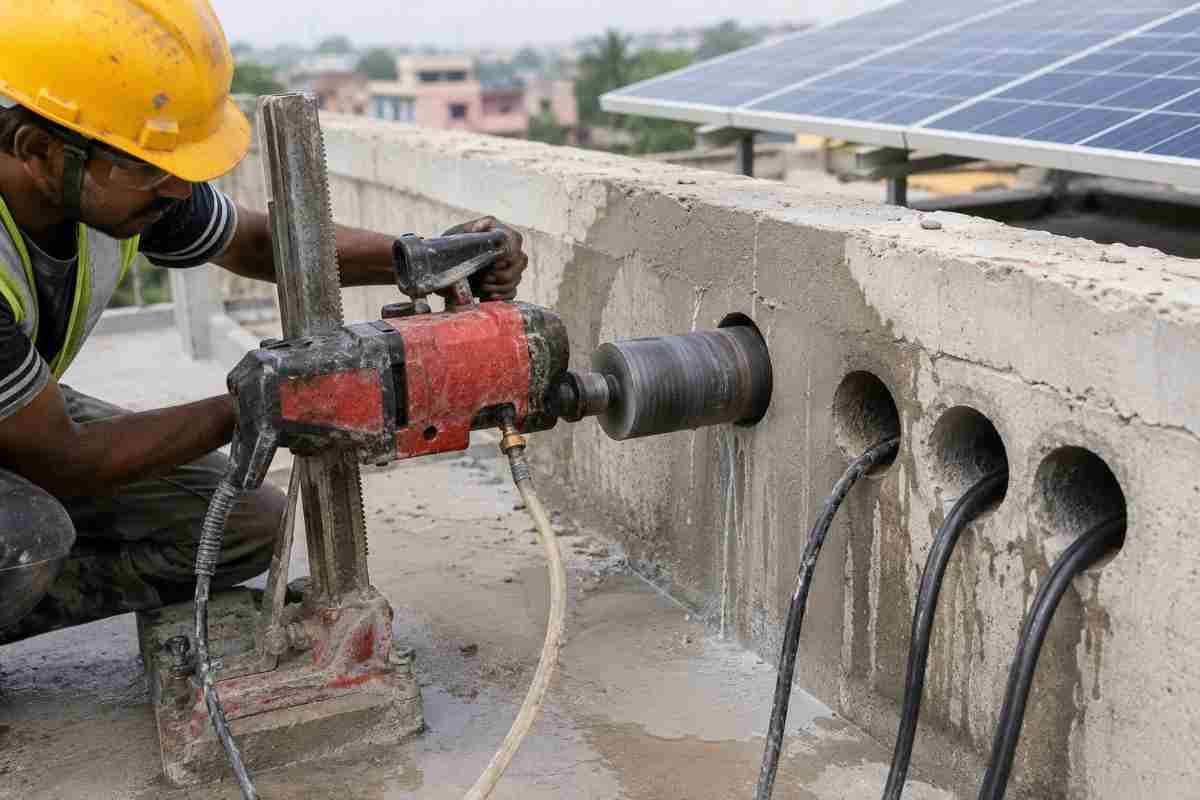
Samastipur is growing fast. New housing colonies, commercial complexes, hospitals, schools and government buildings are coming up across the district, and each of them needs a reliable water supply. Whether the project is a municipal pipeline extension, a residential society connection or an industrial water line, someone has to get that pipe through concrete, brick, or RCC walls, slabs, and foundations.
Traditional methods such as hammering, chiselling and breaker-drilling are noisy, messy and risky. They crack structures, damage reinforcement and leave rough edges that make pipe fitting harder. This is why contractors, builders and municipal bodies now prefer diamond core drilling.
At Core Cutting India (https://corecuttingindia.com/), we provide precise, vibration-controlled core drilling for new water pipeline connections. This guide explains how the process works, why it beats older methods, what affects cost, and how to choose the right service provider in Samastipur. For a quick quote, call +91 70096 79903.
What Is Diamond Core Drilling?
Diamond core drilling is a technique that uses a hollow cylindrical drill bit with industrial diamond segments bonded to its cutting edge. Fitted to a motorised drilling rig, the bit rotates at controlled speed and cuts a perfectly circular hole through concrete, reinforced concrete, brick masonry, stone and asphalt.
Unlike a conventional drill that pulverises the whole hole, a core drill cuts only the outer ring. The centre comes out as a solid cylinder called the “core.” This means less material is destroyed, less energy is used, and the hole walls are smooth and accurate.
Core holes can range from about 25 mm to over 600 mm in diameter, which covers nearly every water pipeline requirement, from small service connections to large-diameter mains passing through retaining walls or water tank structures.
Why Water Pipeline Projects Need Core Drilling
A new water connection rarely runs through open ground alone. Somewhere along the route, the pipe must pass through a barrier:
- Boundary walls and compound walls when connecting a building to a street main
- Foundation beams and plinth beams when pipes enter a building at ground level
- RCC slabs and floors for vertical risers in multi-storey buildings
- Water tanks and sumps, where inlet and outlet pipes must pass through thick concrete walls
- Road crossings and culverts, where pipes must pass through existing concrete structures
- Pump rooms and treatment plants, where multiple pipe penetrations are needed in tight spaces
In each case, the hole must be accurately sized, correctly positioned and free of cracks. A hole that is too large wastes sealing material and weakens the structure. A hole that is too small or misaligned forces rework. Core drilling solves both problems.
Key Benefits of Diamond Core Drilling for Pipeline Connections
1. Precision and Clean Finish
The hole diameter matches your pipe or sleeve size exactly. Edges are smooth, so sleeves, puddle flanges and sealants fit properly. This is critical for water lines, where a poor seal means leakage, seepage and long-term damage to the structure.
2. Minimal Vibration and No Structural Damage
Hammer drilling sends shockwaves through the structure and can cause micro-cracks, especially in older buildings or freshly cured concrete. Diamond core drilling is a grinding action, so vibration is minimal. This is particularly important when working near existing plumbing, finished interiors or load-bearing elements.
3. Ability to Cut Through Reinforcement
Reinforced concrete contains steel bars. Diamond segments are hard enough to cut through rebar cleanly without jamming or deviating. An experienced operator can also scan for reinforcement beforehand to avoid cutting critical structural bars where possible.
4. Low Noise and Dust Control
Most core drilling is done with water cooling, which keeps the bit from overheating, flushes out slurry and suppresses dust. This makes it suitable for occupied buildings, hospitals, schools and busy commercial areas, where noise and dust complaints can stall a project.
5. Faster Completion
A single core hole in a wall can often be completed in minutes, depending on thickness and diameter. For a pipeline project with dozens of penetrations, this speed adds up to days saved on the schedule.
6. Reduced Repair Work
Because holes are clean and accurate, there is far less patching, plastering and grouting afterwards. This lowers the total cost of the job even when the drilling itself costs more than crude methods.
7. Core Samples for Testing
The extracted concrete cores can be sent for compressive strength testing, which is useful when a quality check is required on an existing structure before connecting a new line.
How the Core Drilling Process Works
A professional core drilling job for pipeline connections follows a clear sequence.
Step 1: Site Inspection and Planning. Our team visits the site, checks wall or slab thickness, identifies the material, and confirms pipe diameters and positions. We discuss access, water and power availability, and any safety restrictions.
Step 2: Marking and Scanning. Hole locations are marked based on the pipeline drawing. Where needed, reinforcement and embedded conduits are located so the hole avoids unnecessary cutting of structural steel and live services.
Step 3: Rig Setup and Anchoring. The drilling rig is fixed to the surface either with an anchor bolt or a vacuum base, depending on the surface. A secure setup prevents the rig from shifting and keeps the hole straight.
Step 4: Selecting the Right Bit. The bit diameter is chosen to match the pipe or sleeve, usually with a small clearance for sealing. Bit segment type is matched to the material, since hard concrete, abrasive masonry and heavily reinforced sections each need different diamond formulations.
Step 5: Drilling with Water Cooling. The operator starts the drill at a controlled speed and feed rate, with continuous water flow. Slurry is collected using a wet vacuum or a containment ring, so floors and finished surfaces stay clean.
Step 6: Core Extraction and Finishing. Once through, the core is removed, and the hole is inspected for diameter, alignment and edge quality.
Step 7: Cleaning and Handover. The area is cleaned and debris removed. The team hands over a site ready for sleeve installation, pipe laying and sealing.
Diamond Core Drilling vs. Traditional Breaking Methods
| Factor | Diamond Core Drilling | Hammering / Chiselling |
|---|---|---|
| Hole accuracy | Very high | Low, irregular edges |
| Structural damage | Minimal | High risk of cracks |
| Noise and vibration | Low | High |
| Rebar cutting | Clean and controlled | Difficult, often damaging |
| Dust | Controlled with water | Heavy |
| Repair work | Minimal | Extensive |
| Speed on thick concrete | Fast and consistent | Slow and tiring |
For anything beyond a rough, temporary job, core drilling is the better choice both technically and economically.
Applications Across Samastipur
Samastipur’s development mix creates steady demand for pipeline-related drilling:
Residential Projects. New apartments, independent houses and housing colonies need water inlet connections, overhead tank lines, and vertical risers through floor slabs.
Municipal and Government Works. Extensions to town water supply networks, new overhead tanks, and connections to public buildings often require penetrations through boundary walls, tank walls and culverts.
Commercial Buildings. Shops, malls, hotels and offices require multiple water, drainage and fire-fighting pipe penetrations, often in finished buildings where noise and dust must be controlled.
Industrial and Agricultural Facilities. Food processing units, warehouses, cold storage and rice mills need process and utility pipe connections through thick RCC walls and foundations.
Educational and Healthcare Facilities. Schools, colleges and hospitals need quiet, low-dust work, which core drilling provides.
Choosing the Right Hole Size and Layout
A few practical points help avoid mistakes:
- Choose the sleeve diameter first. For water lines, pipes are usually passed through a sleeve that is cast into or fitted in the hole. The core diameter should match the sleeve, not just the pipe.
- Allow for sealing. Leave enough annular gap for waterproof sealant, puddle flange or link seal, especially where the pipe passes into a tank or basement.
- Maintain spacing. Holes placed too close together weaken the wall. As a general guide, keep a clear distance of at least one hole diameter between adjacent cores, and confirm with your structural engineer.
- Avoid structural members where possible. Where a hole must pass through a beam or column, get approval from the structural designer first.
- Mark slope for drainage. If the line carries water by gravity, the hole may need to be drilled at a specific angle or position to achieve the correct fall.
Safety and Quality Considerations
Core drilling is safe when done by trained operators, but careless work can cause accidents or damage. A reliable provider should follow these practices:
- Check for embedded electrical conduits and live cables before drilling
- Use proper anchoring or vacuum bases so the rig does not move
- Use water cooling and slurry control to keep the site clean and the bit healthy
- Provide trained operators with PPE, including gloves, goggles, ear protection and safety shoes
- Barricade the work area, especially when drilling overhead or through slabs where the core may fall
- Support the core while it is being cut through a slab, so it does not drop onto people or equipment below
What Affects the Cost of Core Drilling?
Pricing varies from job to job. The main factors are:
- Hole diameter. Larger bits cost more and take longer.
- Depth or wall thickness. Cost is usually calculated per hole, per inch or per centimetre of depth.
- Material hardness and reinforcement. Dense, heavily reinforced concrete wears bits faster.
- Number of holes. Bulk jobs often get a better rate per hole.
- Accessibility. Working at height, in basements or in tight spaces may need extra setup.
- Location and mobilisation. Distance to the site and the need for water and power supply can influence the total.
The best way to get an accurate figure is a site visit or a clear description of your requirement. Call +91 70096 79903 with your hole sizes, quantities and wall thickness, and the Core Cutting India team can guide you.
Why Choose Core Cutting India?
When you are connecting a water pipeline, the drilling is a small part of the budget but a big part of the risk. A badly cut hole can mean leakage, rework and delays. Here is what to look for in a provider, and what we focus on at Core Cutting India:
- Modern equipment. Reliable rigs and quality diamond bits for consistent, clean holes.
- Experienced operators. Skilled handling of RCC, brick, stone and heavily reinforced sections.
- Range of sizes. From small service holes to large-diameter penetrations.
- Clean working methods. Water control and slurry management that respect finished spaces.
- Clear communication. Transparent quotes, realistic timelines and prompt response.
- Commitment to safety. Safe procedures that protect your people and your structure.
Learn more about our services at https://corecuttingindia.com/.
Tips for Contractors and Project Managers
Plan penetrations early. Whenever possible, decide hole locations during design, so sleeves can be cast in during construction. Core drilling is the best solution where this was not done, or when connecting to existing structures.
Share drawings with your drilling contractor. Pipe sizes, levels and slopes help the operator position each hole correctly the first time.
Provide water and power access. Core drilling needs a steady water supply and electricity (or a generator). Arranging this beforehand avoids delays.
Schedule drilling before finishing work. Where possible, complete drilling before tiling, painting and flooring, so any dust or slurry does not damage finished surfaces.
Verify with your structural engineer. For beams, columns, shear walls and post-tensioned slabs, always get engineering approval before drilling.
Frequently Asked Questions (People Also Ask)
What is diamond core drilling used for in water pipeline work?
It is used to cut precise holes through concrete walls, slabs, foundations and tanks so pipes, sleeves and fittings can pass through without damaging the structure.
Is core drilling better than breaking concrete for pipe connections?
Yes, in most cases. It gives clean, accurate holes with less vibration, noise and cracking, and reduces repair work afterwards.
Can core drilling cut through reinforced concrete (RCC)?
Yes. Diamond bits are designed to cut both concrete and steel reinforcement. Where possible, holes are positioned to minimise cutting of main structural bars.
What hole sizes can be drilled for water pipes?
Typical sizes range from about 25 mm to over 600 mm, covering small service lines through to large mains, depending on the equipment used.
Is core drilling safe for old or fragile buildings?
Because it creates little vibration compared to hammer drilling, it is generally the safest method for existing structures. Engineering approval is still recommended for structural elements.
How long does it take to drill one hole?
It depends on diameter, thickness and reinforcement. Many standard wall holes take only a few minutes to under half an hour.
Does core drilling make a lot of mess?
Not when done properly. Water cooling and slurry collection keep dust and debris under control.
How much does core cutting cost in Samastipur?
Cost depends on hole diameter, depth, material and number of holes. Contact Core Cutting India on +91 70096 79903 for a quote based on your project.
Can you drill holes at an angle or at height?
Yes, with the correct rig setup and safety measures, angled and elevated drilling is possible.
Do I need permission before drilling through a structure?
For structural members or public infrastructure, you should get approval from the relevant engineer or authority before drilling.
Final Thoughts
Connecting a new water pipeline is only as good as its weakest point, and that is usually where the pipe meets the structure. Diamond core drilling gives you clean, accurate and structurally safe penetrations, helping prevent leakage, cracks and costly rework.
For builders, contractors, municipal teams and property owners in Samastipur, it is the practical way to get water lines into place quickly and professionally.
Ready to start your project? Visit https://corecuttingindia.com/ or call +91 70096 79903 to speak with the Core Cutting India team and get a quote for diamond core drilling in Samastipur.