
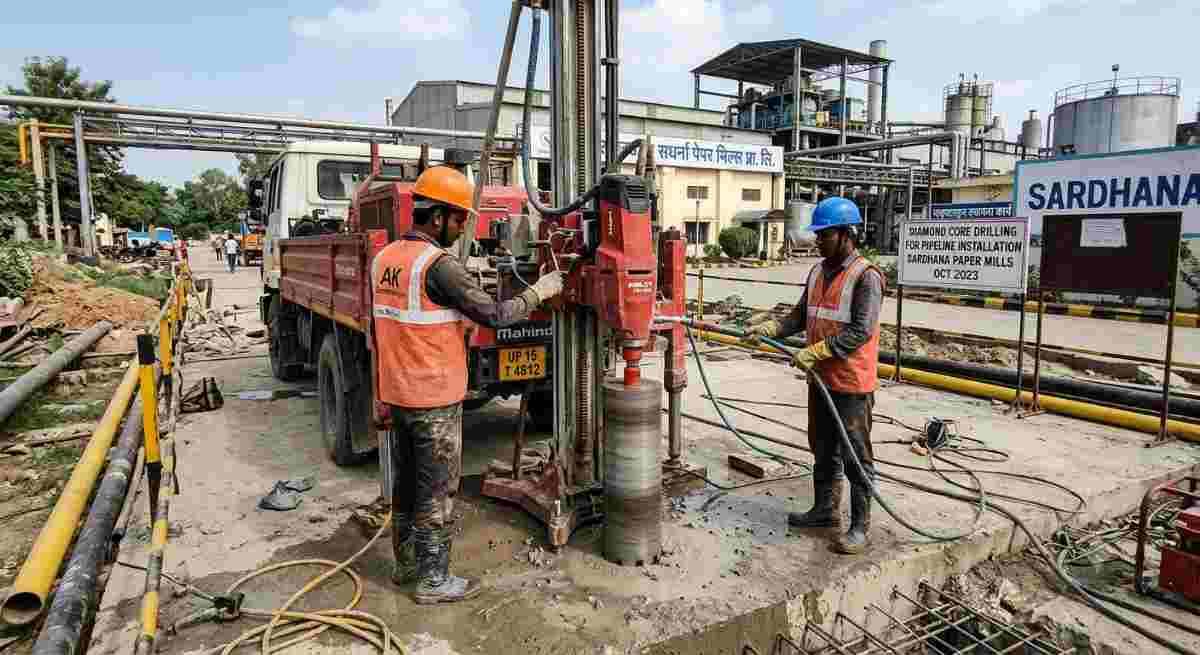
Every paper mill runs on pipes. Water, steam, pulp slurry, chemicals, compressed air, effluent, and fire-fighting lines all have to travel through walls, slabs, foundations, and floors before they reach the machines that need them. In a busy industrial belt like Sardhana, where mills cannot afford long shutdowns, the way those openings are made matters as much as the pipe itself.
This is where diamond core drilling comes in. At Core Cutting India, we make clean, accurate, round openings in reinforced concrete so pipelines can be installed quickly, safely, and without damaging the structure around them. This guide explains how diamond core drilling works for paper mill pipeline installation in Sardhana, where it is used, what it costs you in time and effort, and how to plan the job well.
Why Paper Mills in Sardhana Need Precision Core Drilling
A paper mill is a heavy, wet and continuous operation. Floors carry vibrating machinery, trenches hold process water, and structural members are often thick, heavily reinforced and decades old. Any new pipeline, whether for an expansion, a new paper machine, an effluent upgrade or a fire-safety retrofit, has to pass through this existing concrete.
Traditional methods such as chiselling or hammer breaking create several problems in this setting:
- Cracks that travel beyond the intended opening and weaken slabs, beams and walls
- Heavy vibration that can disturb sensitive machinery and nearby workers
- Rough, irregular edges that make pipe sleeves and sealing difficult
- Excessive dust and noise in areas where pulp, paper and electrical equipment are present
- Long cleanup and repair time after the work is done
Diamond core drilling avoids almost all of these issues. It cuts a circular hole of the exact size you specify, leaves smooth walls and does not shake the structure. For a mill where every hour of downtime has a cost, that precision is a practical advantage, not a luxury.
What Is Diamond Core Drilling?
Diamond core drilling is a method of cutting round holes in concrete, brick, stone and reinforced concrete using a hollow cylindrical drill bit. The cutting edge of the bit is set with industrial diamond segments. These segments grind through concrete and steel reinforcement instead of hammering through them.
The bit is mounted on a motor-driven rig, either hand-held for smaller holes or fixed on a stand anchored to the floor or wall for larger and deeper ones. Water is fed to the bit during cutting. It cools the diamonds, flushes out slurry and keeps airborne dust to a minimum. As the bit advances, it leaves behind a solid cylinder of concrete called the core, which is removed once the hole is through.
Because the bit is hollow and the cut follows the circumference only, the process removes far less material than breaking concrete by force. That is why it is quieter, faster for round openings and far less damaging to the surrounding structure.
Where Pipeline Installation in a Paper Mill Needs Core Drilling
Paper mill projects involve many types of pipelines, and almost all of them need openings at some point. Common applications include:
- Process water and raw water lines: Passing intake and distribution pipes through boundary walls, pump house walls and machine hall foundations
- Steam and condensate lines: Making precise openings for insulated pipes where alignment and clearance are critical
- Effluent and ETP pipelines: Cutting through tank walls, trench walls and slabs for treated and untreated water lines
- Fire-fighting systems: Creating openings for hydrant, sprinkler and header pipes as part of safety upgrades
- Compressed air and chemical dosing lines: Running small-diameter lines through floors and walls with clean finishes
- Cable and conduit routes: Making openings for electrical and instrumentation conduits that run alongside the piping
- HVAC and ventilation ducts: Adding round penetrations during plant expansion and modernization
In each case, the opening needs to match the pipe or sleeve diameter closely. An oversized hole wastes grout and weakens the section; an undersized or crooked one delays installation. Core drilling gets this right the first time.
Key Benefits of Diamond Core Drilling for Pipeline Work
Accuracy and clean finish
Holes are cut to the exact diameter and position marked on site. The smooth inner surface makes it easy to fix a sleeve, apply a sealing compound or grout around the pipe, and achieve a neat, leak-resistant finish.
Low vibration, low structural stress
Since the bit grinds rather than strikes, the surrounding concrete is not shaken or cracked. This protects slabs, beams and columns, and it keeps nearby machinery and instruments undisturbed.
Cuts through steel reinforcement
Paper mill structures often contain dense rebar. Diamond bits cut through concrete and embedded steel in a single pass, so you do not need separate cutting steps or gas torches.
Reduced dust and noise
Wet drilling controls dust at the source. Compared to breaker-based methods, the noise level is also much lower, which helps operations continue in adjacent areas.
Speed and shorter downtime
A properly set up core drilling job can be completed in a fraction of the time that manual breaking would need, with almost no rework. For a plant that cannot stop for long, this directly protects production.
Flexible size range
Core bits are available in a wide range of diameters, from small holes for conduits to large openings for main pipelines and ducts. Depth capacity can be extended with additional barrel lengths, allowing work through thick foundations and walls.
Our Step-by-Step Process for Paper Mill Pipeline Projects
A good core drilling job begins well before the machine starts. Here is how we approach a typical project in Sardhana.
- Site visit and requirement study. We review the drawings, pipe sizes, wall and slab thickness, access conditions and working hours. If the mill is running, we note which zones are live and what restrictions apply.
- Scanning and marking. Before cutting, we locate reinforcement, embedded conduits and utilities where needed, and mark the exact centre and diameter of every hole. This avoids accidental damage to hidden services.
- Rig selection and setup. We select the right bit size and machine, then anchor the rig firmly to the floor or wall using a vacuum base or anchor bolts. A stable rig is the key to straight, accurate holes.
- Water supply and slurry control. A controlled water feed is connected, and slurry is collected through a vacuum or containment arrangement, so floors, electrical panels and machinery stay clean.
- Drilling. The operator advances the bit at a steady, controlled rate. Cutting speed, water flow and pressure are adjusted to suit the concrete strength and the rebar density.
- Core removal and inspection. The core is extracted, and the hole is checked for diameter, alignment and edge quality before moving to the next one.
- Cleanup and handover. We remove slurry and debris, leave the area tidy and hand over openings that are ready for sleeves and pipes.
For jobs with many holes, we sequence the work so that your pipe-fitting team can follow behind us without waiting. This kind of coordination saves days on larger projects.
Equipment and Hole Sizes
The right equipment makes the difference between a smooth job and a stressful one. We use diamond core bits matched to the material, whether that is standard RCC, high-strength concrete or older brickwork, along with rigid drilling stands, vacuum bases and extension barrels for deep cuts. Smaller holes for conduits and air lines can be made with compact machines, while large-diameter pipeline openings use heavier rigs with higher torque.
Because every pipeline layout is different, we confirm the required diameters and depths at the planning stage and bring the correct bit sizes to site in one go. If your design changes mid-project, we can adjust quickly without long delays.
Safety, Dust and Water Management in a Running Mill
Paper mills are wet, electrically dense environments, so safety planning is part of the job and not an afterthought. Our approach includes:
- Marking and barricading the work zone to keep people clear of the drilling area
- Using proper electrical protection and earthing for equipment operating around water
- Managing slurry so it does not flow into drains, trenches or live equipment areas
- Securing the rig and core so that falling pieces cannot cause injury, especially when drilling through slabs
- Checking underneath or on the other side of a slab or wall before breakthrough
- Following your plant's permit, PPE and site entry rules
By keeping the process controlled and clean, we help your team continue working safely nearby.
Planning Tips for Mill Managers and Contractors
A few decisions made early can save time and money on any pipeline installation project.
- Share drawings early. Reinforcement layouts and utility drawings let us plan hole positions with less risk.
- Group the work. Bundling all holes into one or two planned visits is more economical than calling us back repeatedly.
- Confirm sleeve sizes before cutting. The core diameter should suit the sleeve, the insulation thickness and the sealing method you plan to use.
- Provide water and power access. A steady water source and a reliable electrical supply keep the job moving.
- Mark priority areas. If some openings are on the critical path for a shutdown or commissioning date, tell us so we can schedule them first.
- Plan for fire and waterproofing. Where pipes pass through fire-rated or water-retaining walls, allow for proper sealing and fire-stopping after installation.
What Affects the Cost of Core Cutting?
Pricing depends on several factors rather than a single fixed rate. These typically include the diameter and depth of each hole, the number of holes, the density of reinforcement, the type and age of the concrete, the height or position of the work, and access conditions such as confined spaces or working at height. Travel to the site and the need for night or shutdown-period work can also affect the quote.
The best way to get an accurate figure is a short site discussion. Call us on +91 70096 79903, share your hole schedule, and we will provide a clear quotation.
Why Choose Core Cutting India for Sardhana Projects?
Core Cutting India focuses on concrete cutting and drilling for industrial, commercial and infrastructure projects. For paper mills and similar plants in and around Sardhana, we offer:
- Experienced operators who understand reinforced industrial structures
- Accurate, clean holes that are ready for sleeves and pipes
- Dust-controlled, low-vibration methods suitable for working near live operations
- Flexible scheduling, including shutdown periods and off-hours work
- Practical advice on hole positions, sizes and sequencing
- Prompt communication and straightforward quotations
Our aim is simple: to give your project team clean openings on time, so the pipeline work behind us can proceed without delays or rework.
Frequently Asked Questions
What is diamond core drilling?
Diamond core drilling is a technique that uses a hollow bit fitted with diamond segments to cut precise round holes in concrete, brick and stone. Water cools the bit and controls dust while the bit leaves a solid core that is removed after the hole is complete.
Why is core drilling used for pipeline installation?
Pipelines need openings that match the pipe or sleeve size, with clean edges and minimal damage to the surrounding structure. Core drilling delivers exactly that, and it also cuts through reinforcement without cracking the concrete.
How deep can a core drill cut through concrete?
Depth depends on the bit length and the rig. With extension barrels, core drilling can handle thick walls, foundations and slabs. For very deep or heavily reinforced sections, we plan the setup in advance and confirm the approach during the site visit.
Is core cutting better than hammer drilling or breaking?
For round openings in structural concrete, yes. Core cutting produces less vibration, less noise and far less cracking than breaker-based methods, and it gives a smoother, more accurate hole that is easier to seal around a pipe.
How much does core cutting cost in India?
Cost varies with hole diameter, depth, quantity, reinforcement density and site conditions. Instead of relying on a generic rate, it is better to request a quotation based on your actual hole schedule. Contact us at +91 70096 79903 for a clear estimate.
Can core drilling be done in a running plant?
In most cases, yes. Because the method is low-vibration and uses wet drilling with slurry control, it can be carried out with limited disturbance to nearby operations. We coordinate with your team to follow all safety rules and access permits.
Do you provide service in Sardhana and nearby areas?
Yes. We serve industrial and construction clients in Sardhana and the wider Meerut region. Call us or visit corecuttingindia.com to discuss your location and requirements.
Conclusion
Pipeline installation in a paper mill depends on openings that are accurate, clean, and made without harming the structure. Diamond core drilling is the most dependable way to achieve this, offering precision, low vibration, controlled dust, and faster completion than conventional breaking.
If you are planning a new pipeline, plant expansion or utility upgrade in Sardhana, bring in a core cutting specialist early. It saves time, avoids rework and keeps your project on schedule.
Ready to start? Call +91 70096 79903 or visit https://corecuttingindia.com/ to request a site visit and a quotation from Core Cutting India.