
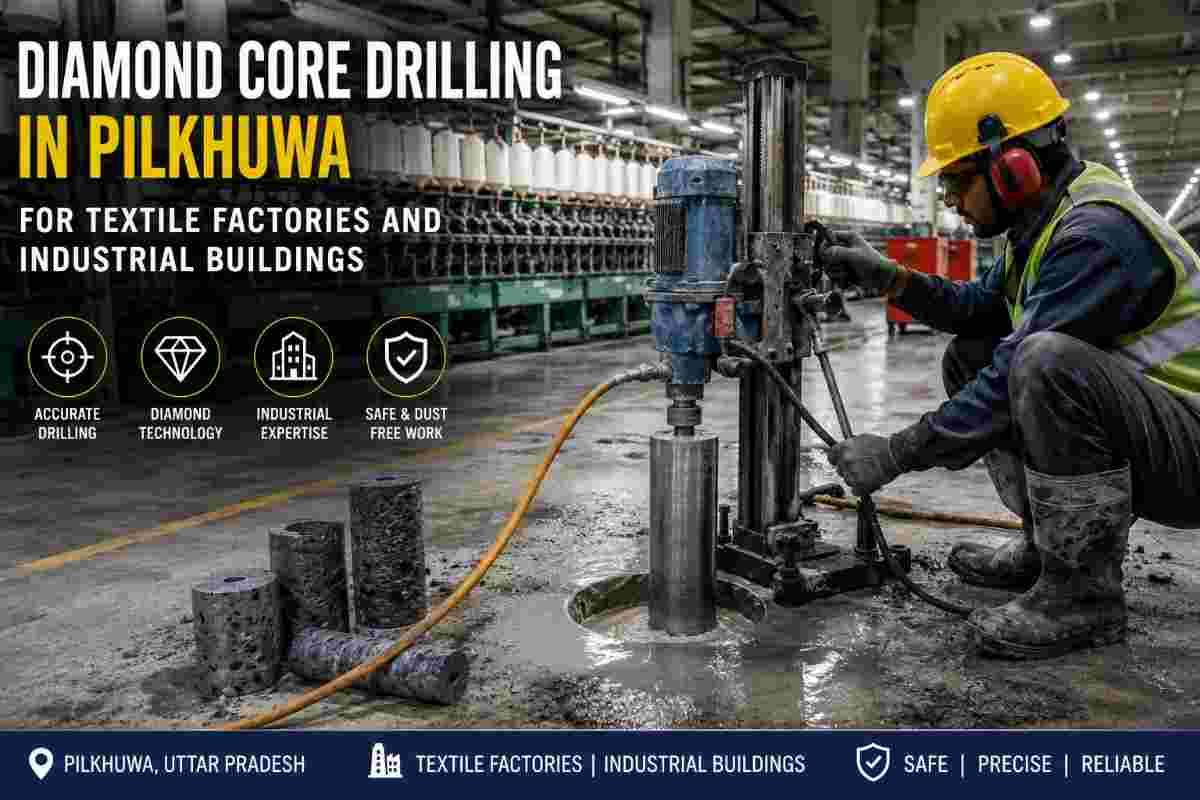
Pilkhuwa, in Hapur district of Uttar Pradesh, is one of the best-known textile and home furnishing hubs in northern India. Block printing units, dyeing and processing houses, weaving sheds, garment manufacturers and export-oriented factories have grown here for decades, and many of them are constantly expanding, upgrading machinery or reorganising their floors to keep up with demand.
Every expansion brings the same practical problem: you need to pass pipes, cables, ducts and drains through thick reinforced concrete, or fix heavy machines to a slab, without damaging the building. Hammer drills and chisels are noisy, slow, dusty and risky for structural elements. That is exactly where diamond core drilling in Pilkhuwa comes in.
At Core Cutting India (https://corecuttingindia.com/), we provide professional diamond core drilling and concrete core cutting for textile factories, warehouses, processing units and industrial buildings. This guide explains how the technique works, where it is used in textile and industrial settings, what to check before hiring a contractor, and how to get the best result from your project.
What Is Diamond Core Drilling?
Diamond core drilling is a method of making clean, round holes in concrete, reinforced cement concrete (RCC), brick, stone and masonry using a hollow cylindrical drill bit. The cutting edge of the bit carries industrial diamond segments bonded in a metal matrix. As the bit rotates, the diamonds grind through the material, and the cylinder of material left in the centre, called the core, is removed in one piece.
A typical setup includes:
- A core drilling machine mounted on a stand, fixed to the surface with an anchor or a vacuum base for stability.
- A diamond core bit chosen for the diameter required and the hardness of the material.
- A water supply, which cools the bit, flushes slurry and keeps dust under control.
- Rebar-cutting capability, because the bit passes through steel reinforcement as easily as concrete.
Because the machine is rigidly mounted and the cutting is smooth rather than percussive, the result is a straight, clean hole with minimal vibration. This is the main reason structural engineers and facility managers prefer core drilling over conventional hammering.
Why Core Drilling Suits Textile Factories
Textile units are not like ordinary office buildings. They combine heavy machinery, wet processes, chemical handling, high humidity, large power loads and tight production schedules. Here is why diamond core drilling fits this environment so well.
1. Minimal Vibration Protects Machinery and Structure
Many textile units run sensitive equipment such as printing tables, stenter machines, looms, calendering machines and automated cutting systems. Heavy percussive drilling sends vibration through the slab and can disturb alignment or create micro-cracks in older structures. Core drilling is far gentler, which means nearby operations can often continue with little interruption.
2. Low Dust Keeps Fabric and Finished Goods Clean
Dust is the enemy of textiles. Fine concrete dust settling on printed fabric, dyed material or packed goods can cause rejection and rework. Because core drilling is typically done with water cooling, the dust becomes slurry that can be collected and cleaned, keeping the work area far cleaner than dry hammer drilling.
3. Accuracy for Tight Layouts
Textile floors are crowded with machines, drains, steam lines and electrical panels. A precisely located hole of an exact diameter helps services fit neatly the first time, with no oversizing, no patching and no ragged edges.
4. Speed Reduces Downtime
A properly equipped crew can complete many holes in a day, depending on depth and diameter. For factories where every idle hour affects delivery commitments, this speed matters.
Common Applications in Textile Units and Industrial Buildings
Core drilling in Pilkhuwa’s industrial belt is used for a wide range of jobs. Some of the most frequent are listed below.
Plumbing and Drainage Penetrations
Dyeing, washing and printing units need robust drainage and water supply. Core holes are made in floors and walls for PVC and GI pipes, floor traps, effluent lines and connections to effluent treatment plants (ETP).
HVAC, Ventilation and Exhaust
Factories need exhaust fans, ducts, humidification systems and air-conditioning lines. Core drilling creates clean openings in walls and slabs for ducting and refrigerant piping.
Electrical Conduits and Cable Routes
As a unit adds machines, it also adds cabling. Core holes allow electrical conduits and cable trays to pass between floors or rooms without weakening the structure.
Fire-Fighting and Safety Systems
Sprinkler lines, hydrant pipes and fire alarm routes often need to pass through RCC slabs and fire-rated walls. Precise coring helps keep the opening neat so it can be sealed with a proper fire-stop afterwards.
Anchor Bolt and Machine Foundation Holes
Heavy textile machinery is anchored to foundations or slabs. Core drilling, along with smaller diamond drilling for anchors, gives accurate holes for chemical anchors, foundation bolts and grouting.
Compressor, Boiler and Generator Rooms
Utility rooms need openings for pipes, flues and cables. Core cutting makes these openings without cracking surrounding concrete.
Structural Investigation and Sampling
If you are planning a floor extension or a load increase, an engineer may need concrete core samples to test strength. Core drilling provides cylindrical samples that can be sent to a lab for compressive strength testing.
Renovation and Retrofitting
Older buildings are frequently modified for new layouts. Core drilling allows openings to be created or enlarged in existing walls and slabs with controlled results.
Benefits of Diamond Core Drilling Over Conventional Methods
|
Feature |
Diamond Core Drilling |
Conventional Hammer Drilling / Chiselling |
|---|---|---|
|
Hole quality |
Clean, round, smooth edges |
Rough, irregular, often chipped |
|
Vibration |
Very low |
High, can crack concrete |
|
Dust |
Controlled with water cooling |
Heavy dust |
|
Noise |
Moderate |
Very loud |
|
Rebar cutting |
Cuts through easily |
Difficult, damages bit and slab |
|
Precision |
High |
Low |
|
Structural safety |
Preserves integrity |
Risk of micro-cracks |
|
Finishing needed |
Minimal |
Often heavy patching |
For a factory owner, the practical takeaway is simple: core drilling costs a little more per hole than crude methods, but it saves money on repairs, rework, downtime and structural risk.
How a Professional Core Drilling Job Is Done
Understanding the process helps you judge whether a contractor is doing the work properly. At Core Cutting India, a typical job follows these steps.
Step 1: Site visit and requirement check. We note the number of holes, diameters, depth, surface type (wall, slab, beam or foundation) and access conditions. For textile units, we also check production schedules and sensitive zones.
Step 2: Marking and scanning. Holes are marked according to the drawing or the client’s instructions. Where possible, the area is checked for embedded conduits, pipes or major reinforcement so we avoid cutting live services or critical structural elements.
Step 3: Machine setup. The drilling rig is fixed firmly with an anchor or vacuum base. A stable setup is essential for a straight hole and a long bit life.
Step 4: Water supply and slurry control. Water is connected for cooling, and slurry is contained and cleaned, which is especially important in textile and food-adjacent environments.
Step 5: Drilling. The diamond bit is advanced at a controlled speed. The operator watches for changes in resistance as the bit meets rebar or different material layers.
Step 6: Core removal and cleanup. The core is extracted, the hole is checked for diameter and alignment, and the area is cleaned.
Step 7: Handover. The client inspects the holes, and any follow-up such as sleeving, grouting or fire-stopping can be done by the relevant team.
Choosing the Right Hole Size and Depth
A common question from factory managers is what diameter they should ask for. While exact needs depend on the pipe, duct or cable, a few principles help:
- Leave a small working clearance around the pipe or sleeve so it can be installed and sealed properly.
- Think about future capacity. If you may add cables or pipes later, a slightly larger opening or a sleeve can save a second drilling visit.
- Match depth to thickness. Industrial slabs and walls can be much thicker than domestic ones, so confirm the actual thickness before ordering.
- Consider sleeves and seals. For wet areas, sleeves with waterproofing and for fire zones, approved fire-stop materials are advisable.
Our team can advise on suitable diameters based on your drawing and the service being installed.
Safety Considerations for Industrial Core Drilling
Safe work is non-negotiable in an operating factory. Good practice includes:
- Checking for hidden services such as live electrical conduits, water lines and gas pipes before drilling.
- Using proper electrical protection, including earthing and residual current protection, because water and electricity are present together.
- Securing the work zone so staff and visitors keep clear of the drilling area.
- Wearing PPE, including safety shoes, gloves, eye protection and hearing protection.
- Controlling slurry to prevent slip hazards on factory floors.
- Supporting the core at the bottom when drilling through slabs so it does not fall onto people or machines below.
A careful contractor will discuss these points with your safety or maintenance team before starting.
What Affects the Cost of Core Drilling in Pilkhuwa?
Pricing depends on several factors, so a fixed rate per hole is rarely accurate for every site. The main variables are:
- Diameter of the hole. Larger diameters need bigger bits and more machine power.
- Depth or thickness of the concrete. Deeper holes take longer and wear bits faster.
- Reinforcement density. Heavily reinforced RCC is harder to cut than plain concrete or brick.
- Number of holes. Larger batches usually reduce the per-hole cost.
- Access and height. Holes at height, in tight spaces or on ceilings need extra setup.
- Site conditions. Water and power availability, working hours and safety requirements influence time and cost.
- Mobilisation. Travel, equipment transport and crew deployment are part of the quote.
The best approach is to request a quotation after sharing your requirement. At Core Cutting India, we provide clear estimates so there are no surprises on the final invoice.
How to Choose a Core Drilling Contractor in Pilkhuwa
Not every contractor offers the same quality. Before you hire, check the following:
- Experience in industrial sites. Factory work is different from residential jobs. Ask about similar projects.
- Modern equipment. Good machines and quality diamond bits mean straighter holes and fewer delays.
- Trained operators. Skill matters, especially when cutting through dense reinforcement or working near live services.
- Dust and slurry management. For textile units, this is critical.
- Safety practices. The contractor should follow clear protocols and carry the right protective gear.
- Transparent pricing. Ask what is included in the quote.
- Responsiveness. Production schedules are tight, so choose a team that responds quickly and finishes on time.
Core Cutting India is built around these priorities, serving clients across Delhi NCR, including Pilkhuwa, Hapur, Ghaziabad and nearby industrial areas.
Frequently Asked Questions (People Also Ask)
What is diamond core drilling used for in factories?
In factories, diamond core drilling is used to create precise openings in walls, floors and slabs for pipes, cables, ducts, drainage, fire-fighting lines and machine anchors. It is also used to take concrete samples for strength testing.
Does core drilling damage the structure?
When done correctly, no. Core drilling produces very little vibration and a clean cut, so it preserves the integrity of the concrete far better than hammer drilling. However, cutting through major beams, columns or heavily reinforced zones should only be done after consulting a structural engineer.
Can a core drilling machine cut through steel reinforcement?
Yes. Diamond bits can cut through rebar embedded in concrete. That said, cutting main structural reinforcement can affect strength, so it should be planned and approved by a qualified engineer.
How long does it take to drill a hole in a concrete wall or slab?
It depends on the diameter, thickness and reinforcement. Small holes in standard walls can take minutes, while large holes in thick, heavily reinforced slabs can take considerably longer. Your contractor can give a realistic estimate after seeing the site.
Is core drilling dusty or noisy?
Wet core drilling is much cleaner than dry hammer drilling because water turns dust into slurry. It is also generally quieter and smoother than chiselling, although some noise is unavoidable.
What is the difference between core drilling and core cutting?
The terms are often used interchangeably. Core drilling usually refers to making round holes using a diamond bit, while core cutting is a broader term that can also cover wall sawing, slab sawing and wire sawing, depending on the project.
What size holes can be made with diamond core drilling?
Core drilling can produce holes from small diameters for anchors and conduits to large diameters for ducts and big drain pipes. The exact range depends on the equipment available, so confirm your required size with the contractor.
How much does core drilling cost?
Cost depends on diameter, depth, reinforcement, number of holes and site conditions. Contact Core Cutting India with your requirement for an accurate quotation.
Can core drilling be done while the factory is running?
Often yes. Because the method produces low vibration and controlled dust, it is possible to schedule work around operations. Planning with your maintenance team ensures safety and minimal disruption.
Why should I hire professionals instead of doing it in-house?
Professionals bring the right equipment, trained operators, safety practices and experience in identifying hidden services. This reduces the risk of damaged structures, broken pipes, electrical hazards and costly rework.
Tips to Get the Best Results From Your Core Drilling Project
- Share drawings or clear marking details so the team knows exact positions and diameters.
- Confirm slab and wall thickness before the visit to avoid surprises.
- Identify known pipes and cables in advance.
- Arrange water and power access near the work area.
- Clear the work zone of stock, fabric and sensitive items.
- Plan sleeves, waterproofing and fire-stopping along with the drilling schedule.
- Schedule during low-production periods where possible.
- Ask for a written quotation so scope and price are clear.
A little preparation saves significant time and money on the day of the job.
Why Choose Core Cutting India for Diamond Core Drilling in Pilkhuwa?
At Core Cutting India, our focus is on delivering accurate, clean and safe concrete cutting and drilling for industrial clients. Here is what you can expect when you work with us:
- Precision results with clean holes and smooth finishes.
- Dust-conscious methods suitable for textile and garment units.
- Experienced operators who understand industrial environments.
- Wide range of services, including RCC core drilling, wall cutting, slab cutting and related concrete cutting work.
- Prompt service designed to respect your production schedule.
- Transparent, competitive quotations based on your actual requirement.
Whether you are setting up a new printing unit, extending a processing plant, installing a new ETP line or upgrading your HVAC system, our team is ready to help.
Conclusion
Pilkhuwa’s textile and industrial sector keeps growing, and so does the need for clean, controlled and reliable building modification. Diamond core drilling lets factories create openings for pipes, cables, ducts and machinery without the vibration, dust and structural risk of old-fashioned methods. For textile units in particular, where cleanliness and uptime directly affect quality and delivery, it is the smart choice.
If you are planning a project and need diamond core drilling in Pilkhuwa, get in touch with the team at Core Cutting India. Share your requirement, and we will guide you on the right approach, timeline and cost.
Website: https://corecuttingindia.com/
Call or WhatsApp: +91 70096 79903
Call now for a free site assessment and quotation.