
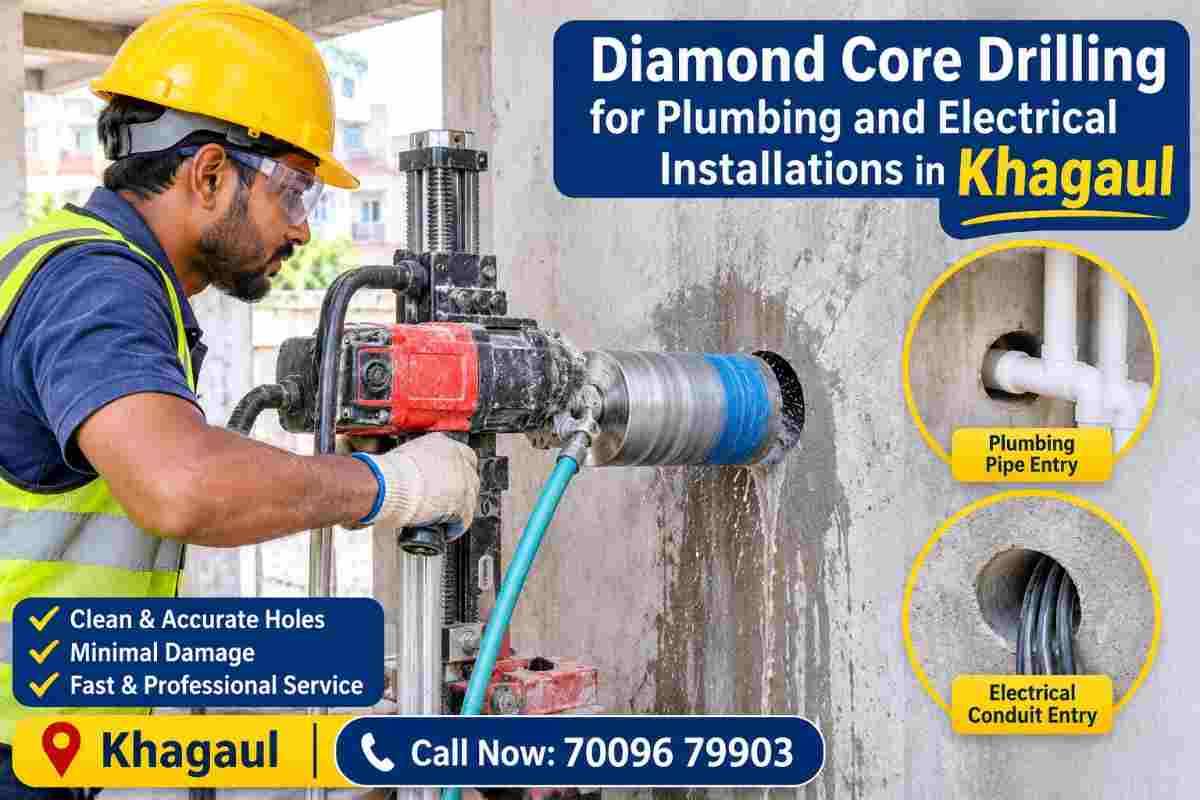
Khagaul is changing quickly. New apartment blocks, commercial complexes, schools, clinics and renovated homes are going up across the area, and nearly all of them use reinforced concrete. Concrete gives buildings strength, but it also makes it hard to run pipes and cables through walls, slabs and beams. This is where diamond core drilling comes in.
At Core Cutting India, we help builders, contractors, plumbers, electricians and homeowners make clean, accurate openings in concrete, brick and stone. This guide explains how diamond core drilling works, why it suits plumbing and electrical installations, and how to choose the right service in Khagaul.
Related searches: diamond core drilling Khagaul, core cutting services Patna, RCC core cutting, wall core drilling for pipes, concrete hole cutting near me, core drilling contractor Bihar.
What Is Diamond Core Drilling?
Diamond core drilling is a precision method of making round holes in hard materials such as reinforced concrete, brick, stone and masonry. A hollow cylindrical drill bit, called a core bit, has industrial diamond segments bonded to its cutting edge. The bit is fitted to a powerful drilling rig and spun at controlled speed, usually with water cooling.
The bit does not pulverise the whole hole. It cuts a ring around the circumference and leaves a solid cylinder of material, called the “core,” which is lifted out intact. Because only the ring is cut, the process is:
- Faster than chiselling or hammer drilling
- Cleaner, with smooth hole walls and minimal debris
- Quieter, with far less vibration
- Safer for the surrounding structure, since it avoids micro-cracks
Holes can range from about 25 mm for small cable entries to 500 mm or more for large drainage and ventilation openings.
Why Traditional Methods Fall Short
Many people still use hammer drills, hand chisels or jackhammers to make openings for pipes and cables. These methods cause real problems:
- Cracks and structural damage. Heavy impact sends vibrations through the concrete and can weaken slabs, beams and columns.
- Rough, uneven holes. Chiselled openings are irregular and need extra patching and finishing.
- Excess noise and dust. This disturbs families, offices and neighbours, and is a particular problem in occupied buildings.
- Slow progress. Cutting through thick RCC by hand takes hours and delays the project.
- Risk to hidden reinforcement. Uncontrolled hammering can damage rebar and existing services.
Diamond core drilling avoids these problems and gives you a hole that matches the specification.
Diamond Core Drilling for Plumbing Installations
Plumbing systems need openings in concrete floors, walls, beams and sometimes foundations. Core drilling handles all of these jobs.
1. Water supply lines
Fresh water pipes often need to pass through walls between rooms or through slabs between floors. A properly sized core hole lets the pipe sit snugly, with room for a sleeve or sealant.
2. Drainage and sewage pipes
Soil pipes, waste pipes and stormwater lines are larger in diameter and must be set at the right slope for good flow. Core drilling gives the precise, angled openings that proper gradients require.
3. Bathroom and kitchen renovations
When moving a toilet, adding a floor drain or relocating a sink, you often need new openings in the slab. Core drilling is the cleanest way to do this without disturbing the rest of the room.
4. Rainwater harvesting and overflow pipes
Terraces, balconies and sunken areas need outlets for water. Core cutting creates neat, leak-resistant openings that are easy to waterproof.
5. Fire sprinkler and HVAC lines
Larger commercial buildings need sprinkler pipes, chilled water lines and condensate drains. Diamond core drilling can cut these openings to exact dimensions, even in thick slabs.
Plumbing benefits at a glance
- Smooth hole walls make waterproofing and sealing more effective
- Accurate diameters reduce gaps and the chance of leaks
- Less vibration protects existing tiles, plaster and fixtures
- Faster work means plumbers can complete their tasks on schedule
Diamond Core Drilling for Electrical Installations
Electrical work in RCC buildings also depends on precise openings. Wires and cables cannot be forced through solid concrete, so contractors need dependable ways to route them safely.
1. Conduit entry points
Electrical conduits that run between floors, rooms or distribution boards need clean openings. Core drilling provides uniform holes that keep conduits aligned and protected.
2. Cable trays and heavy-duty cabling
Commercial and industrial sites use thick cables and multi-core feeders. Larger core holes accommodate these cables and let you install sleeves and fire-stopping materials properly.
3. Earthing and lightning protection
Earthing strips and down-conductors sometimes need to pass through structural elements. Controlled drilling makes sure these openings are placed correctly and do not compromise the structure.
4. Retrofit and upgrade projects
Older buildings frequently need upgrades such as new wiring, extra circuits, CCTV, data cabling or solar connections. Core drilling lets you add these without major demolition.
5. Solar and inverter installations
With more homes and businesses in the region adopting solar power, cable routes from rooftops to inverters and meters often require clean penetrations through slabs and walls.
Electrical benefits at a glance
- Prevents damage to existing wiring when planned correctly
- Produces neat openings that fit conduit and fire-stop systems
- Reduces dust that could affect sensitive electrical equipment
- Keeps work compliant with good site practice
Types of Core Drilling Methods
Different sites call for different approaches. A professional service will choose the right one for your job.
Wet core drilling: Water is fed to the bit to cool the diamonds and flush away slurry. This is the most common method for concrete and gives the best speed and bit life.
Dry core drilling: Used when water is not practical, such as near sensitive electrical panels or in finished interiors. It uses specially designed bits and often a vacuum attachment to control dust.
Handheld core drilling: Suitable for smaller holes and light-duty work, where the operator can safely manage the machine.
Rig-mounted core drilling: A stand-mounted machine is fixed to the floor or wall using an anchor or vacuum base. This gives stability, accuracy and the ability to cut large diameters.
Horizontal and angled drilling: Many plumbing and electrical routes are not vertical. Modern rigs can be set up to drill horizontally or at specific angles.
Planning Before You Drill
Good drilling starts with good planning. Before any holes are cut, a careful operator will consider:
- Hole position and diameter. Confirm sizes with your plumber, electrician or engineer.
- Hidden services. Check drawings and, where needed, use detection tools to locate rebar, cables and pipes inside the concrete.
- Structural considerations. Avoid cutting through main reinforcement, beams or columns without engineering approval.
- Water and slurry management. Plan how runoff will be contained and removed.
- Access and safety. Make sure the area is clear, power is available and the work zone is safe.
Spending a little time on planning prevents costly mistakes later.
Why Choose Core Cutting India in Khagaul?
When you hire a core drilling service, the quality of the work depends on the team, the equipment and the process. Core Cutting India focuses on delivering reliable, precise results for residential, commercial and industrial clients.
What you can expect
- Modern diamond equipment. Quality core bits and drilling rigs for clean, accurate holes.
- Experienced operators. Trained technicians who understand concrete, rebar and building services.
- Minimal disruption. Low-vibration, low-dust methods that keep your site and neighbours comfortable.
- Flexible sizes. From small cable holes to large drainage and ventilation openings.
- Support for contractors. We coordinate with plumbers, electricians, builders and engineers.
- Clear communication. Straightforward quotes and realistic timelines.
Whether you are building a new house, renovating a flat or outfitting a commercial space, we aim to make the drilling stage smooth and stress-free.
Common Applications in Khagaul
Khagaul has a mix of residential colonies, growing commercial streets and institutional buildings. Typical projects where core drilling helps include:
- New house construction: Openings for water lines, drains, conduits and AC piping
- Apartment complexes: Multiple penetrations across floors for shared services
- Renovations and remodelling: Adding bathrooms, kitchens or new electrical points
- Shops and offices: Cable routes for networking, CCTV, lighting and AC systems
- Schools and hospitals: Precise, low-noise drilling in occupied buildings
- Workshops and small factories: Heavy-duty openings for machinery utilities
- Water tanks and terraces: Outlet and overflow pipes through thick concrete
Cost Factors for Core Drilling
The price of a core drilling job depends on several factors. Understanding them helps you compare quotes fairly.
- Hole diameter. Larger holes take more time and need bigger bits.
- Depth of the cut. Thicker slabs and walls take longer.
- Material hardness. Dense reinforced concrete with heavy rebar is more demanding than brick.
- Number of holes. Bulk work often has a lower per-hole cost.
- Access and height. Difficult locations, ceilings or confined spaces may need special setups.
- Method. Dry drilling or vacuum-assisted work may differ in cost from standard wet drilling.
The best way to get an accurate figure is to share your requirements and have the team assess the job.
Safety and Cleanliness
Professional core drilling is safer than traditional breaking methods, but good practice still matters. A responsible team will:
- Check for hidden electrical lines and pipes before drilling
- Use proper anchoring so the rig does not shift
- Control water and slurry to protect floors and electrical equipment
- Wear protective gear and keep the work area tidy
- Clean up after the job so your space is ready to use
Tips for Homeowners and Contractors
- Mark your positions clearly and confirm them with your plumber or electrician before drilling begins.
- Share building drawings if you have them, as they help avoid hidden services.
- Tell the team about special conditions, such as occupied rooms, delicate finishes or limited water access.
- Plan all penetrations together so the work can be done in a single visit.
- Seal and waterproof properly after pipes and cables are installed.
Frequently Asked Questions (People Also Ask)
What is diamond core drilling used for?
It is used to cut precise round holes in concrete, brick and stone for plumbing pipes, electrical conduits, HVAC lines, anchor bolts, drainage and inspection or sampling.
Is core drilling better than hammer drilling?
For larger holes and hard concrete, yes. Core drilling is cleaner, quieter and creates less vibration, which reduces the risk of cracks and structural damage.
Can you core drill through reinforced concrete (RCC)?
Yes. Diamond core bits are designed to cut through concrete and steel reinforcement, though the operator must plan carefully to avoid cutting critical structural bars.
How long does core drilling take?
A single hole often takes only a few minutes to under an hour, depending on diameter, depth and material. Setup time adds to this.
Does core drilling make a lot of mess?
Wet drilling produces slurry, but a trained team manages and cleans it. Dry or vacuum-assisted methods reduce mess further.
Is core drilling safe for old buildings?
Generally yes, because it creates less vibration than impact methods. A professional assessment is recommended for older structures.
What size holes can be drilled?
Common sizes range from about 25 mm to over 500 mm, depending on the equipment and project.
How do I find core drilling services near me in Khagaul?
Look for a provider with the right equipment, experienced operators and clear communication. You can contact Core Cutting India directly for a quote.
Get Your Core Drilling Done Right
Plumbing and electrical systems are the lifelines of any building, and the first step to a good installation is a clean, accurate opening. Diamond core drilling gives you that precision without the damage, noise and delays of older methods.
If you are planning a project in Khagaul and need reliable core cutting, Core Cutting India is ready to help.
Website: https://corecuttingindia.com/
Call or WhatsApp: +91 70096 79903
Contact us today to discuss your requirements, get a quote and schedule your diamond core drilling service.