
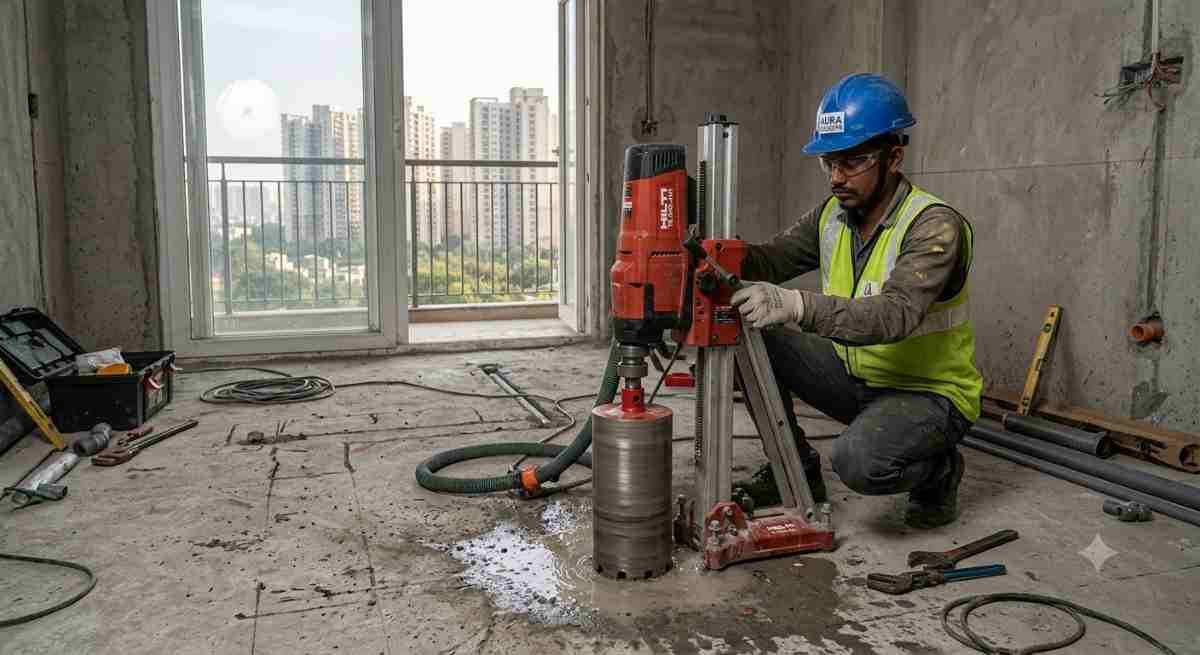
Renovating a bathroom, shifting a kitchen sink, or adding a new water line in a Noida apartment sounds simple until you meet the concrete. Modern high-rises in Sector 62, Sector 137, Noida Extension, Sector 150 and along the Expressway are built with reinforced cement concrete (RCC). Slabs, shear walls and columns are dense, steel-reinforced and structurally critical. A hammer drill or a chisel is the wrong tool for this job.
This is where diamond core drilling comes in. At CoreCuttingIndia, we help homeowners, builders, plumbers and facility managers create precise, clean openings for plumbing pipes with minimal noise, dust and structural risk. This guide explains how the process works, why it suits apartment plumbing, what it costs, and what to check before you hire a contractor.
What Is Diamond Core Drilling?
Diamond core drilling is a method of cutting perfectly round holes in concrete, brick, stone and masonry using a hollow cylindrical drill bit. The bit’s cutting edge carries industrial diamond segments, which are far harder than concrete and steel reinforcement bars.
Instead of pulverising the whole circle of material the way a hammer drill does, the bit cuts only the outer ring and leaves a solid cylinder, called the “core,” which is lifted out intact. The result is a smooth, accurate hole with no cracks radiating into the surrounding slab or wall.
Holes typically range from 25 mm to 600 mm or more. For apartment plumbing, the most common sizes are:
- 50 mm to 75 mm for wash basin drains and kitchen waste lines
- 100 mm to 110 mm for WC (toilet) soil pipes and main drainage stacks
- 150 mm and above for larger stacks, ducts and shafts
- 20 mm to 40 mm for water supply lines and cable conduits
Why Plumbing Installation in Noida Apartments Needs Core Drilling
1. Dense RCC Construction
Noida’s residential towers use M25 to M40 grade concrete with heavy steel reinforcement. Conventional drilling or manual breaking is slow, noisy and unpredictable at this density. Diamond bits slice through both concrete and rebar cleanly.
2. Strict Society Rules
Most Resident Welfare Associations (RWAs) and apartment owners’ associations in Noida restrict renovation hours and ban high-vibration, high-noise work. Core drilling produces far less vibration and noise than breaker-based demolition, so it is much easier to get approved and to carry out without neighbour complaints.
3. Structural Safety
Hammering and chiselling send shock waves through a slab, causing micro-cracks that weaken the structure and can lead to seepage later. Core drilling is a controlled, low-vibration cut that protects structural integrity.
4. Precision for Plumbing Alignment
Drain pipes depend on gradient and alignment. An oversized, ragged hole forces plumbers to patch with mortar, which can crack and leak. A core-drilled hole matches the pipe or sleeve diameter closely, so the installation sits true.
5. Cleanliness in Occupied Homes
Most renovations in Noida happen in occupied apartments, often with a family living below. Wet core drilling contains dust and slurry, protecting furniture, flooring and the lungs of everyone in the building.
Common Plumbing Applications in Apartments
New Bathroom Construction or Relocation. Shifting a WC or shower to a new position requires a new floor opening for the soil and waste pipe. Core drilling gives a precise opening exactly where the pipe needs to go.
Kitchen Sink and Chimney Lines. Moving a kitchen sink or adding a water purifier drain often means a new hole through a wall or slab. A small-diameter core bit does it in minutes.
Water Supply Line Penetrations. Running CPVC, UPVC or PPR pipes through walls and beams needs neat sleeves, and core drilling provides them.
Drainage Stack Additions. When an extra bathroom or utility area is added, a new vertical stack may be needed through multiple floors, which requires accurate, aligned holes.
Geyser, AC and Washing Machine Lines. Condensate drains, washing machine outlets and similar lines need small penetrations through walls and slabs.
Rainwater and Balcony Drainage. Balcony outlets and terrace drainage points are frequently created or corrected using core cutting.
How the Diamond Core Drilling Process Works
Understanding the process helps you judge whether a contractor is doing it properly.
Step 1: Site Inspection and Marking
A technician inspects the location, confirms the pipe size and marks the exact centre point. In a slab, they check what lies beneath, including the ceiling of the apartment below and any known service lines.
Step 2: Scanning for Reinforcement and Services
Before drilling, a good contractor checks for embedded electrical conduits, water lines or heavily clustered rebar, ideally with a rebar or utility detector. This avoids dangerous surprises such as cutting a live conduit.
Step 3: Machine Setup and Anchoring
The core drilling rig is fixed to the surface with an anchor bolt or a vacuum base. A stable setup is essential, since any wobble produces a crooked hole and can jam the bit. The rig stands on a rigid column for vertical or horizontal drilling.
Step 4: Water Cooling and Dust Control
Water is fed continuously through the bit. It cools the diamond segments, flushes out slurry and suppresses dust. In occupied homes, a wet vacuum or slurry collector catches the runoff so floors stay clean.
Step 5: Drilling
The operator feeds the bit at a controlled pace. Too much pressure glazes the diamonds, and too little wastes time. Through reinforcement the bit cuts steadily without shattering the concrete.
Step 6: Core Extraction and Finishing
Once through, the core is removed, the hole is rinsed and checked for diameter and alignment. The plumber can then insert a pipe sleeve and seal it with non-shrink grout or fire-rated sealant as needed.
A typical standard-size hole in a slab takes anywhere from a few minutes to under half an hour, depending on thickness, reinforcement density and diameter.
Benefits of Diamond Core Drilling vs. Traditional Methods
| Feature | Diamond Core Drilling | Hammer/Breaker Method |
|---|---|---|
| Hole accuracy | Precise, smooth edges | Rough, oversized |
| Vibration | Very low | High |
| Structural impact | Minimal micro-cracking | Risk of cracks and weakening |
| Noise | Moderate to low | Very high |
| Dust | Controlled with water | Heavy dust |
| Cutting rebar | Clean cut | Difficult, messy |
| Finishing work | Little | Extensive patching |
| Neighbour disturbance | Low | High |
For apartment owners, the real savings come from avoiding later repairs. A neat, correctly sized opening means fewer leaks, less patch plaster and a longer-lasting plumbing installation.
Wet vs. Dry Core Drilling in Apartments
Wet drilling is the standard for plumbing work. Water cools the bit, extends its life, controls dust and speeds up the cut. It does require slurry management, which a professional team handles with collectors and wet vacuums.
Dry drilling is used only in specific situations, such as small holes where water use is impractical or in areas near sensitive electronics. It needs dust extraction attachments and suits only limited diameters and materials. For most plumbing penetrations in concrete slabs, wet drilling is the better and safer choice.
Safety Considerations Before You Drill
Core drilling is safe when done by trained professionals, but several precautions matter in an apartment building:
- Get approval from your RWA or society. Most Noida societies require permission for renovation work, with specified working hours and sometimes a refundable deposit.
- Check what’s below and around the cut. Confirm there are no electrical conduits, gas lines or water lines in the drilling path. Inform the neighbour below if you are drilling through a slab.
- Never cut structural elements without engineer approval. Beams, columns and shear walls carry load. Openings in them should be checked by a structural engineer. Slab penetrations for standard pipes are routine, but their position relative to beams matters.
- Use protective equipment. Operators should wear gloves, safety shoes, eye protection and ear protection.
- Electrical safety with water. Because wet drilling combines water and electricity, the equipment must use proper earthing and RCCB or GFCI protection.
- Protect the floor below. Covering furniture and flooring in the lower apartment is a courtesy that prevents damage claims.
How Much Does Core Drilling Cost in Noida?
Pricing depends on several factors rather than one fixed rate:
- Hole diameter. Larger holes cost more because they need bigger bits and more time.
- Depth or slab thickness. Deeper cuts take longer and wear the bit more.
- Reinforcement density. Heavy rebar slows cutting.
- Access and position. Overhead, wall-mounted or tight-space drilling needs extra setup.
- Number of holes. Multiple holes in one visit usually lower the per-hole cost.
- Floor level and logistics. High-floor work or restricted access can add transport and handling effort.
Contractors typically quote per hole, or per inch of diameter and depth. The most reliable approach is to request a quotation after a quick site assessment or a description of hole sizes and locations. For a transparent estimate, you can contact CoreCuttingIndia at +91 70096 79903.
How to Choose a Core Drilling Contractor in Noida
Not every contractor with a drill is equipped for apartment work. Look for these markers:
Proper Equipment. Ask whether they use modern diamond core rigs with stable stands and water-feed systems, not improvised hand drills.
Trained Operators. Experience matters when the bit meets dense rebar or when working above an occupied floor.
Dust and Slurry Control. A professional team arrives with wet vacuums, covers and cleanup supplies.
Clear Quotation. The quote should list hole sizes, quantity and any extras so there are no surprises.
Society Compliance. The team should understand RWA norms, timing restrictions and entry procedures.
Reputation and Reviews. Look for verified customer feedback and a visible track record in residential projects.
Responsiveness. Quick site visits and clear communication signal a reliable service.
Tips for Homeowners Planning Plumbing Work
- Plan all openings at once. Marking every required hole before the team arrives saves time and reduces the per-hole cost.
- Confirm pipe sizes with your plumber first. The core bit diameter should match the sleeve or pipe, usually slightly larger for the sleeve.
- Mark gradients. For drain lines, plan the slope before drilling, since the hole position affects the pipe’s fall.
- Coordinate the sequence. Drilling should precede waterproofing and tiling, so that sleeves can be sealed properly afterward.
- Seal around the pipe. After installation, fill the gap with non-shrink grout or appropriate sealant to prevent seepage between floors.
- Waterproof after drilling. Bathroom slab openings need careful waterproofing to avoid leaks into the apartment below, a very common problem in Noida buildings.
Common Mistakes to Avoid
- Using a hammer drill for large holes. It damages the slab and produces uneven openings.
- Skipping the rebar and conduit scan. Cutting through an unseen live wire or main reinforcement is risky.
- Poor sealing after pipe installation. Gaps lead to leaks, dampness and neighbour disputes.
- Ignoring RWA rules. Unapproved work can lead to fines or stopped work.
- Choosing on price alone. Very low quotes often mean worn bits, no dust control or untrained operators.
- Drilling too close to beams or edges. Positions near structural members should be reviewed by an engineer.
Frequently Asked Questions (People Also Ask)
What is diamond core drilling used for in plumbing?
It creates clean, accurate round holes in concrete walls and slabs so drain pipes, water supply lines and sleeves can pass through during installation or renovation.
Is core drilling safe for apartment buildings?
Yes, when done by trained professionals using proper equipment. It is a low-vibration method that protects structural integrity far better than hammering or chiselling. Holes near beams, columns or shear walls should be approved by a structural engineer.
How much does core cutting cost in Noida?
Cost depends on diameter, depth, rebar density, access and the number of holes. Most contractors quote per hole. Contact CoreCuttingIndia at +91 70096 79903 for a quotation based on your requirement.
Can you core drill through a slab with steel reinforcement?
Yes. Diamond bits cut through both concrete and rebar. The operator should still scan beforehand to avoid cutting critical reinforcement in structural members.
Does core drilling make a lot of noise or dust?
It produces much less noise, vibration and dust than a hammer or breaker. Wet drilling suppresses dust, and slurry is collected with vacuums.
How long does it take to drill one hole?
A typical plumbing-sized hole through a standard slab takes a few minutes to around thirty minutes, depending on diameter, thickness and reinforcement.
Do I need permission from the society for core drilling?
In most Noida housing societies, yes. Renovation work generally needs RWA approval and must follow set timings. Check your society’s rules before booking.
What size hole is needed for a toilet drain pipe?
Soil pipes are commonly 100 mm to 110 mm, so the hole is typically 110 mm to 150 mm depending on whether a sleeve is used. Confirm with your plumber.
What is the difference between core drilling and core cutting?
The terms are often used interchangeably. Both mean cutting a cylindrical core from concrete with a diamond bit. “Core cutting” is the more common term in India, while “core drilling” is used globally.
Can core drilling be done in old apartments?
Yes. In fact, it is often preferred in older buildings because the low vibration reduces the risk of cracking aged concrete. A site assessment is recommended.
Why Choose CoreCuttingIndia for Your Noida Apartment?
At CoreCuttingIndia, we understand that apartment work needs more care than an open construction site. Our approach focuses on:
- Precision cutting with modern diamond core drilling equipment
- Low-vibration, low-dust methods suited to occupied residential towers
- Trained, experienced operators who handle dense RCC confidently
- Clear, transparent quotations with no hidden charges
- Quick response and scheduling around your society’s working hours
- Clean, tidy work so your home stays protected
Whether you are renovating a single bathroom or fitting out multiple units for a builder, we provide reliable core drilling tailored to plumbing installation needs.
Conclusion
Plumbing work in Noida’s RCC apartments demands more than a standard drill. Diamond core drilling delivers clean, accurate, low-vibration openings that protect your building’s structure, keep your home tidy and make the plumbing installation sturdier and leak-resistant. By planning your openings in advance, following society rules, using a professional contractor and sealing and waterproofing properly, you can avoid the most common renovation headaches.
Ready to get your plumbing openings done right? Visit https://corecuttingindia.com/ or call +91 70096 79903 to book a site visit and get a quick, transparent quote for diamond core drilling in your Noida apartment.