
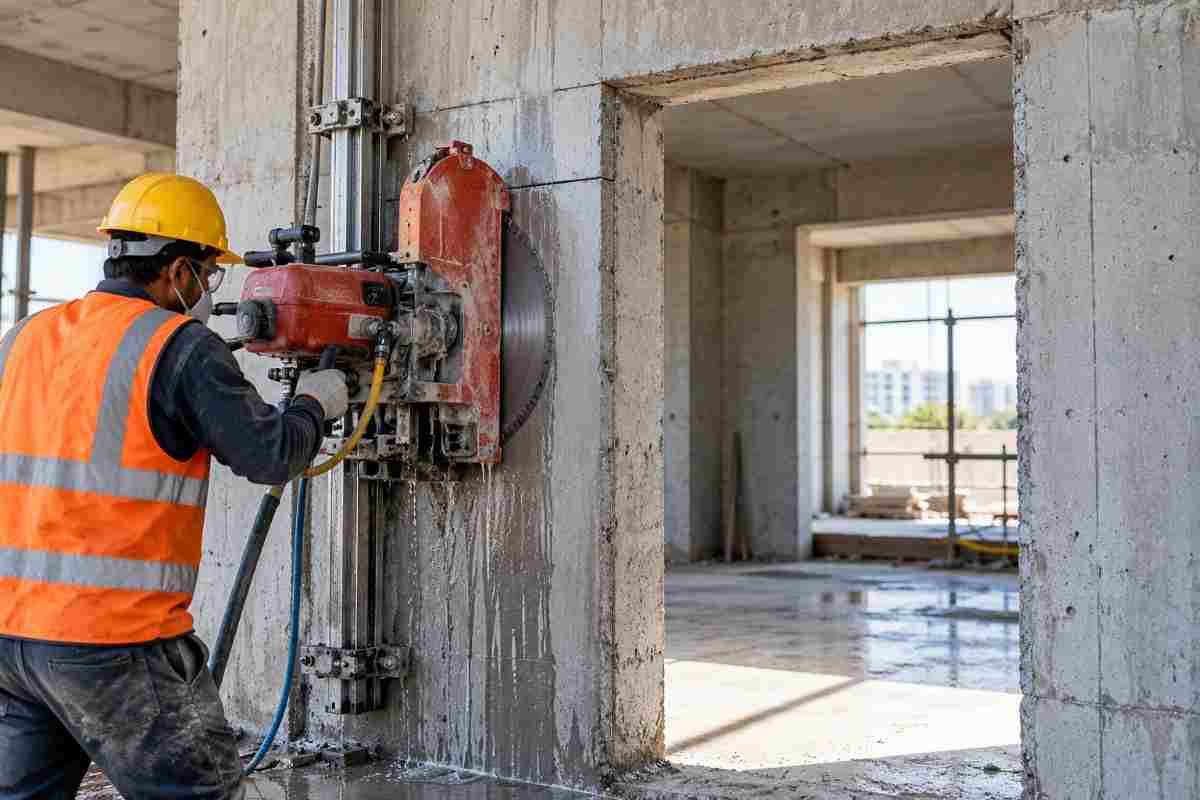
Few building changes are as satisfying as a new doorway. Whether you want to connect two rooms, add an emergency exit to a factory, or give a shop its own entrance, a new opening can change how a space works. In a concrete building, though, the job is hard. Concrete is dense, and it is usually reinforced with steel bars, so ordinary demolition methods can shake the structure and leave rough, cracked edges.
This is where diamond cutting comes in. At Core Cutting India, we use diamond-tipped tools to cut reinforced concrete cleanly, accurately, and safely. This guide explains how diamond cutting works, why it is the preferred method for door openings, and what to expect from the process.
What Is Diamond Cutting in Concrete?
Diamond cutting uses tools whose cutting edges are embedded with industrial diamond particles. Diamond is the hardest known material, so it can grind through concrete, granite, and steel reinforcement far more efficiently than any conventional blade.
The tool does not chip or smash the concrete. The diamond segments grind a thin, precise channel through it. Water is fed constantly to cool the blade, control dust, and flush out slurry. The result is a smooth, straight cut with clean edges, ready for a door frame or finishing work.
For door openings, the main diamond-cutting methods are:
- Diamond wall sawing: a track-mounted saw with a large circular blade that cuts straight lines through walls.
- Diamond wire sawing: a flexible wire loop strung with diamond beads, used where a blade cannot reach or where walls are very thick.
- Diamond core drilling: hollow, cylindrical drill bits used to make corner holes and relief cuts, or to remove small sections.
- Hand sawing and ring sawing: compact tools for tight spaces and finishing details.
Why Traditional Demolition Methods Fall Short
Before diamond tools became common, contractors made openings with jackhammers and breakers. These methods still exist, but they cause several problems:
- Heavy vibration. Hammering sends shock waves through the whole structure. These can cause micro-cracks in nearby walls, beams, and slabs, which matters most in older buildings.
- Uneven edges. Breaker-cut openings are ragged and need heavy repair and patching before a frame can be fitted.
- High noise and dust. Impact demolition is extremely loud and disruptive for occupants, neighbours, and workers.
- Risk of over-cutting. It is hard to control exactly how much material comes out. A few extra centimetres can weaken the surrounding wall.
- Slower finishing. The time saved in demolition is often lost in cleanup and restoration.
Diamond cutting avoids these problems by removing material with controlled grinding instead of brute force.
Key Benefits of Diamond Cutting for Door Openings
1. Precision to the Millimetre
A diamond wall saw runs along a fixed rail, so each cut follows an exact line. You get a perfectly rectangular opening that matches your drawings, with square corners and plumb sides. Door and window frames then fit cleanly, with little extra work.
2. Minimal Vibration, Maximum Safety
Because the blade grinds rather than hammers, vibration is almost nil. This is critical when you are working next to sensitive equipment, in occupied buildings, in hospitals, in data centres, or in heritage structures. The surrounding concrete is not stressed or cracked, so the building’s integrity stays intact.
3. Cuts Through Steel Reinforcement
Reinforced concrete (RCC) contains rebar that stops many tools. Diamond blades and wires cut through concrete and embedded steel in one pass, so no separate torch cutting or manual rebar removal is needed.
4. Low Noise and Reduced Dust
Wet diamond cutting keeps dust close to nothing. Noise is also far lower than with breakers, which lets work continue in offices, malls, hospitals, schools, and residential societies with little disturbance.
5. Faster Project Completion
Clean cuts mean less debris, less patching, and quicker finishing. A task that might take days with breakers can often be done in hours, which saves labour costs and shortens downtime.
6. Controlled, Removable Sections
Many diamond-cut openings are made by cutting the concrete into manageable blocks that are lifted out in one piece. This avoids scattered debris and makes disposal simple. For thick or heavy walls, the cut slab can be sectioned and removed safely with lifting equipment.
Can You Cut a Door Opening in a Concrete Wall?
Yes, in most cases. Concrete walls can be cut for doors, windows, ventilation, ducts, and passages. The real question is whether the wall carries structural load.
- Non-load-bearing (partition) walls are generally straightforward to cut.
- Load-bearing walls can also be opened, but only after proper structural assessment. An engineer may specify lintels, steel frames, or temporary props to redirect loads around the new opening.
Never cut a load-bearing wall without an engineer’s approval. A qualified contractor will ask for drawings or arrange a site survey before starting.
Step-by-Step: How a Door Opening Is Cut with Diamond Tools
Every project differs, but a typical professional job follows these stages.
Step 1: Site Survey and Structural Check
The team inspects the wall: its thickness, reinforcement, and whether it is load-bearing. They also check for hidden services such as electrical conduits, water pipes, and gas lines. Scanning equipment such as GPR or rebar detectors can locate these before cutting.
Step 2: Marking the Opening
The door size and position are marked on the wall using a level and measuring tools. Marking carefully at this stage prevents costly errors later, and the layout is confirmed with the client.
Step 3: Setting Up Protection and Safety
Floors, furniture, and nearby areas are protected. Water supply and slurry collection are arranged so the site stays clean. Workers wear protective gear, and the area is barricaded as needed.
Step 4: Core Drilling the Corners
Small core holes are drilled at the corners of the marked rectangle. These let the saw blade overrun safely and give clean, square internal corners. They also help with lifting and handling the cut section.
Step 5: Mounting the Wall Saw
The wall saw’s track is anchored firmly to the wall so it cannot shift. The blade is selected to match the concrete’s hardness and reinforcement density.
Step 6: Cutting the Opening
The saw runs along the track, cutting the top, bottom, and sides of the opening in sequence. The operator controls cutting depth and speed, often remotely, so they can stay clear of the cutting zone. Water cools the blade throughout.
Step 7: Removing the Concrete Section
Once cuts are complete, the concrete block is secured and lifted or slid out. For heavy slabs, the section may be divided into smaller pieces first and removed with a crane, hoist, or trolley.
Step 8: Cleaning and Finishing
Slurry is cleaned up, edges are inspected, and the opening is ready for door-frame installation, plastering, or whatever finishing is planned. Because the cut is clean, finishing work is minimal.
Wall Saw vs. Wire Saw: Which Is Right for Your Opening?
Diamond wall saw: Best for most door openings in walls up to about 600–800 mm thick. It is fast, accurate, and ideal for straight cuts in slabs and walls.
Diamond wire saw: Best for very thick walls, irregular shapes, or places with limited access. The wire can wrap around large structures and cut through massive sections, which is why it is used for bridge piers, thick foundations, and industrial structures.
An experienced contractor will choose based on wall thickness, access, and project requirements, not just on what equipment they happen to own.
Where Diamond Cutting for Door Openings Is Used
Diamond cutting for door and wall openings is common across many settings:
- Residential buildings: joining rooms, adding doors in RCC walls, creating new entry points.
- Commercial spaces: shop entrances, partition changes, and office reconfiguration.
- Industrial plants: emergency exits, equipment access, and conveyor or duct openings.
- Hospitals and labs: low-vibration openings in sensitive environments.
- Basements and parking structures: new stair access, ventilation, and drainage passages.
- Renovation and retrofit projects: modernising older buildings without damaging their structure.
What Affects the Cost of Cutting a Door Opening?
Pricing depends on the specifics of each job. The main factors are:
- Wall thickness: thicker walls take more time and cutting length.
- Reinforcement density: more steel means slower cutting and more blade wear.
- Size of the opening: larger openings require more linear cutting.
- Height and access: work at height or in tight spaces needs special setup.
- Debris removal: hauling and disposal may be extra.
- Location and urgency: travel and accelerated schedules can influence price.
Concrete cutting is usually priced per running metre or per job. The best approach is to request a site visit and a written quotation instead of relying on rough estimates, since hidden complexities can change the price.
Tips for a Successful Door Opening Project
- Get structural advice first. Confirm whether the wall is load-bearing before you do anything else.
- Share drawings. Building plans help the contractor locate services and plan safely.
- Plan for supports. Lintels or steel frames may be needed above the opening.
- Clear the area. Move furniture and valuables, and tell neighbours about the work.
- Choose experienced specialists. Cutting is not a job for general labour. Skilled operators protect your structure and your budget.
- Plan the finishing. Decide on door frames, plastering, and painting in advance so work flows smoothly after cutting.
Common Mistakes to Avoid
- Cutting without checking for hidden pipes and cables. This can cause leaks, short circuits, or injury.
- Ignoring structural loads. Removing a load-bearing section without support can cause cracking or collapse.
- Hiring based on price alone. Cheap, unskilled work often costs more in repairs.
- Skipping safety measures. Water control, dust management, and barricading are essential.
- Poor marking. Inaccurate layout leads to misaligned doors and expensive corrections.
Why Choose Core Cutting India?
Core Cutting India specialises in precision concrete cutting using modern diamond equipment. Our teams handle wall sawing, wire sawing, core drilling, slab cutting, and opening creation for residential, commercial, and industrial clients.
What sets us apart:
- Experienced operators trained in safe and accurate cutting.
- Advanced equipment suited to different wall types and thicknesses.
- Low-vibration, low-dust methods that protect your property and surroundings.
- Clean, finished-ready openings that save you time on repairs.
- Safety-first practices at every stage, from survey to cleanup.
- Transparent communication and clear quotations before work begins.
Whether you need a single doorway or multiple openings across a large facility, we plan and execute each job with care.
Frequently Asked Questions
Can you cut a door opening in a concrete wall?
Yes. With diamond wall saws and core drills, doors can be cut cleanly in concrete and RCC walls. Load-bearing walls need engineering approval and often additional structural support.
Is diamond cutting safe for the building?
Yes. It produces minimal vibration and does not shock the structure, which makes it much safer than breaking concrete with hammers.
How long does it take to cut a door opening?
A standard door opening in a typical wall can often be completed within a few hours to a day, depending on thickness, reinforcement, and access.
Does diamond cutting make a lot of dust or noise?
Wet cutting keeps dust very low, and noise is far less than with breakers, so it suits occupied buildings.
Can diamond tools cut through rebar?
Yes. Diamond blades and wires cut concrete and embedded steel reinforcement together.
How much does it cost to cut a door in a concrete wall?
Cost depends on wall thickness, reinforcement, opening size, and site conditions. A site inspection gives the most accurate quote.
Final Thoughts
Diamond cutting has changed how concrete openings are made. It replaces noisy, destructive demolition with a controlled, precise, and much safer process. For anyone planning a new door opening in a concrete wall, it delivers clean edges, minimal disruption, and a structure that stays sound.
If you are planning a renovation, expansion, or retrofit, work with professionals who understand both the tools and the structure. Visit https://corecuttingindia.com/ to learn more about our services or to request a site inspection and quote from the Core Cutting India team.