
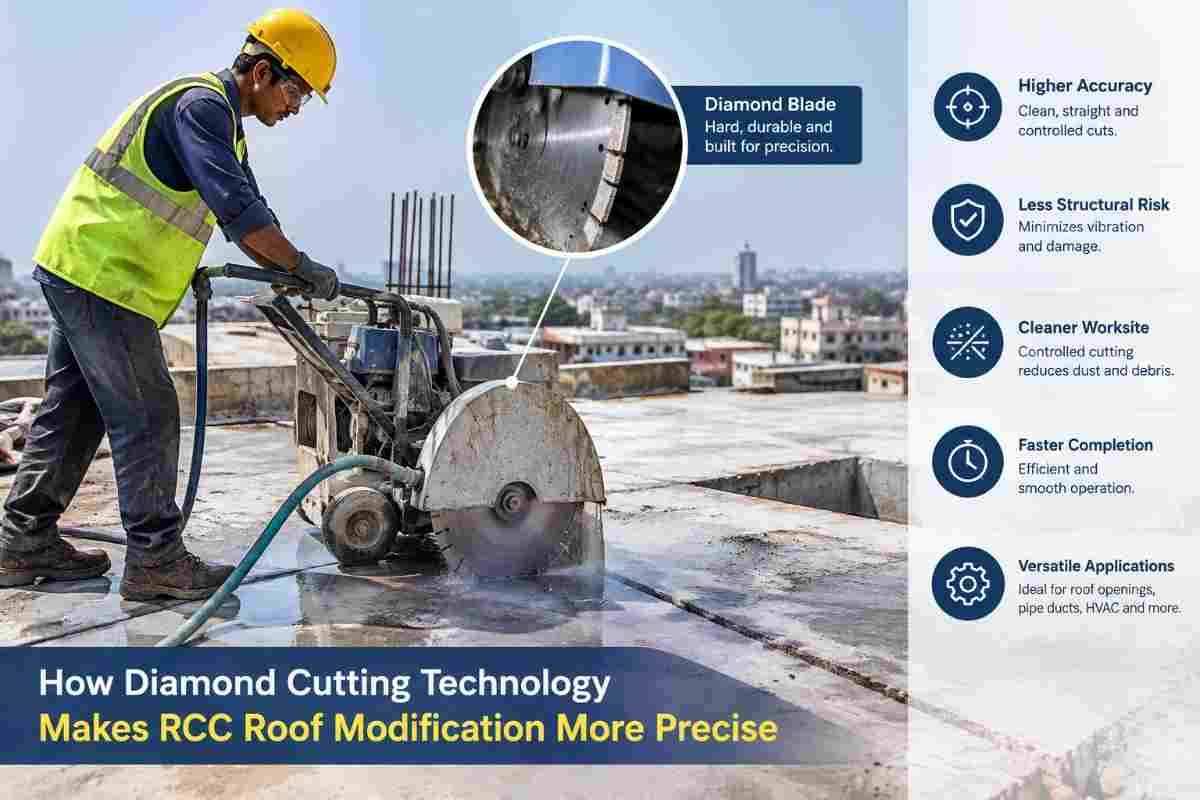
Reinforced cement concrete (RCC) is the backbone of most Indian buildings. It is strong and durable, which is exactly why it is so hard to modify. Adding a staircase opening, installing a skylight, creating space for a lift, or reworking a terrace used to mean weeks of dust, noise, and risk to the structure. Today, diamond cutting technology has changed that.
At Core Cutting India, we see this shift every day. Property owners, builders, and engineers no longer have to choose between modifying a roof and protecting the building. This article explains how diamond cutting makes RCC roof modification more precise, safer, and cleaner than conventional demolition.
Why RCC Roof Modification Demands Precision
An RCC roof is not just a block of concrete. It is an engineered system of concrete, steel reinforcement, beams, and load paths. Each part carries weight and transfers it to columns and foundations. Cut in the wrong place, or cut carelessly, and you risk:
- Cracks spreading beyond the intended opening
- Damage to adjacent beams, columns, or slabs
- Cutting through reinforcement that carries structural load
- Water leakage from poorly finished edges
- Costly repair work afterward
Traditional methods such as jackhammers, pneumatic breakers, and manual chiselling rely on impact. Impact sends shock waves through the whole structure, and the result is often rough edges, microcracks, and unpredictable breakage. Precision is difficult to achieve when the tool is essentially smashing concrete apart.
What Is Diamond Cutting Technology?
Diamond cutting uses tools embedded with industrial diamond segments to grind through concrete and steel. Diamond is the hardest known material, so it cuts through materials that would quickly wear down ordinary blades.
Instead of breaking concrete with force, diamond tools abrade it. Tiny diamond particles on a rotating blade, wire, or drill bit grind the material away in a controlled path. Water is usually used to cool the tool, suppress dust, and flush out slurry.
The result is a clean, straight, predictable cut, with the slab left essentially undisturbed on either side of the cut line.
Types of Diamond Cutting Used in RCC Roof Work
Different roof modifications call for different tools. A skilled contractor selects the method based on slab thickness, access, and the shape of the opening.
1. Slab Saw (Floor Saw) Cutting
A slab saw is a walk-behind machine with a large diamond blade. It is well suited to cutting straight lines in flat roofs and terraces, such as expansion joints or rectangular openings. It offers excellent depth control and straight edges.
2. Wall Saw Cutting
A wall saw is mounted on a rail system fixed to the slab or wall. It can cut thick RCC sections with exceptional accuracy and is often used for large openings, deep cuts, and sections that must be removed in manageable blocks.
3. Diamond Wire Saw Cutting
For very thick, heavy, or awkward structures, a diamond wire saw is the answer. A loop of wire strung with diamond beads is pulled through the concrete. It can cut sections of almost any size or shape, including places a circular blade cannot reach.
4. Core Drilling
Core drilling uses hollow cylindrical diamond bits to create round holes in the roof. These are used for plumbing, ducting, cabling, drainage, and anchor points. Core drilling also helps define corners in larger openings, so cuts finish cleanly without overcutting.
5. Hand Saw / Ring Saw Cutting
For tight spaces and small adjustments, handheld ring saws and cut-off saws with diamond blades offer flexibility without heavy machinery.
How Diamond Cutting Delivers Precision
Precision is not a single feature. It comes from several advantages working together.
Controlled, Predictable Cut Lines
Before cutting begins, the opening is marked according to the structural drawings. Because the diamond tool follows a guided path, either along a rail or a fixed frame, the cut matches the marked line closely. Edges are straight and corners are accurate. There is no guesswork about where the concrete will fracture.
Minimal Vibration
This is perhaps the biggest difference. Impact tools send vibrations through the structure, which can loosen the bond between concrete and steel or crack nearby elements. Diamond cutting is a grinding process with very little vibration. Neighbouring slabs, beams, finishes, and even sensitive equipment in the building stay protected.
Clean Edges and Smooth Finish
Diamond-cut edges are smooth and ready for the next stage, whether that is framing, waterproofing, or finishing. Broken edges, by contrast, require extensive patching and rework. A clean edge also bonds better with new concrete, sealants, and structural additions.
Accurate Depth Control
Slab saws and wall saws allow cutting to a specific depth. This matters when you need to cut only through the slab and not into an underlying beam, or when you are creating a recess or a groove. Operators can adjust and monitor depth throughout the job.
Ability to Cut Through Reinforcement
Because diamond tools cut through concrete and embedded steel together, the reinforcement is severed cleanly without tearing or bending. This avoids the damage that breakers can do when they strike rebar and pull it out of the surrounding concrete.
Flexibility in Shape and Size
Rectangular openings, circular holes, angled cuts, and complex profiles are all possible. Designers can plan modifications with confidence because the cutting method can follow the design rather than force the design to fit the method.
Benefits Over Traditional Demolition Methods
Precision leads to practical benefits that property owners notice immediately.
Structural safety. With less vibration and a controlled cut, the surrounding structure is far less stressed. Engineers can design modifications knowing that the rest of the roof will remain intact.
Less noise. Diamond cutting is considerably quieter than hammering and breaking. This is a major advantage in residential buildings, hospitals, offices, schools, and any occupied property.
Reduced dust. Wet cutting captures most of the dust at the source. That means a cleaner site and better air quality for workers and occupants.
Faster completion. Cutting is efficient, and because edges need little rework, the overall project timeline often shortens. Large sections can be cut into blocks and lifted away in one go.
Lower repair cost. Since neighbouring areas are left undamaged, there is little patching, plastering, or re-concreting to do afterward.
Less debris. Removed sections come out as clean blocks rather than rubble, making disposal simpler.
Common Applications in RCC Roof Modification
Diamond cutting supports a wide range of roof and slab projects:
- Staircase openings to access a terrace or add a new floor
- Lift shaft openings in existing buildings
- Skylights and ventilation openings to bring in light and air
- Water tank and drainage openings
- Duct, pipe, and cable passages for HVAC, plumbing, and electrical work
- Terrace modifications and redesign
- Removal of damaged or unsafe slab portions
- Expansion joints and relief cuts to control cracking
- Rooftop solar and equipment installation requiring anchor or cable holes
Each of these benefits from clean, accurate cuts that respect the existing structure.
The Typical Process of Diamond Cutting an RCC Roof
A professional job follows a structured approach.
1. Site inspection and assessment. The team studies the roof, slab thickness, reinforcement layout, access, and surrounding conditions. Scanning tools may be used to locate rebar, conduits, and post-tensioned cables before any cutting starts.
2. Structural review. A structural engineer should confirm that the opening is safe and whether any strengthening, such as additional beams or support, is needed.
3. Marking and planning. The cut lines are marked precisely, and the sequence of cuts is planned, including how sections will be supported and removed.
4. Setup and safety measures. Machines are positioned and secured, water supply is arranged, and temporary supports or barricades are installed where needed.
5. Cutting. The diamond saw, wire, or drill cuts along the marked lines. Corners may be core-drilled first to prevent overcutting.
6. Section removal. Cut sections are lifted out using appropriate lifting equipment, or broken down into smaller pieces if required.
7. Cleaning and finishing. Slurry is cleaned, edges are inspected, and the opening is prepared for the next stage of construction.
Safety and Structural Considerations
Precision tools do not replace good planning. Anyone considering roof modification should keep a few points in mind.
- Always involve a structural engineer. Removing part of a slab changes how loads travel through the building. Beams, trimmers, or supports may be required around the new opening.
- Locate hidden elements. Electrical conduits, water lines, and tension cables can be hidden within the slab. Scanning before cutting prevents accidents.
- Plan for support and lifting. Cut blocks can weigh several hundred kilograms or more. Proper lifting and temporary support are essential.
- Use trained operators. Diamond cutting equipment is powerful. Skilled operators ensure both accuracy and safety.
- Follow local building regulations. Structural modifications may require approvals depending on your location and the type of building.
Choosing the Right Diamond Cutting Contractor
The technology is only as good as the team using it. When selecting a contractor for RCC roof modification, look for:
- Experience with RCC roofs and structural work, not just general concrete cutting
- A range of equipment, including slab saws, wall saws, wire saws, and core drills
- Trained operators and a clear safety record
- Willingness to coordinate with your structural engineer
- Transparent pricing and a clearly defined scope of work
- Positive references from past projects
Core Cutting India provides professional concrete cutting services with modern diamond equipment and an engineer-friendly approach, helping clients get precise results without compromising the building.
Frequently Asked Questions
What is diamond cutting in RCC?
Diamond cutting is a method of cutting reinforced concrete using tools embedded with industrial diamond segments. It grinds through concrete and steel along a controlled path, producing clean cuts with very little vibration or damage to the surrounding structure.
Is diamond cutting safe for RCC roofs?
Yes, when done correctly. Because diamond cutting produces minimal vibration, it is much gentler on the structure than hammering or breaking. Safety still depends on proper planning, structural assessment, and trained operators.
Can you cut an opening in an RCC slab without weakening the building?
An opening changes how loads are carried, but a properly designed opening, with reinforcement or supporting beams where required, can be made safely. A structural engineer should approve the design before cutting begins.
How thick a slab can diamond cutting handle?
Diamond wall saws and wire saws can cut through very thick concrete sections, well beyond typical roof slab thicknesses. The right method depends on thickness, access, and the shape of the cut.
Is diamond cutting better than traditional demolition?
For modification work, generally yes. It offers better accuracy, lower noise, less dust, minimal vibration, and cleaner edges. Traditional breaking may still be used for complete demolition where precision is not a concern.
How much does RCC roof cutting cost?
Cost depends on slab thickness, the size and shape of the opening, reinforcement density, access, location, and the cutting method used. A site visit is the most reliable way to get an accurate quote.
How long does it take to cut an opening in an RCC roof?
Small openings can often be completed within a day, while larger or more complex modifications may take longer. Planning, supports, and removal of cut sections also affect the timeline.
Does diamond cutting create a lot of dust?
Wet diamond cutting keeps dust low because water suppresses it at the source. The slurry produced is collected and cleaned up, leaving a much cleaner worksite than dry breaking methods.
Conclusion
RCC roof modification no longer needs to be a messy, risky, and unpredictable process. Diamond cutting technology brings accuracy, control, and respect for the existing structure. It offers clean cut lines, minimal vibration, precise depth control, and the flexibility to handle everything from small core holes to large staircase and lift openings.
Combined with proper structural planning and an experienced team, diamond cutting turns a difficult task into a controlled, efficient one. If you are planning an opening, extension, or alteration in your RCC roof, working with a specialist is the surest way to protect your building and get the result you designed.
To discuss your project, visit Core Cutting India and speak with a team that understands both the technology and the structure.