
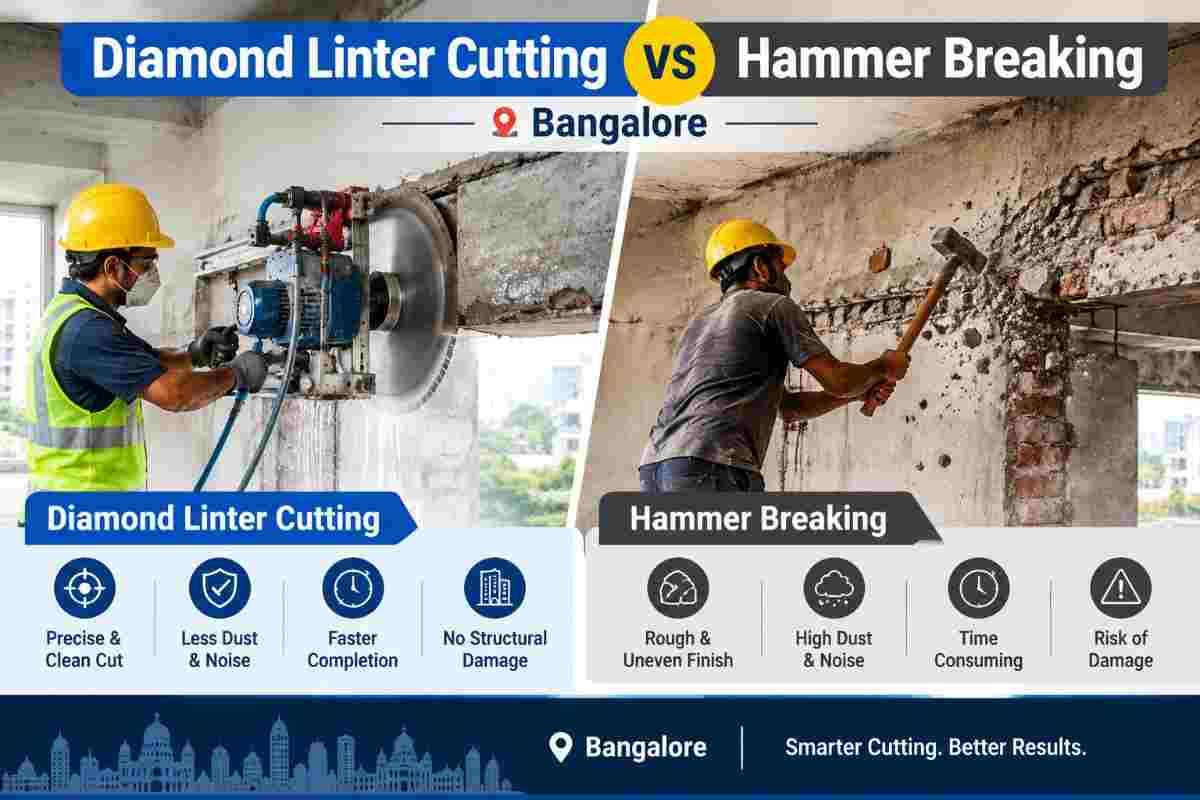
If you are renovating a flat in Whitefield, expanding a commercial space on MG Road, or modifying an industrial unit in Peenya, sooner or later you face the same question: how do we open up this concrete? For decades, the default answer in Bangalore was simple. Call a labour crew, bring a jackhammer and start breaking. Today there is a better option, and it is changing how builders, interior designers and facility managers approach modifications.
That option is diamond cutting, often searched as "diamond linter cutting". It uses diamond-embedded blades, wires and core bits to slice through reinforced concrete cleanly instead of smashing it apart.
In this guide from Core Cutting India, we compare diamond cutting and hammer breaking across the factors that matter most: precision, cost, noise, dust, safety, speed and structural impact. By the end you will know which method suits your project and when each one makes sense.
What Is Diamond Cutting?
Diamond cutting is a precision method of cutting concrete, brick, stone, asphalt and reinforced cement concrete (RCC) using tools fitted with industrial diamond segments. Diamond is the hardest known material, so these tools grind through aggregate and steel reinforcement rather than hammering them apart.
Common diamond cutting techniques include:
- Core cutting (core drilling): A hollow cylindrical bit cuts perfectly round holes, typically from 25 mm to several hundred millimetres, for pipes, ducts, cables and drains.
- Wall sawing: A track-mounted saw cuts openings for doors, windows, lift shafts and ventilation in walls.
- Slab sawing (floor sawing): A walk-behind saw cuts straight lines in floors, roads and pavements.
- Wire sawing: A diamond wire loop cuts very thick, large or awkwardly shaped structures such as columns, beams and foundations.
- Hand saw cutting: Handheld saws make smaller, accessible cuts.
Each technique produces a clean, straight edge with minimal vibration, and each can be controlled to within a few millimetres.
What Is Hammer Breaking?
Hammer breaking, also called manual or mechanical breaking, uses jackhammers, pneumatic breakers or hydraulic hammers to fracture concrete through repeated impact. Labourers or machine operators strike the surface until it cracks and falls away, after which exposed steel bars are cut with gas or grinders.
Hammer breaking is the traditional approach and still has a place in full-scale demolition. It requires little specialised equipment, so it often looks cheaper at first glance. The trouble is what comes with it: intense vibration, heavy noise, flying debris and uncontrolled cracking that extends beyond the area you intended to open.
Diamond Cutting vs Hammer Breaking: Head-to-Head Comparison
1. Precision and Finish Quality
This is where diamond cutting wins decisively. A diamond blade follows a marked line, leaving smooth, straight edges that need little or no finishing. If you need a 900 mm door opening in a load-bearing wall or a perfectly round 150 mm hole for a drainage pipe, diamond cutting delivers exactly that.
Hammer breaking is imprecise by nature. Impact energy travels through the concrete in unpredictable directions, creating jagged edges and oversized openings. You then spend extra time and money patching, plastering and levelling. In interior projects where finish matters, those repair costs quickly erase the apparent savings.
2. Structural Safety and Vibration
Every hammer blow sends shock waves through the structure. In an old Bangalore building, or in a multi-storey apartment where you are modifying one wall, this vibration can create micro-cracks in neighbouring walls, loosen tiles, damage plumbing and even affect beams and columns.
Diamond cutting is a low-vibration process. The blade removes material by abrasion rather than impact, so the surrounding structure stays largely undisturbed. This is why structural engineers routinely specify diamond cutting for modifications in occupied or load-bearing structures, hospitals, data centres and heritage buildings.
3. Noise Levels
Bangalore's residential and commercial areas are increasingly sensitive to construction noise, and many apartment associations and office parks restrict working hours. A jackhammer is among the loudest tools on any site and is a regular source of neighbour complaints.
Diamond cutting, especially wet cutting, is considerably quieter. For work in occupied homes, offices, hospitals, schools and malls, this difference can decide whether a project can proceed during working hours at all.
4. Dust and Debris
Breaking concrete creates large volumes of dust and rubble, along with silica particles that are harmful when inhaled over time. Cleanup can take longer than the demolition itself.
Wet diamond cutting uses water to cool the blade and capture dust at the source, leaving a much cleaner work area. The removed section also comes out as a controlled block or slug that is easy to lift and remove, rather than a pile of broken fragments.
5. Worker and Occupant Safety
Hammer breaking exposes workers to hand-arm vibration, flying chips, noise and silica dust. Over time these cause serious health problems, which is a growing concern for contractors who care about their teams.
Diamond cutting is mechanised and controlled. Operators work at a distance from the cutting point with proper guards and protective gear, making the process safer for the crew and for occupants nearby.
6. Speed and Efficiency
It is a common misconception that hammer breaking is faster. For a small opening in thin concrete it may seem quick, but once you add steel cutting, debris removal, cleanup and repair work, the total timeline stretches.
Diamond cutting handles concrete and rebar in one pass, produces a finished edge and requires little rework. For thick RCC walls, slabs and columns, a diamond saw or wire saw usually completes the job in a fraction of the time. Faster completion also means less disruption to the people using the space.
7. Cost: Upfront vs Total
Here is where many clients get it wrong. Hammer breaking usually quotes lower on paper because labour is cheap and equipment is simple. Diamond cutting involves specialised machinery, trained operators and consumable diamond tools, so the per-metre or per-hole rate is higher.
But total project cost tells a different story. With hammer breaking you may pay for:
- Patching and plastering oversized openings
- Repairing cracks in adjacent walls and floors
- Replacing damaged tiles, pipes or fixtures
- Debris removal and deep cleaning
- Delays caused by noise complaints or society restrictions
- Structural assessment if damage is suspected
When these are counted, diamond cutting is often cheaper overall, particularly in finished interiors, occupied buildings and structural work. Hammer breaking remains economical mainly for large-scale demolition where precision is irrelevant.
8. Reinforcement Steel Handling
RCC is concrete reinforced with steel bars. A hammer breaks the concrete around the bars, leaving them exposed and bent, which then need separate cutting. Diamond tools cut through concrete and rebar together, leaving neat cut ends that are easy to treat or connect with structural repair methods.
9. Suitability for Thick and Heavy Structures
Wall saws and wire saws can cut concrete several hundred millimetres or even metres thick. Hammering through that much material is slow, exhausting and risky. Wire sawing in particular can remove entire columns, bridge sections or machine foundations in manageable pieces without damaging what remains.
Quick Comparison Table
|
Factor |
Diamond Cutting |
Hammer Breaking |
|---|---|---|
|
Precision |
Very high, clean straight edges |
Low, jagged edges |
|
Vibration |
Minimal |
High |
|
Noise |
Low to moderate |
Very high |
|
Dust |
Low with wet cutting |
High |
|
Safety |
Controlled and safer |
Higher risk to workers and structure |
|
Speed on thick RCC |
Fast |
Slow |
|
Rework needed |
Minimal |
Significant |
|
Upfront cost |
Higher |
Lower |
|
Total project cost |
Often lower |
Often higher |
|
Best for |
Precise openings, interiors, structural work |
Full demolition, non-critical areas |
When Should You Choose Diamond Cutting in Bangalore?
Diamond cutting is the right choice when:
- You need openings for doors, windows, staircases or lift shafts in existing walls or slabs.
- You are installing plumbing, HVAC, electrical or fire-safety lines that need clean core holes.
- You are working in occupied buildings such as apartments, offices, hospitals, schools or malls.
- The structure is old or sensitive, or the building is structurally critical.
- Noise, dust and vibration must be strictly controlled.
- You need accurate dimensions to fit frames, ducts or equipment.
- You are cutting thick or heavily reinforced concrete.
- You are doing road, bridge, flyover or pavement work where clean joints matter.
- You want to reduce rework and finishing costs.
When Does Hammer Breaking Still Make Sense?
To be fair, hammer breaking is not obsolete. It can be the practical choice when:
- You are completely demolishing a structure and precision does not matter.
- You are breaking thin, non-structural slabs in an empty site.
- The budget is extremely tight and the surrounding areas are not sensitive.
- Access is so limited that large cutting equipment cannot be positioned.
Even then, many contractors combine both: they use diamond cutting to isolate and separate sections cleanly, then use breakers only on the sections that are being discarded. This hybrid approach protects the parts of the structure that stay while keeping costs reasonable.
Why Bangalore Projects Benefit Most from Diamond Cutting
Bangalore's construction landscape has some particular characteristics that make diamond cutting especially valuable.
Dense residential communities. Gated societies and apartment complexes have strict rules on noise and working hours. Quiet, low-vibration cutting helps contractors stay within them and avoids disputes with neighbours.
Booming interior and fit-out work. From IT parks in Electronic City and Bellandur to retail outlets in Indiranagar and Koramangala, offices and showrooms are constantly being redesigned. Clean openings and core holes are needed for new cabling, HVAC and plumbing.
Aging buildings in older neighbourhoods. Areas like Jayanagar, Malleshwaram and Basavanagudi have older structures where heavy vibration can do real harm.
Infrastructure growth. Metro expansion, road widening and flyover works demand accurate, controlled cutting of concrete pavements and structures.
Industrial and warehouse expansion. Facilities in Peenya, Hoskote and Nelamangala often need machine foundation modifications and floor cutting that wire and slab saws handle efficiently.
Common Applications of Diamond Cutting
Here are the services most frequently requested by Bangalore clients:
- Core cutting for pipes and ducts: Round holes for water supply, drainage, AC refrigerant lines, cable trays and sleeves.
- RCC wall cutting: New doorways, window openings, ventilation cut-outs and partition changes.
- Slab cutting: Openings for staircases, lifts, shafts and utility penetrations.
- Floor and road sawing: Expansion joints, trenching and pavement repairs.
- Column and beam cutting: Structural modifications done with engineering supervision.
- Wire sawing: Massive foundations, bridge elements and tight-access demolition.
- Brick and stone cutting: Clean openings in masonry walls and heritage structures.
How to Choose the Right Concrete Cutting Contractor in Bangalore
The method matters, but so does the team. Before you hire, check these points:
- Experience: Look for a contractor with a long record in RCC cutting, core drilling and wire sawing.
- Equipment quality: Modern machines and quality diamond tooling give cleaner cuts and fewer delays.
- Trained operators: Skilled technicians understand rebar layouts, load paths and safe cutting sequences.
- Safety practices: Ask about protective gear, dust control and site protocols.
- Scanning and marking: Good contractors detect embedded conduits and rebar before cutting to avoid damage.
- Transparent pricing: Insist on clear quotes per hole, per metre or per job, with no hidden charges.
- Client references: Past work in similar buildings is a strong signal of reliability.
- Structural advice: A good team will tell you when an engineer's approval is needed.
At Core Cutting India, the focus is on precise, low-vibration concrete cutting for homes, offices, commercial buildings and industrial sites, so that your project stays on schedule and your structure stays sound.
Tips to Get the Most from Diamond Cutting
- Share drawings early. Structural and MEP plans help the team avoid hidden hazards.
- Mark your openings clearly. Confirm sizes before cutting begins, since cut concrete cannot be put back.
- Plan for water. Wet cutting needs a water supply and a way to manage slurry.
- Clear the area. Move furniture and protect floors and fixtures nearby.
- Get structural approval. For load-bearing walls, columns and beams, involve a qualified structural engineer.
- Schedule smartly. Quiet cutting allows work during normal hours, but check society or building rules anyway.
Frequently Asked Questions
Is diamond cutting better than hammer breaking?
For most renovation, modification and structural projects, yes. It is more precise, quieter, safer and cleaner, and it protects the rest of the structure. Hammer breaking suits full demolition where finish and vibration do not matter.
Is diamond cutting expensive in Bangalore?
The per-unit rate is higher than hammer breaking, but the total cost is frequently lower once you factor in reduced repairs, less cleanup and faster completion.
Can diamond cutting be done in an occupied building?
Yes. Because it produces low vibration, less dust and moderate noise, it is the preferred method for apartments, offices, hospitals and malls.
Can diamond tools cut through steel reinforcement?
Yes. Diamond blades and core bits cut through concrete and the embedded rebar in a single operation.
How thick a concrete wall can be cut?
Wall saws handle substantial thickness, and wire saws can cut sections that are metres thick, depending on the job and machine used.
Does cutting weaken the structure?
Cutting load-bearing elements can affect structural capacity if done without proper planning. Always consult a structural engineer before cutting walls, beams, columns or slabs, and use proper reinforcement or support where required.
Is hammer breaking safe for old buildings?
Generally no. Vibration can cause hidden cracks and damage to adjacent elements. Diamond cutting is far safer for older structures.
How long does a core cutting job take?
A typical core hole in standard concrete can be completed in minutes, depending on diameter and depth. Larger wall and slab cuts take hours to a few days based on scale.
Final Verdict: Cut Smart, Not Hard
The debate between diamond cutting and hammer breaking is really a question of priorities. If your only goal is to bring a structure down as cheaply as possible, hammer breaking has its place. But for nearly every modification, renovation, installation and precision job in Bangalore, diamond cutting is the better investment. It gives you accurate openings, protects the surrounding structure, reduces noise and dust, keeps your crew safer and cuts the cost of rework.
As Bangalore keeps growing upward and outward, with more occupied buildings, tighter regulations and higher quality expectations, the case for clean, controlled concrete cutting only gets stronger.
Get a Free Quote from Core Cutting India
Planning a project that involves cutting walls, slabs, floors or columns, or drilling core holes for pipes and ducts? Visit https://corecuttingindia.com/ to explore services and request a quote. Share your drawings, dimensions and location, and the team will recommend the right method, tools and timeline for your site.
Cut it clean. Cut it right. Choose diamond cutting.