
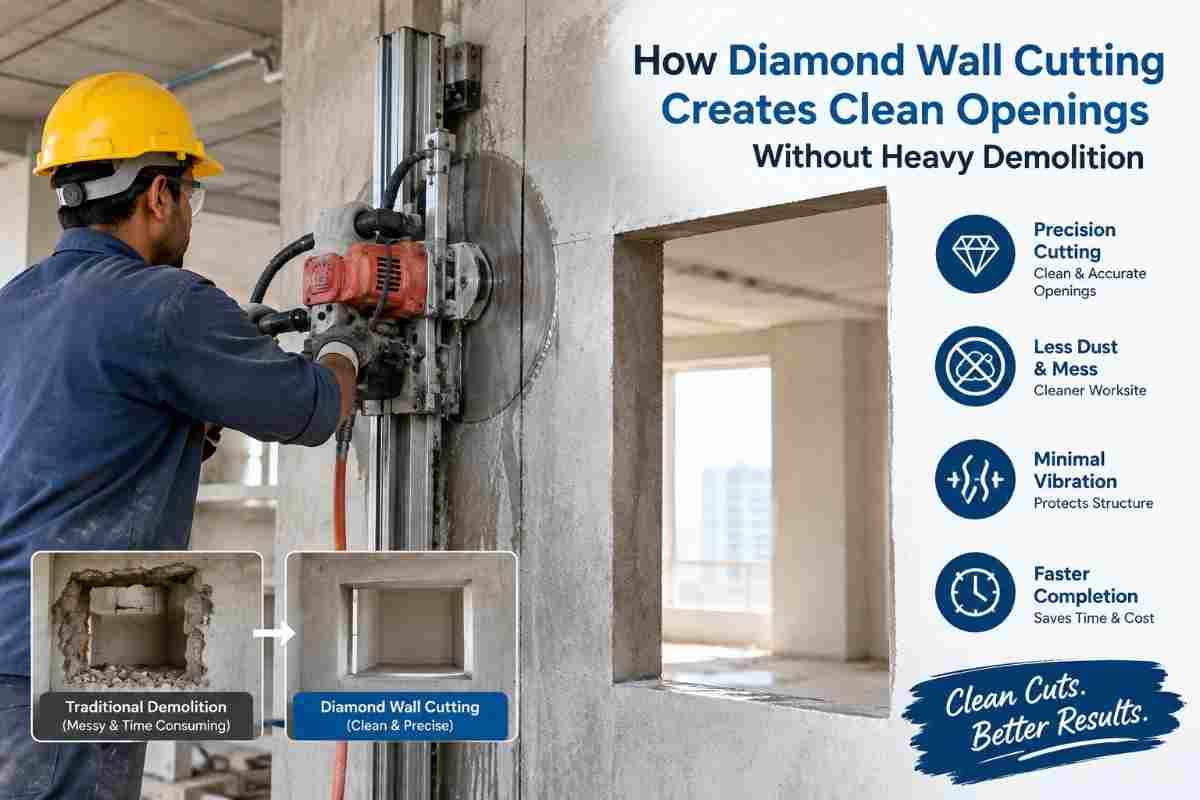
Every renovation or retrofit project eventually hits the same obstacle: a solid concrete wall that needs a new door, window, duct passage, or staircase void. For decades, the default answer was demolition with jackhammers, breakers, and brute force. The result was cracked surfaces, damaged reinforcement, flying debris, and a site coated in dust.
Today there is a far better way. Diamond wall cutting removes exactly the section you need and leaves the rest of the structure undisturbed. At Core Cutting India, this precision method is the foundation of how we help builders, architects, and facility owners modify concrete safely and cleanly.
This guide explains how diamond wall cutting works, why it avoids heavy demolition, where it is used, and how to decide whether it suits your project.
What Is Diamond Wall Cutting?
Diamond wall cutting is a controlled method of cutting through reinforced concrete, brick, stone, and masonry using tools embedded with industrial diamond segments. Because diamond is the hardest known material, it can grind through steel rebar and aggregate that would quickly destroy ordinary blades.
The process uses a wall saw, a track-mounted machine fitted with a circular diamond blade. The saw is fixed to the wall and moves along a rigid rail, cutting a straight line to a precise depth. Water continuously cools the blade and flushes away slurry, which keeps dust to a minimum.
Unlike percussive demolition, which breaks concrete through impact and shock, diamond cutting works by abrasion. The blade grinds a narrow, clean groove rather than shattering the material. That difference is why the surrounding structure stays intact.
Why Traditional Demolition Causes So Many Problems
To appreciate diamond cutting, it helps to see what it replaces. Conventional breaking has several drawbacks.
Uncontrolled cracking. Hammering transmits shock through the whole wall. Micro-cracks can travel well beyond the intended opening and weaken the structure.
Rough, irregular edges. Broken edges need heavy patching, plastering, or reshaping before frames can be fitted.
Vibration damage. Impact tools shake the building. In occupied properties, hospitals, offices, and heritage structures, this can disturb neighbours, damage finishes, and affect sensitive equipment.
Noise and dust. Jackhammering is loud and generates large amounts of airborne silica dust, a recognised health hazard for workers and occupants.
Higher cleanup and rework costs. Debris is scattered and irregular, and corrective finishing work adds time and money.
Diamond wall cutting addresses nearly all of these issues at once.
How Diamond Wall Cutting Works, Step by Step
A successful cut depends on planning as much as equipment. Here is the typical workflow.
1. Site Survey and Marking
Engineers inspect the wall, confirm its thickness and structural role, and mark the exact opening dimensions. Before any cutting, they scan for embedded electrical conduits, plumbing, and reinforcement so nothing critical is hit.
2. Structural Assessment
If the wall is load-bearing, a structural engineer determines whether temporary supports, props, or lintels are needed. Cutting a load-bearing wall without proper planning is dangerous, so this step is non-negotiable.
3. Rig Setup
The wall saw’s track is anchored securely to the wall surface. Accurate alignment here ensures the finished cut is perfectly straight and square.
4. Corner Relief Drilling
Many contractors drill core holes at the corners of the opening first. These holes give a clean corner radius, let the blade overcut safely, and make removal of the cut panel easier.
5. Cutting
The saw runs along the track, making the horizontal and vertical cuts. The water supply keeps the blade cool, extends its life, and captures dust as slurry. Depth is increased gradually in passes until the blade goes through.
6. Safe Removal of the Concrete Block
Since the cut piece is fully separated, it can be lifted out whole, or cut into smaller sections first for easier handling. Slabs of several tonnes may be removed with cranes, chain pulley blocks, or hydraulic equipment depending on access.
7. Slurry Management and Cleanup
The water and concrete slurry is collected and cleared, leaving a tidy work area ready for the next trade.
Key Benefits of Diamond Wall Cutting
Precision You Can Measure
Diamond cutting produces openings accurate to a few millimetres. Straight edges and sharp corners mean door and window frames fit with minimal finishing. This precision is valuable in projects where tolerances matter, such as machinery installations and elevator shafts.
Minimal Vibration and Structural Stress
Because the blade grinds instead of hammers, vibration is dramatically lower. The surrounding wall, adjacent rooms, and sensitive equipment remain undisturbed. This is why diamond cutting is preferred in hospitals, data centres, laboratories, and occupied buildings.
Cleaner, Safer Worksites
Water-fed cutting suppresses airborne dust, protecting workers from silica exposure and keeping surrounding areas cleaner. Lower noise levels also make it possible to work in tenanted or operational buildings with minimal disruption.
Cutting Through Reinforced Concrete
Heavily reinforced walls with thick steel bars are no obstacle. Diamond blades cut through concrete and rebar together in a single operation, something conventional tools struggle to do efficiently.
Faster Project Timelines
Although the setup requires care, the cutting itself is quick and the finish needs little repair. Less patching, less debris removal, and fewer rework cycles mean the project moves forward sooner.
Preservation of Existing Structure
By removing only what is required, you protect the integrity of the remaining wall. This supports compliance with structural requirements and reduces the risk of costly repairs later.
Common Applications of Diamond Wall Cutting
Diamond wall cutting suits a wide range of residential, commercial, and industrial work:
- Door and window openings in existing concrete or brick walls
- Ventilation, HVAC, and duct penetrations through walls and slabs
- Staircase and lift shaft openings in floors and walls
- Utility passages for plumbing, cables, and pipes
- Partial wall removal to merge rooms or expand open-plan spaces
- Machinery relocation or installation requiring custom wall access
- Heritage and restoration work where gentle, controlled cutting is essential
- Bridge, tunnel, and industrial structure modification
In each case, the underlying goal is the same: make a precise change without harming everything around it.
Wall Saw Cutting vs. Core Drilling vs. Wire Sawing
Several diamond-based techniques exist, and the right one depends on the job.
| Method | Best For | Key Strength |
|---|---|---|
| Wall saw cutting | Large rectangular openings in walls and floors | Straight, deep, precise cuts |
| Core drilling | Round holes for pipes, anchors, and cables | Clean circular openings |
| Wire sawing | Very thick or irregular structures | Cuts almost unlimited thickness |
| Hand-held ring or slab saw | Smaller, shallow, or confined cuts | Flexibility in tight spots |
Experienced contractors often combine methods. For example, core drilling can relieve corners while a wall saw completes the straight cuts. At Core Cutting India, the method is chosen to suit the wall, access conditions, and project requirements, so clients get the cleanest result with the least disruption.
Is Diamond Wall Cutting Safe for Load-Bearing Walls?
This is one of the most frequent questions, and the honest answer is: it can be, with proper engineering.
The cutting method itself is gentle on the structure. However, a load-bearing wall carries weight from above, so removing a section changes how loads travel. Before cutting, a qualified structural engineer should evaluate the wall and, where needed, specify temporary shoring and a permanent lintel or frame to carry the load around the new opening.
Never treat a load-bearing wall like a partition. Planning, supports, and sequencing are what make the work safe. Diamond cutting simply gives you the controlled, damage-free cut that this careful approach requires.
Factors That Affect Diamond Wall Cutting Cost
Pricing varies from project to project. The main factors include:
- Wall thickness and material. Thicker or harder concrete takes longer to cut.
- Reinforcement density. More steel means more blade wear and slower progress.
- Cut length and depth. Total running metres of cutting directly influence cost.
- Access and height. Cutting at heights or in confined spaces requires extra equipment and effort.
- Debris handling. Heavy blocks may need cranes or special lifting arrangements.
- Site conditions. Water and power availability, working hours, and safety requirements all play a role.
Although diamond cutting may cost more per metre than rough breaking, the savings in rework, finishing, and downtime often make it the more economical choice overall.
How to Choose the Right Concrete Cutting Contractor
The quality of a diamond cut depends heavily on the team behind the machine. When selecting a provider, look for:
- Proven experience with similar wall types and project sizes.
- Modern, well-maintained equipment that delivers consistent results.
- Trained operators who understand structures, reinforcement, and safety.
- Clear safety practices, including dust control and protective procedures.
- Transparent quotations that explain scope, method, and timelines.
- Coordination with engineers on load-bearing and structural questions.
A reliable contractor surveys the site, explains the plan, and delivers a finished opening that is ready for the next stage of construction.
Practical Tips Before Your Project Begins
- Clarify the opening size and position early, and share drawings if available.
- Confirm the wall type (load-bearing, partition, shear wall) with an engineer.
- Arrange water and power access near the cutting area.
- Protect nearby furniture and finishes, even though dust is minimal.
- Plan debris removal and lifting routes for heavy cut sections.
- Inform occupants if work takes place in a live building.
A little preparation helps the cutting go quickly and smoothly.
Frequently Asked Questions
What is diamond wall cutting used for?
It is used to create openings for doors, windows, ducts, stairways, and utility passages in concrete, brick, and stone walls, with high precision and minimal damage to surrounding structure.
Is diamond wall cutting better than breaking a wall with a hammer?
For most projects, yes. It produces cleaner edges, much less vibration, lower noise, and less dust. This reduces repair work and protects the remaining structure.
Can diamond cutting go through reinforced concrete?
Yes. Diamond blades are designed to cut concrete and steel rebar together, which makes them ideal for heavily reinforced walls.
How thick a wall can be cut?
Wall saws handle substantial thicknesses, and wire saws can cut even thicker or more complex structures. The right method depends on the wall’s size and access.
Does diamond cutting create a lot of dust?
No. Water cooling captures most of the dust as slurry, making it far cleaner and healthier than dry demolition methods.
Is it safe to cut a load-bearing wall?
It can be done safely, but only after a structural engineer has assessed the wall and designed temporary supports and a permanent lintel or frame.
How long does a typical wall cutting job take?
Small openings can be completed in hours, while larger or more complex jobs may take a day or more. Timing depends on thickness, reinforcement, and site conditions.
How accurate is diamond wall cutting?
Very accurate. Tracked wall saws produce straight, square cuts within a few millimetres of the marked line.
Conclusion
Heavy demolition is no longer the only way to modify a concrete structure. Diamond wall cutting delivers clean, accurate, low-vibration openings while protecting the integrity of everything around them. It reduces dust and noise, saves time on finishing, and gives architects and builders the flexibility to reshape spaces with confidence.
Whether you are adding a doorway, opening a window, installing ducts, or creating a lift shaft, the right cutting method makes all the difference between a messy, risky job and a smooth, professional one.
If you are planning a renovation or structural modification, the team at Core Cutting India can help you choose the best approach and deliver precise results with minimal disruption. Visit https://corecuttingindia.com/ to discuss your project and request a consultation.