
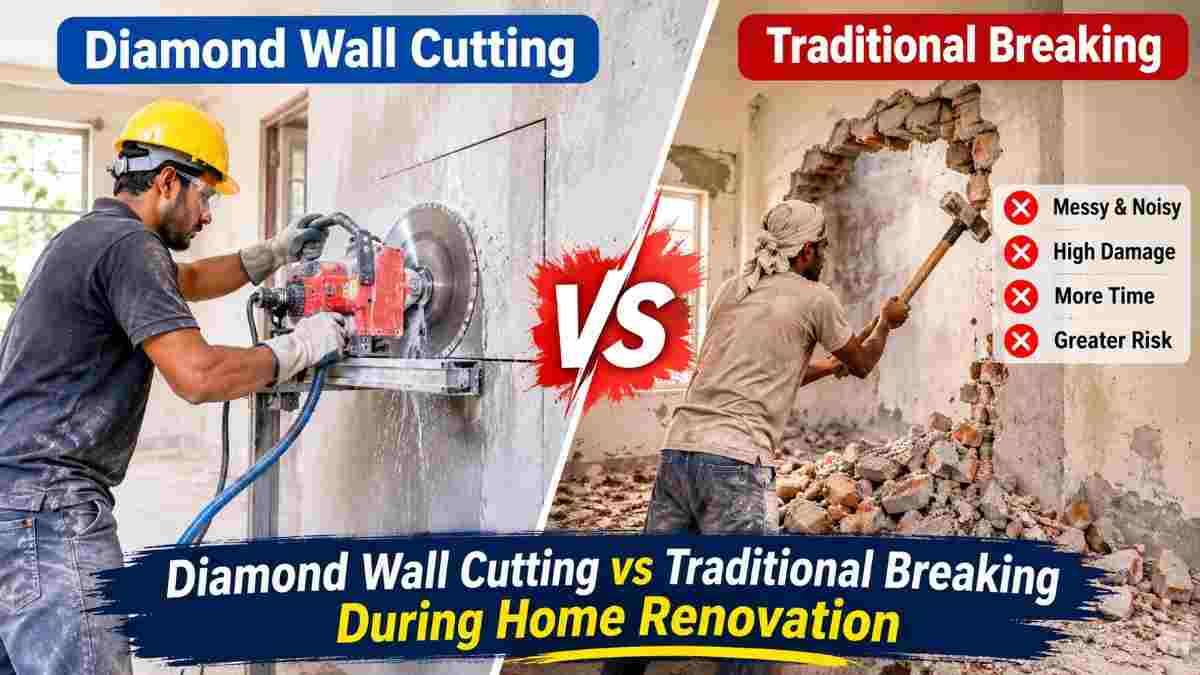
Every renovation starts with a wall. Maybe you want a wider doorway between the kitchen and living room, a new window for natural light, a staircase opening, or a space for a lift or AC duct. In the past, the answer was always the same: bring in labourers with hammers and breakers and knock the wall down.
Today there is a cleaner alternative. Diamond wall cutting uses specialised diamond-tipped blades and wires to slice through concrete, brick and stone with surgical accuracy. At Core Cutting India (https://corecuttingindia.com/), we have seen homeowners, architects and contractors move steadily away from old-school breaking, and for good reason.
In this guide, we compare diamond wall cutting and traditional breaking on the factors that matter most to a homeowner: precision, noise, dust, structural safety, speed, cost and cleanup. By the end, you will know which method suits your project.
What Is Traditional Wall Breaking?
Traditional breaking, often called manual or mechanical demolition, relies on impact force. Workers use sledgehammers, chisels, electric hammers or jackhammers (also called breakers) to smash through the wall piece by piece.
This method has been used for decades because it needs little specialised equipment and the upfront quote looks low. For a thin, non-structural brick partition that will be fully demolished anyway, it can still be a practical choice.
The trouble begins when the wall is reinforced concrete (RCC), when you only need a precise opening, or when the wall sits next to finished flooring, furniture or a neighbour’s flat. Impact demolition is blunt. It sends shock waves through the structure, and you cannot control where the cracks travel.
What Is Diamond Wall Cutting?
Diamond wall cutting is a precision method in which industrial diamond segments grind through concrete instead of smashing it. Depending on the job, technicians use:
- Wall saw cutting: A track-mounted circular diamond blade slices straight, clean lines through thick RCC walls and slabs.
- Wire saw cutting: A diamond-impregnated wire cuts large or awkwardly shaped sections.
- Hand saw / ring saw cutting: Handy for tight corners and smaller openings.
- Core cutting (drilling): Cylindrical diamond bits drill neat round holes for pipes, ducts, cables and drainage.
The result is a clean-edged opening that matches your drawing to the millimetre. Because the material is cut rather than shattered, the surrounding structure remains largely undisturbed.
Precision and Finish: Cutting Wins by a Mile
Precision is the biggest difference between the two methods.
With a hammer or breaker, edges end up jagged and uneven. Chunks break off beyond the marked line, so the opening is usually larger than planned. Masons then spend extra days patching, plastering and levelling.
Diamond cutting gives you straight, smooth, right-angled edges. A doorway, window or lift shaft opening comes out exactly where you marked it. Frames fit snugly, and finishing work such as plaster, tiling and cladding is faster and neater. For modern homes with modular kitchens, glass partitions and designer doorways, this accuracy is essential.
Noise Levels: A Quieter Renovation
Anyone who has lived through a breaker running next to the bedroom knows the misery. Impact demolition is extremely loud and creates constant, rattling vibration. In apartments and gated societies in Delhi NCR, Mumbai, Bengaluru and other cities, it often triggers neighbour complaints and resident welfare association (RWA) restrictions on working hours.
Diamond cutting produces a steady, much lower hum, and the vibration is minimal. It is not silent, but it is dramatically more tolerable. If you are renovating while living in the house, or you have children studying, elderly parents or a work-from-home setup, this matters a great deal.
Dust and Cleanup: Cleaner Sites, Less Stress
Breaking a concrete wall throws a cloud of dust and debris through the house. It settles in cupboards, on electronics and in lungs. Fine silica dust is a genuine health concern, and cleaning it up can take days.
Diamond wall cutting is typically a wet process. Water cools the blade and traps dust as slurry, so the air stays far cleaner. The wall is also removed as neat blocks or slabs rather than rubble, which makes disposal easier. You save on labour, cleaning costs and the repair of damaged belongings.
Structural Safety: Protecting Your Home
This is where the choice becomes serious. Repeated hammering sends vibrations through beams, columns and adjoining walls. In older buildings, it can cause hairline cracks, loosened plaster, damaged tiles, and in worst cases structural weakening.
Diamond cutting is controlled and localised. Because only the target area is cut, neighbouring walls, slabs and finished surfaces stay safe. It also allows cutting of load-bearing elements only under a structural engineer’s guidance, with proper propping and support.
A word of caution: never open or remove a load-bearing wall without a structural engineer’s approval, regardless of the method used. A reputable cutting contractor will ask for this, not skip it.
Speed and Efficiency
Many homeowners assume that smashing is faster. For thin brick partitions, it may be. For thick RCC walls, the picture reverses.
Breaking reinforced concrete is slow because the steel bars must be cut separately, and workers fatigue quickly. A diamond saw passes through concrete and rebar in a single operation, producing a clean cut in hours rather than days. Faster cutting also means fewer days of disruption, which can bring the whole renovation schedule forward.
Cost Comparison: Cheaper Now or Cheaper Overall?
Let us be honest. Traditional breaking often has a lower initial quote, because the equipment is simple. Diamond cutting involves costly machinery, consumable blades and trained operators, so the per-job rate is higher. Pricing for diamond work usually depends on wall thickness, material, access, the length of the cut and the site location, which is why a site visit gives the most accurate quote.
But the real cost of a renovation includes more than the demolition line item. Consider the hidden expenses of breaking:
- Extra plastering and finishing to fix rough edges
- Repair of cracks in adjacent walls and floors
- Cleanup and debris removal
- Damage to furniture, flooring and electronics
- Delays from neighbour disputes or society objections
- Longer labour hours
When you add these up, diamond cutting often works out equal or more economical for precise, medium to large jobs. For a small, throwaway partition, breaking may still be the cheaper path.
Side-by-Side Comparison
| Factor | Diamond Wall Cutting | Traditional Breaking |
|---|---|---|
| Precision | Very high, clean edges | Low, rough edges |
| Noise | Low to moderate | Very high |
| Vibration | Minimal | Heavy |
| Dust | Controlled (wet cutting) | Heavy, uncontrolled |
| Structural risk | Low with proper planning | Higher, cracks possible |
| Speed on RCC | Fast | Slow |
| Cleanup | Easy, neat blocks | Messy rubble |
| Upfront cost | Higher | Lower |
| Total project cost | Often comparable or lower | Can rise with repairs |
| Best for | Doors, windows, openings, RCC | Full demolition, thin partitions |
When Should You Choose Diamond Wall Cutting?
Diamond cutting is the smarter choice when:
- You are making a door, window, ventilation or staircase opening in an existing wall
- The wall is RCC, reinforced or very thick
- You live in an apartment or society with strict noise and working-hour rules
- You are renovating while staying in the house
- Neighbouring walls, floors or finishes must stay intact
- You need pipe, AC, duct or cable holes (core cutting)
- The building is old and vibration could damage it
- You want a neat finish with minimal rework
When Is Traditional Breaking Still Acceptable?
Fairness matters, so here is when breaking still makes sense:
- You are demolishing an entire thin brick partition with no need for neat edges
- The space is empty and unoccupied
- The budget is very tight and the finish is not critical
- The wall is non-structural and no sensitive surroundings are nearby
Even then, many homeowners find that a hybrid approach works best: diamond cutting for precision edges, followed by light breaking of the removed section.
Environmental and Health Benefits
Diamond cutting also scores better on health and sustainability. Reduced dust protects your family’s lungs. Lower noise protects hearing and sanity. Cutting out large sections generates less fine debris, and sections can sometimes be reused or disposed of more responsibly. Wet-cut slurry is managed on site, so far less airborne pollution leaves the work area.
Tips Before You Hire a Wall Cutting Contractor
- Get a structural opinion if the wall could be load-bearing.
- Ask for a site visit so the quote reflects actual thickness and access.
- Check the equipment: modern wall saws, wire saws and core drills signal a serious operator.
- Confirm water and power requirements in advance.
- Look for trained, experienced operators and ask about safety practices.
- Verify the scope: clarify whether debris removal and cleaning are included.
- Inform neighbours and your society about the work schedule.
Frequently Asked Questions (People Also Ask)
What is the difference between diamond wall cutting and traditional breaking?
Diamond cutting grinds through concrete with a diamond blade or wire for clean, accurate openings. Traditional breaking smashes the wall with hammers or breakers, which is louder, dustier and less precise.
Is diamond wall cutting better than breaking a wall?
For most renovation work involving RCC walls, precise openings or occupied homes, yes. It is cleaner, quieter and safer for the structure. For simple, thin partitions, breaking can still do the job.
Is diamond wall cutting expensive?
The upfront rate is usually higher than breaking, but you save on repairs, finishing and cleanup. The final cost depends on thickness, length of cut, access and location.
Can you cut a load-bearing wall with a diamond saw?
Technically yes, but only with a structural engineer’s approval and proper support. Never cut a load-bearing wall without professional assessment.
Does diamond wall cutting create dust?
Very little. Wet cutting traps most dust as slurry, making it far cleaner than hammering.
How long does it take to cut a concrete wall?
A standard door or window opening can often be completed within hours to a day, depending on thickness and reinforcement.
Can diamond cutting be done in an apartment?
Yes. Because of lower noise, minimal vibration and less dust, it is the preferred method in apartments and societies.
Will cutting a wall cause cracks?
Cracks are far less likely than with breaking, because the process creates little impact vibration.
What is core cutting used for?
Core cutting creates neat round holes in concrete for plumbing, drainage, AC pipes, ducts, cables and anchor bolts.
Final Verdict
If your renovation involves a precise opening, thick or reinforced concrete, or a home that people are living in, diamond wall cutting is the clear winner. It delivers cleaner edges, lower noise and dust, greater structural safety and a faster finish. Traditional breaking still has a place for simple, full-demolition jobs where finish does not matter, but for most modern renovations, the small extra investment in diamond cutting pays itself back in saved repairs, time and peace of mind.
Talk to the Experts at Core Cutting India
Planning a door opening, window cut, staircase void, lift shaft or core drilling in your home? Core Cutting India provides professional diamond wall cutting, wire sawing, core drilling and concrete cutting services with trained operators and modern equipment.
📞 Call or WhatsApp: +91 70096 79903
🌐 Website: https://corecuttingindia.com/
Share your wall details and get expert guidance and a quote for your renovation today.