
-
Target-Related Searches:
-
Diamond wire cutting concrete
-
Wall saw cutting machine price and usage
-
Wire saw concrete cutting cost per square foot
-
Diamond wall saw blades for reinforced concrete
-
Track saw vs wire saw for construction demolition
-
Underwater concrete cutting tools
-
How to cut 24-inch thick concrete walls
-
-
People Also Ask (PAA):
-
What is the maximum depth a diamond wall saw can cut?
-
How does a diamond wire saw work?
-
Which is faster: wall sawing or wire sawing?
-
Can a wire saw cut through steel-reinforced concrete?
-
How much does it cost to cut concrete with a wire saw?
-
- https://corecuttingindia.com/
- https://corecuttingindia.com/rate-calculator/
In the fast-evolving world of construction, modification, and demolition, the ability to cut through heavily reinforced concrete with precision is non-negotiable. Gone are the days when jackhammers and wrecking balls were the only ways to alter a concrete structure. Today, diamond-tipped technology rules the industry, offering unmatched speed, accuracy, and safety.
When structural modifications require clean cuts through vertical surfaces, heavily reinforced concrete, or massive stone structures, contractors generally turn to two heavy-duty titans: the Diamond Wall Saw and the Diamond Wire Saw.
But how do you know which cutting method is the right fit for your specific project?
In this comprehensive guide, we will break down the mechanics, advantages, limitations, and ideal use cases for both diamond wall saws and wire saws. Whether you are cutting a new doorway in a commercial building or decommissioning a bridge pier, making the right choice will save you time, money, and structural headaches. For personalized advice, you can always reach out to the experts at [email protected].
1. The Evolution of Concrete Cutting
Before diving into the specifics of wall and wire saws, it is essential to understand why diamond tools are used in the first place. Concrete is incredibly dense, and when reinforced with steel rebar, it becomes a composite material that easily destroys standard cutting blades.
Industrial diamonds—synthetic stones engineered for maximum hardness—are bonded to metal matrices on blades and wires. Rather than "cutting" like a knife, these diamonds grind away the material at a microscopic level, turning hard concrete and steel into a fine slurry. This technology allows for vibration-free cutting, which is critical for maintaining the structural integrity of the surrounding building.
Both wall saws and wire saws utilize this diamond-grinding technology, but they apply it in vastly different ways.
2. What is a Diamond Wall Saw?
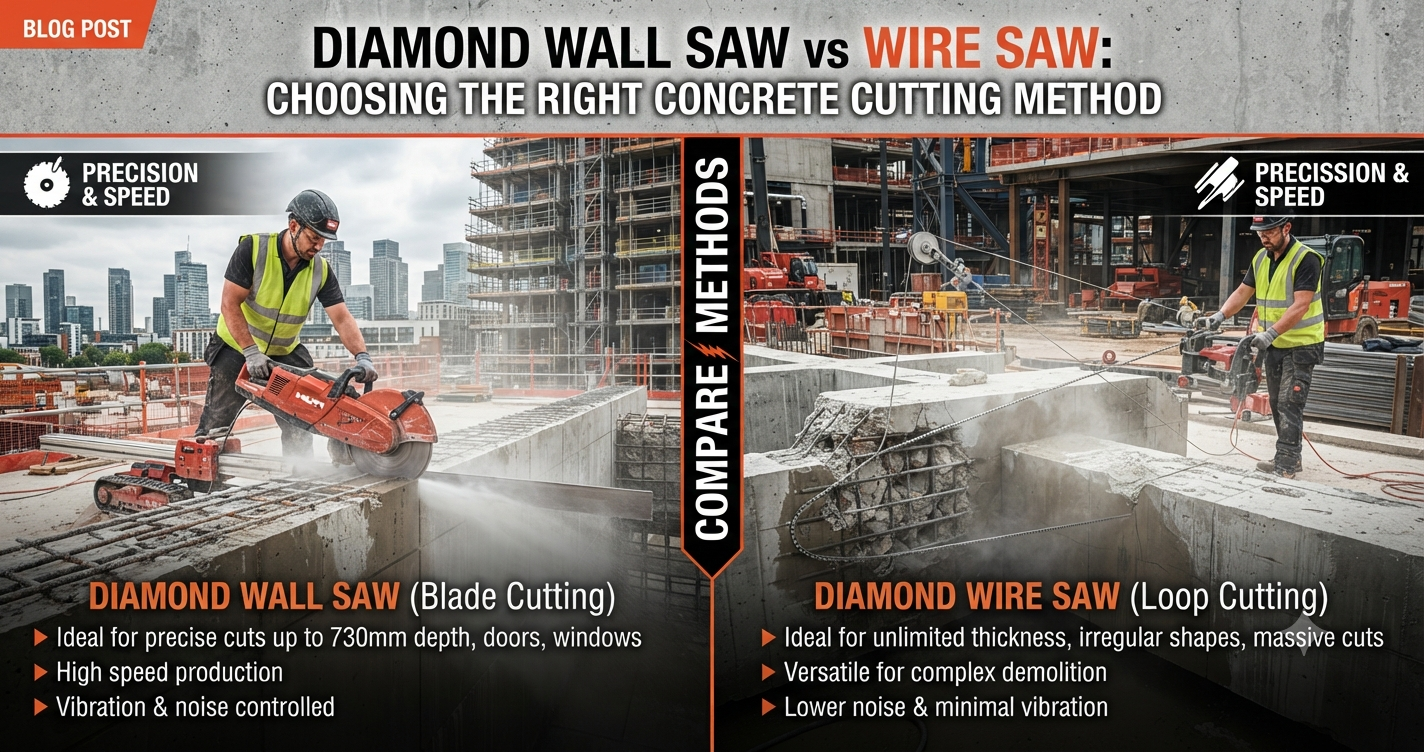
A diamond wall saw (often referred to as a track saw) is a powerful piece of machinery used primarily for making precise, straight cuts in vertical or sloped surfaces.
How It Works
The system consists of a track (or rail) that is bolted directly onto the concrete surface. A heavy-duty cutting head is then mounted onto this track. The cutting head houses a large circular steel blade featuring diamond-impregnated segments along its edge.
Powered by hydraulic, high-frequency electric, or pneumatic motors, the blade traverses back and forth along the track. The operator uses a remote control to slowly plunge the blade deeper into the concrete with each pass until the desired depth is reached.
Key Applications for Wall Saws
-
Doors and Windows: Cutting precise openings for new doors, windows, and HVAC registers in existing concrete walls.
-
Staircases and Elevators: Creating perfectly straight structural openings for new stairwells or elevator shafts.
-
Flush Cutting: Slicing concrete flush against an adjoining wall, ceiling, or floor.
-
Joint Cutting: Creating expansion joints in large vertical concrete slabs.
Advantages of Wall Sawing
-
Exceptional Precision: Because the saw is mounted on a rigid track, it produces impeccably straight cuts with a smooth finish that often requires no further finishing.
-
Speed: For cuts within its depth range, a wall saw is generally faster to set up and operate than a wire saw.
-
One-Sided Access: You only need access to one side of the wall to perform the cut.
-
Portability: Modern high-frequency electric wall saws are incredibly compact and easy to transport around a job site.
Limitations of Wall Sawing
-
Depth Restrictions: The maximum cutting depth is dictated by the diameter of the blade. Most standard wall saws max out at a depth of 24 to 36 inches (600mm to 900mm).
-
Over-Cutting: Because the blade is circular, cutting a perfect 90-degree corner requires the blade to "over-cut" past the corner mark. If over-cutting is not permitted (to protect structural integrity), the corners must be finished by core drilling.
-
Setup Requirements: A relatively flat surface is required to mount the track securely.
3. What is a Diamond Wire Saw?
When a project exceeds the capabilities of a traditional wall saw, the diamond wire saw steps in. Wire sawing is the most versatile and heavy-duty concrete cutting method available in the construction industry today.
How It Works
Instead of a circular solid blade, a wire saw uses a multi-strand steel cable threaded with cylindrical diamond-impregnated beads. This wire is wrapped around the structure that needs to be cut.
The wire is fed through a series of guide pulleys and connected to a large drive wheel. As the drive wheel spins, it pulls the wire continuously through the concrete in a massive loop. As the cut progresses, the drive wheel pulls back on a track to maintain constant tension on the wire, shrinking the loop until it completely slices through the structure.
Key Applications for Wire Saws
-
Massive Structures: Cutting bridge piers, dams, foundations, and bank vaults where the concrete thickness exceeds 3 feet.
-
Irregular Shapes: Slicing through heavily reinforced concrete of any shape—cylindrical, hexagonal, or completely asymmetrical.
-
Confined Spaces: Wire saws can operate in tight environments where a bulky wall saw track cannot fit, as the drive motor can be placed safely outside the work area.
-
Underwater Demolition: The perfect tool for cutting submerged pipes, bridge supports, and marine infrastructure.
Advantages of Wire Sawing
-
Unlimited Depth: There is theoretically no limit to how deep or thick a wire saw can cut. If you can wrap the wire around the object, you can cut it.
-
No Over-Cutting: Wire saws can create clean corners without damaging the surrounding structures.
-
Low Noise and Vibration: Wire sawing is incredibly quiet and produces virtually zero vibration, making it ideal for operating in sensitive environments like hospitals or occupied residential buildings.
-
Flexibility: The system of guide pulleys allows cuts to be made from almost any angle.
Limitations of Wire Sawing
-
Complex Setup: Setting up the pulley system, drilling access holes to thread the wire, and establishing the right tension can be time-consuming.
-
Cost: Wire sawing is generally more expensive than wall sawing due to the cost of the consumable diamond wire and the specialized labor required.
-
Access Requirements: You typically need access to both sides of the structure (or must drill intersecting core holes) to loop the wire around the object.
-
Water Management: Wire saws require a constant, high-volume flow of water to cool the wire and flush away the concrete slurry, which requires robust water management on-site.
4. The Showdown: Wall Saw vs. Wire Saw
To make the best decision for your project, let's compare these two titans of concrete cutting across several critical metrics.
| Feature | Diamond Wall Saw | Diamond Wire Saw |
| Cutting Mechanism | Circular steel blade with diamond segments | Steel cable with diamond-impregnated beads |
| Maximum Depth | Limited (Usually up to 36 inches / 900mm) | Unlimited (Depends on wire length) |
| Precision | Very High (Track-guided, perfectly straight) | Moderate to High (Can sometimes wander slightly) |
| Speed of Setup | Fast to Moderate | Slow (Complex pulley systems required) |
| Access Needed | One side of the structure | Requires looping around the structure |
| Corners | Results in over-cutting | Clean corners, no over-cutting |
| Best For | Doors, windows, standard walls, trenches | Bridge piers, machine bases, ultra-thick walls |
5. How to Choose the Right Tool for Your Project
Choosing between a diamond wall saw and a wire saw ultimately comes down to a few critical factors regarding your specific job site. Ask yourself the following questions:
A. How thick is the concrete?
This is the ultimate deciding factor. If your concrete wall is 12, 18, or 24 inches thick, a Diamond Wall Saw is highly efficient, cost-effective, and will get the job done quickly. However, if you are tasked with removing a 5-foot thick machine foundation, a wall saw simply cannot reach that depth. In this scenario, the Diamond Wire Saw is your only viable option.
B. What are your space and access constraints?
Wall saws require you to bolt a track to the wall and mount a fairly large saw head to it. If you are working in a cramped crawlspace, you might not have the physical room to mount the equipment. A wire saw, however, is highly adaptable. You can place the large drive motor 20 feet away from the actual cut, using small guide pulleys to direct the wire into the tightest of spaces.
Conversely, if you only have access to one side of a wall, a wall saw is the winner. A wire saw requires you to loop the wire entirely around the structure, which usually requires access to the back side (or extensive core drilling to create a path for the wire).
C. Do you need perfectly sharp, uncompromised corners?
When cutting a doorway, a circular wall saw blade will over-cut past the corner by several inches on the reverse side of the wall. If structural integrity dictates that you absolutely cannot cut past your layout lines, you must stop the wall saw short and finish the corners with a core drill or a chainsaw. A wire saw, operating like a giant band saw, pulls straight through without any over-cutting, leaving structural perimeters intact.
D. What is your budget and timeline?
Wall sawing is generally faster to set up and requires fewer consumables, making it the more budget-friendly option for standard commercial modifications. Wire sawing is a specialized service. The diamond wire itself is expensive and wears out, and setting up the complex geometry of guide pulleys takes time. However, for massive demolition projects, the wire saw's ability to remove massive blocks of concrete in a single lift can actually save time and money on heavy machinery and hauling.
6. Safety and Environmental Considerations
Concrete cutting is heavy-duty work that comes with significant safety and environmental responsibilities. Whether you are utilizing a wall saw or a wire saw, professional contractors must adhere to strict safety protocols.
Dust Control and Slurry Management
Both wall saws and wire saws are strictly "wet-cutting" methods. Water is pumped directly onto the blade or wire during operation. This serves two vital purposes:
-
Cooling: Friction generates immense heat that can melt the steel matrix holding the diamonds. Water keeps the tools from self-destructing.
-
Dust Suppression: Silica dust, created by pulverizing concrete, is a severe respiratory hazard. Wet cutting traps this dust, turning it into a heavy slurry.
Managing this concrete slurry is a critical part of the job. Contractors must use industrial wet vacuums and containment barriers to prevent the slurry from damaging property or entering local drainage systems.
Operator Safety
Wire saws, in particular, hold immense kinetic energy. The wire is pulled incredibly tight and moves at high speeds. If a wire snaps—a rare but possible occurrence—it acts like a whip. Because of this, operators must establish strict exclusion zones, use protective lexan guards, and operate the machinery remotely.
Wall saws also require remote operation to keep the technician away from the spinning blade and any potential kickback or concrete blowout.
7. The Future of Concrete Cutting
The concrete cutting industry continues to innovate. Today, we are seeing the introduction of automated, smart machinery. High-frequency electric wall saws now feature auto-feed systems that monitor the torque and speed of the blade, automatically slowing down when they hit dense steel rebar to prevent blade damage.
Similarly, wire saws are becoming more modular and portable. Newer diamond bead formulations are lasting longer and cutting faster, slightly bridging the cost gap between standard track sawing and wire sawing.
Regardless of technological advancements, the physics remain the same: matching the right tool to the right job requires expertise, experience, and an understanding of structural engineering.
Conclusion: Making the Right Cut
In the debate between the Diamond Wall Saw vs. Wire Saw, there is no superior tool—only the right tool for your specific application.
-
Choose the Diamond Wall Saw for fast, perfectly straight cuts in standard walls, floors, and sloped surfaces where the depth does not exceed 36 inches.
-
Choose the Diamond Wire Saw for unlimited cutting depth, massive concrete structures, highly reinforced steel, irregular shapes, and heavily restricted spaces.
Undertaking a concrete cutting or demolition project requires immense planning, precision, and adherence to safety standards. Attempting these cuts with subpar equipment or inexperienced labor can lead to project delays, structural damage, and severe safety hazards.
If you are planning a residential, commercial, or industrial concrete modification project and need expert guidance, do not leave it to chance. Partner with professionals who have the cutting-edge technology and the engineering know-how to get the job done right, on time, and on budget.
Ready to start your next concrete cutting project?
Reach out to the experts today for a consultation and a tailored quote. Let us help you determine exactly what equipment your project demands.
Contact us directly at: [email protected]
Precision in every cut. Excellence in every project.