
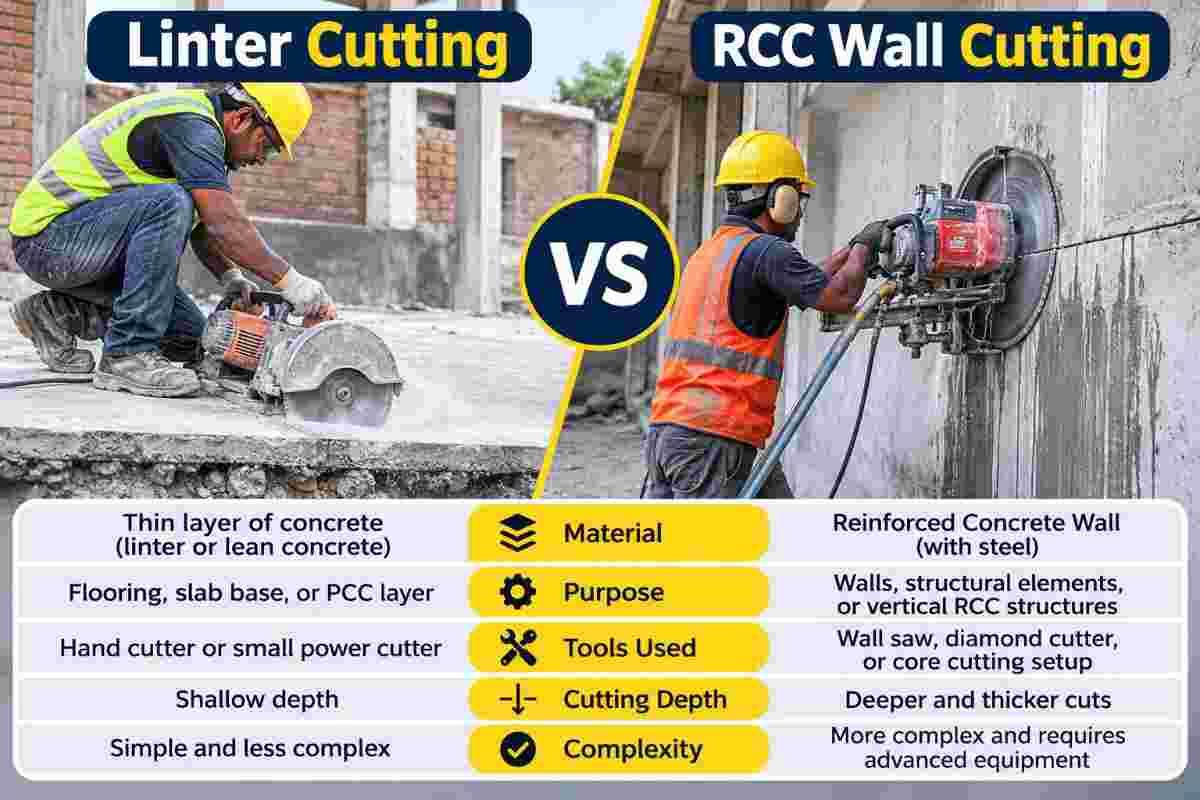
Renovating a home, factory or commercial building often means making new openings or removing parts of existing structures. Two terms come up again and again in these projects: linter cutting and RCC wall cutting. Many property owners treat them as the same job, but they are very different in technique, risk, equipment and cost.
At Core Cutting India, we regularly meet customers who ask, “Is cutting a lintel the same as cutting an RCC wall?” The short answer is no. This guide explains the difference between linter cutting and RCC wall cutting so you can plan your project safely and avoid expensive mistakes.
What Is Linter (Lintel) Cutting?
A lintel, often searched as “linter,” is a horizontal structural member placed over openings such as doors, windows and ventilators. Its job is to carry the weight of the masonry or slab above the opening and transfer that load to the walls on either side.
Lintels can be made of reinforced concrete (RCC), stone, brick, steel or timber. In most modern Indian buildings, they are cast in RCC, typically 100 mm to 230 mm deep and running the full width of the wall.
Linter cutting means cutting, trimming, removing or modifying this beam. Common reasons include:
- Widening a door or window opening
- Raising the height of a door or window
- Removing a damaged or deteriorated lintel
- Creating space for a new duct, AC sleeve or pipe passage
- Merging two openings into one larger opening
Because a lintel is a load-carrying element, cutting it without proper support can cause cracks, sagging or even partial collapse of the wall above. The work is delicate and needs planning, temporary supports and precision tools.
What Is RCC Wall Cutting?
RCC wall cutting means cutting through a Reinforced Cement Concrete wall, a dense structural element made of concrete and embedded steel reinforcement bars. RCC walls are common in:
- High-rise buildings and shear walls
- Basements and retaining walls
- Lift shafts and staircase cores
- Industrial buildings and warehouses
- Water tanks, bridges and parapets
RCC walls are usually much thicker than ordinary brick walls, often 150 mm to 600 mm or more. They contain a mesh of steel bars and stirrups, so cutting them requires heavy-duty diamond tools that can slice through both concrete and steel cleanly.
Typical reasons for RCC wall cutting include:
- Creating new door, window or lift openings
- Making openings for ducts, pipes and cable trays
- Demolishing part of a structure for redesign
- Cutting expansion joints
- Removing walls during factory or warehouse expansion
Linter Cutting vs RCC Wall Cutting: Key Differences
1. Structural Role
A lintel is a beam that supports the load above an opening. An RCC wall is a vertical element that may act as a load-bearing wall, a shear wall or a partition. Cutting a lintel directly affects the load path above the opening, while cutting an RCC wall changes how forces flow through the whole structure. Both need engineering review, but the risks differ.
2. Size and Depth of Cut
Linter cutting usually involves smaller cross-sections, since a lintel is typically a narrow beam. RCC wall cutting involves larger, deeper cuts, often over several metres in length and a few hundred millimetres in depth. This affects the machine and blade you need.
3. Equipment Used
For linter cutting, the common tools are:
- Hand-held diamond cutters for shallow cuts
- Small wall saws for controlled, straight cuts
- Core drilling machines for small service holes
- Hydraulic or manual breakers (used sparingly) for finishing
For RCC wall cutting, the common tools are:
- Diamond wall saw machines (track-mounted)
- Wire saw machines for very thick or irregular sections
- Heavy-duty core cutting rigs
- Floor saws for horizontal cuts
Wall saws and wire saws are built for deep, long cuts. Lighter equipment is often enough for lintel work.
4. Reinforcement Complexity
A lintel has a few main bars and stirrups. An RCC wall often has a dense double-layer steel mesh, which slows cutting and wears blades faster. Diamond segments must be matched to the density of the reinforcement for efficient cutting.
5. Temporary Support Requirements
Cutting a lintel almost always requires temporary props or needle beams to hold the masonry above. Without them, the wall can settle or crack. RCC wall cutting also needs support in many cases, especially in load-bearing or shear walls, but the support design is usually more complex and is decided by a structural engineer.
6. Time Required
A single lintel cut can often be finished in a few hours. Large RCC wall cutting, such as lift openings or industrial partitions, can take a full day or several days depending on thickness, height and reinforcement.
7. Cost
Cost depends on several factors, including thickness, depth, rebar density, access, height and location. In general, linter cutting is cheaper because of its smaller scale, while RCC wall cutting costs more because of larger surface area, deeper cuts and heavier machinery. Most professional services quote RCC wall cutting by square foot or running metre of cut, and lintel work by the job or per opening. For an accurate quote, call +91 70096 79903.
8. Noise, Dust and Vibration
Both processes, when done with diamond tools, produce far less vibration than conventional demolition. Wet cutting controls dust, and modern diamond saws are much quieter than hammers and breakers. This makes them suitable for occupied buildings, hospitals, offices and residential societies.
9. Risk Level
Linter cutting carries a higher risk of local failure if done wrongly, because the beam is directly supporting the wall above. RCC wall cutting carries a higher risk of global structural impact, especially for shear walls and core walls. Both demand expertise, but the type of risk is different.
Quick Comparison Table
| Factor | Linter (Lintel) Cutting | RCC Wall Cutting |
|---|---|---|
| Element | Horizontal beam above openings | Vertical concrete wall |
| Typical size | Small cross-section | Large, thick sections |
| Equipment | Hand-held cutters, small wall saws | Wall saws, wire saws, heavy rigs |
| Reinforcement | Light | Dense mesh |
| Support needed | Needle beams / props almost always | Depends on wall type |
| Time | Few hours | Hours to several days |
| Cost | Lower | Higher |
| Common use | Widening doors/windows | Lift openings, ducts, redesign |
Step-by-Step Process of Linter Cutting
- Site inspection: Check wall type, lintel size, loads above and existing cracks.
- Marking: Mark the exact cut lines using a laser or chalk line.
- Temporary support: Install props or needle beams to carry the load.
- Cutting: Make precise cuts with diamond tools, using water to control dust.
- Removal: Lift out the cut section in manageable pieces.
- Strengthening: If required, install a new lintel or steel beam.
- Finishing: Clean the opening and prepare it for plaster, frames or finishing.
Step-by-Step Process of RCC Wall Cutting
- Structural review: Confirm with an engineer that the wall can be cut.
- Scanning: Detect rebar and embedded services with a scanner.
- Layout: Mark the opening size and cutting sequence.
- Machine setup: Fix the track, anchor the wall saw and connect water supply.
- Cutting: Cut along the marked lines in a planned order.
- Safe removal: Secure and lower cut slabs using lifting equipment.
- Slurry management: Collect and dispose of slurry properly.
- Edge finishing: Clean the opening edges for framing or strengthening.
Which One Do You Need?
- If you only want to widen a door or window in a brick wall with an RCC lintel, you need linter cutting.
- If you want to create a new opening, lift shaft or duct passage in a thick concrete wall, you need RCC wall cutting.
- If you want to merge rooms by removing a wall that includes a beam or lintel, you may need both.
When in doubt, get a professional site inspection. Misjudging the element type is one of the most common causes of damage in renovation projects.
Safety Tips Before Cutting Any Lintel or RCC Wall
- Never cut a structural element without an engineer’s approval.
- Always scan for hidden electrical conduits, water pipes and gas lines.
- Use proper temporary supports before cutting.
- Choose wet cutting to control dust and protect health.
- Make sure the team uses protective gear such as helmets, goggles, masks and gloves.
- Clear the area below and around the cutting zone.
- Work with a company that has trained operators and proper insurance.
Why Choose Core Cutting India?
At Core Cutting India, we specialise in precise, dust-controlled and low-vibration concrete cutting for residential, commercial and industrial projects. Our services include:
- Linter and lintel cutting
- RCC wall cutting
- Diamond wall sawing
- Wire saw cutting
- Core drilling
- Floor and slab cutting
- Door, window and lift opening cutting
Our trained operators use modern diamond equipment to deliver clean edges, minimal disturbance and safe working conditions, whether you are cutting a single lintel in your home or a thick RCC wall in a factory.
Frequently Asked Questions (People Also Ask)
What is the difference between lintel cutting and RCC wall cutting?
Lintel cutting involves a horizontal beam above a door or window, usually smaller in size. RCC wall cutting involves a thick vertical concrete wall with heavy reinforcement. They need different equipment, support systems and planning.
Can I cut a lintel without damaging the wall?
Yes, if the wall above is properly propped before cutting and the work is done with diamond tools. Unsupported cutting can cause cracks or settlement.
Is RCC wall cutting safe for an occupied building?
Yes. Diamond wall sawing produces much less noise and vibration than breakers, so it is widely used in occupied homes, offices and hospitals when proper precautions are taken.
How much does RCC wall cutting cost?
The cost depends on wall thickness, rebar density, cut length, access and height. It is generally charged per square foot or running metre. Contact +91 70096 79903 for a site-specific quote.
Do I need an engineer before cutting an RCC wall?
Yes. Any cutting in a load-bearing, shear or structural wall should be reviewed by a qualified structural engineer.
What machine is used for RCC wall cutting?
Diamond wall saws and wire saws are the most common machines. For small holes, core drilling machines are used.
Can a load-bearing wall be cut to make a door?
Often yes, but only with a proper lintel or beam designed to carry the load, plus temporary supports during the work.
How long does lintel cutting take?
Usually a few hours for a single opening, though strengthening and finishing may take additional time.
Final Thoughts
Linter cutting and RCC wall cutting may sound similar, but they are different jobs with different risks, tools and costs. Lintel cutting focuses on modifying a beam that supports an opening, while RCC wall cutting deals with large, heavily reinforced concrete walls. Understanding the difference helps you plan better, budget accurately and keep your building safe.
Whether you need to widen a window, create a new door or cut a thick concrete wall, professional help makes all the difference.
Get a Free Quote Today
Ready to start your project? Contact the experts at Core Cutting India.
📞 Call us: +91 70096 79903
🌐 Website: https://corecuttingindia.com/
Precision cutting. Minimal dust. Maximum safety.