
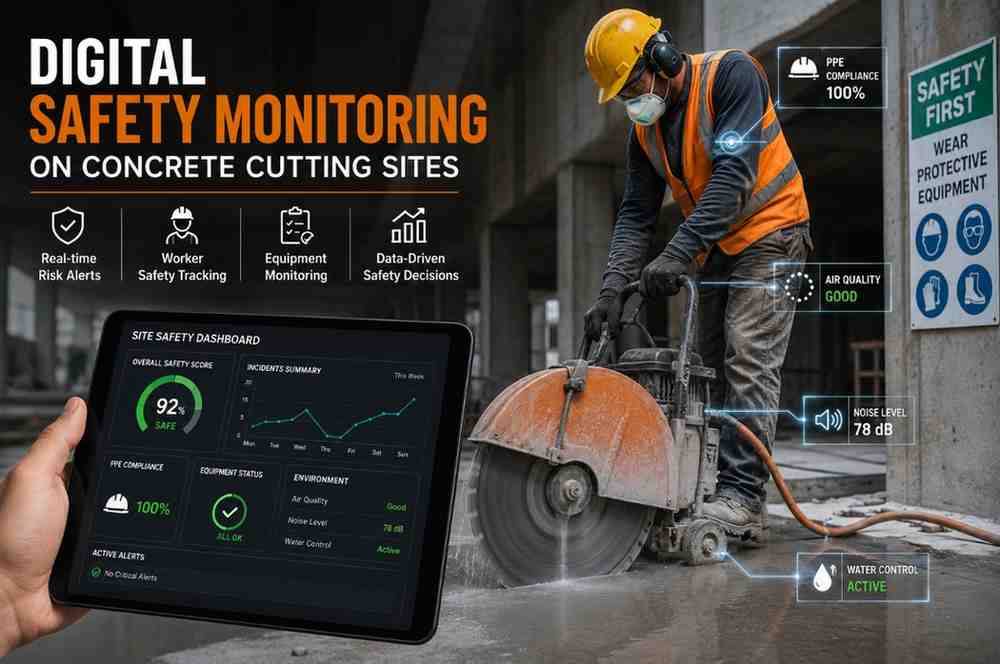
Concrete cutting is one of the most physically demanding and hazard-prone activities on any construction or infrastructure site. From high-decibel noise and airborne silica dust to the risk of equipment kickback, electrical hazards, and structural instability, the people operating core drills, wall saws, and floor saws face dangers every single day. For decades, safety on these sites relied almost entirely on manual checklists, verbal briefings, and the vigilance of supervisors walking the floor. Today, that approach is changing fast. Digital safety monitoring is reshaping how concrete cutting companies protect their workers, and at Core Cutting India, we believe this shift is not just a trend but a necessity for the future of the industry.
Why Concrete Cutting Sites Need a New Approach to Safety
Concrete cutting operations differ from general construction work in one important way: the tools themselves are inherently high-risk. Diamond blades spinning at thousands of RPMs, high-pressure hydraulic systems, and heavy core drilling rigs all demand precision and constant vigilance. A single lapse in attention, a worn-out blade, or an undetected structural weakness can lead to catastrophic outcomes.
Traditional safety practices, while still valuable, have inherent limitations. Paper-based inspection logs get lost or filled out inaccurately. Supervisors cannot be everywhere at once. Hazards like rising dust concentration or a slowly overheating machine often go unnoticed until it is too late. This is exactly the gap that digital safety monitoring is designed to close.
What Is Digital Safety Monitoring?
Digital safety monitoring refers to the use of connected technology, sensors, software, and data analytics to track hazards, equipment condition, and worker behavior on a job site in real time. Instead of relying solely on human observation, digital systems continuously collect data and flag risks the moment they emerge, often before a human eye would ever catch them.
On a concrete cutting site, this can include everything from wearable devices that monitor a worker's vital signs and location, to fixed sensors that measure dust particles and noise levels, to AI-powered cameras that detect unsafe behavior such as missing personal protective equipment (PPE) or workers entering restricted zones.
Key Components of Digital Safety Monitoring on Concrete Cutting Sites
1. IoT Sensors for Environmental Hazards
Internet of Things (IoT) sensors are now widely used to track environmental conditions that are otherwise invisible or hard to gauge. On concrete cutting sites, this typically includes:
- Silica dust monitors, which continuously measure respirable crystalline silica levels in the air. Since prolonged silica exposure is linked to serious respiratory illness, real-time alerts allow crews to pause work, activate dust suppression systems, or evacuate an area before exposure limits are breached.
- Noise level sensors, which track decibel exposure over a shift and warn workers when hearing protection thresholds are approaching or exceeded.
- Vibration sensors, attached to handheld cutting tools, that monitor whether a worker's exposure to hand-arm vibration is within safe limits.
- Temperature and humidity sensors, particularly relevant for outdoor cutting operations where heat stress is a genuine risk.
These sensors feed data into centralized dashboards, giving site managers a live picture of environmental conditions across multiple work zones simultaneously.
2. Wearable Safety Devices
Smart PPE has moved from concept to common practice on many advanced job sites. Wearables now include:
- Smart helmets with built-in sensors that detect impacts, falls, or sudden changes in posture.
- Connected vests or wristbands that monitor heart rate, body temperature, and fatigue indicators, alerting a worker or supervisor if signs of heat exhaustion or exhaustion-related risk appear.
- GPS and RFID tracking tags that show exactly where each worker is located on a large site, which becomes critical during emergencies or when someone strays into a hazardous cutting zone.
- Proximity sensors that trigger an alarm when a worker gets too close to an active saw, a suspended load, or moving machinery.
For concrete cutting specifically, proximity alerts around wire saws and wall saws are particularly valuable, since these tools operate with extended cutting lines that are not always easy to see at a glance.
3. AI-Powered Video Monitoring
Closed-circuit cameras have existed on construction sites for years, but the addition of artificial intelligence has transformed passive recording into active hazard detection. AI-powered video systems can now:
- Automatically detect whether workers are wearing required PPE such as safety glasses, gloves, and respirators.
- Identify unsafe postures or behaviors, such as a worker standing in the cutting path of a slab saw.
- Recognize unauthorized access into restricted or high-risk zones.
- Flag equipment left running unattended.
Rather than requiring a person to watch dozens of camera feeds simultaneously, AI software analyzes footage continuously and sends instant alerts to supervisors' phones or the central control room when a violation is detected.
4. Equipment and Machinery Monitoring
Concrete cutting equipment, including core drills, wall saws, wire saws, and floor saws, can now be fitted with condition-monitoring sensors that track:
- Blade wear and temperature, helping prevent overheating or blade failure mid-cut.
- Hydraulic pressure levels, which can indicate a developing leak or system fault.
- Vibration patterns that may signal an early mechanical issue before it becomes a breakdown or safety hazard.
- Runtime hours, supporting predictive maintenance schedules so equipment is serviced before it fails rather than after.
This kind of monitoring does more than protect operators; it also protects the structural integrity of the project itself, since a malfunctioning saw can compromise the precision of a cut in load-bearing concrete elements.
5. Cloud-Based Safety Management Software
All the data collected from sensors, wearables, and cameras needs a central place to live. Cloud-based safety management platforms consolidate this information into dashboards that project managers, safety officers, and even clients can access remotely. These platforms typically offer:
- Real-time alerts sent directly to mobile devices.
- Digital incident reporting that replaces paper forms.
- Automated compliance checklists aligned with regulatory standards.
- Historical data analysis to identify recurring risk patterns across multiple sites.
- Audit-ready documentation for regulatory inspections.
This digital record-keeping is particularly valuable for companies managing multiple concrete cutting projects across different cities or states, as it allows leadership to compare safety performance and identify sites that need additional support.
Benefits of Digital Safety Monitoring for Concrete Cutting Companies
Faster Hazard Detection and Response
The single biggest advantage of digital monitoring is speed. A dust sensor can flag a problem within seconds of a threshold being crossed, long before a worker experiences symptoms. A proximity sensor can sound an alert before a worker steps into a saw's cutting radius. This head start can be the difference between a near-miss and a serious injury.
Reduced Human Error
Manual safety checks depend on attentiveness, and even the most experienced supervisor cannot monitor every worker and machine at all times. Digital systems remove this dependency by providing continuous, automated oversight that does not get tired, distracted, or overwhelmed by a busy site.
Data-Driven Decision Making
Over time, digital monitoring systems build a rich dataset about a site's safety performance. Patterns emerge, such as certain shifts having higher noise exposure or specific equipment repeatedly triggering vibration alerts. This data allows companies to make targeted improvements rather than relying on guesswork.
Improved Regulatory Compliance
Regulatory bodies increasingly expect documented proof of safety practices, particularly around silica dust exposure and noise limits. Digital systems automatically log this data, making it far easier to demonstrate compliance during inspections or audits, and reducing the administrative burden on site staff.
Better Worker Confidence and Morale
When workers know that their environment is being actively monitored for their protection, and that hazards will be caught quickly, it builds trust. This can improve morale, reduce turnover, and even help attract skilled labor in a competitive industry where safety reputation matters.
Cost Savings Over Time
While the upfront investment in sensors, wearables, and software can seem significant, the long-term savings are considerable. Fewer accidents mean lower insurance premiums, reduced downtime, fewer legal liabilities, and less equipment damage from undetected mechanical issues.
Challenges in Implementing Digital Safety Monitoring
It would be misleading to suggest that digital safety monitoring is a simple plug-and-play solution. Companies adopting these systems often face real challenges:
- Initial cost and infrastructure, since reliable connectivity and sensor installation require investment, especially on remote or temporary sites.
- Worker adaptation, as some team members may resist wearing additional devices or feel that constant monitoring is intrusive.
- Data overload, where too many alerts and dashboards can overwhelm supervisors if the system is not configured thoughtfully.
- Integration with existing workflows, since digital tools need to complement, not complicate, established safety procedures.
The most successful implementations treat digital monitoring as a support system for experienced safety personnel rather than a replacement for human judgment. Technology flags the risk; trained professionals still make the final call on how to respond.
Best Practices for Rolling Out Digital Safety Monitoring
- Start with a risk assessment to identify which hazards on your specific concrete cutting operations most urgently need digital oversight, whether that's dust, noise, proximity risk, or equipment failure.
- Choose scalable systems that can grow from a single site to multiple projects without requiring a complete overhaul.
- Train your team thoroughly, ensuring workers understand not just how to use wearables and respond to alerts, but why the system exists.
- Set clear alert thresholds so that notifications remain meaningful and do not create alert fatigue.
- Review data regularly, using weekly or monthly safety reviews to translate collected data into concrete improvements.
- Combine digital tools with traditional safety culture, including toolbox talks, manual inspections, and open communication channels, so technology strengthens rather than replaces good safety habits.
The Future of Safety on Concrete Cutting Sites
Looking ahead, digital safety monitoring on concrete cutting sites is likely to become even more sophisticated. Predictive analytics will increasingly forecast potential hazards before they occur, based on patterns in historical data. Integration between wearables, machinery sensors, and building information modeling (BIM) systems will give project teams a complete digital picture of both the site and the structure being worked on. Automated drones may soon supplement fixed cameras for large outdoor cutting sites, offering aerial hazard detection across sprawling project areas.
As these technologies mature and become more affordable, they will likely shift from being a competitive advantage to an industry standard, much like hard hats and safety glasses became standard decades ago.
Conclusion
Digital safety monitoring represents a genuine turning point for the concrete cutting industry. It closes the gaps left by manual observation, giving site managers real-time visibility into hazards ranging from silica dust and noise exposure to equipment malfunction and unsafe worker behavior. While implementation comes with its own set of challenges, the long-term benefits, in terms of faster hazard response, improved compliance, and safer outcomes for the people doing this demanding work, make it a worthwhile investment.
At Core Cutting India, safety has always been central to how we approach every concrete cutting project, and we believe embracing digital monitoring tools is one of the most effective ways to protect our teams while delivering precise, reliable results for our clients. As the industry continues to evolve, companies that invest in these technologies today will be the ones setting the safety standard for tomorrow.
For more information on our concrete cutting services and safety practices, reach out to us at [email protected].