
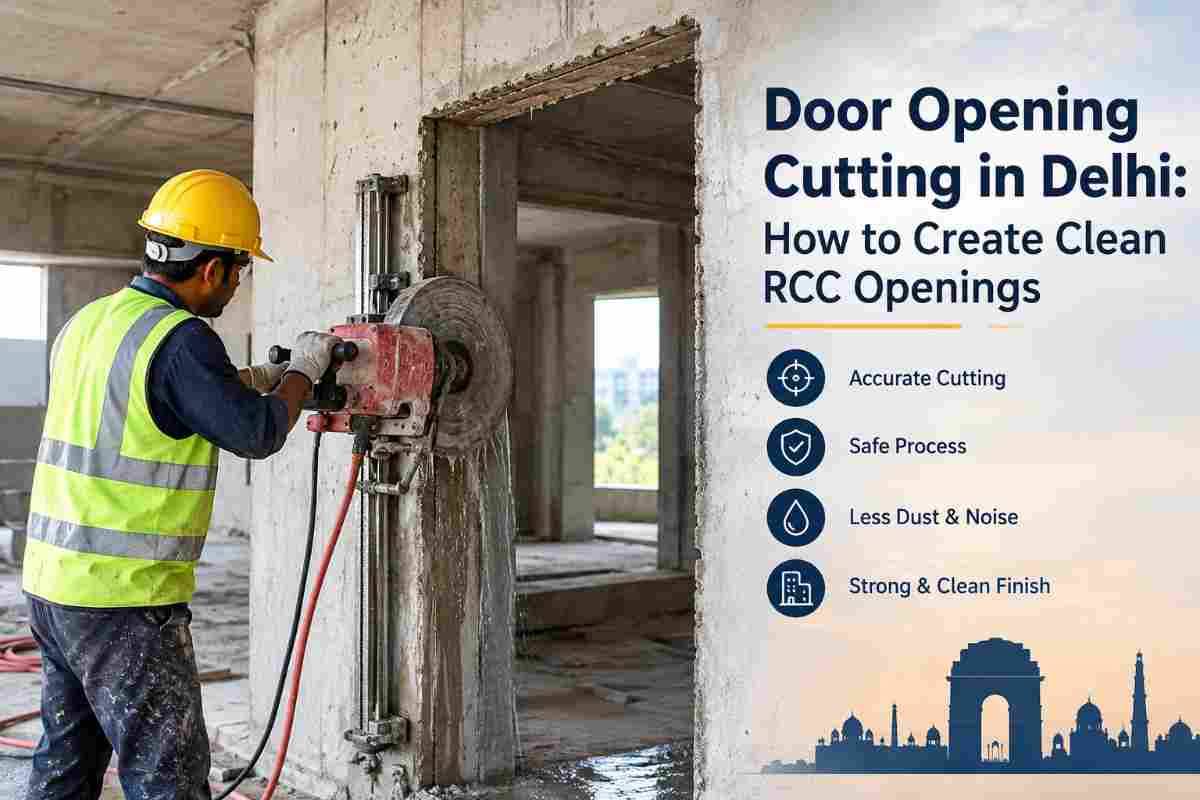
Delhi's homes, offices, and commercial buildings are changing constantly. A family wants a new entrance to a rented floor. A shop owner wants a wider shutter. A factory needs a passage between two bays. In nearly every case, the answer is the same: cut a new door opening in an existing reinforced cement concrete (RCC) wall.
Done badly, this job brings cracks, uneven edges, vibration damage, and even structural risk. Done properly, it leaves a straight, smooth opening that is ready for a frame in a day or two. This guide explains how professional door opening cutting works in Delhi, what to plan for, and how to get a clean result. It draws on the approach followed by Core Cutting India.
What Is Door Opening Cutting in RCC?
Door opening cutting is the process of creating a new doorway in an existing concrete or masonry wall using precision cutting equipment, rather than breaking it with hammers or jackhammers.
RCC is concrete reinforced with steel bars. That combination makes it strong, but it also makes it hard to modify. A conventional breaker transmits heavy shock through the structure, causing micro-cracks well beyond the cut line. Modern diamond cutting works differently. A diamond-impregnated blade or wire grinds through concrete and steel together, leaving only a clean kerf (cut line) and almost no vibration in the surrounding structure.
Why Delhi Properties Need Precision Cutting
Delhi has some conditions that make controlled cutting especially important.
Dense construction. Many buildings share walls, and neighbours are only a few feet away. Heavy hammering can disturb adjoining units, break plaster, and cause disputes.
Ageing and modified buildings. Older areas have walls built with varying quality of concrete and steel. Cutting methods need to respect what is actually inside the wall.
Vertical expansion and redevelopment. Builder floors, additional storeys, and layout changes mean openings are often needed in already occupied buildings.
Dust and noise concerns. Delhi's air quality challenges mean dust control matters. Contractors are expected to follow construction dust-mitigation norms, and restrictions on construction activity can apply during severe pollution periods. Always check the current rules before scheduling work.
Diamond cutting handles these conditions well because it is controlled, low in vibration, and can be paired with water cooling to suppress dust.
Common Methods for Cutting Door Openings in RCC
Different walls and sites call for different tools. A good contractor chooses based on wall thickness, access, reinforcement, and location, rather than using one method for everything.
1. Wall Saw Cutting
A wall saw is a track-mounted machine with a large circular diamond blade. The track is anchored to the wall, and the blade moves along it, cutting in straight lines.
It is the preferred method for door openings because it produces:
- Perfectly straight vertical and horizontal edges
- Deep cuts through thick walls (often several hundred millimetres, depending on blade size)
- Minimal vibration and a smooth finish that needs little rework
Wall saws are ideal for doorways, large window openings, lift shaft openings, and shutter widening.
2. Wire Saw Cutting
A diamond wire saw uses a looped, beaded cable pulled around the section to be cut. It is used where blades cannot reach, such as very thick walls, heavy columns, or awkward locations. It is slower to set up but extremely versatile.
3. Hand Saw (Ring Saw) Cutting
Hand-held hydraulic or pneumatic ring saws are used in tight spaces, corners, and where track-mounting is difficult. They are suitable for smaller or finishing cuts, though the finish depends heavily on the operator's skill.
4. Core Drilling at Corners
Core drilling means making round holes with a hollow diamond bit. In door cutting, cores are often drilled at the corners of the opening. This prevents over-cutting, relieves stress at the corners, and helps the saw blade stop cleanly at the marked line. Core cutting is also used for pipe, duct, and cable penetrations around the same project.
Why Not Just Use a Breaker?
Breaking with jackhammers is cheaper per hour but costly in consequences: irregular edges, damaged rebar bonds, cracks running into the surrounding wall, loud noise, and heavy debris. For any structural wall, controlled cutting is the safer and neater choice.
Step-by-Step: How a Clean RCC Door Opening Is Created
Here is how a professional job typically proceeds.
Step 1: Site Inspection and Assessment
The team visits the site to understand the wall type (load-bearing or non-load-bearing), thickness, reinforcement pattern, nearby services (electrical conduits, plumbing, gas lines), and access for equipment. Where possible, scanning is used to locate rebar and embedded services before any cutting.
Step 2: Structural Check
This is the most important step and the one most often skipped. A door should never be cut into a load-bearing wall, shear wall, or column without a structural engineer's review. The engineer decides whether the opening is permissible and what support is required, such as a new lintel, RCC jambs, or steel framing around the opening.
Step 3: Permissions and Society Approvals
Depending on your property, you may need permission from the housing society, resident welfare association, or building owner. For structural changes, local authority norms can also apply. In Delhi, properties fall under different bodies, such as MCD, NDMC, or DDA, and rules differ by property type and area. Confirm requirements before the work begins.
Step 4: Marking the Opening
The exact size and position of the door are marked on the wall with a straight line. Dimensions should include space for the frame and clearances. Measuring twice avoids expensive mistakes, since concrete cannot be put back easily once cut.
Step 5: Temporary Support (Propping)
When the opening affects load paths, temporary props or shoring support the structure above while the cut is made and the permanent lintel is installed. This keeps the building stable throughout the job.
Step 6: Setting Up the Equipment
The wall saw track is anchored firmly to the wall, aligned precisely with the marked lines. Water supply is connected for blade cooling and dust suppression, and slurry is controlled so it does not spread across the site.
Step 7: Cutting
Core holes are drilled at the corners where needed. The wall saw then cuts along each line, through concrete and reinforcement steel. The cut section is generally divided into smaller blocks, which are secured and lifted out safely with rigging rather than allowed to fall.
Step 8: Removing the Section and Cleaning Up
Cut blocks are removed carefully, and slurry and debris are cleaned. Because the cutting is dry of heavy impact, the surrounding wall and finishes remain largely intact.
Step 9: Finishing and Framing
The edges are inspected. If needed, minor patching, plastering, or new RCC jambs and lintels are added. The door frame is then fitted, and the opening is ready for finishing.
Planning Your Opening: Things to Decide in Advance
Size and position. Standard internal doors are commonly around 2.1 m high and 0.9 to 1.0 m wide, but your frame, shutter, or accessibility needs may differ. Confirm the size before cutting.
Wall type. RCC, brick, and block walls behave differently and need different methods and support.
Reinforcement. Cutting through steel increases time and blade wear, which affects the quote.
Access. Upper floors, narrow lanes, and basements need extra planning for equipment and debris removal.
Timing. Decide when noise and dust are acceptable. For occupied buildings, plan the cutting for hours that cause the least disruption, and check any seasonal construction restrictions.
Utilities. Isolate or relocate electrical and plumbing lines within the cut zone.
Benefits of Professional Diamond Cutting
Clean, accurate edges. Straight lines mean easier frame fitting and less plaster or concrete repair.
Low vibration. The surrounding structure is far less likely to crack or loosen.
Reduced noise. Diamond cutting is considerably quieter than breaking, which matters in residential colonies and offices.
Controlled dust. Wet cutting keeps airborne dust down.
Speed. Most standard door openings can be cut in a matter of hours once set up, compared with much longer, messier demolition.
Safety. Planned support and controlled cut-outs reduce risk to workers and occupants.
Mistakes to Avoid
- Cutting without engineering advice. This is the biggest risk. Never assume a wall is non-structural.
- Hiring on the lowest price alone. Very cheap quotes often mean breaker-based work, untrained operators, or skipped safety steps.
- Skipping utility checks. Hitting a live cable or gas pipe is dangerous and costly.
- Poor marking. Inaccurate dimensions lead to frames that do not fit.
- Ignoring finishing. Plan the lintel, jambs, and plaster work as part of the same project.
- No debris plan. Concrete blocks are heavy; know how they will be removed and disposed of.
How Much Does Door Opening Cutting Cost in Delhi?
There is no single fixed rate. Pricing typically depends on:
- Wall thickness and concrete strength
- Amount of reinforcement steel
- Area or running length of the cut
- Floor level and access difficulty
- Method used (wall saw, wire saw, hand saw)
- Extra work such as propping, lintel casting, and debris removal
Quotes are usually based on the cutting measure, either per running foot or per square foot, plus mobilisation. The most reliable approach is to request a site visit and a written quote that lists exactly what is included. Be wary of quotes that cannot explain how they were calculated.
Choosing the Right Contractor in Delhi
When comparing providers, look for:
- Proper equipment. Wall saws, wire saws, and core drills, not just breakers.
- Experienced operators. Skill directly affects finish quality and safety.
- A structural-first approach. A good firm asks about wall type and recommends engineer input.
- Clear scope and pricing. Written quotes, defined timelines, and transparency on debris removal.
- Site discipline. Water control, dust management, and respect for neighbours.
- Relevant experience. Ask about previous door, window, and shutter opening jobs.
Why Choose Core Cutting India
At Core Cutting India, the focus is on precision concrete cutting for homes, commercial spaces, and industrial sites across Delhi NCR. The approach is built around a few simple principles: assess the wall first, use the right method for the job, keep vibration and dust low, and leave openings that are ready for framing.
Services typically relevant to door and opening work include RCC wall cutting, wall saw cutting, core drilling, and opening cutting for doors, windows, and shutters. Whether you are planning a single doorway or several openings across a building, a short site visit helps define the right method and a realistic timeline.
Frequently Asked Questions
Can I cut a door in an RCC wall?
Often yes, but it depends on the wall's role in the structure. If the wall is load-bearing or a shear wall, you need a structural engineer's approval and usually a new lintel or reinforced frame. Non-structural partition walls are simpler.
Is it safe to cut a door in a load-bearing wall?
It can be done safely with engineering design, temporary propping, and proper reinforcement around the opening. It is not safe to do without that planning.
How long does door opening cutting take?
A standard door opening can often be cut in a few hours to a day once the machine is set up. Thicker walls, heavy reinforcement, or difficult access can extend this. Finishing work such as lintel casting and plastering takes additional time.
What is the difference between wall saw cutting and breaking?
Wall saw cutting uses a diamond blade for a precise, low-vibration cut. Breaking uses impact tools that shake the structure and leave rough edges. Cutting is cleaner and safer for structural walls.
Does concrete cutting create a lot of dust?
Wet cutting greatly reduces dust because water cools the blade and traps particles. Some slurry is produced, which should be contained and cleaned.
Do I need permission before cutting a door opening in Delhi?
You usually need the consent of the building owner and, in a society or apartment, the association. Structural changes may also be subject to local authority rules depending on the property. Check before starting.
Can the opening be cut to an exact size?
Yes. Track-mounted wall saws follow marked lines accurately, which is why they are preferred when you need a precise fit for a frame or shutter.
What happens to the steel reinforcement?
Diamond blades and wires cut through rebar along with the concrete. The structural design then determines what edge reinforcement or lintel is added around the opening.
Is core cutting the same as door cutting?
Not exactly. Core cutting makes round holes, often for pipes and ducts. For doors, it is used at corners alongside wall saw cutting to get a cleaner result.
Final Thoughts
A well-cut door opening should look like it was always part of the building: straight edges, a correct size, and no cracks. Getting there is less about the machine and more about the process: structural review, accurate marking, proper support, the right cutting method, and sensible finishing.
If you are planning door opening cutting in Delhi, start with a site assessment and an engineer's opinion, then choose a contractor who works with precision equipment and explains their method clearly. To discuss your project or request a site visit, contact Core Cutting India and get your RCC opening done cleanly and safely.