
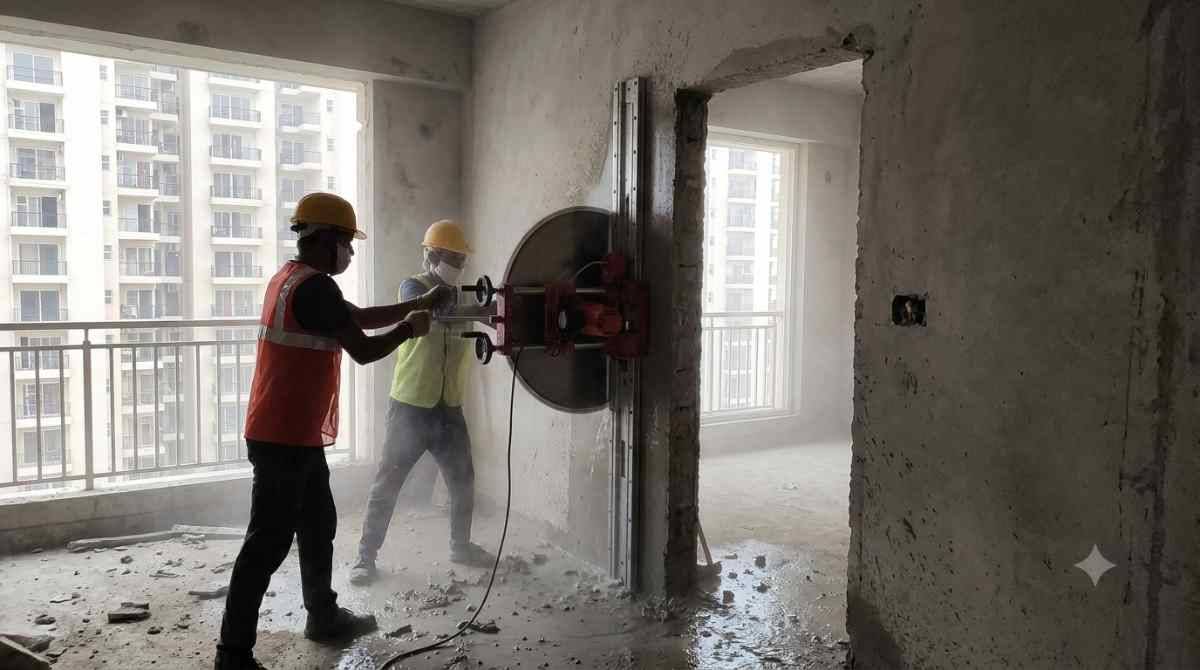
Renovating a home in Noida often means rethinking how rooms connect. Maybe you want to join two bedrooms, open up a kitchen to the living area, add a separate entrance for a rented floor, or create a balcony access that the original plan never offered. In many modern apartments, independent floors and villas across Noida, Greater Noida and Noida Extension, these changes involve an RCC (reinforced cement concrete) wall. Breaking such a wall with a hammer is noisy, messy and risky. That is why door opening cutting in RCC walls using modern diamond cutting equipment has become the preferred method for homeowners, architects and interior designers.
In this guide from Core Cutting India (https://corecuttingindia.com/), we explain how door opening cutting works, when it is safe, what the process looks like, what affects the cost, and how to choose the right contractor for your home renovation in Noida.
What Is Door Opening Cutting in RCC Walls?
Door opening cutting is the process of creating a precise doorway in an existing concrete wall using diamond-tipped cutting tools instead of manual demolition. The contractor marks the exact size of the opening, then cuts along the lines with a wall saw or wire saw. The cut-out block is removed in controlled sections, leaving clean, straight edges ready for a door frame, lintel or finishing.
Unlike chiselling or a jackhammer, which shake the whole structure and leave ragged edges, diamond cutting is a controlled, low-vibration method. The result is a neat opening with minimal damage to the surrounding wall, tiles, flooring and plaster.
Why Homeowners in Noida Are Choosing RCC Wall Cutting
Noida has a large stock of high-rise apartments, builder floors and residential societies where RCC construction is common. In these settings, conventional demolition causes real problems: dust that spreads across the floor, noise that irritates neighbours, vibration that may crack adjacent walls, and society rules that restrict hammering work. Wall cutting solves most of these issues.
Here is why it is popular:
- Clean, accurate edges: The opening matches the drawn dimensions, so door frames fit properly.
- Low vibration: Neighbouring walls, ceilings and fixtures are far less likely to be disturbed.
- Less dust and noise: Water-cooled cutting suppresses dust, and the work is quieter than breaking concrete.
- Faster completion: Many openings can be cut in hours rather than days.
- Reduced repair cost: Because the edges are clean, finishing work such as plastering and painting is simpler.
- Suitable for confined spaces: Compact equipment can work inside apartments and on upper floors.
Is It Safe to Cut a Door in an RCC Wall? Load-Bearing vs Non-Load-Bearing
This is the most important question before any renovation. Not every RCC wall can be cut freely. In many structures, concrete walls may be shear walls or load-bearing walls that carry vertical loads and resist lateral forces such as wind and earthquakes. Noida falls in a seismically active zone, so the structure's integrity matters greatly.
Before cutting, you should:
- Identify the wall type. Check the original structural drawings, or ask the builder or society for them. A non-structural partition wall in a framed structure is generally easier to modify than a shear or load-bearing wall.
- Consult a qualified structural engineer. The engineer will assess whether the opening is permissible, how large it can be, and what reinforcement or framing is needed around it.
- Plan structural support. For openings in structural walls, the engineer may specify a lintel beam above the opening and additional reinforcement or jamb strengthening at the sides.
- Seek permissions. Apartment owners usually need approval from the RWA, society management or builder before altering walls. Independent-house owners should also follow local building rules.
A responsible cutting contractor will not simply start cutting. They will ask about the wall, confirm the marking, and encourage you to get structural advice for any wall that may be structural.
Methods Used for Door Opening Cutting in Concrete Walls
Different walls and site conditions call for different techniques. The main methods used in Noida home renovations are:
1. Wall Saw Cutting
A wall saw is mounted on a track fixed to the wall. A large diamond blade moves along the track and cuts straight lines through the concrete, including the embedded steel reinforcement. It is ideal for thick RCC walls and gives very precise, straight cuts. The track system keeps the blade stable, which improves accuracy and safety.
2. Wire Saw Cutting
A diamond wire saw uses a flexible wire embedded with diamond beads, looped around the section to be removed. It is excellent for heavy, thick or awkward sections, and for places where a large blade cannot be positioned. It is also useful where overcuts at corners must be avoided.
3. Hand Saw / Ring Saw Cutting
For smaller or lighter work, handheld diamond saws and ring saws can be used. These are suitable for shallow cuts or limited-space jobs, though thick walls usually need a wall saw or wire saw.
4. Core Drilling at Corners
Core drilling is often used alongside cutting. Holes are drilled at the corners of the marked opening so the blade can finish the cut cleanly without overcutting into the wall beyond the marked lines. Core holes also help with lifting and removing sections.
Step-by-Step Process of Door Opening Cutting
Understanding the process helps you plan your renovation and coordinate with other trades such as carpenters, tile fitters and painters.
Step 1: Site Inspection and Consultation
The contractor visits the site, checks wall thickness, reinforcement density, access for equipment, water and power availability, and any hidden services in or near the wall.
Step 2: Marking the Opening
The exact door size is marked using a level and measuring tape. A standard internal door opening is often around 3 feet wide and 7 feet high, but you should add allowances for the frame, as advised by your carpenter or architect.
Step 3: Checking for Hidden Services
Electrical conduits, plumbing lines, gas pipes and data cables can run through walls. These must be located and, where needed, switched off or rerouted. Scanning and careful inspection prevent accidents.
Step 4: Protection and Preparation
Furniture is moved away, floors are covered, and nearby areas are protected. Water supply is arranged for cooling the blade and controlling slurry. Slurry is collected so it does not spread across your home.
Step 5: Cutting
The wall saw track is anchored and the cutting begins. Corner core holes may be drilled first. The saw cuts along all four sides of the marked opening, passing through concrete and steel.
Step 6: Safe Removal of the Cut Section
The cut concrete block can be heavy. It is supported, secured and removed in manageable pieces using proper lifting and handling methods to prevent it falling suddenly.
Step 7: Cleaning and Debris Removal
Slurry, dust and debris are cleaned. A professional team leaves the work area tidy, ready for the next stage of renovation.
Step 8: Finishing
After the opening is cut, your team can install the door frame, add a lintel or reinforcement if specified, and complete plastering, tiling and painting.
Common Renovation Scenarios in Noida
Here are some situations where homeowners typically need door opening cutting:
- Connecting two flats or adjoining rooms: Families who buy neighbouring units often want an internal connecting door.
- Creating a separate entrance for a rented portion: Independent floors and villas may need a new entry for a tenant or a home office.
- Opening the kitchen to the dining area: Open-plan living is popular in new interiors.
- Adding balcony or terrace access: A new door to a terrace or balcony improves light, ventilation and usability.
- Shifting an existing door: Changing the door position for better furniture layout or traffic flow.
- Commercial-residential conversions: Home-based clinics, studios and offices often need extra openings.
Factors That Affect the Cost of Door Opening Cutting in Noida
Costs vary from job to job, so it is best to get a written quote after a site visit. The main factors include:
- Wall thickness: Thicker walls need more cutting depth and time.
- Opening size: Larger openings mean more linear cutting and a heavier block to remove.
- Reinforcement density: Heavily reinforced concrete takes longer to cut and wears blades faster.
- Floor level and access: Upper floors, narrow lifts and tight staircases can raise handling effort.
- Method required: Wall saw, wire saw or combined methods may be priced differently.
- Utility arrangements: Availability of water and electricity at the site.
- Debris disposal: Whether removal and cleaning are included in the quote.
- Structural work needed: Lintel casting, jamb reinforcement and finishing are generally separate from the cutting itself.
Always ask the contractor what is included so you can compare quotations fairly.
Why Choose Professional Diamond Cutting Over Manual Breaking?
|
Feature |
Diamond Cutting |
Manual Breaking |
|---|---|---|
|
Accuracy |
High, clean straight edges |
Rough, uneven edges |
|
Vibration |
Low |
High |
|
Noise and dust |
Lower, with water suppression |
High |
|
Risk to adjacent walls |
Minimal |
Higher chance of cracks |
|
Finishing work |
Simple |
Extensive repairs |
|
Time |
Usually faster |
Slower and messier |
For homes in occupied societies where neighbours are close and rules are strict, diamond cutting is usually the more practical and considerate approach.
Safety Precautions During RCC Wall Cutting
Cutting concrete involves heavy equipment, electricity, water and heavy loads. A professional team should follow these safety practices:
- Use trained operators who understand equipment and structural behaviour.
- Switch off and isolate electrical lines near the cutting area.
- Use proper earthing and water-safe electrical connections.
- Support the cut section before the final cut so it cannot fall unexpectedly.
- Keep people, pets and children away from the working zone.
- Wear protective gear, including helmets, gloves, goggles, ear protection and safety shoes.
- Control slurry to avoid slipping hazards and damage to flooring.
As a homeowner, ensure the contractor is willing to explain their safety measures and, if required, support you with society approvals.
Tips for Homeowners Before Booking a Door Opening Cutting Service
- Finalise the design first. Confirm door size, position and frame type with your architect, interior designer or carpenter before marking.
- Get structural clearance. For any wall that could be structural, written advice from a structural engineer is essential.
- Inform your society. Obtain permission and share the planned working hours with the management and neighbours.
- Ask about equipment. Confirm whether the contractor uses wall saws and wire saws rather than breakers.
- Clarify inclusions. Discuss debris removal, cleaning, scaffolding or lifting help, and who arranges water and power.
- Plan the finishing. Coordinate with your carpenter, mason and painter so work flows smoothly after cutting.
- Check experience. Ask about previous residential projects and request references where possible.
Why Core Cutting India for Door Opening Cutting in Noida?
At Core Cutting India, we specialise in precision concrete cutting for homes, offices and commercial projects. Our services include RCC wall cutting, door and window opening cutting, wall saw cutting, wire saw cutting and core drilling. We understand that a home is lived in, so we focus on clean work, careful handling and clear communication.
What you can expect from our team:
- Site-specific planning: We study the wall, access and surroundings before recommending a method.
- Modern diamond equipment: Cutting is accurate and low-vibration compared with traditional breaking.
- Trained operators: Our team is experienced with RCC work in residential settings.
- Clean working practices: We manage slurry and debris to protect your interiors.
- Transparent quotations: You get clear information on what is included before work starts.
- Support across the NCR: We serve Noida, Greater Noida, Noida Extension, Delhi, Ghaziabad and Gurugram.
Visit https://corecuttingindia.com/ to learn more about our services, or call us on +91 70096 79903 to discuss your project.
Frequently Asked Questions (People Also Ask)
How is a door opening cut in an RCC wall?
The opening is marked on the wall, and a diamond wall saw or wire saw cuts along the marked lines. Corner holes may be drilled first, and the cut section is supported and removed carefully, leaving clean edges for the door frame.
Can I cut a door in a load-bearing RCC wall?
Sometimes, but only after a structural engineer has reviewed it. Openings in load-bearing or shear walls may need a lintel, additional reinforcement and approvals. Never cut such a wall without professional structural advice.
How much does door opening cutting cost in Noida?
The cost depends on wall thickness, opening size, reinforcement, floor level, method and site conditions. A site inspection gives the most accurate quote. Contact Core Cutting India on +91 70096 79903 for an estimate.
How long does it take to cut a door opening in a concrete wall?
Many standard residential openings can be cut within a few hours to a day, depending on wall thickness, reinforcement and access. Preparation and finishing work add to the overall timeline.
Is concrete wall cutting noisy or dusty?
It is significantly quieter and cleaner than manual breaking, especially when water-cooled equipment is used. Some noise is unavoidable, so inform your society and neighbours beforehand.
Do I need permission to cut a door in an apartment wall?
In most societies, yes. You generally need approval from the RWA, society management or builder, and the work should follow the rules for structural changes. Check your society bylaws before starting.
What is the difference between wall saw cutting and wire saw cutting?
A wall saw uses a track-mounted diamond blade for straight, precise cuts in walls. A wire saw uses a diamond wire loop and suits thick, heavy or hard-to-reach sections. The best choice depends on the site.
Can the cutting damage the rest of my house?
Diamond cutting is low-vibration and controlled, so the risk is much lower than with hammering. Proper planning, support of the cut block and protection of nearby areas reduce the chance of damage further.
Related Searches
- RCC wall cutting service in Noida
- Concrete wall cutting for door opening
- Wall saw cutting contractor Noida
- Wire saw cutting in Noida
- Door and window opening cutting in concrete
- Core cutting service in Noida
- Concrete cutting for home renovation
- Diamond wall cutting in Noida Extension
- Wall cutting near me
- Structural opening in RCC wall
Conclusion
Creating a new door in an RCC wall can transform how your home looks, flows and functions. Done properly, it improves space usage, brings in light and adds convenience. Done carelessly, it can compromise safety and create expensive problems. The right approach combines structural advice, society permissions, precise diamond cutting and careful finishing.
If you are planning a renovation in Noida, choose a team that respects your home, your neighbours and the structure itself. Core Cutting India offers professional door opening cutting in RCC walls with modern equipment and clean, careful execution.
Ready to open up your space? Visit https://corecuttingindia.com/ or call +91 70096 79903 to book a site visit and get a clear quotation for your door opening cutting project in Noida.