
Concrete cutting looks simple from the outside — a diamond blade or wire saw slices through a wall, slab, or column, and the job is done. But behind every clean, precise cut lies a critical, often overlooked step: inspection. Before any blade touches concrete, contractors need to know exactly what lies beneath the surface. Hidden rebar, electrical conduits, water pipes, and post-tensioned cables can turn a routine cutting job into a costly, dangerous mistake if they aren't identified in advance.
This is where drone-assisted inspection is changing the game. At Core Cutting India ([email protected]), we've seen firsthand how integrating drone technology into the pre-cutting survey process improves accuracy, reduces risk, and saves both time and money for our clients. In this blog, we'll explore what drone-assisted inspection actually involves, why it matters so much before concrete cutting, and how it's reshaping safety standards across the construction and demolition industry in India.
Why Inspection Before Concrete Cutting Is Non-Negotiable
Concrete structures are rarely as simple as they appear. Beneath a smooth slab or wall surface, there could be a dense network of steel reinforcement, electrical wiring, plumbing lines, gas pipes, or structural tendons that hold the entire building together. Cutting into concrete without knowing what's inside is like performing surgery blindfolded.
If a cutting crew accidentally severs a live electrical cable, the result can range from a power outage to a serious injury. Cutting through a load-bearing rebar cage without proper planning can compromise the structural integrity of a building, leading to cracks, sagging, or even collapse in extreme cases. Damaging a water or gas line can cause flooding, service disruption, or safety hazards that put the entire project timeline and budget at risk.
This is why professional core cutting and concrete cutting companies always insist on a thorough inspection before any cutting work begins. Traditionally, this inspection relied on tools like Ground Penetrating Radar (GPR), rebar scanners, and manual visual assessments. While these tools remain valuable, they have limitations — especially on large sites, elevated structures, or hard-to-access areas. That's exactly the gap drone-assisted inspection is filling.
What Is Drone-Assisted Inspection?
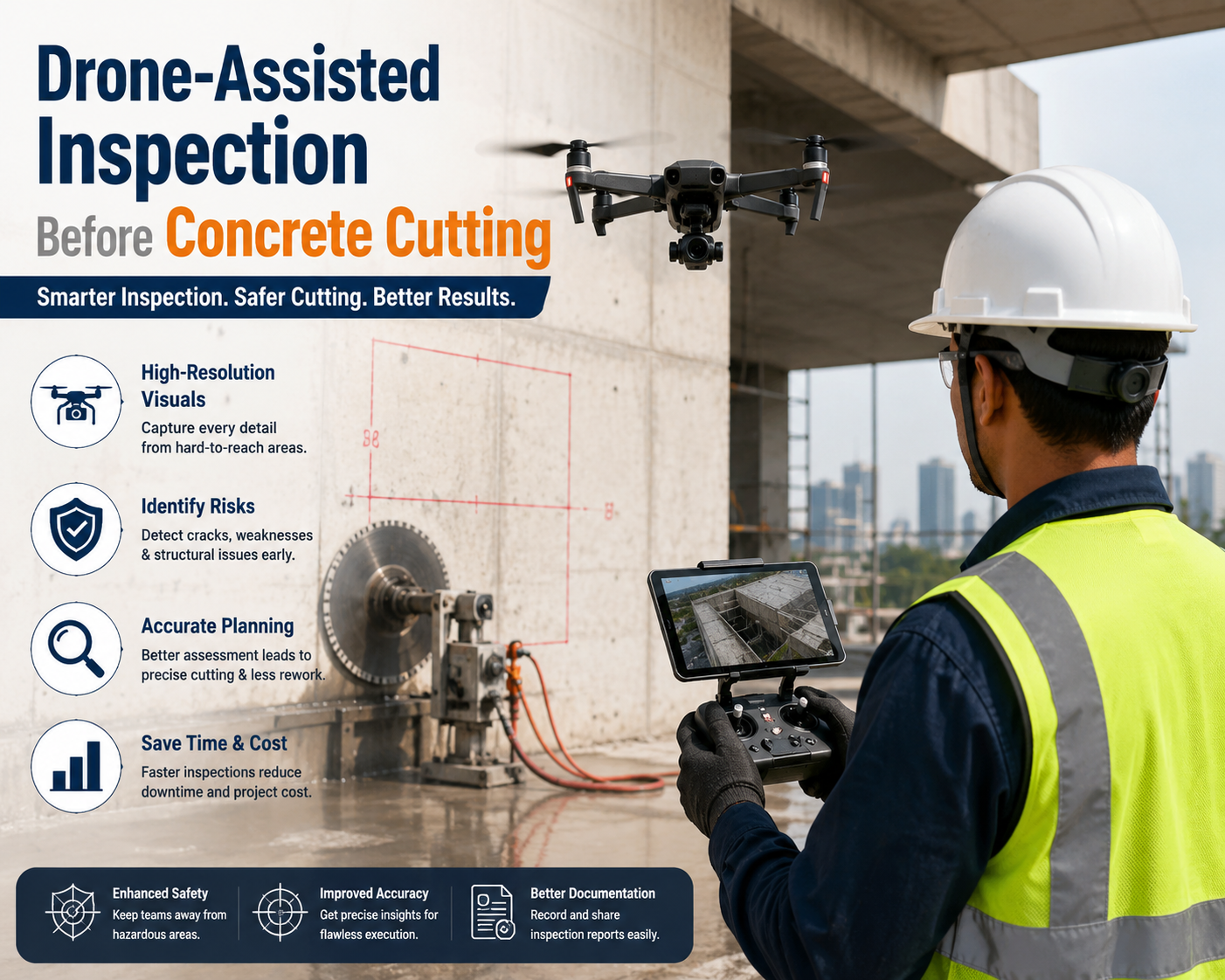
Drone-assisted inspection uses unmanned aerial vehicles (UAVs) equipped with high-resolution cameras, thermal imaging sensors, and sometimes LiDAR technology to capture detailed visual and structural data of a site before any physical work begins. Instead of relying solely on ground-level assessments, drones give inspectors an aerial and multi-angle view of the structure — including areas that would otherwise require scaffolding, cranes, or risky manual climbing to access.
For concrete cutting projects specifically, drones are used to:
- Map the overall structure and identify visible cracks, spalling, or deterioration
- Capture thermal imaging data to detect moisture intrusion or voids behind concrete surfaces
- Survey large industrial sites, bridges, chimneys, and high-rise facades quickly and safely
- Create 3D models of the structure to plan precise cutting paths
- Identify access points and potential hazards around the cutting zone before the crew arrives
While drones don't replace tools like GPR for detecting embedded rebar and utilities, they complement these technologies by providing a broader, faster, and safer overview of the entire site — something that's especially valuable for large commercial, industrial, or infrastructure projects.
How the Drone Inspection Process Works
A typical drone-assisted inspection before concrete cutting follows a structured process:
1. Pre-Flight Planning Before the drone even takes off, the inspection team studies existing structural drawings, previous survey data, and site access points. This helps define flight paths and identify priority zones for closer inspection.
2. Aerial Survey and Data Capture The drone is flown across the structure, capturing high-resolution images and video footage. For larger sites, this may involve multiple flight passes to cover different elevations and angles. Thermal cameras can also be used at this stage to detect temperature anomalies that may indicate hidden moisture, voids, or structural weaknesses.
3. Data Processing and 3D Mapping The captured footage is processed using specialized software to create detailed 3D models or orthomosaic maps of the structure. This gives engineers and cutting teams a clear visual reference of the entire site, including areas that are difficult to reach physically.
4. Cross-Referencing with GPR and Scanning Data Once the aerial data is available, it's cross-referenced with ground-based scanning results — such as GPR scans and rebar detection reports — to build a complete picture of both the external structure and its internal composition.
5. Cutting Plan Finalization With all this information combined, the cutting team can finalize a precise cutting plan. This includes marking exact cutting lines, identifying zones to avoid, and determining the safest equipment and technique for the job — whether that's a wall saw, wire saw, core drilling rig, or track saw.
Key Benefits of Drone-Assisted Inspection Before Concrete Cutting
Improved Safety for Workers Traditional inspections of tall structures, bridges, or industrial facilities often require workers to use scaffolding, cranes, or rope access systems just to get a visual assessment. Drones eliminate much of this risk by capturing the same data remotely, keeping inspection teams safely on the ground.
Faster Turnaround Times A drone can survey a large facade, rooftop, or multi-story structure in a fraction of the time it would take a human team to inspect manually. This speeds up the overall project timeline, allowing cutting work to begin sooner without compromising on thoroughness.
Better Access to Difficult Areas Bridges, water tanks, chimneys, elevated slabs, and rooftop structures are notoriously difficult to inspect using conventional methods. Drones can easily access these areas, capturing clear imagery without the need for expensive temporary access equipment.
More Accurate Documentation The high-resolution images and 3D models generated during drone inspections serve as valuable documentation for the entire project. They can be referenced later for quality checks, dispute resolution, or future maintenance planning.
Cost Savings on Large Projects While drone inspection does involve an upfront cost, it often reduces overall project expenses by minimizing the need for scaffolding, manual labor for hard-to-reach inspections, and costly rework caused by unexpected structural surprises during cutting.
Early Detection of Structural Issues Thermal imaging and high-resolution visuals can reveal early signs of concrete deterioration, cracking, or water damage that might not be visible to the naked eye. Identifying these issues before cutting begins allows the team to adjust their approach and avoid making existing problems worse.
Where Drone-Assisted Inspection Makes the Biggest Difference
Not every concrete cutting job requires a drone survey — a small residential wall opening, for instance, may only need a basic GPR scan. However, drone-assisted inspection becomes especially valuable in these scenarios:
- High-rise buildings and towers, where facade inspection or rooftop cutting work requires views from elevated, hard-to-access angles
- Bridges and flyovers, where structural assessment from below or from the sides is otherwise extremely difficult
- Industrial plants and chimneys, where safety regulations limit manual access to certain zones
- Large commercial complexes, where multiple cutting locations across a wide area need to be mapped efficiently
- Heritage or aging structures, where understanding existing deterioration is critical before any cutting or demolition work begins
Combining Drone Technology with Traditional Inspection Methods
It's important to understand that drone-assisted inspection isn't meant to replace tools like Ground Penetrating Radar, rebar locators, or ultrasonic testing devices. Each technology serves a different purpose. GPR and rebar scanners are essential for identifying what's inside the concrete — rebar, cables, and utility lines that drones simply cannot detect from the air.
Drones, on the other hand, excel at providing a broader, faster, and safer overview of the structure's exterior condition and overall layout. When combined, these technologies give cutting teams a complete, layered understanding of a site: what the structure looks like from every angle, and what's hidden beneath its surface. This combination significantly reduces the chances of unexpected surprises during the actual cutting process.
Why This Matters for Every Concrete Cutting Project
Every concrete cutting job — whether it's creating a doorway, installing new plumbing, cutting expansion joints, or preparing a structure for renovation — carries inherent risk if approached without proper planning. Drone-assisted inspection adds an extra layer of confidence to the process, ensuring that cutting teams have complete visibility into the site before they begin work.
This is particularly important in India's rapidly growing construction sector, where projects are becoming larger, taller, and more complex. As buildings age and infrastructure expands, the need for precise, non-destructive inspection methods before any structural modification becomes even more critical.
Choosing the Right Concrete Cutting Partner
When selecting a concrete cutting contractor, it's worth asking whether they incorporate advanced inspection methods like drone surveys and GPR scanning into their process. A contractor who invests in proper pre-cutting inspection is far more likely to deliver safe, accurate, and efficient results compared to one who relies solely on visual estimation.
At Core Cutting India, we combine modern inspection technology with decades of hands-on cutting expertise to ensure every project — from small residential openings to large-scale industrial cutting jobs — is executed with precision and safety at the forefront. Our team evaluates each site individually to determine whether drone-assisted inspection, GPR scanning, or a combination of both is the right approach before any cutting begins.
Final Thoughts
Concrete cutting is a precise trade that leaves little room for guesswork. As structures grow taller, sites become more complex, and safety regulations tighten, drone-assisted inspection is quickly becoming an essential part of responsible concrete cutting practice. It offers a faster, safer, and more comprehensive way to understand a structure before any blade or drill touches its surface.
Whether you're planning a small renovation or a large-scale infrastructure project, investing in proper pre-cutting inspection isn't just good practice — it's the foundation of a safe and successful job.
If you're planning a concrete cutting project and want to know whether drone-assisted inspection is right for your site, reach out to our team at [email protected]. Core Cutting India is here to help you plan every cut with confidence, precision, and safety.
Frequently Asked Questions
1. What is drone-assisted inspection in construction? It's the use of unmanned aerial vehicles equipped with cameras and sensors to capture visual, thermal, and structural data of a building or site, helping teams assess conditions before construction, cutting, or demolition work begins.
2. Why is inspection necessary before concrete cutting? Inspection helps identify hidden rebar, utility lines, cracks, or structural weaknesses inside or around the concrete. Cutting without this knowledge can damage utilities, weaken structural integrity, or injure workers.
3. Can drones detect rebar and embedded utilities inside concrete? Not directly. Drones capture exterior visual and thermal data, while tools like Ground Penetrating Radar (GPR) and rebar scanners are used to detect what's embedded inside the concrete itself.
4. Is drone inspection expensive for small projects? For small, straightforward jobs, a basic GPR scan is often sufficient. Drone inspection is most cost-effective and useful for large, elevated, or hard-to-access structures.
5. What is the difference between GPR scanning and drone inspection? GPR scanning detects what's inside the concrete, such as rebar and pipes, while drone inspection captures the exterior condition and overall layout of a structure, especially in areas that are difficult to access manually.
6. How long does a drone inspection take before cutting begins? Depending on the size and complexity of the site, a drone survey can typically be completed within a few hours to a day, with data processing and reporting following shortly after.