
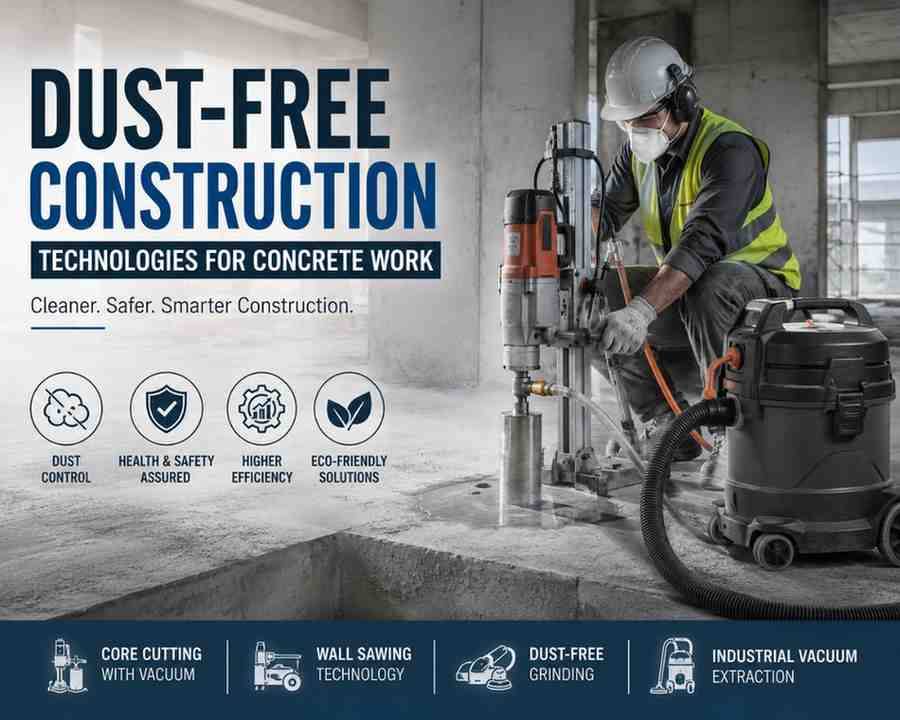
Concrete cutting, coring, and demolition have always been dusty jobs. For decades, contractors accepted clouds of fine grey dust as an unavoidable part of the trade — something to be swept up after the work was done, rather than prevented in the first place. That mindset is changing fast. Today, dust-free construction technologies are no longer a luxury reserved for high-end commercial projects; they are becoming an industry standard, driven by stricter safety regulations, growing awareness of occupational health risks, and a genuine push toward cleaner, smarter job sites.
At Core Cutting India, we've spent years working at the intersection of precision concrete cutting and worker safety. In this guide, we break down exactly what dust-free construction technology means, why it matters, and which methods and equipment are leading the shift toward cleaner concrete work.
Why Dust Control Matters in Concrete Work
When concrete, brick, stone, or masonry is cut, drilled, or ground, it releases fine particulate matter — much of it containing crystalline silica. Unlike ordinary construction debris, this dust is small enough to stay suspended in the air for hours and to penetrate deep into the lungs when inhaled.
The health consequences of prolonged, unprotected exposure are well documented. Respirable crystalline silica (RCS) has been linked to silicosis, chronic obstructive pulmonary disease, and an increased risk of lung cancer. Because these conditions often develop silently over years, workers may not realize the damage until it is advanced and irreversible.
Beyond health, dust creates practical problems on-site: reduced visibility, contaminated HVAC systems, damage to nearby equipment, complaints from neighboring residents or businesses, and additional cleanup time and cost. In dense urban environments — where a large share of construction and renovation work now takes place — uncontrolled dust can also violate local environmental and municipal regulations, leading to project delays or fines.
This combination of health, safety, environmental, and regulatory pressure is exactly why dust-free construction technology has moved from "nice to have" to "non-negotiable" on modern job sites.
What Is Dust-Free Construction Technology?
Dust-free construction technology refers to the equipment, techniques, and workflows designed to capture, suppress, or eliminate dust at the point it's generated — rather than letting it disperse into the air and settle across the site. It's a "capture at source" philosophy rather than a "clean up after" approach.
This isn't a single tool or gadget. It's an ecosystem of solutions that includes water-fed cutting systems, vacuum-integrated tools, high-efficiency filtration, enclosed cutting chambers, and even fully automated equipment that minimizes direct human exposure altogether. When these are combined intelligently, dust levels at the source can be reduced by well over 90% compared to traditional dry-cutting methods.
Core Dust-Free Technologies Used in Concrete Work
1. Wet Cutting and Wet Sawing
Wet cutting is one of the oldest and most reliable dust-control methods, and it remains a cornerstone of dust-free concrete work today. A controlled stream of water is directed onto the blade or cutting surface during operation. This water binds with dust particles as they're generated, turning airborne silica dust into a wet slurry that can be safely contained and disposed of rather than inhaled.
Modern wet saws — whether handheld, walk-behind floor saws, or wall saws — are engineered with precision water-flow systems that cool the diamond blade while suppressing dust, extending blade life and improving cut quality at the same time. Wet cutting is especially effective for road cutting, floor sawing, and large-format slab work.
2. Vacuum Dust Extraction Systems
For situations where water isn't practical — such as indoor renovations, electrical-sensitive environments, or finished interiors where slurry could cause damage — vacuum dust extraction is the preferred dust-free alternative.
These systems pair cutting or grinding tools with an integrated shroud or hood that encloses the cutting zone. A high-powered vacuum unit continuously draws dust away from the point of contact as it's produced, channeling it directly into a sealed collection canister. Because the dust never has a chance to become airborne in the room, this method keeps both the immediate work area and the wider site remarkably clean.
3. HEPA-Filtered Vacuum Systems
Standard vacuums aren't sufficient for construction-grade silica dust, since ordinary filters allow the finest — and most dangerous — particles to pass straight through and recirculate into the air. HEPA (High-Efficiency Particulate Air) filtration systems are designed to capture particles as small as 0.3 microns with over 99.97% efficiency.
Pairing dust-shrouded tools with HEPA-filtered vacuum units is now considered best practice for indoor and enclosed-space concrete work, including floor grinding, wall chasing, and core drilling near occupied areas.
4. Diamond Core Drilling with Water Cooling
Core drilling — used for everything from plumbing and electrical penetrations to structural sampling — generates a huge amount of fine dust when performed dry. Water-cooled diamond core drilling solves two problems at once: it suppresses dust at the drill bit, and it prevents the diamond segments from overheating, which significantly extends tool life and improves drilling accuracy.
For sites where water use is restricted, dry core drilling combined with a vacuum shroud attachment offers a practical dust-free alternative, particularly for smaller-diameter holes.
5. Dustless Floor Grinding and Polishing
Concrete floor grinding and polishing — a popular finish for warehouses, showrooms, and industrial facilities — traditionally produced enormous volumes of fine dust. Modern grinding machines now come with fully integrated dust shrouds connected to industrial vacuum systems, capturing debris continuously as the grinding head moves across the floor. This allows polishing work to be carried out even in occupied buildings without disrupting adjacent operations.
6. Enclosed and Containment-Based Cutting Systems
For particularly sensitive environments — hospitals, laboratories, food-processing facilities, or occupied residential buildings — physical containment adds another layer of protection. Temporary dust barriers, negative-air-pressure enclosures, and sealed cutting chambers prevent any dust that does escape a shroud from migrating into surrounding spaces. Combined with wet or vacuum methods, containment systems make it possible to perform concrete cutting work in even the most dust-sensitive locations.
7. Automated and Remote-Controlled Cutting Equipment
An emerging frontier in dust-free construction is automation. Remote-controlled wall saws, robotic demolition units, and semi-autonomous core drilling rigs allow operators to control equipment from a safe distance — reducing direct exposure to both dust and vibration. While still a growing category, automated equipment is increasingly used on large infrastructure and industrial demolition projects where dust and safety risks are highest.
Key Benefits of Dust-Free Construction Technology
Protects worker health. Reducing airborne silica dust is the single most effective way to lower the long-term risk of silicosis and related respiratory illness among concrete cutting crews.
Ensures regulatory compliance. Occupational safety authorities worldwide have tightened permissible exposure limits for respirable crystalline silica. Dust-free methods help contractors stay compliant and avoid penalties or project shutdowns.
Improves site cleanliness and neighbor relations. Less airborne and settled dust means less cleanup time, less damage to nearby surfaces and equipment, and fewer complaints from occupants or neighboring properties — particularly important for urban renovation and retrofit work.
Extends tool and equipment life. Water cooling and vacuum extraction reduce heat buildup and abrasive wear on diamond blades and bits, which translates into fewer replacements and lower long-term equipment costs.
Enables work in occupied and sensitive spaces. Hospitals, offices, data centers, and residential buildings can often only permit renovation work if dust generation is tightly controlled — dust-free technology makes these projects viable.
Supports environmental responsibility. Controlling dust at the source reduces particulate pollution released into the surrounding air and helps construction firms meet increasingly strict environmental clearance requirements.
Choosing the Right Dust-Free Approach for Your Project
Not every job calls for the same solution. The right combination of technology depends on several factors:
- Location: Outdoor road or slab cutting can often rely on wet cutting, while indoor or occupied spaces are usually better suited to vacuum and HEPA systems.
- Material and depth of cut: Deeper cuts and larger cross-sections generate more dust and heat, often requiring water-cooled equipment.
- Site sensitivity: Hospitals, labs, and finished interiors may require full containment in addition to source-capture methods.
- Water availability and drainage: Sites without adequate drainage or water access may need to default to dry-vacuum methods to avoid slurry management issues.
- Regulatory requirements: Local safety and environmental regulations may dictate minimum dust-control standards for a given project type.
An experienced concrete cutting contractor will assess these variables on-site and recommend the method — or combination of methods — that delivers both a clean result and full compliance.
Why Choose Core Cutting India
At Core Cutting India, dust-free technology isn't an add-on service — it's built into how we approach every concrete cutting, coring, and drilling project. Our teams work with modern wet-cutting saws, vacuum-shrouded grinding and drilling equipment, and HEPA-filtered dust extraction systems to keep job sites clean, compliant, and safe for both our crews and our clients' occupants.
Whether the project involves road and floor sawing, wall sawing, diamond core drilling, or controlled demolition, we tailor our dust-control strategy to the specific demands of the site — from open infrastructure projects to sensitive indoor renovations.
If you're planning a concrete cutting or coring project and want a partner who takes dust control and worker safety seriously, reach out to our team at [email protected]. We're happy to walk through your project requirements and recommend the right dust-free approach.
Final Thoughts
The construction industry's relationship with dust is changing for good reason. What used to be treated as an unavoidable nuisance is now understood as a serious occupational health hazard — and the technology to address it has matured to the point where dust-free concrete work is both achievable and cost-effective. Wet cutting, vacuum extraction, HEPA filtration, and containment systems, used individually or together, give contractors the tools to protect their workers, satisfy regulators, and deliver cleaner results for their clients.
As regulations continue to tighten and client expectations rise, contractors who adopt dust-free technology now will be better positioned for the projects — and the workforce — of the future.
Core Cutting India | [email protected]