
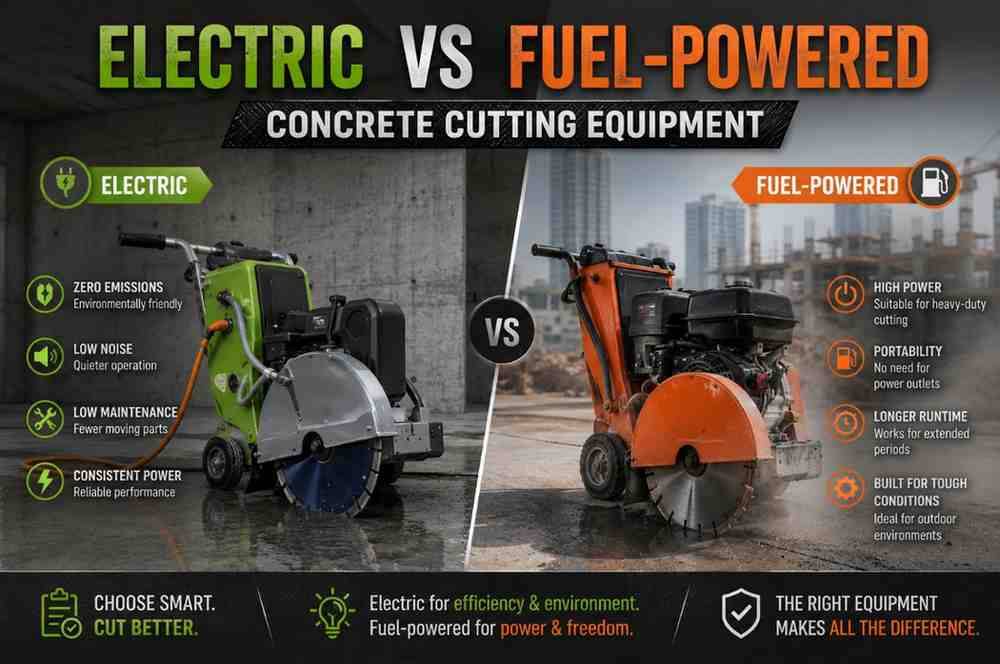
Concrete cutting is one of the most demanding tasks in construction, renovation, and demolition work. Whether you are widening a doorway, cutting expansion joints, removing a damaged slab, or creating openings for pipes and cables, the equipment you choose plays a direct role in how efficiently, safely, and cost-effectively the job gets done. Among the many decisions contractors and project managers face, one question comes up again and again: should you use electric concrete cutting equipment or fuel-powered (petrol/diesel) machines?
At Core Cutting India, we work with both types of equipment across residential, commercial, and industrial projects, and we know firsthand that there is no single "best" answer. The right choice depends on the site conditions, the scale of the project, ventilation, noise restrictions, and budget. In this blog, we break down the differences between electric and fuel-powered concrete cutting equipment so you can make an informed decision for your next project. If you need expert guidance or professional cutting services, you can always reach out to us at [email protected].
Understanding Concrete Cutting Equipment
Before comparing power sources, it helps to understand what concrete cutting equipment actually does. These machines use diamond-tipped blades, discs, or chains to cut through concrete, masonry, asphalt, and reinforced structures. Common types include:
- Wall saws – used for precision vertical and horizontal cutting in walls
- Floor saws – used for cutting slabs, roads, and pavements
- Wire saws – used for cutting thick or heavily reinforced concrete sections
- Handheld cutters – used for smaller, more mobile cutting jobs
- Core drills – used for creating circular openings for pipes, cables, and ducts
Each of these machines can be powered either by electricity or by an internal combustion engine running on petrol or diesel. The power source significantly affects how, where, and when the equipment can be used.
Electric Concrete Cutting Equipment: An Overview
Electric concrete cutters run on mains power or generators and are widely used in indoor and enclosed environments. They tend to be popular in urban construction sites, hospitals, residential buildings, and commercial spaces where noise and air quality are strictly regulated.
Advantages of Electric Equipment
1. Zero on-site emissions. Because electric machines don't burn fuel, they don't release carbon monoxide or other exhaust fumes. This makes them the safer and often the only legal choice for indoor cutting jobs, basements, tunnels, and poorly ventilated spaces.
2. Lower noise levels. Electric motors are significantly quieter than combustion engines. This is a major advantage for projects in hospitals, schools, residential complexes, or any site with strict noise ordinances.
3. Lower maintenance requirements. Electric equipment has fewer moving parts than fuel-powered engines. There's no need to manage fuel filters, spark plugs, or exhaust systems, which reduces maintenance time and long-term servicing costs.
4. Consistent power output. Electric motors deliver steady, consistent torque, which can result in smoother, more precise cuts, especially useful for detailed or high-accuracy jobs.
5. Environmentally friendly. With no direct fuel combustion, electric machines have a smaller carbon footprint, which is increasingly important as construction companies work toward sustainability goals and green building certifications.
Limitations of Electric Equipment
1. Dependency on power supply. Electric cutters need a reliable power source, either grid electricity or a generator. On remote sites or locations with unstable power, this can be a serious limitation.
2. Cable management. Power cords limit mobility and can be a tripping hazard or logistical challenge on large or sprawling job sites.
3. Lower power for heavy-duty tasks. While technology has improved significantly, some high-powered fuel engines still outperform electric motors when it comes to cutting extremely thick or heavily reinforced concrete over long durations.
Fuel-Powered Concrete Cutting Equipment: An Overview
Fuel-powered machines, typically running on petrol or diesel, have long been the standard for outdoor and heavy-duty concrete cutting. They are valued for their portability and raw power, especially on large infrastructure and road construction projects.
Advantages of Fuel-Powered Equipment
1. High mobility and independence. Since these machines don't rely on a power cord or nearby outlet, they can be used virtually anywhere, including remote sites, highways, and locations without electrical infrastructure.
2. Greater cutting power. Fuel engines, particularly diesel ones, often deliver higher horsepower, making them well-suited for large-scale, continuous cutting operations such as road resurfacing, bridge work, and thick industrial slabs.
3. Faster setup. There's no need to run cables or arrange a power source. You simply fuel the machine and get to work, which can save valuable time on fast-moving job sites.
4. Better suited for extended outdoor use. Fuel-powered equipment is generally built to withstand tougher, more exposed working conditions over long shifts.
Limitations of Fuel-Powered Equipment
1. Exhaust emissions. Combustion engines release carbon monoxide and other pollutants, making them unsuitable and often illegal for indoor or enclosed spaces without proper ventilation.
2. Higher noise levels. Petrol and diesel engines are considerably louder, which can be a problem near residential areas, hospitals, or sites with noise restrictions.
3. More maintenance. Fuel-powered machines require regular servicing, including oil changes, spark plug replacement, air filter cleaning, and fuel system checks.
4. Fuel costs and storage. Ongoing fuel expenses add up, and storing and transporting fuel safely adds another layer of logistics and risk to manage on-site.
5. Higher environmental impact. Emissions contribute to air pollution and carbon output, which may conflict with sustainability targets on modern construction projects.
Electric vs Fuel-Powered: A Side-by-Side Comparison
| Factor | Electric Equipment | Fuel-Powered Equipment |
|---|---|---|
| Best suited for | Indoor, enclosed, noise-sensitive sites | Outdoor, remote, heavy-duty sites |
| Emissions | None on-site | Carbon monoxide and exhaust fumes |
| Noise level | Low | High |
| Power output | Moderate to high (improving steadily) | Very high, especially diesel |
| Mobility | Limited by power source/cables | Highly mobile |
| Maintenance | Lower | Higher |
| Running cost | Electricity cost | Fuel cost |
| Environmental impact | Lower | Higher |
Which One Should You Choose?
The decision between electric and fuel-powered concrete cutting equipment ultimately comes down to the specifics of your project. Here's a simple way to think about it:
Choose electric equipment if:
- You're working indoors, underground, or in an enclosed space
- The site has noise restrictions (hospitals, residential zones, schools)
- You have reliable access to power
- You're prioritizing lower emissions and a smaller environmental footprint
- The job requires precision cutting over raw cutting power
Choose fuel-powered equipment if:
- You're working outdoors or on a remote site with no power access
- The project involves large-scale, continuous, heavy-duty cutting
- Mobility and independence from power sources are essential
- The task involves cutting extremely thick or heavily reinforced concrete
Many large-scale projects, in fact, use a combination of both. Fuel-powered machines handle the heavy outdoor cutting, while electric equipment takes care of interior work where ventilation and noise are concerns.
Why Professional Expertise Matters
Choosing the right equipment is only part of the equation. Concrete cutting also demands precise technique, proper safety protocols, and an understanding of structural implications, especially when cutting near load-bearing walls, embedded utilities, or reinforced sections. Improper cutting can compromise structural integrity, create dust and safety hazards, or lead to costly rework.
This is where experienced concrete cutting professionals make a real difference. At Core Cutting India, our teams are trained to assess each site and select the right combination of electric and fuel-powered equipment based on the specific demands of the job, whether it's a small residential renovation or a large industrial demolition project. We factor in ventilation, noise regulations, structural considerations, and project timelines before recommending an approach.
Safety Considerations for Both Equipment Types
Regardless of the power source, concrete cutting comes with inherent risks that must be managed carefully:
- Dust control: Concrete cutting generates fine silica dust, which is hazardous if inhaled. Wet cutting methods and dust extraction systems should be used wherever possible.
- Personal protective equipment (PPE): Operators should always wear safety goggles, hearing protection, gloves, and appropriate respiratory protection.
- Ventilation: For fuel-powered equipment used in semi-enclosed areas, proper ventilation is essential to prevent carbon monoxide buildup.
- Electrical safety: For electric equipment, cables and connections must be checked regularly to avoid electrical hazards, especially in wet cutting conditions.
- Blade selection: Using the correct diamond blade for the material being cut reduces the risk of blade failure and improves cutting efficiency.
Final Thoughts
Both electric and fuel-powered concrete cutting equipment have their place in modern construction and demolition work. Electric machines shine in indoor, noise-sensitive, and emission-restricted environments, while fuel-powered equipment delivers the raw power and mobility needed for large outdoor and heavy-duty projects. Understanding these differences helps you plan smarter, work more safely, and avoid costly delays.
If you're unsure which equipment is right for your upcoming project, the team at Core Cutting India is here to help. With experience across residential, commercial, and industrial concrete cutting projects, we bring the right tools, techniques, and expertise to every job. Get in touch with us at [email protected] to discuss your project requirements and get a solution tailored to your site.