
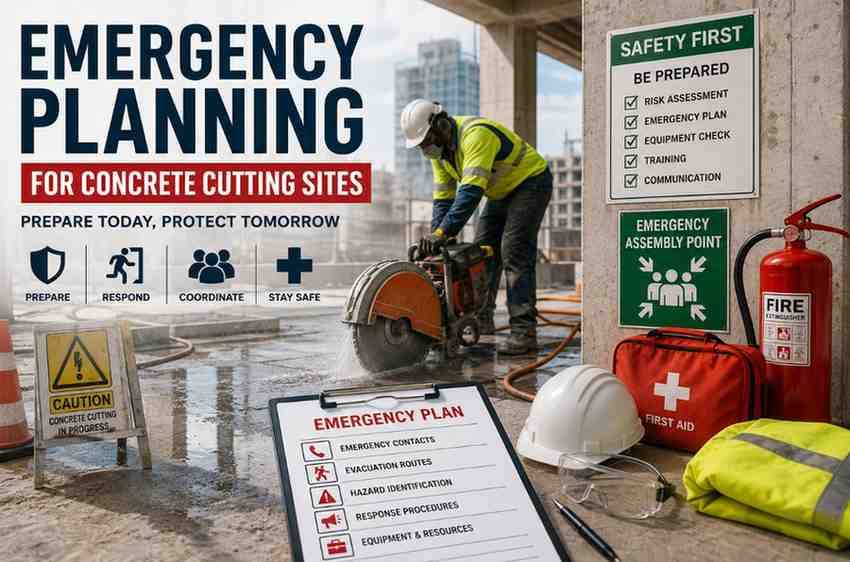
Concrete cutting is among the most demanding and high-risk operations in the modern construction and demolition industries. Whether a crew is performing wall sawing, core drilling, flat sawing, or diamond wire sawing, the combination of heavy machinery, high-voltage power sources, pressurized water systems, and compromised structural elements creates a challenging work environment.
When things go wrong on a concrete cutting site, they tend to escalate rapidly. A blade failure can turn into shrapnel, a compromised slab can suffer an unexpected structural collapse, or utility strikes can trigger electrocutions and flooding. Because the margin for error is razor-thin, having a robust, well-rehearsed emergency plan is not just an administrative formality—it is a matter of life and death.
The Unique Hazards of Concrete Cutting Operations
Before drafting an emergency action plan (EAP), safety managers and site supervisors must thoroughly understand the specific hazards associated with concrete cutting. Unlike general construction, concrete cutting introduces distinct physical and mechanical stressors.
1. Structural Collapse and Unintended Demolition
Cutting into load-bearing walls, foundations, elevated slabs, or bridge decks alters the structural integrity of a building instantly. If shoring is inadequate or calculations are flawed, sections of concrete can shear off prematurely, trapping workers or bringing down adjacent structures.
2. High-Pressure Hydraulic and Electrical Hazards
Modern diamond wire saws and heavy-duty wall saws rely on high-pressure hydraulic power packs or high-voltage electrical systems. Hydraulic line ruptures can spray high-temperature fluid, causing severe burns or injection injuries, while electrical faults in wet environments exponentially increase the risk of electrocution.
3. Flying Debris and Blade Fragmentation
Diamond-segmented blades spin at incredible speeds. If a blade binds, hits a hidden piece of heavy rebar at an awkward angle, or suffers structural fatigue, it can fragment violently. These shards act like shrapnel, threatening operators and bystanders alike.
4. Utility Strikes (Electrical, Gas, and Water)
Subsurface utility clearance is mandatory, but mislocated conduits, live electrical lines, high-pressure water pipes, or gas lines are still accidentally struck during core drilling and wall sawing. A gas line strike can lead to instant ignition, while a major water strike can flood the work area and short-circuit equipment.
5. Silica Dust and Chemical Exposure
While wet cutting significantly mitigates airborne crystalline silica dust, water supply failures can instantly turn a wet cut into a blinding cloud of hazardous dust. Additionally, chemical grouts and sealants used in conjunction with cutting can cause severe respiratory and dermal irritation if containment fails.
Core Components of an Effective Emergency Action Plan
An emergency plan for a concrete cutting site must be comprehensive, site-specific, and easily understood by every crew member on the ground. According to safety regulations and industry best practices, an effective EAP must include the following foundational pillars:
1. Chain of Command and Roles
Confusion during an emergency wastes precious seconds. The EAP must clearly define who is in charge during a crisis.
-
Site Incident Commander: Usually the project manager or senior safety officer, responsible for coordinating the overall response.
-
Communications Lead: Responsible for calling emergency services (police, fire, ambulance) and notifying relevant stakeholders.
-
First Aid Responders: Designated personnel certified in CPR, advanced first aid, and trauma response (specifically trained for construction injuries like crushing, lacerations, and amputations).
2. Emergency Contact Directory
A visible, up-to-date contact list must be posted at the site office and tool stations. This list should include:
-
Local emergency services (Police, Fire, Medical)
-
Nearest hospital with a trauma center (including physical directions from the job site)
-
Utility providers (Electric, Gas, Water)
-
Company safety director and corporate headquarters
-
Equipment manufacturers or technical support (in case specialized machinery needs to be shut down via emergency overrides)
3. Evacuation Routes and Assembly Points
Every concrete cutting site—whether it is a subterranean basement, a high-rise core, or an open-air highway bridge—must have designated evacuation routes.
-
Routes must be kept clear of slurry hoses, power cords, and cut concrete debris at all times.
-
Assembly points must be located safely away from the drop zone of cranes, heavy vehicles, and unstable structures.
-
Roll calls must be conducted immediately after evacuation to account for all workers, subcontractors, and visitors.
Step-by-Step Response Protocols for Specific Scenarios
Different emergencies require vastly different tactical responses. Below are standard protocols for the most common critical incidents encountered on concrete cutting sites.
Scenario A: Structural Collapse or Slab Drop
If a section of concrete shifts unexpectedly or begins to collapse:
-
Immediate Halt: Anyone spotting movement must shout the predetermined stop command and hit master kill switches if safe to do so.
-
Evacuate the Immediate Zone: All workers must clear the collapse zone immediately to prevent secondary collapses.
-
Account for Personnel: Conduct an immediate head count at the assembly point.
-
Do Not Attempt Amateur Rescuers: If workers are trapped beneath heavy concrete, do not attempt to lift slabs with makeshift equipment, as this can cause shifting and further crush injuries. Wait for professional urban search and rescue (USAR) teams equipped with hydraulic spreaders, airbags, and shoring equipment.
-
Secure Utilities: Shut down main power and gas feeds to the affected zone to prevent fires or secondary electrocutions.
Scenario B: Severe Injury (Laceration, Amputation, or Crush)
Concrete cutting machinery can cause catastrophic soft-tissue and bone injuries.
-
Shut Down Equipment: Instantly cut power to the saw, wire saw, or core drill. Never pull a victim away from active machinery if it risks entangling them further.
-
Apply Trauma First Aid: Utilize the site trauma kit. For severe arterial bleeding or amputations, apply a tourniquet immediately high and tight on the limb. For crush injuries, note the exact time the weight was applied or removed to inform paramedics about potential crush syndrome.
-
Clear Access for EMS: Ensure site gates and internal access paths are completely cleared of machinery, vans, and debris so emergency vehicles can pull directly up to the patient.
-
Preserve the Scene: Do not alter the position of equipment unless necessary for life safety, as OSHA or local safety authorities will require an incident investigation.
Scenario C: Utility Strike (Electrical or Gas)
Striking a hidden utility line requires immediate, decisive action.
-
Electrical Strike:
-
Assume all lines are live. Do not touch the equipment or the operator if they are in contact with the machine and showing signs of shock.
-
If the operator is conscious and clear, shut down the main breaker panel feeding the work area.
-
If the operator is unresponsive and touching the machinery, do not touch them directly. Use a non-conductive rescue hook or wait for the utility company to cut power at the transformer.
-
-
Gas Line Strike:
-
Evacuate the area immediately upwind.
-
Eliminate all sources of ignition (turn off engines, forbid smoking, avoid using cell phones near the leak).
-
Call the gas emergency hotline and fire department immediately. Do not attempt to clamp or patch a high-pressure gas line yourself.
-
Equipment-Specific Emergency Shutdown Procedures
Knowing how to rapidly deactivate specialized concrete cutting machinery can prevent a minor mishap from turning fatal.
-
Wall Saws and Track Saws: Operators must know the exact location of the remote emergency stop (E-stop) pendant and the main power disconnect box. In a bind, cutting power at the source is safer than reaching across a spinning blade housing.
-
Diamond Wire Saws: Wire saws operate under extreme tension. If a wire snaps (known as "birdcaging" or breaking), it can whip violently through the air. The wire saw housing is designed to contain this, but operators must immediately hit the master kill switch to stop the drive pulley. Everyone must stay clear until the flywheel comes to a complete standstill.
-
Core Drills: Core drill motors can bind suddenly, causing the entire drill rig to violently spin and twist the operator's wrists or arms. Operators should be positioned so they can easily slap the paddle switch or pull the plug if the core barrel jams in the rebar.
Training, Drills, and Communication
An emergency plan written on a piece of paper inside a trailer is useless if the crew has never practiced it. Safety culture on a concrete cutting site must prioritize proactive readiness.
ToolBox Talks and Safety Briefings
Before starting any new project—especially complex structural cutting jobs—hold a comprehensive briefing. Discuss:
-
Specific weight loads and cut sequences.
-
Location of emergency exits, fire extinguishers, and first aid kits.
-
Emergency signals (air horns, whistles, or verbal cues).
Regular Emergency Drills
Conduct periodic, unannounced mock drills simulating scenarios like a sudden hydraulic fluid fire, an electrical short, or a partial shoring failure. Evaluate how quickly the team evacuates, how accurately the head count is performed, and whether communication protocols function smoothly.
Multilingual Communication
On many construction and concrete cutting sites, crews may speak multiple languages. Ensure that all critical emergency signage, evacuation maps, and verbal safety instructions are communicated in the primary languages spoken by the workforce. Miscommunication during a crisis wastes precious minutes.
Post-Emergency Procedures and Continuous Improvement
When an emergency occurs and is successfully resolved, the work does not end when the ambulance departs. A rigorous post-incident protocol ensures accountability and prevents future occurrences.
-
Incident Reporting and Investigation: Document every detail of what happened, why it happened, and who was involved. Take photographs, preserve damaged equipment, and collect witness statements before memories fade.
-
Regulatory Notifications: Depending on the severity of the incident (e.g., fatalities, hospitalizations, or major structural failures), notify regulatory bodies like OSHA or local labor authorities within the mandated legal timeframe.
-
Debriefing the Crew: Bring the team together to discuss the emergency. Analyze what went right during the response and where communication or execution broke down.
-
Updating the EAP: Use the lessons learned from the incident or drill to refine and update the site’s emergency action plan. Safety is a living process that must continuously adapt to new machinery, tighter deadlines, and complex job site environments.
Conclusion
Emergency planning for concrete cutting sites demands absolute diligence, technical knowledge, and unwavering discipline. Because concrete cutting involves heavy loads, massive kinetic energy, and hidden structural risks, hazards can materialize without warning. By implementing a clear chain of command, establishing rigorous equipment shutdown procedures, conducting regular drills, and maintaining open lines of communication, companies can safeguard their most valuable asset: their workers.
For professional guidance, equipment safety standards, or specialized concrete cutting services, reach out to industry experts at [email protected] to ensure your next project meets the highest benchmarks of safety and operational excellence.
Target-Related Searches
-
concrete cutting safety manual PDF
-
wall sawing hazard assessment
-
diamond wire saw safety protocols
-
core drilling risk management checklist
-
construction site emergency action plan template
People Also Ask (PAA) Questions
-
What are the main hazards of concrete cutting?
-
How do you respond to a structural collapse on a construction site?
-
What is the emergency procedure for a diamond wire snap?
-
Why is wet cutting important for safety?
-
Who is responsible for emergency planning on a demolition site?