
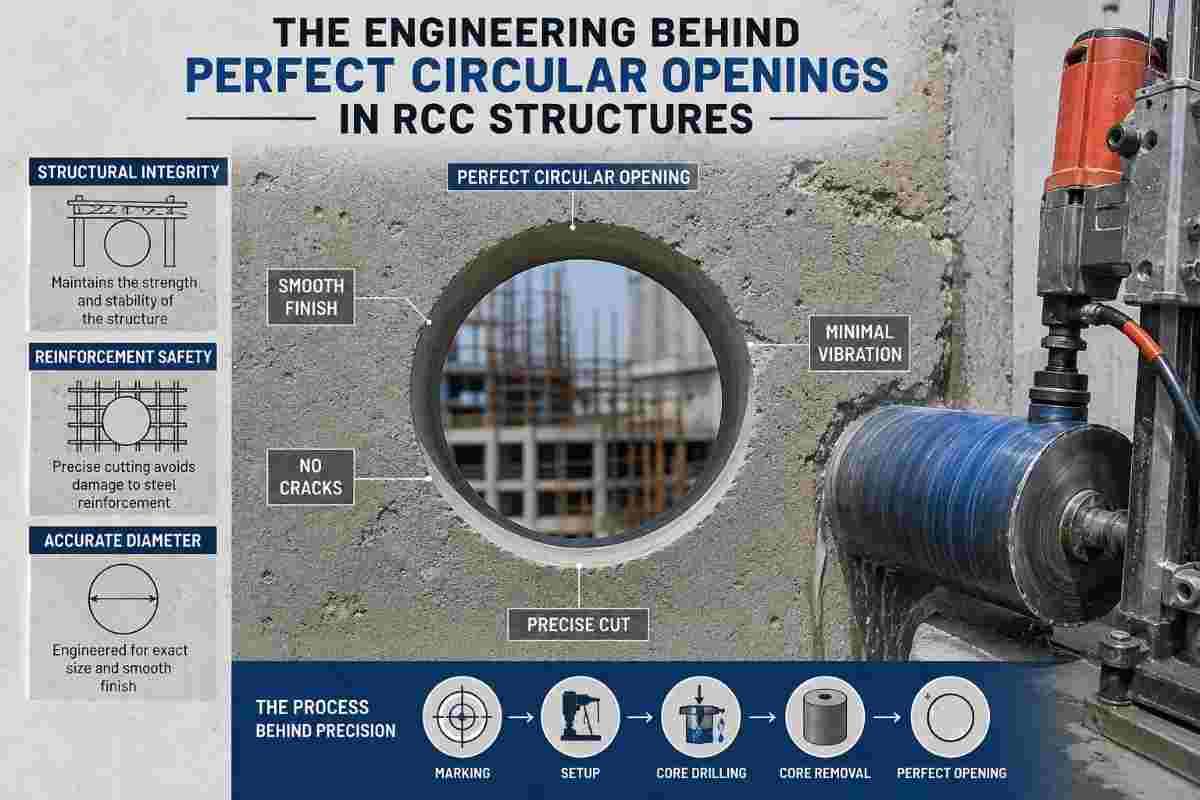
Introduction: Precision Matters in RCC Openings
Reinforced Cement Concrete, commonly known as RCC, is designed to carry substantial structural loads. It combines concrete's compressive strength with steel reinforcement's tensile capacity to create slabs, beams, walls, columns, foundations, and other structural components.
However, modern buildings require numerous openings for plumbing pipes, electrical conduits, air-conditioning lines, drainage systems, fire-fighting pipes, ventilation, communication cables, and other MEP services. Creating these openings after concrete has hardened requires much more than simply drilling a hole.
A perfectly circular opening in RCC is the result of engineering, accurate measurement, appropriate equipment, controlled cutting speed, reinforcement awareness, and experienced operation.
This is where professional diamond core drilling becomes important. Instead of breaking concrete with impact tools, core drilling uses a hollow diamond-tipped bit that gradually grinds through concrete and reinforcement, removing a cylindrical core. The technique is widely used for clean, controlled openings with minimal disturbance to the surrounding concrete.
For projects requiring precision RCC cutting, Core Cutting India provides specialized core cutting and diamond drilling solutions for construction, renovation, and MEP requirements.
What Makes a Circular RCC Opening "Perfect"?
A professional circular opening is not judged only by whether a pipe can pass through it. Engineering quality involves several factors:
- Correct diameter
- Accurate centre location
- Circular geometry
- Smooth internal surface
- Controlled penetration depth
- Minimal damage around the opening
- Appropriate treatment of reinforcement
- Proper alignment with the service being installed
- Safe execution without compromising structural performance
For example, a hole intended for an AC pipe may need only a relatively small diameter, while plumbing, drainage, fire-fighting, or HVAC systems may require substantially larger openings.
The important principle is that the opening must be designed and executed according to both the service requirement and the structural condition of the RCC member.
The Engineering Principle Behind Diamond Core Drilling
The central engineering concept behind core drilling is controlled rotary abrasion.
A diamond core bit is a hollow cylindrical tool with industrial diamond segments attached around its cutting edge. As the bit rotates, the diamond segments grind through cement paste, aggregates, and, where encountered, steel reinforcement.
Unlike percussion drilling, the primary cutting action is rotational rather than repeated hammer impacts. This allows the operator to maintain a controlled cutting path and produce a cylindrical opening.
The removed material forms a cylindrical concrete core. Once drilling reaches the required depth or passes completely through the member, the core can be extracted.
This principle explains why diamond core drilling is particularly effective when accurate circular openings are required. Core Cutting India's technical guides describe the process as a precision method for producing clean cylindrical openings in concrete and RCC.
1. Engineering Assessment Comes Before Cutting
One of the most important aspects of professional RCC core cutting happens before the machine starts.
The proposed opening must first be assessed.
An engineer or experienced site professional may need to consider:
- Type of RCC member
- Thickness of the concrete
- Structural function
- Location of reinforcement
- Presence of embedded services
- Required hole diameter
- Required depth
- Accessibility
- Potential effect on structural capacity
A circular opening in a non-structural partition is very different from a penetration through a structural slab, beam, column, or load-bearing wall.
For structural members, the proposed opening should be reviewed according to the project's structural drawings and applicable engineering requirements. Core drilling should never be treated as permission to arbitrarily remove structural concrete.
Core Cutting India's guidance similarly emphasizes site assessment and structural evaluation before creating openings in existing concrete structures.
2. Rebar Scanning: Finding What Is Hidden Inside RCC
RCC does not contain only concrete. Steel reinforcement is embedded inside it, and the location of that reinforcement can be critical.
Before drilling, professional teams may use reinforcement detectors or scanning equipment to identify embedded steel and other potential obstructions.
This step helps answer important questions:
- Where are the reinforcement bars?
- Is the proposed hole intersecting important reinforcement?
- Are electrical conduits or other services embedded nearby?
- Is there a post-tensioning system that requires special precautions?
The purpose is not simply to make drilling easier. It is to reduce the risk of cutting critical reinforcement or concealed services.
For particularly sensitive structures, advanced scanning methods such as GPR may be appropriate. A scan-first approach is especially important when modifying existing structural concrete.
3. Accurate Marking Determines the Final Result
Once the location is approved, the centre point of the opening must be accurately marked.
Even the best core drilling machine cannot compensate for an incorrectly marked hole.
The team generally establishes:
- Exact centre point
- Required diameter
- Drilling direction
- Required depth
- Alignment with the pipe, duct, or service
For through-holes, alignment between the entry and exit sides is particularly important.
Consider a plumbing penetration through a slab. If the hole is slightly misaligned, the pipe may not connect properly with the riser below. Similarly, an AC pipe penetration through a wall needs sufficient accuracy to accommodate the pipe, insulation, sleeve, and finishing requirements.
Precision at the marking stage therefore directly affects installation quality.
4. Choosing the Correct Core Bit
Core drilling is not a one-bit-fits-all operation.
The diameter and specification of the diamond core bit must correspond to the required opening and the material being cut.
The selection can depend on:
- Required hole diameter
- RCC strength
- Aggregate characteristics
- Reinforcement density
- Concrete thickness
- Drilling orientation
- Required drilling speed
- Machine capacity
A bit that is inappropriate for the material can reduce cutting efficiency, increase wear, generate excessive heat, or produce poor results.
Professional diamond drilling equipment is designed to provide controlled cutting through concrete and reinforced concrete.
5. Rig Stability Is Critical to Circular Accuracy
A core drill must remain stable while cutting.
The drilling rig or stand is therefore securely positioned before operation. Depending on the project and equipment, anchoring arrangements can vary.
Why does stability matter?
Imagine trying to create a perfect circle while the cutting tool moves sideways during rotation. The result can be an irregular opening, excessive bit wear, or difficulty maintaining the intended drilling direction.
A properly secured rig helps maintain:
- Consistent drilling direction
- Circular geometry
- Controlled pressure
- Reduced vibration
- Better operator control
- More predictable cutting performance
Core Cutting India's published process guides identify secure rig setup as an important stage of professional core drilling.
6. The Role of Water in Wet Diamond Drilling
Water is commonly used during wet diamond core drilling.
It performs several important functions:
Cooling
Diamond cutting generates heat. Continuous water flow helps remove heat from the cutting zone.
Slurry Removal
Water helps carry away fine concrete particles produced during drilling.
Tool Life
Proper cooling can help reduce excessive thermal stress on the cutting equipment.
Dust Control
Wet drilling significantly reduces airborne dust compared with dry impact methods, which is especially useful on occupied construction or renovation sites.
The resulting water-and-concrete mixture is commonly collected and managed as slurry rather than allowing dust to spread through the work area. Core Cutting India's technical material highlights water cooling and dust control as important advantages of diamond drilling.
7. Controlled Cutting Produces a Clean Opening
Once the machine is positioned and operating conditions are confirmed, the diamond core bit begins penetrating the RCC.
The operator must maintain controlled feed pressure.
Too much force can create unnecessary stress on the equipment and reduce cutting efficiency. Too little controlled pressure can slow the operation.
The objective is to allow the diamond segments to perform the cutting work efficiently.
As the bit progresses, it passes through layers of cement paste and aggregate and may encounter reinforcement steel. Professional diamond tooling is designed for such applications, but reinforcement density and structural considerations still need to be accounted for.
The result is a cylindrical cut rather than a fractured opening.
8. Why Circular Openings Are Structurally Valuable
There is an engineering reason circular openings are commonly preferred for pipe penetrations.
A circle has no sharp internal corners. Compared with an irregular or angular opening, a properly formed circular penetration provides a smooth boundary around the opening.
This is particularly useful when installing:
- Plumbing pipes
- Drainage pipes
- AC copper lines
- Electrical conduits
- Fire-fighting pipes
- HVAC services
- Communication cables
The exact structural effect of an opening depends on its location, diameter, member type, reinforcement arrangement, and loading conditions. Therefore, the fact that an opening is circular does not automatically make it structurally acceptable.
The geometry is only one part of the engineering solution.
9. Core Cutting vs. Hammering: Why Precision Wins
Traditional breaking methods use impact energy to fracture concrete. While such methods can be useful for certain demolition activities, they are not ideal when the objective is a precise circular penetration.
Hammering can produce:
- Irregular edges
- Excessive vibration
- Unnecessary concrete damage
- More debris
- Difficult finishing
- Less dimensional control
Diamond core drilling approaches the task differently.
It removes a defined cylindrical section of material and can provide a much cleaner opening with considerably less disturbance to surrounding concrete.
This is one reason professional core cutting is widely used for MEP installations and retrofit work in existing buildings.
10. Common Applications of Circular RCC Openings
Perfect circular openings have applications across almost every modern building type.
Plumbing
RCC slabs and walls often require penetrations for water supply, drainage, soil pipes, and waste lines.
HVAC and AC Installation
Small and medium-sized openings may be required for AC copper pipes, drain lines, ventilation systems, and HVAC services.
Electrical Systems
Core drilling can provide controlled passages for electrical conduits and cable routes.
Fire-Fighting Systems
Commercial buildings and industrial facilities frequently require penetrations for fire-fighting and sprinkler pipelines.
Data and Communication
Modern buildings contain extensive networking, CCTV, fibre-optic, and communication infrastructure.
Industrial Construction
Factories and warehouses may require openings for process pipes, ventilation, utilities, and equipment connections.
These applications are among the reasons diamond core drilling has become an important part of modern construction and building-service installation.
11. Special Considerations for Slabs, Walls, Beams and Columns
Not every RCC element should be approached in the same way.
RCC Slabs
Slab penetrations are frequently required for plumbing, electrical and HVAC services. However, reinforcement layout and the structural role of the slab must be considered before drilling.
RCC Walls
Walls may contain structural reinforcement and embedded services. The proposed location and size of the penetration should be assessed carefully.
Beams
Beams are structural load-carrying elements. Creating an opening can alter the load path and therefore generally requires engineering review before cutting.
Columns
Columns are critical vertical structural elements. Unauthorized drilling or cutting can potentially compromise their capacity and should never be undertaken simply because a pipe needs to pass through.
For structural modifications, the safest approach is to follow approved engineering drawings and obtain appropriate structural review before cutting.
12. Finishing and Post-Cutting Inspection
The work does not necessarily end when the core comes out.
After drilling, the opening should be inspected for:
- Correct diameter
- Correct location
- Clean edges
- Required depth
- Alignment
- Unintended damage
- Proper service fit
If the penetration is being used for a pipe or cable, the opening may require a sleeve or other finishing arrangement.
In fire-rated walls and floors, penetrations may also require appropriate fire-stopping systems after services are installed. Core Cutting India's guidance highlights sealing and fire-stopping as important considerations for service penetrations in applicable buildings.
13. Safety Is Part of Engineering
A technically accurate hole is not a successful job if the process creates unacceptable risk.
Professional RCC core cutting should consider:
- Operator safety
- Electrical safety
- Water management
- Equipment stability
- Falling core sections
- Work-at-height requirements
- Nearby occupants
- Embedded services
- Structural stability
- Slurry collection and disposal
Particular care is required when drilling overhead or through thick slabs because the extracted concrete core can be heavy.
The work area should be controlled so that people are not exposed to falling materials, rotating equipment, electrical hazards, or uncontrolled slurry.
How Core Cutting India Approaches Precision RCC Openings
At Core Cutting India, the focus of professional RCC core cutting is precision combined with controlled execution.
The typical workflow involves:
Site assessment → Location marking → Reinforcement/service scanning → Equipment selection → Rig setup → Water management → Diamond core drilling → Core extraction → Inspection → Finishing
This structured approach is particularly useful for projects where clean openings, predictable dimensions, and minimum disturbance are important.
Core Cutting India's published resources describe applications ranging from residential plumbing and AC installations to commercial HVAC, electrical, fire-fighting, and other building-service penetrations.
Factors That Affect RCC Core Cutting Performance
Several factors influence the time, difficulty, and cost of a core cutting project:
Hole Diameter
Larger openings generally require more powerful equipment and longer cutting time.
RCC Thickness
A deeper hole means the diamond bit must remain engaged with the material for longer.
Reinforcement Density
Dense reinforcement can affect drilling speed and tooling requirements.
Concrete Characteristics
Concrete strength, aggregate type, age, and condition can influence cutting performance.
Accessibility
Restricted locations may require specialized equipment or additional setup.
Number of Openings
Multiple identical holes can often be planned more efficiently than isolated openings.
Working Environment
Occupied buildings, hospitals, offices, and residential properties may require additional dust, water, noise, and safety controls.
For this reason, professional contractors generally evaluate the site before providing a final project quotation rather than relying solely on a generic per-hole rate.
Frequently Asked Questions
What is the engineering principle behind RCC core cutting?
RCC core cutting uses controlled rotary abrasion. A hollow diamond-tipped core bit rotates against concrete and reinforcement, gradually removing a cylindrical section and producing a precise circular opening.
Can diamond core drilling cut through reinforcement?
Yes, suitable diamond core drilling equipment can cut through reinforced concrete and embedded steel. However, reinforcement should be located and assessed before cutting because removing structural reinforcement may affect the member's performance.
Is core cutting safe for RCC structures?
Core cutting can be a controlled method for creating openings, but safety depends on the location, diameter, structural member, reinforcement arrangement, and engineering assessment. Structural members should not be drilled without appropriate review.
Why is a circular opening better than a manually broken hole?
A diamond core drill produces a controlled cylindrical opening with smooth edges and accurate dimensions. Manual breaking can produce irregular edges and unnecessary surrounding damage.
Why is water used during core drilling?
Water helps cool the cutting tool, carry away cutting debris, and reduce airborne dust during wet drilling.
What are common uses of RCC core cutting?
Common applications include plumbing, drainage, AC piping, electrical conduits, HVAC services, fire-fighting pipelines, communication cables, and other building-service penetrations.
How do professionals find reinforcement before drilling?
Depending on the project, teams can use reinforcement detectors, scanning equipment, or GPR to identify embedded steel and other concealed elements before cutting.
Can core cutting be used in existing buildings?
Yes. Diamond core drilling is particularly useful for renovation and retrofit projects because it can create controlled openings with relatively low vibration and limited disturbance compared with impact-based breaking methods.
Conclusion: Precision Is the Result of Engineering
A perfect circular opening in an RCC structure may look simple when the job is finished, but achieving that result requires much more than a powerful drilling machine.
The engineering process begins with understanding the structural element, identifying reinforcement and hidden services, selecting the correct drilling equipment, accurately marking the opening, stabilizing the rig, controlling the cutting process, managing water and slurry, extracting the core safely, and inspecting the finished penetration.
The most important lesson is simple: precision core cutting should be treated as an engineered construction activity, not ordinary drilling.
When performed by trained professionals using appropriate diamond equipment and proper planning, RCC core drilling can provide accurate openings for plumbing, HVAC, electrical, fire-fighting, drainage, and other modern building services while minimizing unnecessary disturbance to the surrounding concrete.
For professional RCC core cutting, diamond drilling, and precision concrete opening requirements across India, visit Core Cutting India.
Related Reading: Core Cutting India's guides cover the fundamentals of RCC core cutting, diamond core drilling, and creating service openings in existing concrete structures.