
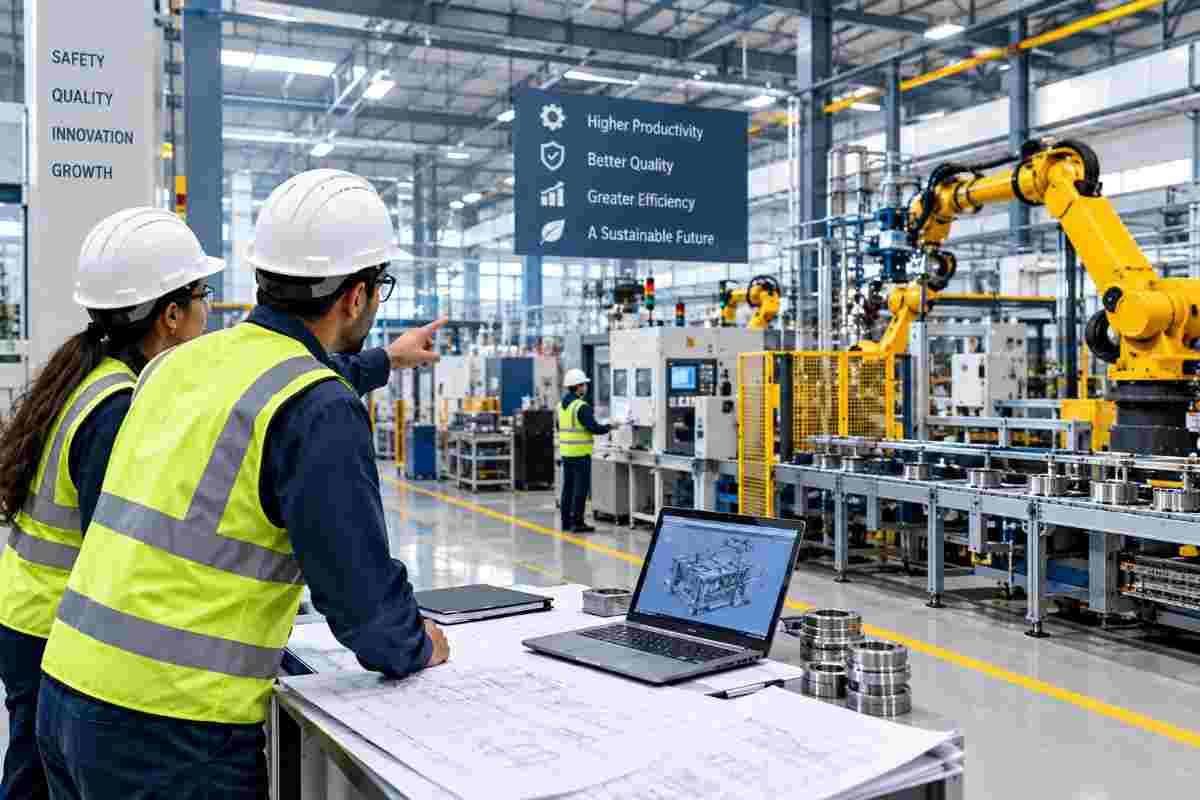
Modern manufacturing facilities are no longer simple sheds with machines bolted to the floor. They are highly engineered ecosystems where structural design, utility routing, automation, safety compliance, and sustainability all have to work together without a single weak link. As Indian industry moves toward smart factories, faster production cycles, and stricter environmental norms, the engineering challenges behind building and maintaining these facilities have grown just as fast as the technology inside them.
At Core Cutting India, we work closely with contractors, builders, and facility managers who are constantly modifying industrial structures — cutting openings for new pipelines, retrofitting old plants for new machinery, and creating access points for cables, ducts, and drainage. This gives us a front-row seat to the real-world engineering hurdles that modern manufacturing facilities face. In this article, we break down the most pressing challenges and how thoughtful planning — including precise concrete and RCC cutting — helps solve them.
1. Balancing Structural Integrity with Flexibility
A manufacturing facility built today may need to support an entirely different production line five years from now. This creates a fundamental tension: structures must be strong enough to bear heavy machinery, vibration loads, and multi-storey mezzanines, yet flexible enough to be reconfigured without a complete rebuild.
Engineers increasingly favor modular structural systems — pre-engineered steel frameworks, moment-resisting connections, and RCC columns designed with future load increases in mind. But flexibility isn't only about the initial design. It's also about how easily a structure can be modified later. This is where core cutting and wall cutting become critical. When a plant needs a new conveyor route, an additional exhaust duct, or a revised drainage line, contractors must cut through existing RCC slabs, beams, or walls without compromising structural strength. Poorly planned cutting can weaken load-bearing elements, while precision diamond core cutting allows clean, calculated openings that preserve the integrity of the surrounding concrete.
2. Utility and Service Routing in Dense Facilities
Modern factories are crowded with more than machines. Compressed air lines, chilled water pipes, electrical conduits, fire suppression systems, process gas lines, and data cabling all need dedicated pathways — often within the same limited floor-to-ceiling space. Routing these utilities without clashes is one of the most persistent engineering headaches in facility design.
Building Information Modeling (BIM) has become the standard tool for clash detection, allowing engineers to simulate every duct, pipe, and cable run before construction begins. Even with the best modeling, on-site conditions often demand last-minute adjustments. This is where wall cutting and slab cutting services prove essential — enabling contractors to create precise openings for pipe sleeves, cable trays, and ventilation ducts after the structure is already up, without resorting to disruptive and imprecise breaking methods. Clean, dust-minimal core cutting also reduces downtime in facilities that cannot afford long production halts.
3. Foundation Design for Heavy and Vibrating Equipment
Manufacturing equipment — presses, CNC machines, compressors, and large motors — generates significant dynamic loads and vibration. If the foundation isn't engineered correctly, this vibration can travel through the slab, affecting nearby sensitive equipment, weakening structural joints over time, or even causing measurable damage to adjacent buildings.
Foundation engineers must calculate not just static load but dynamic response, often using isolation pads, spring mounts, or deeper pile foundations for particularly heavy machinery. In existing facilities, retrofitting a new machine frequently means cutting into an existing slab to install a properly isolated foundation pit — a task that demands accurate, controlled RCC core cutting rather than manual demolition, which can crack surrounding concrete and undermine the new foundation's performance.
4. Retrofitting Older Plants for New Technology
India has a large base of manufacturing facilities that are decades old but still operational. Upgrading these plants to accommodate automation, robotics, or new environmental standards is one of the toughest engineering challenges in the industry today — arguably tougher than building new.
Retrofitting means working within existing structural constraints: floor levels that don't match new equipment specifications, walls that block efficient material flow, and utility systems designed for a different era of manufacturing. Engineers must assess existing RCC strength, identify load-bearing elements that cannot be touched, and plan modifications carefully around them. Precision core cutting and wall cutting allow teams to create new doorways, machine openings, and service routes in these older structures with minimal disruption, letting factories modernize without needing a full rebuild.
5. Fire Safety and Compliance in Complex Layouts
As manufacturing facilities become larger and more automated, fire safety engineering becomes exponentially more complex. Multiple hazard zones, chemical storage areas, high-voltage equipment rooms, and dense machinery layouts all require carefully engineered fire compartmentalization, smoke extraction routes, and sprinkler zoning.
National Building Code requirements and local fire NOC regulations often demand fire-rated walls and slabs — meaning any later modification, such as adding a new duct or pipe penetration, must preserve the fire rating of that wall or slab. This requires cutting methods that are precise enough not to create uncontrolled gaps, along with proper fire-stopping materials sealed around the new opening. Getting this wrong isn't just a compliance risk — it's a genuine safety risk for everyone working in the facility.
6. Energy Efficiency and Thermal Performance
Rising energy costs and sustainability mandates have pushed energy efficiency to the top of the engineering priority list. Manufacturing facilities are significant energy consumers, and inefficient building envelopes, poor insulation, and uncontrolled air leakage can add up to substantial waste over a facility's lifetime.
Engineers now design with thermal breaks, high-performance roofing systems, and natural ventilation strategies that reduce reliance on mechanical cooling. Skylights and ventilation openings, when added to an existing roof slab, must be cut with precision to avoid compromising waterproofing or structural strength — another area where controlled concrete cutting techniques matter more than they might initially appear to.
7. Automation-Ready Infrastructure
The shift toward Industry 4.0 means manufacturing facilities must be designed — or redesigned — to support robotics, automated guided vehicles (AGVs), and sensor networks. This is a fundamentally different engineering challenge than traditional factory design, because automated systems require flat, precisely leveled floors, dedicated power and data infrastructure, and clear, obstruction-free pathways.
Installing AGV charging stations, robotic arm foundations, or embedded floor sensors in an existing facility often means cutting into the slab to run conduits or create recessed mounting points. Accuracy here is non-negotiable: a robotic arm foundation that is even slightly uneven can throw off calibration across an entire automated line. This has made precision core cutting an increasingly common requirement in facilities upgrading toward automation.
8. Managing Downtime During Construction and Retrofits
Perhaps the most underrated engineering challenge is logistical: how do you modify a live manufacturing facility without stopping production? Every hour of downtime has a direct cost, and in high-volume plants, that cost can be substantial.
This is precisely why dust-minimal, vibration-controlled techniques like diamond core cutting and wall cutting have become the preferred method over traditional breaking and chiseling. These methods are faster, cleaner, and far less disruptive to ongoing operations nearby. Planning cutting work around shift schedules, using wet-cutting techniques to control dust, and coordinating closely with plant operations teams are now standard parts of facility engineering projects across India.
9. Water Management and Drainage Engineering
Manufacturing processes often generate wastewater, coolant runoff, or process water that must be managed through carefully engineered drainage systems. Poor drainage design can lead to flooring damage, equipment corrosion, or regulatory violations related to effluent discharge.
Engineers must plan slab slopes, trench drains, and effluent treatment connections at the design stage — but in existing facilities, adding or modifying drainage routes usually means cutting channels into concrete flooring. Precision slab cutting ensures these channels are consistent in depth and width, which is essential for proper water flow and long-term durability.
10. Coordinating Multiple Trades and Contractors
Finally, one of the most persistent challenges isn't purely technical — it's coordination. A modern manufacturing facility project involves structural engineers, MEP contractors, automation specialists, fire safety consultants, and specialized trades like core cutting and wall cutting contractors, all working on overlapping timelines.
Platforms that connect facility managers and builders with verified, experienced contractors — like Core Cutting India — help reduce this coordination burden. Having access to trusted, rated professionals for RCC cutting, wall cutting, slab cutting, and beam modification across 500+ Indian cities means engineering teams can move faster and with more confidence that the specialized work will be done correctly the first time.
11. Noise Control and Worker Safety Engineering
Beyond structural and utility concerns, modern manufacturing facilities must also engineer for acoustic comfort and worker safety. High-decibel machinery, compressors, and stamping presses can create noise levels that exceed occupational safety limits if left unaddressed. Engineers increasingly specify acoustic panelling, vibration-dampening mounts, and sound-isolated control rooms as standard features rather than afterthoughts.
Retrofitting acoustic solutions into an existing facility often means cutting recesses into walls or ceilings for insulation panels, or creating isolated foundation pits for noisy equipment so vibration doesn't transmit through the slab to worker stations elsewhere in the plant. As labour safety regulations in India continue to tighten, this aspect of facility engineering is becoming a bigger part of every retrofit project, not just new builds.
12. Scalability and Future Expansion Planning
A manufacturing facility that can't grow with the business quickly becomes a liability. Engineers today are expected to design with future expansion in mind — leaving structural capacity for additional floors, extra utility load, or entirely new production bays that may be added years later.
This forward planning reduces the scale of later retrofitting work, but it rarely eliminates it entirely. When expansion does happen, engineering teams still need to tie new structures into existing ones, which usually involves cutting into current slabs and walls to create connecting openings, doorways, and shared utility routes. Facilities designed with this eventuality in mind — using clearly marked expansion joints and accessible utility risers — make this future cutting work faster, cleaner, and less risky for the existing structure.
Conclusion
The engineering challenges of modern manufacturing facilities go far beyond pouring concrete and installing machinery. They involve a constant balancing act between structural strength, flexibility, safety, energy efficiency, and the practical realities of construction and retrofitting on live sites. As Indian manufacturing continues to modernize, the demand for precise, professional concrete cutting services — RCC core cutting, wall cutting, and slab cutting — will only grow, because these specialized techniques sit at the intersection of nearly every challenge discussed above.
Whether you're building a new facility or retrofitting an existing plant for the next generation of manufacturing, working with verified, experienced contractors makes the difference between a smooth project and a costly setback. Core Cutting India connects you with verified core cutting, wall cutting, and slab cutting contractors across 500+ cities in India — helping engineering teams tackle these modern manufacturing challenges with precision and confidence.
People Also Ask
1. What are the biggest engineering challenges in manufacturing facility design? The most significant challenges include structural flexibility for future equipment changes, utility and service routing in limited space, vibration-resistant foundations for heavy machinery, fire safety compliance, and energy-efficient building design.
2. How is core cutting used in manufacturing facility construction? Core cutting is used to create precise openings in RCC slabs, walls, and beams for pipes, cables, ducts, and machine foundations — allowing facilities to be built or retrofitted without weakening the surrounding structure.
3. Why is retrofitting older manufacturing plants so difficult? Retrofitting is challenging because engineers must work within existing structural limitations, outdated utility layouts, and floor levels that may not suit new automated equipment, all while minimizing disruption to ongoing operations.
4. How do manufacturing facilities minimize downtime during construction work? Facilities use dust-minimal, vibration-controlled techniques such as diamond core cutting and wall cutting, and schedule work around production shifts to reduce disruption and avoid costly downtime.
5. What role does automation play in modern manufacturing facility engineering? Automation requires precisely leveled floors, dedicated power and data infrastructure, and robotic foundation points — often requiring accurate concrete cutting to retrofit existing facilities for AGVs, robotics, and sensor networks.
6. How much does RCC core cutting cost for industrial projects in India? Costs typically range from ₹150 to ₹800 per hole depending on diameter, material, and location — use the Core Cutting India Rate Calculator for an instant estimate.