
Introduction
In the world of construction, concrete is king. It is durable, versatile, and incredibly strong. However, concrete has one notorious "weakness": it is a living material that reacts to its environment. As it dries, it shrinks. As temperatures fluctuate, it expands and contracts. Without proper management, these natural movements lead to unsightly and often dangerous cracks.
This is where expansion joint cutting becomes essential. By strategically creating controlled gaps in your concrete, you dictate exactly where the material can "breathe," protecting your structure from the stresses that lead to failure. Whether you are working on a massive industrial warehouse or a residential driveway, understanding how, when, and why to cut these joints is the difference between a pristine floor and a crumbling one.
What is Expansion Joint Cutting?
At its core, an expansion joint is an engineered separation between sections of a structure. It acts as a buffer zone that absorbs physical movement caused by thermal expansion, contraction, seismic activity, and structural loading.
While "expansion joints" and "control joints" are often used interchangeably, they serve slightly different purposes. Expansion joints are often physical gaps installed before a pour, whereas control joints (often achieved through saw cutting) are deliberate grooves cut into the surface of the concrete after it has hardened to guide the path of shrinkage cracks
Why are they necessary?
-
Preventing Random Cracks: Concrete will crack. Cutting joints ensures that if it does crack, it happens in a straight, neat line rather than in a jagged, erratic pattern.
-
Accommodating Movement: They allow structures to shift independently, preventing stress buildup that could lead to buckling or structural failure.
-
Enhancing Longevity: By managing stress, you extend the lifespan of the entire structure and significantly reduce long-term maintenance costs.
The Science of Timing: When to Cut
Timing is arguably the most critical factor in expansion joint cutting. If you cut too early, you risk "raveling"—where the blade tears up the surface because the aggregate hasn't fully locked in. If you cut too late, microscopic cracks may have already formed, rendering your joint useless.
The Window of Opportunity
Generally, for conventional saw cutting, the optimal window is 4 to 12 hours after finishing the concrete. However, this is heavily dependent on:
-
Ambient Temperature: Hotter days require faster action, sometimes within 6 hours.
-
Humidity and Wind: These factors accelerate surface drying.
-
Mix Design: The chemical composition of your concrete affects the rate of hardening.
Pro-Tip: Many modern projects use early-entry saws, which allow for cutting as soon as 1 to 4 hours after the concrete has been poured. This is the safest way to ensure control before any random shrinkage cracks have the chance to develop.
Tools and Equipment: Getting the Right Cut
You cannot achieve a professional result without the right machinery. Different projects require different approaches:
-
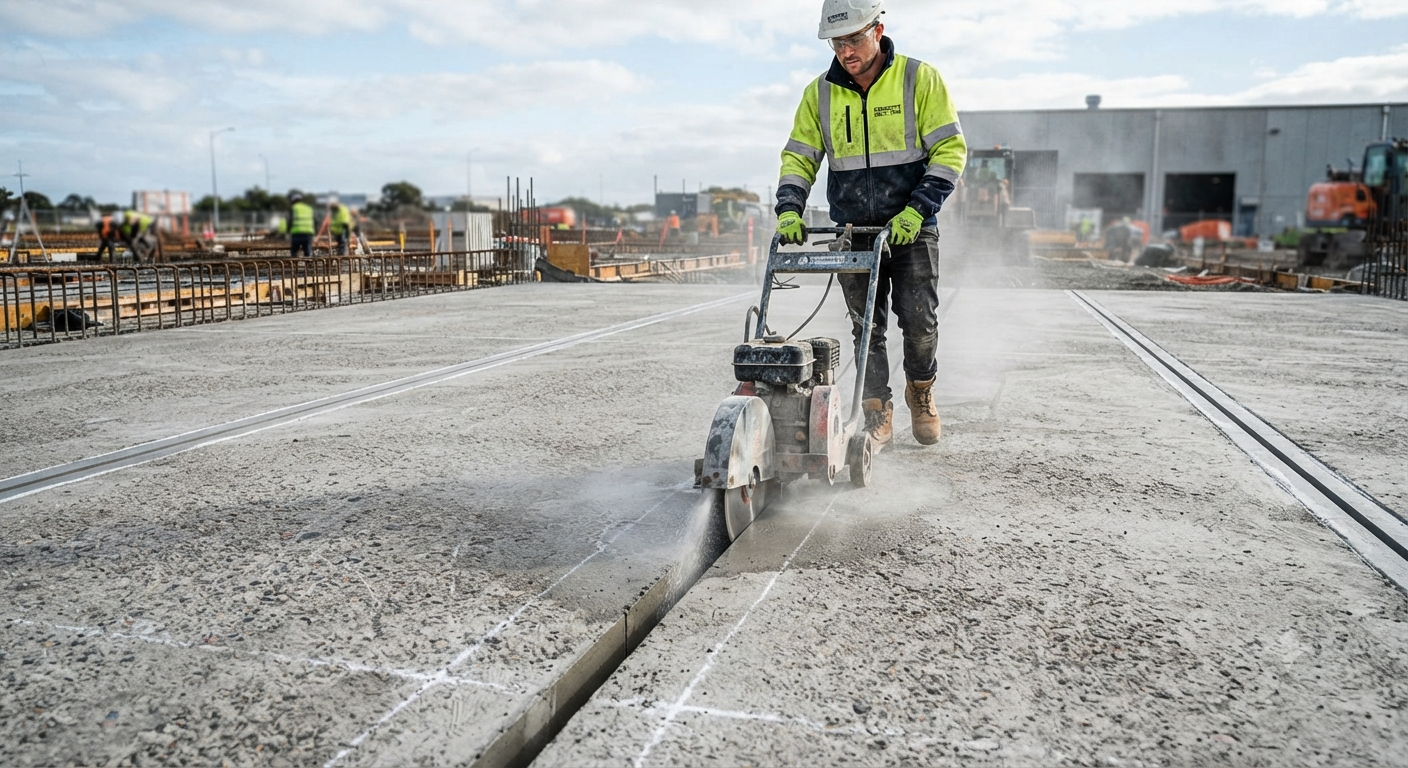
Slab Saws (Floor Saws): These are the gold standard for large horizontal surfaces like roads, bridges, and warehouse floors. They are wheeled, high-powered, and allow for consistent depth control.
-
Handheld/Walk-Behind Saws: Perfect for smaller or tighter areas where large machinery cannot fit.
-
Diamond Blades: Essential for cutting through hardened concrete. They provide the precision and durability needed to make clean, straight cuts without chipping the surrounding edges.
-
Dust Extraction Systems: Always pair your cutting tools with industrial vacuums. This not only keeps the site clean but ensures that debris doesn't contaminate the joint, which is vital if you plan on filling the joint with sealant later.
Best Practices for Professional Results
To ensure your joints are both functional and aesthetic, follow these industry-standard best practices:
-
Follow the One-Quarter Rule: A common industry standard is to cut the joint to a depth of at least one-quarter of the slab thickness. For a 100mm slab, you need a 25mm deep cut.
-
Mind the Spacing: Joint spacing should generally be 24 to 36 times the slab thickness. For a standard 4-inch (approx. 100mm) residential slab, this usually means a grid of 8 to 12 feet (2.4 to 3.6 meters).
-
Layout Planning: Plan your cuts before you start. Use a chalk line or laser guide to ensure your lines are perfectly straight. If possible, align joints with walls or columns to "hide" them.
-
Clean and Seal: After cutting, the joint must be cleaned of all slurry and dust. If the joint is intended for high-traffic areas, filling it with a semi-rigid filler protects the edges from chipping when forklifts or heavy machinery roll over them.
People Also Ask (PAA)
Q: Can I cut expansion joints in concrete myself? A: While it is technically possible for small DIY projects, professional equipment is required for clean, efficient results. A bad joint is often worse than no joint at all, as it creates an uneven surface that can chip or cause accidents.
Q: Why does my concrete crack even with expansion joints? A: This usually happens if the cuts were made too late or were not deep enough. If a crack appears, it means the slab was under stress before the "release" path was provided.
Q: Do I need to fill the expansion joints? A: For outdoor or decorative slabs, joints are often left open. However, for commercial or industrial floors, sealing the joints with a specialized filler is critical to protect the edges from heavy equipment and to prevent debris buildup.
Conclusion
Expansion joint cutting is a precise balance of art and engineering. By respecting the physical properties of concrete and utilizing the right tools at the right time, you can ensure your project remains structurally sound and visually appealing for decades to come. Don't leave your structural integrity to chance—plan your joints early and execute them with precision.
Need expert assistance? If you are looking for professional, high-precision concrete cutting, our team is ready to help. Reach out to us at [email protected] for consultations and top-tier services.
Related Searches
-
Concrete slab saw cutting techniques
-
How to prevent cracks in concrete floors
-
Commercial concrete cutting services
-
Control joint vs expansion joint
-
Best diamond blades for green concrete