
Target-Related Keywords
-
concrete core test factors
-
causes of low core strength in concrete
-
IS 456 core strength acceptance criteria
-
concrete core drilling India
-
factors influencing compressive strength of core
-
structural audit concrete testing
People Also Ask (PAA)
-
What factors affect the strength of a concrete core?
-
Why is core cutter test value lower than cube test?
-
What is the acceptance criteria for concrete core test as per IS code?
-
How does rebar affect concrete core test results?
Every engineer working on high-rise residential towers in Mumbai, infrastructure corridors in Delhi, or metro rail projects in Bengaluru relies heavily on quality assurance to ensure structural safety. Among the numerous non-destructive and semi-destructive testing methods available, the Concrete Core Test stands out as the ultimate reality check. When standard site-cured or lab-cured cubes show lower-than-expected strengths, engineers turn to core drilling to evaluate the actual in-situ concrete strength.
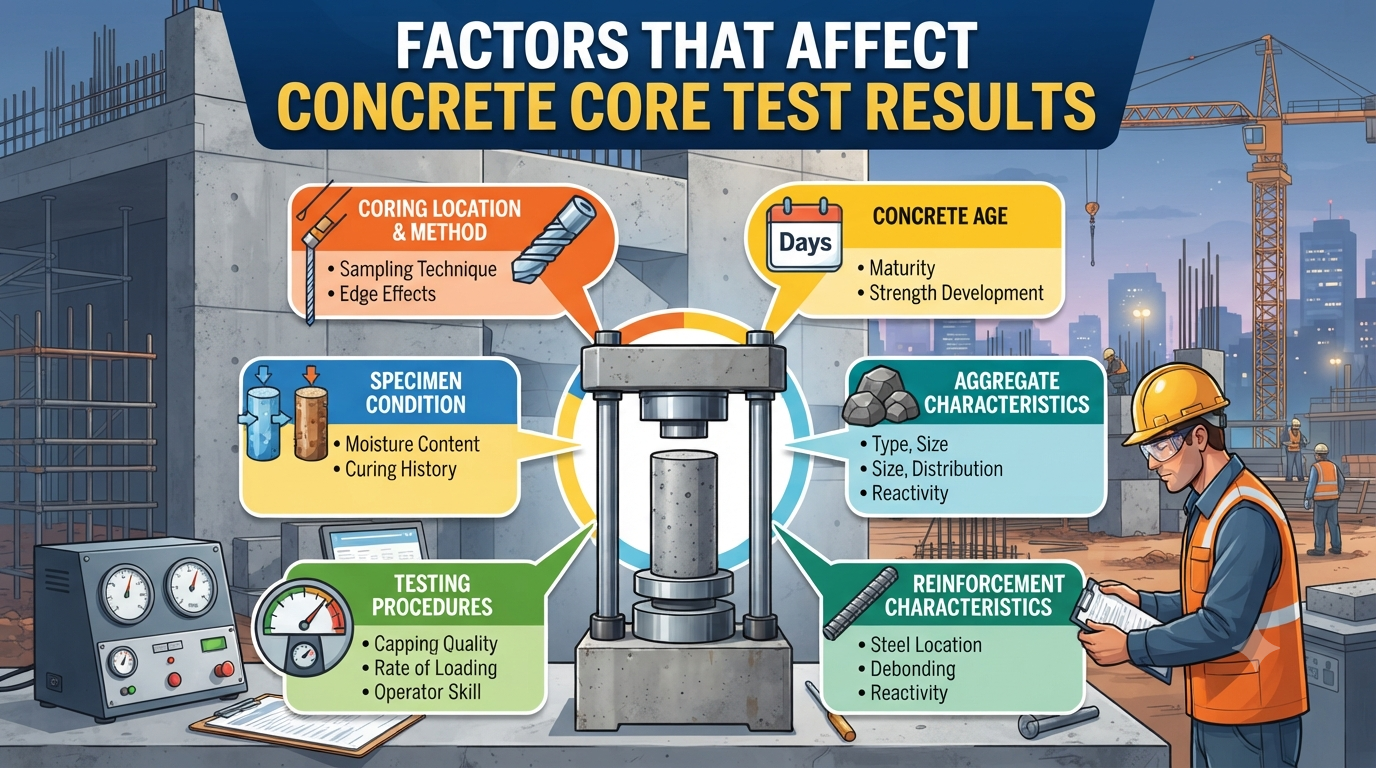
However, extracting and testing a cylindrical specimen from a hardened structure is not as straightforward as crushing a standard lab cube. The numbers that emerge from the universal testing machine (UTM) are subject to a complex web of physical, geometric, and environmental variables. Understanding what distorts or influences these values is vital for structural consultants, project managers, and quality control engineers across India.
This comprehensive guide breaks down the critical factors that affect concrete core test results, contextualized within Indian standards and real-world construction site challenges.
1. Specimen Geometry and Size Effects
The physical dimensions of the core sample play a fundamental role in determining its measured compressive strength. Unlike factory-molded cubes, a core sample is extracted directly from a structural element, meaning its size and aspect ratio are dictated by structural constraints rather than ideal laboratory dimensions.
Diameter and Aggregate Size Ratio
As a thumb rule defined in standard practices, the diameter of a core should be at least three times the nominal maximum size of the coarse aggregate (NMSA), and in most cases, not less than twice the aggregate size.
-
The Indian Reality: In heavy infrastructure projects like dams, bridges, or massive foundation rafts across India, aggregates of 20mm to 40mm are common. If a 50mm (2-inch) core is erroneously extracted from concrete containing 40mm aggregates, the failure plane will bypass or shear through the large stones rather than testing the composite mass of mortar and aggregate, resulting in erratic or unrepresentative strength readings. Ideally, 100mm or 150mm diameter cores are preferred for coarse-aggregate concrete.
Length-to-Diameter (L/D) Ratio
Standard test procedures require a specific height-to-diameter ratio, typically 2:0. However, due to the limited thickness of slabs, walls, or beams, cores are often extracted with shorter L/D ratios.
-
A core that is shorter than its diameter will show a artificially higher compressive strength due to the platen restraint effect of the testing machine, which restricts lateral expansion.
-
Conversely, longer cores can exhibit buckling tendencies.
-
To counter this, correction factors specified in codes like IS 516 (Part 4) must be meticulously applied to adjust the measured strength of cores with non-standard L/D ratios.
2. Presence and Orientation of Reinforcing Steel (Rebar)
One of the most frequent challenges faced during core cutting operations on Indian construction sites is striking embedded steel reinforcement. Modern RCC (Reinforced Cement Concrete) structures are heavily congested with rebars, especially in seismic zones like Zone IV and V (e.g., Delhi, Northeast India).
How Rebar Distorts Core Test Results
-
Strength Enhancement Illusion: If a core contains a piece of longitudinal or transverse rebar running straight through its middle parallel to the axis, the steel will bear a significant portion of the compressive load during testing. This results in an artificially inflated compressive strength that does not reflect the actual quality of the concrete matrix.
-
Bond Failure and Spalling: If a rebar runs perpendicular to the core axis, it creates a plane of discontinuity. The bond between the steel and the surrounding concrete is often weaker than the concrete itself. Under compression, micro-cracks propagate along the steel-concrete interface, causing premature splitting and yielding a lower strength value.
Mitigation Strategies
Before deploying diamond core cutting rigs, professional testing teams utilize advanced rebar locators (pachometers) or ground-penetrating radar (GPR) to map out steel locations. If cutting through a rebar is unavoidable, codes dictate maximum allowable bar sizes and numbers, and correction formulas must be applied to isolate the net concrete strength.
3. Moisture Condition at the Time of Testing
Water is both a curing agent and a weakening agent depending on when and how it interacts with the concrete matrix. The moisture state of a core sample from the moment of extraction to the moment of crushing introduces major variations in test results.
-
Saturated vs. Dry Cores: A core tested in a fully saturated (wet) condition will consistently yield a 10% to 15% lower compressive strength compared to the same core tested in an air-dried condition. Water trapped within the capillary pores builds internal pore pressure under compressive loading, accelerating crack propagation.
-
Indian Standard Guidelines: IS 516 outlines specific conditioning protocols. Cores should generally be tested in a moisture condition that simulates the structural element's service environment, or they must be soaked in water for 40 hours prior to testing if standard dry-comparison is required. Ignoring moisture conditioning leads to misleading variations between labs.
4. Damage Caused During Drilling and Extraction
The mechanical process of core cutting is a violent, high-friction operation. If not executed by skilled operators using professional-grade diamond core bits and adequate water cooling, the extraction process itself can severely compromise the structural integrity of the specimen.
-
Micro-Cracking: Worn-out diamond bits, excessive drill pressure, or vibration of the drilling rig can induce micro-cracks along the outer periphery of the core. These edge fractures act as stress concentrators during crushing, causing the sample to fail prematurely.
-
Thermal Damage: Inadequate water supply during the wet-drilling process generates localized frictional heat. This thermal shock can alter the hydration products of the cement paste and weaken the bond with aggregates.
-
Improper Capping: If the ends of the extracted core are uneven, non-parallel, or poorly capped with high-strength sulfur mortar or neat cement paste, the load from the UTM will apply unevenly. High stress concentrations at localized high points will trigger premature shear failure, showing lower core strength than what actually exists in the wall or column.
5. Degree of Compaction and In-Situ Curing Variations
Standard concrete cubes cast in a laboratory are compacted using standardized table vibrators or tamping rods and are cured under optimal temperature and humidity conditions (typically $27^\circ\text{C} \pm 2^\circ\text{C}$ and 95% relative humidity). Real-world structures on Indian construction sites rarely experience such controlled environments.
-
Workmanship and Honeycombing: In massive pours or congested beam-column junctions, manual or needle vibration might be inadequate, leading to pockets of honeycombing or segregation. A core extracted from a poorly compacted zone will show dismal strength, whereas a core from a well-compacted section of the same member will pass with flying colors.
-
Curing Deficits in Indian Climates: Extreme ambient temperatures—such as the blistering summer months in Rajasthan or central India—cause rapid moisture evaporation from exposed concrete surfaces. If curing compounds or wet burlap curing are neglected, the outer skin of the concrete (and consequently the outer zones of a core) will suffer from incomplete cement hydration, drastically dragging down the core strength compared to moist-cured lab cubes.
6. Age and Carbonation of the Concrete
Concrete is a living, evolving material that continues to hydrate and gain strength over months and years, provided moisture is available. However, chemical changes over time also influence test results.
-
Age Factor: A core test conducted at 28 days will yield vastly different results compared to a core extracted from a structure that is 5 years old. Structural audits in India frequently involve older buildings where continued pozzolanic activity (if fly ash or slag cement was used) can push core strengths significantly higher than the specified characteristic strength ($f_{ck}$).
-
Carbonation Effects: Over time, atmospheric carbon dioxide reacts with calcium hydroxide in the hydrated cement paste to form calcium carbonate. This carbonation process densifies the outer shell of the concrete, increasing its hardness and surface strength. If a core is tested without accounting for carbonation depth, surface hardness variations can distort localized readings, though core compression tests are generally less susceptible to this than surface rebound hammer tests.
7. Correlation Between Cube Strength and Core Strength
One of the most contentious issues among Indian structural engineers is the expectation that a core test must match or exceed the characteristic cube strength ($f_{ck}$) specified in the structural drawings (e.g., M25, M30, M40).
As per global standards and Indian practices (such as IS 456 and IS 516), core strength is not expected to equal cube strength.
-
Due to differences in shape (cylinder vs. cube), size, compaction energy, and curing, an in-situ core strength is typically considered acceptable if it satisfies the criteria laid down in IS 456 (Clause 17.5.3), which generally states that the concrete in the member represented by a core test is considered acceptable if the average equivalent cube strength of the cores is at least 85% of the specified characteristic strength, with no single core falling below 75%.
Conclusion: Ensuring Accurate Assessments with [email protected]
The concrete core test remains an indispensable diagnostic tool for assessing structural integrity, resolving contractual disputes, and validating structural safety during renovation or forensic audits. However, because core results are sensitive to geometry, rebar interference, moisture state, and drilling technique, interpreting them requires deep technical expertise.
To eliminate testing anomalies and secure accurate, court-admissible, and reliable structural data, partnering with seasoned professionals is essential. For expert core cutting, advanced structural testing, and precision sampling services tailored to Indian engineering standards, reach out to the specialists at [email protected]. Precision in cutting leads to precision in engineering—protect your structures with accurate testing from day one.