
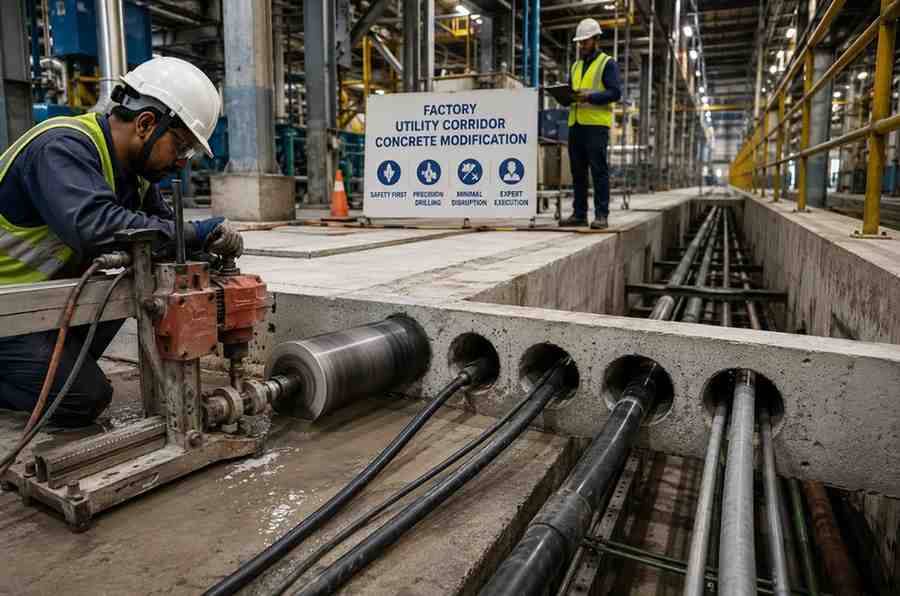
Modern manufacturing plants, assembly lines, and heavy process facilities are living, breathing ecosystems. They demand a seamless web of power supply conduits, water lines, pneumatic channels, high-speed data cables, and waste management systems to operate at peak efficiency. Over time, technological disruptions, automation integration, and capacity expansions render legacy infrastructure obsolete. This evolutionary bottleneck makes factory utility corridor concrete modification a critical operational necessity.
Altering heavy-duty industrial concrete to accommodate new utility networks is far from a routine construction task. It requires meticulous engineering, zero-downtime strategies, specialized equipment, and elite execution to prevent structural compromise. Bringing decades of technical mastery to complex industrial settings, [email protected] specializes in transforming rigid structural layouts into adaptable, future-ready operational pathways.
1. Deconstructing the Factory Utility Corridor
A factory utility corridor is a designated subterranean, trench-level, or wall-adjacent pathway engineered to house vital plant services. Unlike commercial office buildings where cabling runs effortlessly behind drop ceilings, heavy industries rely heavily on thick, steel-reinforced concrete slabs to carry monumental equipment loads.
Key Elements Hosted Within Utility Corridors:
-
Electrical Infrastructure: Heavy-duty bus ducts, high-voltage lines, and automated control wiring.
-
Fluid Dynamics: High-pressure water feeds, fire suppression systems, chemical processing lines, and wastewater drainage channels.
-
Pneumatic and HVAC Lines: Compressed air systems, ventilation ducts, and process cooling loops.
-
Data and Telecommunications: Industrial Ethernet rings, fiber optic backbones, and IoT sensor networks.
When manufacturing specs shift, these corridors must expand, redirect, or upgrade. This calls for calculated concrete modification rather than random, destructive demolition.
2. Why Concrete Modification is Mandatory for Industrial Upgrades
Industrial facilities operate on tight margins where equipment layout dictates profitability. Retrofitting an older factory floor or expanding a newly acquired production line invariably triggers the need for structural concrete alterations.
+------------------------------------------------------------+
|        DRIVERS FOR FACTORY UTILITY MODIFICATION            |
+------------------------------------------------------------+
|  * Automation & Industry 4.0 Integration (New Cabling)     |
|  * Capacity Expansion (Upgraded Water/Power Mains)         |
|  * Regulatory Compliance (Environmental/Safety Overhauls)  |
|  * Plant Relayout & Machinery Replacement                  |
+------------------------------------------------------------+
The Cost of Inaction or Poor Planning
Attempting to force new utilities through substandard channels or relying on outdated trenching techniques can lead to disastrous consequences:
-
Structural Failure: Random breaking with heavy drop-hammers can induce micro-cracks throughout the foundation slab, threatening heavy machinery stability.
-
Production Downtime: Unplanned structural failures extend project timelines, bleeding revenue from active manufacturing lines.
-
Safety Hazards: Striking live, undocumented sub-floor utilities endangers on-site personnel and halts operations instantly.
3. Advanced Engineering Techniques in Concrete Modification
Executing modifications inside a sensitive factory environment requires methods that isolate vibration, eliminate airborne silica dust, and protect adjacent structural integrity. Professional operators rely on a suite of non-disruptive technologies.
A. Diamond Flat Sawing and Slab Sawing
For surface-level utility trenching, flat saws equipped with industrial diamond blades deliver straight, clean linear cuts. Unlike jackhammers that shatter concrete randomly, diamond saws slice cleanly through aggregate and rebar alike, preventing edge spalling and creating neat profiles for subsequent backfilling or plating.
B. Core Drilling for Vertical and Horizontal Penetrations
When utility lines need to transition through thick factory foundation walls, grade beams, or multi-level concrete decks, diamond core drilling is the gold standard. It extracts flawless cylindrical cores ranging from micro-diameters up to massive commercial sizes, leaving surrounding structures completely intact and structurally sound.
C. Diamond Wire Sawing for Massive Structural Elements
In cases where massive machine foundations, thick concrete vaults, or dense service tunnels must be reconfigured, diamond wire saws—interlaced with diamond beads driven by high-powered pulleys—glide through impenetrable mass concrete with surgical precision, regardless of thickness.
4. Step-by-Step Execution of a Factory Utility Corridor Project
A successful concrete modification project is a symphony of safety protocols, structural mapping, precise mechanical cutting, and careful waste management.
Step 1: Sub-Surface Diagnostics and Mapping
Before a single blade touches the floor, advanced non-destructive evaluation (NDE) techniques such as Ground-Penetrating Radar (GPR) and electromagnetic scanning are deployed. This maps existing rebar layouts, post-tension cables, and active utilities to prevent catastrophic strikes.
Step 2: Isolation and Dust Mitigation
Industrial facilities cannot afford particulate contamination, especially in electronics, pharmaceutical, or food-processing manufacturing sectors. Dust-shrouded cutting systems coupled with heavy-duty industrial HEPA vacuum units and wet-cutting techniques ensure a clean, contamination-free workspace.
Step 3: Controlled Cutting and Trench Extraction
Technicians execute precision perimeter cuts to defined engineering depths. Once the concrete section is isolated, specialized lifting equipment or chemical expansion agents safely extract the cut blocks without transmitting shockwaves to nearby precision CNC machinery.
Step 4: Subgrade Preparation and Utility Installation
With the trench or corridor opened, the subgrade is re-leveled and compacted. New utility conduits, pipes, and cabling trays are laid out, pressure-tested, and certified.
Step 5: High-Performance Restoration
The modified corridor is backfilled using high-strength, rapid-setting concrete, flowable fill, or industrial epoxy mortars designed to match or exceed the load-bearing capacities of the original factory floor.
5. Overcoming Operational Challenges in Industrial Retrofitting
Modifying concrete within an active manufacturing plant presents unique logistical hurdles that differentiate industrial contractors from general construction crews.
-
Working in Confined Spaces: Utility trenches and service tunnels are often tight, restricted spaces requiring specialized compact machinery, electric-powered cutters (to eliminate toxic exhaust fumes), and strict safety oversight.
-
Tight Scheduling Windows: Most factories operate round-the-clock. Modifications must often fit within compressed weekend shutdowns or scheduled maintenance windows. Rapid-curing repair materials and multi-shift crews are vital to meeting these deadlines.
-
Vibration Control: Heavy vibrations can misalign sensitive calibration instruments and optical machinery on the factory floor. Low-vibration diamond cutting tools safeguard surrounding equipment assets.
6. Best Practices for Long-Term Structural Integrity
To maximize the lifespan of a modified utility corridor, facility managers must prioritize proactive engineering standards:
-
Incorporate Future-Proofing: Always oversize utility trenches by 20% to 30% during modification to accommodate upcoming expansions without requiring future concrete cutting.
-
Install Protective Joint Armor: Protect trench edges subjected to heavy forklift traffic with steel edge angles to prevent chipping and wheel wear.
-
Maintain Accurate As-Built Documentation: Update facility blueprints immediately following any modification. Accurate maps streamline future maintenance and drastically lower accident risks.
Conclusion
Factory utility corridor concrete modification is the literal backbone of industrial evolution. As manufacturing technologies advance, the infrastructure supporting them must adapt with equal precision. By substituting crude, destructive demolition methods with sophisticated, diamond-tool-based concrete modification strategies, facility owners protect their capital investments, safeguard workers, and future-proof their operations.
For professional assessment, expert engineering consultations, and elite industrial cutting solutions tailored to your plant’s exact requirements, partner with industry leaders at [email protected] to drive your next infrastructure upgrade forward with absolute precision.