
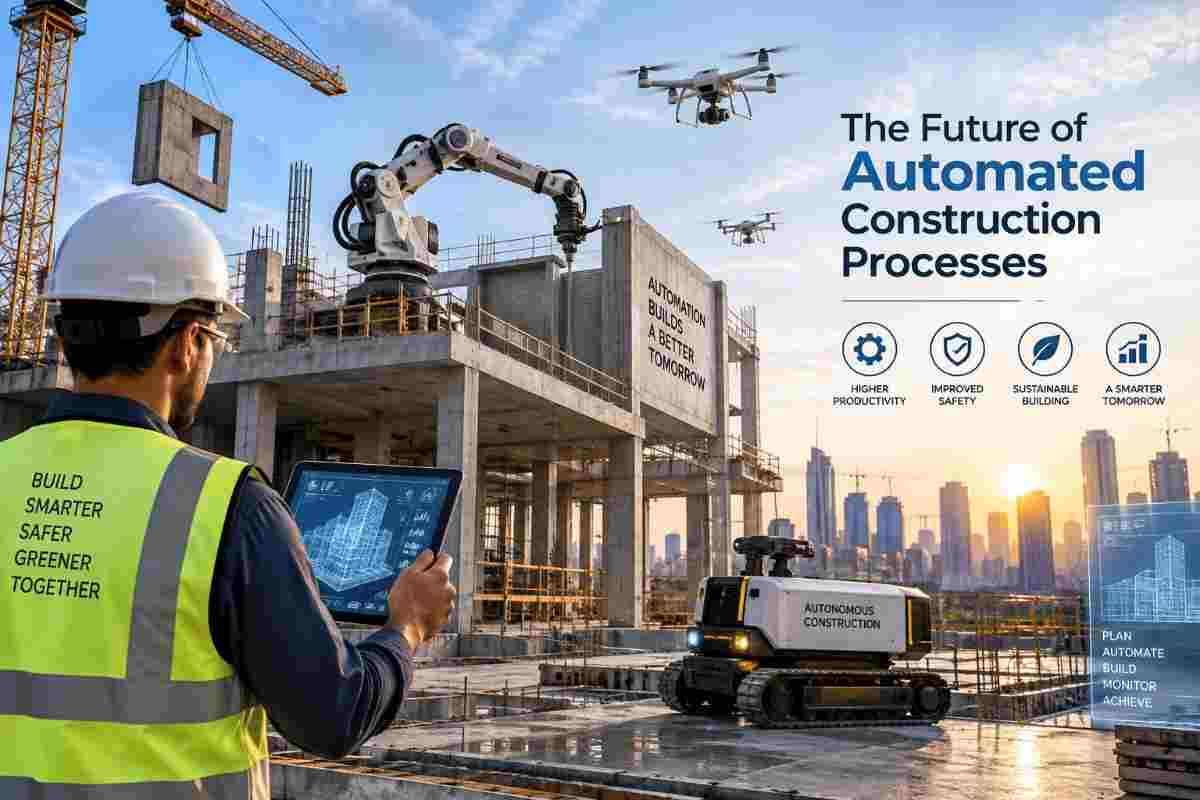
Construction has always been one of the last major industries to fully embrace digital transformation. For decades, the sector relied almost entirely on manual labour, paper drawings, and trial-and-error site management. But that's changing fast. From self-operating machinery to AI-driven project planning and robotic precision cutting, automated construction processes are no longer futuristic concepts — they're already reshaping how buildings, roads, and infrastructure are designed, planned, and executed across India and the world.
At Core Cutting India, we work at the intersection of construction and precision technology every day, connecting builders and contractors with verified core cutting, wall cutting, and slab cutting professionals across 500+ Indian cities. This gives us a front-row view of how automation is quietly transforming even the most traditional parts of the construction workflow. In this article, we explore where automated construction processes are headed, what technologies are driving the change, and what it means for builders, contractors, and homeowners alike.
Why Automation Is Becoming Essential in Construction
India's construction industry is under pressure from multiple directions at once. Urban infrastructure demand is growing rapidly, skilled labour is becoming harder to source consistently, project timelines are tightening, and clients expect higher precision with lower costs. Manual processes simply can't keep pace with these demands at scale.
Automation solves several problems simultaneously. It reduces dependency on manual labour for repetitive or physically demanding tasks, minimizes human error in measurements and structural work, speeds up project timelines significantly, and improves safety by removing workers from high-risk situations. It also creates more predictable, data-backed outcomes — something traditional construction has historically struggled to deliver.
As raw material costs rise and project margins tighten, automation isn't just a nice-to-have anymore. It's becoming the difference between construction firms that stay competitive and those that fall behind.
Key Technologies Driving Automated Construction
1. Building Information Modelling (BIM) and Digital Twins
BIM has moved from being an optional design tool to becoming the backbone of automated construction planning. A digital twin — a virtual replica of a building or site — allows architects, engineers, and contractors to simulate every stage of construction before a single brick is laid. This reduces design clashes, material waste, and costly on-site corrections.
Combined with real-time sensor data from the actual construction site, digital twins are increasingly being used to monitor progress, predict delays, and even flag structural risks before they become expensive problems.
2. Robotics and Autonomous Machinery
Robotic bricklaying machines, autonomous excavators, and 3D-printing construction robots are moving from pilot projects to mainstream use in several countries, and India is beginning to adopt similar technology in select large-scale infrastructure and industrial projects. These machines can work continuously, follow digital blueprints with millimetre-level accuracy, and significantly cut down repetitive manual labour.
Autonomous or semi-autonomous machinery is also being deployed for earthmoving, paving, and material handling — tasks that are physically demanding and prone to inconsistency when done manually at scale.
3. AI-Powered Project Management
Artificial intelligence is transforming how construction projects are planned and monitored. AI tools now analyze weather patterns, labour availability, material delivery schedules, and site data to predict potential delays before they happen. Computer vision systems installed on-site can automatically flag safety violations, monitor whether workers are wearing protective gear, and track daily progress against the project schedule — all without manual site inspections.
This shift from reactive to predictive project management is one of the biggest advantages automation brings to construction.
4. Prefabrication and Modular Construction
Prefabrication — manufacturing building components in a factory-controlled environment before assembling them on-site — is one of the fastest-growing areas of construction automation. Modular construction reduces on-site labour requirements, shortens project timelines dramatically, and ensures consistent quality because components are built under controlled, repeatable conditions rather than exposed to variable site conditions.
This approach is especially valuable for large residential projects, hospitals, and commercial buildings where speed and consistency matter as much as design flexibility.
5. Automated and Precision Cutting Technology
One of the most overlooked but critical parts of construction automation is precision cutting — the process of creating clean, accurate openings in concrete, RCC, and masonry structures for plumbing, electrical conduits, HVAC systems, and structural modifications.
Traditional cutting methods relied heavily on manual measurement and hammer-and-chisel techniques, which often led to cracked surfaces, structural weakening, and inconsistent hole sizes. Modern diamond core cutting and wall cutting technology, using calibrated electric and hydraulic machines, has already automated much of this precision work — delivering clean, dust-minimal, vibration-free cuts with far greater accuracy than manual methods ever could.
As construction sites become more automated overall, precision cutting is increasingly being integrated directly into digital project plans. Contractors now use BIM-derived measurements to pre-mark exact cutting points for pipes, cables, and structural openings, reducing guesswork and rework significantly. Platforms like Core Cutting India make it easier for builders to find verified contractors equipped with this modern cutting technology, ensuring that even this specialized step in the construction process keeps pace with broader automation trends.
How Automated Construction Benefits Builders and Contractors
The shift toward automation isn't just about flashy technology — it delivers concrete, measurable benefits across the construction lifecycle.
Faster project completion. Automated planning tools and prefabricated components can cut construction timelines by weeks or even months compared to fully manual approaches.
Reduced material waste. Digital planning and precision execution mean fewer errors, less rework, and significantly less wasted material — a major cost saver on large projects.
Improved worker safety. Automation handles many of the most physically demanding and hazardous tasks, reducing on-site accidents and long-term health risks for construction workers.
Greater cost predictability. AI-driven forecasting and digital project tracking give builders far more accurate cost estimates upfront, reducing budget overruns.
Higher structural accuracy. From robotic bricklaying to precision core cutting, automated processes consistently outperform manual methods in terms of measurement accuracy and structural integrity.
Challenges Facing Automated Construction in India
Despite the clear advantages, widespread adoption of construction automation in India faces real obstacles. High upfront investment in robotic and digital tools remains a barrier for small and mid-sized contractors. There's also a shortage of workers trained to operate and maintain automated equipment, and many existing job sites simply weren't designed with automation compatibility in mind.
Regulatory and safety standards for autonomous machinery are still evolving in India, and fragmented supply chains can make it difficult to source or maintain specialized automated equipment consistently across different regions.
That said, the pace of change is accelerating. As more construction companies see measurable ROI from automation — faster timelines, fewer errors, lower long-term costs — adoption is expected to grow steadily across both metro and tier-2 city markets over the next decade.
What the Future Looks Like
Looking ahead, the construction sites of the near future will likely blend human expertise with automated precision at nearly every stage. Expect to see wider adoption of 3D-printed structural components for both residential and commercial buildings, AI-driven site monitoring becoming a standard requirement rather than an add-on service, and drone-based surveying replacing manual site inspections for large projects.
Specialized processes like core cutting, wall cutting, and slab cutting will continue to modernize as well — moving toward greater integration with digital blueprints, more precise diamond-tipped equipment, and contractor platforms that make it easier to find qualified, verified professionals equipped with the latest tools. Sustainability will also play a bigger role, with automated systems optimizing material usage and reducing construction waste as environmental regulations tighten across Indian states.
The construction industry of tomorrow won't replace skilled tradespeople — it will make their work faster, safer, and significantly more precise.
Final Thoughts
Automated construction processes represent one of the most significant shifts the building industry has seen in decades. From AI-powered project management to robotic machinery and precision diamond cutting technology, automation is helping the industry solve long-standing challenges around cost, safety, and timeline predictability.
Even specialized, detail-oriented tasks like RCC core cutting and wall cutting — essential for plumbing, electrical, and structural work — are becoming faster, cleaner, and more accurate thanks to modern equipment and better planning integration. As India's construction industry continues to modernize, working with verified, technology-equipped contractors will matter more than ever.
If you're planning a construction or renovation project and need reliable, precision cutting services, Core Cutting India connects you with verified core cutting, wall cutting, and slab cutting contractors across 500+ cities in India — helping you build for the future, today.
People Also Ask
What is automation in construction? Automation in construction refers to the use of technology — including robotics, AI, digital planning tools, and automated machinery — to perform tasks that were traditionally done manually, improving speed, accuracy, and safety on construction sites.
How is AI changing the construction industry? AI is helping construction teams predict project delays, monitor site safety through computer vision, optimize resource allocation, and make data-driven decisions that reduce cost overruns and improve project outcomes.
Will robots replace construction workers? Robots and automated machinery are more likely to support and augment human workers rather than fully replace them, taking over repetitive or hazardous tasks while skilled tradespeople focus on complex, judgment-driven work.
What are the benefits of automated construction processes? Key benefits include faster project timelines, reduced material waste, improved worker safety, more accurate cost estimates, and higher structural precision compared to fully manual methods.
Is construction automation cost-effective in India? While upfront investment in automated tools can be high, most builders see long-term cost savings through reduced rework, faster project delivery, and fewer safety-related delays, making automation increasingly cost-effective as adoption grows.