
Introduction
For decades, the construction and core cutting industry relied on heavy manual labor, handheld rotary hammers, and sheer physical endurance to drill thousands of holes into reinforced concrete slabs. While human skill remains foundational to building infrastructure, traditional drilling methods are plagued by bottlenecks: repetitive strain injuries, high error rates, drifting hole depths, and a severe shortage of skilled labor.
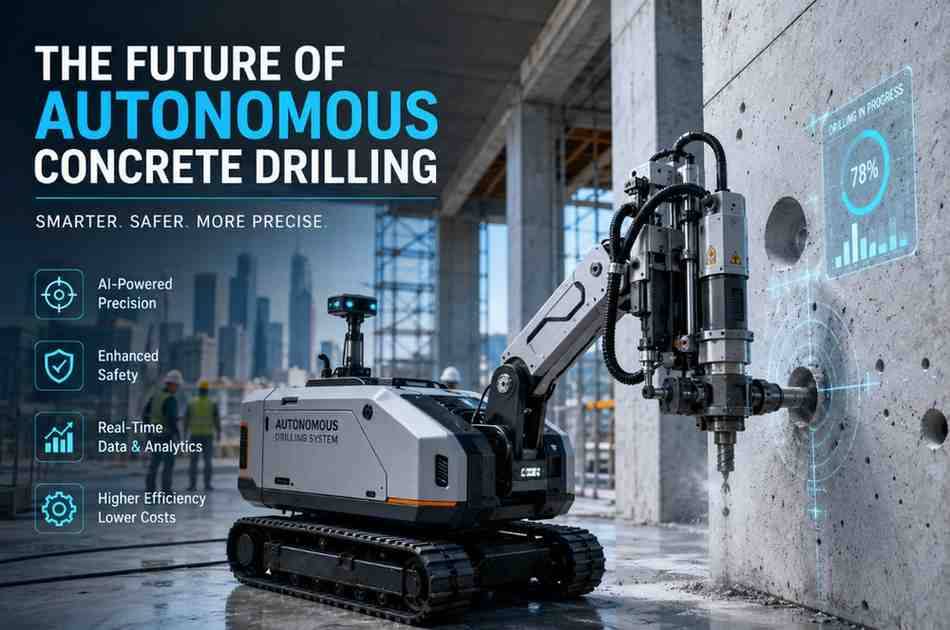
Enter autonomous concrete drilling—a paradigm-shifting technology driven by artificial intelligence (AI), Building Information Modeling (BIM), and heavy-duty field robotics. What was once considered science fiction has rapidly materialized on modern jobsites. With pioneering developments like fleet-capable downward-drilling robots (such as DEWALT’s IRON-X/DALE systems in partnership with August Robotics and Hilti's Jaibot), the construction sector is entering an era of unprecedented productivity.
At [email protected], we are closely monitoring these monumental shifts to understand how advanced automation alters project execution, workflow efficiency, and cost optimization.
Target-Related Searches & People Also PAA
Target-Related Searches
-
Autonomous concrete drilling robots
-
Robotic core cutting and wall sawing technology
-
BIM-integrated concrete drilling systems
-
Automated MEP layout and anchor installation
-
Future of construction automation in India and globally
People Also Ask (PAA)
-
How do autonomous concrete drilling robots work?
-
What are the benefits of using robotic core cutting over manual labor?
-
Can concrete drilling robots integrate directly with BIM models?
-
How much time and money can autonomous drilling save on large construction projects?
How Autonomous Concrete Drilling Works
To appreciate where the industry is heading, it helps to understand how these machines operate on active jobsites. Autonomous drilling systems combine advanced mobile bases, precision sensors, and intelligent software to execute complex drilling patterns with minimal human intervention.
-
BIM Integration: The workflow begins in the digital space. Engineers upload CAD or Revit files (BIM) containing exact specifications for hole locations, diameters, and depths into the cloud or field tablet.
-
Autonomous Navigation: Using local positioning systems (like robotic total stations) and onboard lidar, cameras, and collision-avoidance sensors, the robot navigates raw concrete slabs autonomously.
-
Precision Execution: Once positioned over a target coordinate, a robotic arm or stabilization mast locks into place, counteracting vibrations while a heavy-duty rotary hammer drills the hole.
-
Data Logging & Dust Mitigation: The system logs metadata for every drilled hole—verifying depth and accuracy—while integrated HEPA vacuum systems capture up to 99% of hazardous silica dust at the source.
Key Drivers Behind the Automation Boom
The rapid adoption of autonomous drilling is not merely a trend; it is a calculated response to massive economic and structural pressures facing the global construction market.
1. The Global Data Center and Infrastructure Race
The exponential rise of artificial intelligence and cloud computing has triggered a massive global demand for data centers and hyperscale infrastructure. Construction timelines are tighter than ever. Autonomous drilling fleets have proven capable of slashing schedules dramatically—with pilot programs showing timeline reductions of up to 80 weeks across large multi-phase data center projects by drilling thousands of anchor holes up to 10 times faster than manual crews.
2. Overcoming the Skilled Labor Shortage
Across the globe, the construction industry faces a shrinking pool of skilled tradespeople. Strenuous overhead drilling and repetitive floor work lead to severe physical fatigue and musculoskeletal disorders. Autonomous systems take over these high-risk, repetitive tasks, allowing human workers to transition into supervisory and higher-judgment engineering roles.
3. Dramatic Cost Reductions and ROI
While initial capital investments in robotics are high, the long-term savings are staggering. Field data indicates that manual drilling can cost upwards of $65 per hole when factoring in labor, consumables, and rework. Advanced robotic systems can lower this cost to roughly $20 per hole while achieving a staggering 99.97% positional and depth accuracy.
The Broader Impact on Core Cutting and Specialized Services
While much of the immediate spotlight is on high-volume floor anchoring for MEP (Mechanical, Electrical, and Plumbing) systems, the technology is expanding into adjacent domains:
-
Wall and Wire Sawing Automation: Automated rails and remote-controlled diamond wire saws allow operators to execute precise structural openings without standing directly in the hazard zone.
-
Real-Time Quality Assurance: Digital integration ensures that every hole or cut matches the engineering drawings down to the millimeter, virtually eliminating costly on-site rework.
-
Enhanced Jobsite Safety: By reducing long-term exposure to hand-arm vibration syndrome (HAVS) and concrete dust, robotics fundamentally shift the safety and EMR (Experience Modification Rate) profile of modern contractors.
The Road Ahead: What to Expect in the Next Decade
As we look toward the 2030s, autonomous drilling technology will evolve in several key directions:
-
Swarm Robotics and Fleet Coordination: Future jobsites will feature fleets of autonomous units communicating via mesh networks, dividing large-scale floor plans dynamically to finish layout tasks overnight.
-
AI-Powered Geological Adaptation: Next-generation drills will use real-time acoustic and torque feedback to detect rebar strikes or shifting aggregate densities instantly, modifying RPM and feed rates on the fly to protect bits and extend equipment life.
-
Expanded Accessibility: As hardware costs stabilize and modular software platforms mature, medium and small-scale contractors—including specialized providers like [email protected]—will increasingly integrate semi-autonomous and robotic assets into regional operations.
Conclusion
Autonomous concrete drilling represents much more than a mechanical upgrade—it is a fundamental transformation of how we shape the built environment. By marrying the speed and precision of artificial intelligence with the rugged demands of heavy construction, robotic drilling solves critical labor shortages, compresses impossibly tight project schedules, and elevates jobsite safety to new heights.
To stay competitive in an increasingly automated marketplace, builders, project managers, and specialized contractors must embrace these digital workflows. To learn more about cutting-edge construction methodologies, diamond core cutting, and structural modification solutions, reach out to us at [email protected].