
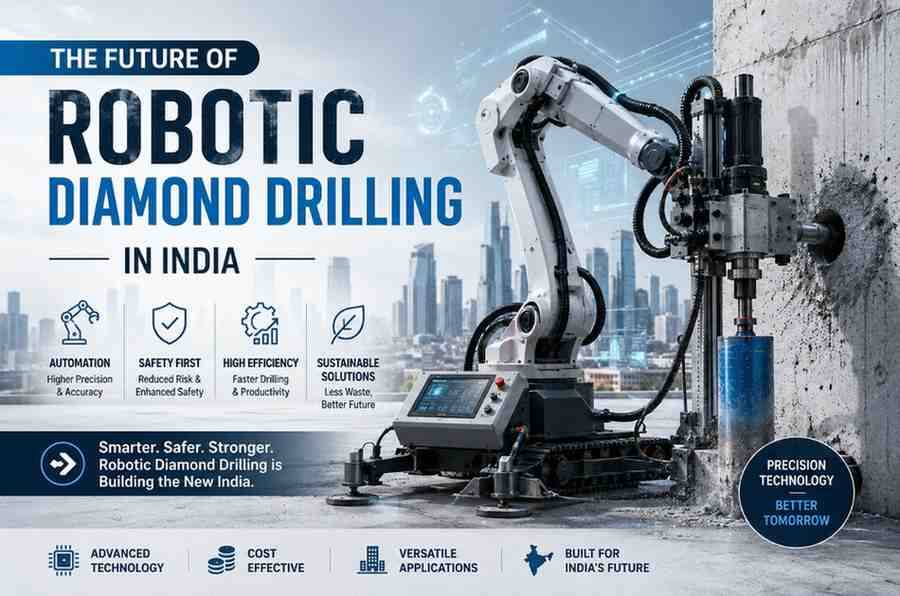
India's construction and infrastructure sector is entering a new era, one shaped less by muscle and more by machine intelligence. Among the many technological shifts reshaping the industry, robotic diamond drilling stands out as one of the most transformative. From metro rail corridors to nuclear power plants, from high-rise demolitions to precision core sampling in mining, diamond drilling has quietly become the backbone of modern construction work. What was once a manual, labour-intensive, and often risky process is now being reimagined through robotics, automation, and smart sensor technology.
At Core Cutting India ([email protected]), we've watched this transformation unfold firsthand. As a company deeply invested in diamond drilling and cutting solutions, we believe it's important to look ahead and understand where this industry is headed — and why robotic diamond drilling is not just a passing trend, but the future of precision construction in India.
Understanding Diamond Drilling: A Quick Refresher
Before diving into the future, it helps to understand the present. Diamond drilling is a technique that uses diamond-tipped core bits to cut through concrete, stone, brick, and reinforced structures with exceptional precision. Unlike traditional percussion drilling, diamond drilling produces clean, smooth holes without cracking or damaging surrounding material. This makes it indispensable for tasks like installing utility lines, structural investigations, HVAC ducting, plumbing, electrical conduits, and creating openings in load-bearing walls without compromising structural integrity.
For decades, this process has relied heavily on skilled human operators who manually position rigs, apply pressure, monitor water flow for cooling, and adjust drilling angles. While effective, this manual approach comes with limitations — operator fatigue, inconsistent pressure application, exposure to dust and vibration, and the inherent risks of working at height or in confined spaces.
This is precisely where robotics enters the picture.
Why Robotics Is the Natural Next Step for Diamond Drilling
Robotic diamond drilling systems combine the precision of diamond-tipped tooling with automated positioning, remote operation, and intelligent control systems. Instead of a technician manually guiding a rig, robotic arms and automated platforms handle the physical drilling process, often controlled remotely via tablets or control panels, or increasingly, through semi-autonomous programming.
Several forces are driving this shift in India:
1. Rising demand for precision infrastructure work. As India accelerates projects like metro rail expansions, highway corridors, smart city developments, and industrial facilities, the margin for error in structural work has shrunk considerably. Robotic systems can maintain consistent drilling angles and depths across hundreds of holes, something extremely difficult to replicate manually at scale.
2. Worker safety concerns. Drilling into reinforced concrete, especially in elevated or unstable structures, carries genuine risk. Robotic systems allow operators to control equipment from a safe distance, reducing exposure to dust, vibration-related injuries, and structural collapse risks.
3. Labour availability and skill gaps. Skilled diamond drilling technicians are not always easy to find, particularly for large-scale or remote projects. Robotic systems reduce dependency on highly specialized manual labour by standardizing the drilling process through pre-programmed settings.
4. Growing complexity of structures. Modern buildings increasingly use post-tensioned concrete, dense rebar grids, and composite materials. Robotic systems equipped with sensors can detect rebar and utility lines before drilling begins, minimizing the risk of costly and dangerous strikes.
Key Technologies Driving the Robotic Drilling Revolution
The future of robotic diamond drilling in India will be shaped by a convergence of several technologies working together.
Sensor-guided precision. Modern robotic drilling rigs are increasingly integrated with ground-penetrating radar and rebar detection sensors. This allows the system to scan a surface before drilling, identifying embedded steel, electrical conduits, or utility lines. This dramatically reduces the risk of damaging critical infrastructure hidden within concrete.
Remote and semi-autonomous operation. Many robotic drilling platforms now allow operators to control equipment from a distance using wireless remotes or tablet-based interfaces. This is particularly valuable in hazardous zones, high-rise construction, or areas with poor structural stability, where sending a technician physically to the drilling point isn't ideal.
AI-assisted process optimization. Artificial intelligence is beginning to play a role in optimizing drilling speed, pressure, and water flow based on the material being cut. Instead of relying purely on operator judgment, AI-assisted systems can adjust parameters in real time, improving both drilling quality and equipment lifespan.
IoT-enabled monitoring. Internet-of-Things connectivity allows drilling rigs to transmit real-time data on performance, wear and tear, and maintenance needs. This is especially useful for companies managing multiple projects or equipment fleets across different cities, enabling predictive maintenance rather than reactive repairs.
Dust and slurry management automation. Robotic systems are increasingly paired with automated water recycling and dust suppression units, addressing both environmental compliance and worker health concerns, an important consideration as Indian cities tighten construction pollution norms.
Applications Set to Benefit Most in India
While robotic diamond drilling has broad applications, a few sectors in India are particularly well-positioned to benefit from this evolution.
Metro rail and urban transit projects. With multiple Indian cities expanding metro networks, robotic drilling offers the consistency needed for large-scale structural work, including tunnel segment connections and station infrastructure, often carried out under strict timelines and space constraints.
Nuclear and power infrastructure. Facilities requiring extreme structural precision, such as nuclear power plants and high-voltage substations, benefit from robotic drilling's ability to minimize human exposure to hazardous environments while maintaining tight tolerances.
High-rise and commercial real estate. As Indian cities continue building vertically, robotic drilling systems capable of operating safely at height are becoming increasingly valuable for utility installations, structural modifications, and renovation work in existing towers.
Mining and geological exploration. Diamond core drilling has long been essential for mineral exploration in India. Robotic and semi-autonomous drilling rigs are improving core sample accuracy while reducing the number of personnel required at remote or difficult-to-access sites.
Demolition and structural modification. Controlled robotic drilling and cutting is increasingly used for selective demolition, where precision matters as much as speed, particularly in renovation projects where surrounding structures must remain undisturbed.
Challenges on the Road Ahead
Despite the clear advantages, the path to widespread robotic diamond drilling adoption in India isn't without obstacles.
Upfront investment costs. Robotic drilling equipment carries a significantly higher initial cost compared to traditional rigs. For small and mid-sized contractors, this can be a barrier, even though the long-term efficiency gains often justify the investment.
Skill transition requirements. While robotics reduces dependency on manual drilling expertise, it introduces a new requirement: operators trained in robotics control systems, sensor interpretation, and digital interfaces. This means the industry needs a parallel investment in technical training programs.
Infrastructure and connectivity gaps. IoT-enabled and remotely operated systems depend on reliable connectivity. In certain remote project sites, particularly mining locations, inconsistent network access can limit the effectiveness of fully connected robotic systems.
Standardization and regulation. As robotic drilling becomes more common, India's construction and safety regulatory frameworks will need to evolve to address certification standards for robotic equipment operators and safety protocols specific to automated drilling.
What the Next Decade Likely Holds
Looking ahead, robotic diamond drilling in India is likely to follow a gradual but steady adoption curve, similar to how CNC machining and automated welding gained traction in Indian manufacturing over the past two decades.
In the near term, expect wider adoption among large infrastructure contractors and government-backed projects, where budgets support the upfront investment and precision requirements are non-negotiable. Metro projects, expressway construction, and industrial facility builds are likely early adopters.
Mid-term, as equipment costs gradually decrease and more Indian companies begin manufacturing or assembling robotic drilling components domestically, adoption is expected to trickle down to mid-sized contractors and specialized drilling service providers.
Longer term, the integration of AI-driven predictive drilling, fully autonomous rigs capable of completing standardized drilling patterns with minimal supervision, and tighter integration with Building Information Modeling (BIM) systems could redefine how construction projects are planned and executed from the ground up. Drilling data could eventually feed directly into digital twins of buildings, creating a continuous feedback loop between design and on-site execution.
Environmental considerations will also shape this future. As sustainability becomes a bigger priority in Indian construction, expect robotic systems to increasingly incorporate water recycling, noise reduction, and energy-efficient motors, aligning drilling operations with green building certifications.
The Human Element Still Matters
It's worth noting that the rise of robotic diamond drilling doesn't mean the disappearance of skilled professionals, it means their role is evolving. Experienced drilling technicians will increasingly become equipment operators, quality controllers, and project coordinators, overseeing robotic systems rather than manually performing every drilling operation themselves. Companies that invest in training their teams to work alongside this technology, rather than resisting it, will be best positioned to lead in this new landscape.
Core Cutting India's Perspective
At Core Cutting India, we see robotic diamond drilling not as a replacement for expertise, but as an amplifier of it. The precision, safety, and efficiency gains this technology offers align closely with where India's construction industry is headed, faster timelines, stricter safety expectations, and increasingly complex structural requirements.
As adoption grows, companies that combine deep drilling expertise with a willingness to integrate new technology will be the ones setting the pace for the industry. Whether it's core drilling for utility installations, structural investigations, or large-scale infrastructure projects, staying ahead of these trends isn't optional anymore, it's becoming the standard.
Conclusion
Robotic diamond drilling represents a meaningful shift in how India approaches construction, infrastructure, and industrial projects. It brings together precision engineering, worker safety, and operational efficiency in ways that manual drilling simply cannot match at scale. While challenges around cost, training, and regulation remain, the trajectory is clear: robotics and automation are becoming integral to the future of diamond drilling in India.
For contractors, infrastructure developers, and project planners looking to stay ahead of this shift, understanding these trends today will make adapting to tomorrow's construction landscape considerably easier.
Have a project that needs precision diamond drilling or cutting expertise? Reach out to Core Cutting India at [email protected] to discuss how our services can support your next project.