
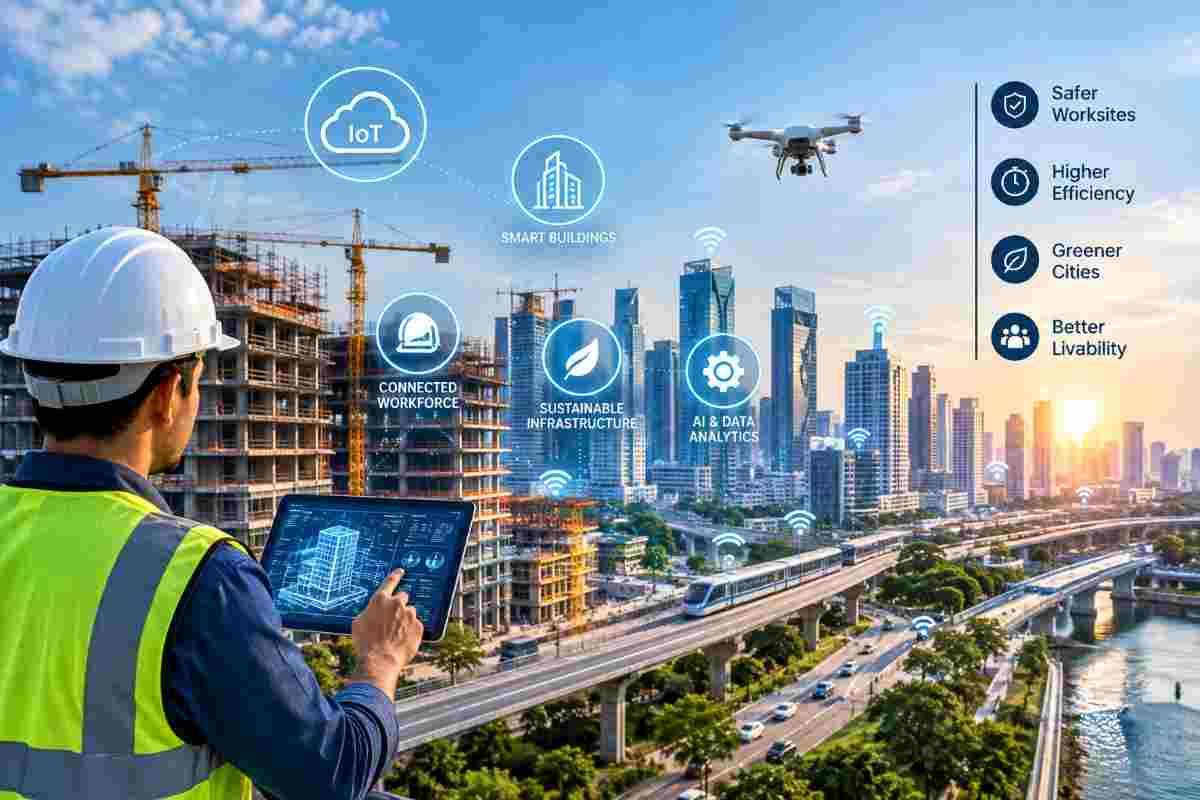
Infrastructure is changing rapidly. Roads, bridges, buildings, metro systems, airports, industrial facilities, utility networks and urban developments are no longer being planned only with traditional drawings and periodic inspections. Increasingly, these projects are becoming connected, data-driven and technology-enabled.
This transformation is creating a new generation of smart infrastructure projects where physical assets work together with digital systems to improve planning, construction, operation, maintenance and sustainability.
Technologies such as Artificial Intelligence (AI), Internet of Things (IoT), Building Information Modelling (BIM), digital twins, drones, cloud computing, advanced sensors, robotics and real-time analytics are becoming important parts of modern infrastructure development.
India is already exploring this direction. The Government of India's Department of Telecommunications launched the Sangam: Digital Twin initiative to investigate how digital twins, 5G, IoT, AI, AR/VR and other technologies can support future infrastructure planning and design.
The future of infrastructure will therefore not simply be about constructing bigger projects. It will increasingly be about creating infrastructure that can be monitored, analysed, maintained and improved throughout its lifecycle.
What Is Smart Infrastructure?
Smart infrastructure refers to physical infrastructure that uses digital technologies, connected devices, data and intelligent systems to improve performance.
A traditional building, road or utility network may primarily depend on physical inspections and scheduled maintenance. A smart infrastructure system can use sensors and connected platforms to continuously collect information about its condition and operation.
For example, sensors may monitor:
- Structural movement
- Temperature
- Vibration
- Energy consumption
- Water usage
- Traffic flow
- Equipment performance
- Air quality
- Occupancy
- Mechanical systems
The information can then be analysed to identify unusual conditions, potential failures or opportunities for optimisation.
This creates a shift from reactive infrastructure management toward more proactive and predictive approaches.
Research published in 2026 describes a decision-centric approach in which sensing, data platforms, AI analytics, digital twins and operational decision-making are connected into a continuous infrastructure-management system.
Why Smart Infrastructure Projects Are Becoming Important
Infrastructure projects are becoming larger and more complex. At the same time, owners and governments need assets that are safer, more efficient, sustainable and easier to maintain.
Smart technology can help address several challenges.
1. Better Planning
Digital models can allow project teams to visualise proposed infrastructure before construction begins.
With BIM, GIS, 3D modelling and digital twins, engineers can study relationships between different systems and identify potential problems earlier.
2. Improved Construction Monitoring
Digital platforms can help project teams track progress, resources, equipment and site conditions.
Drones and reality-capture technologies can also support inspections and progress documentation.
3. Predictive Maintenance
Instead of waiting for equipment or infrastructure components to fail, sensor data and analytics can identify unusual behaviour and potential maintenance requirements.
4. Greater Sustainability
Smart systems can monitor energy, water and resource consumption, helping operators identify inefficiencies.
5. Better Decision-Making
When information from different systems is connected, project stakeholders can make decisions using current data rather than relying entirely on outdated reports.
1. Artificial Intelligence Will Transform Infrastructure Planning
Artificial Intelligence is expected to play a major role in future infrastructure projects.
AI systems can analyse large volumes of information much faster than traditional manual processes. In infrastructure, this could include data from sensors, project schedules, drawings, weather systems, traffic networks, equipment and historical maintenance records.
AI can support applications such as:
- Predictive maintenance
- Construction risk identification
- Project scheduling
- Resource optimisation
- Traffic analysis
- Energy management
- Structural monitoring
- Safety monitoring
- Quality control
- Design optimisation
AI does not eliminate the need for engineers and construction professionals. Instead, it can provide additional information that helps professionals make better-informed technical decisions.
India's recent digital-twin initiatives demonstrate the growing interest in combining AI, connectivity and infrastructure data for more dynamic planning.
2. Digital Twins Will Become a Major Infrastructure Tool
One of the most important technologies for the future of smart infrastructure is the digital twin.
A digital twin is a digital representation of a physical asset, system or environment. When connected with real-world data, it can provide a dynamic view of how the physical asset is performing.
For infrastructure projects, digital twins may be used for:
- Buildings
- Bridges
- Roads
- Railways
- Airports
- Water networks
- Power systems
- Industrial facilities
- Urban districts
- Utility networks
The Department of Telecommunications' Sangam initiative specifically explored digital twins as a way to combine physical infrastructure with real-time information, simulation and collaboration.
The benefit is particularly important during the operational phase.
Instead of having construction drawings sitting separately from maintenance information, project stakeholders can increasingly work with connected digital information throughout the asset lifecycle.
3. IoT Sensors Will Make Infrastructure More Connected
The Internet of Things (IoT) is another major component of smart infrastructure.
IoT devices can collect information from physical environments and transmit it to digital platforms.
Imagine a commercial building with sensors monitoring:
- Electricity consumption
- HVAC performance
- Indoor temperature
- Water usage
- Occupancy
- Equipment condition
The building-management system can analyse this information and identify unusual patterns.
Similarly, smart roads could collect traffic information, while bridges could use monitoring systems to track structural behaviour.
The combination of IoT and AI creates an important feedback loop:
Physical Asset → Sensors → Data → Analytics → Decision → Action
This model can make infrastructure management more responsive and data-driven.
4. BIM Will Connect Design and Construction
Building Information Modelling has already changed how many construction professionals approach project planning.
BIM allows project teams to create detailed digital representations of buildings and infrastructure.
It can help coordinate:
- Architecture
- Structural engineering
- Electrical systems
- Plumbing
- HVAC
- Fire protection
- MEP services
- Construction sequencing
The future will increasingly involve connecting BIM models with other technologies such as IoT, GIS, cloud platforms and digital twins.
This can help create a more complete digital record of an infrastructure asset.
For projects involving structural modifications or new service openings, accurate information about existing structures becomes particularly important.
Professional concrete cutting and core drilling can support such modifications where technically appropriate. For construction and RCC modification requirements, businesses can explore services at Core Cutting India.
5. Robotics and Automation Will Change Construction Sites
Construction sites traditionally depend heavily on manual labour and conventional machinery.
The future may see greater use of:
- Robotic equipment
- Automated surveying
- Autonomous machinery
- Robotic inspection
- Automated material handling
- 3D printing
- Machine-controlled excavation
- AI-assisted quality inspection
Automation can be particularly useful for repetitive, hazardous or highly precise tasks.
However, construction is a complex physical environment. Human supervision, engineering judgement and site-specific decision-making will continue to remain important.
The likely direction is therefore not simply “human versus machine”, but human expertise supported by intelligent machines.
6. Drones Will Improve Infrastructure Inspection
Drones are increasingly useful for surveying, inspection and progress monitoring.
A drone can capture images and spatial information from areas that may be difficult or risky to access manually.
Potential applications include:
- Bridge inspection
- Highway surveys
- Roof inspection
- Construction progress monitoring
- Quarry and earthwork surveys
- Large industrial sites
- High-rise structures
- Utility infrastructure
Drone data can also be integrated with GIS, BIM and digital-twin platforms.
India's construction sector is increasingly examining AI, drones, digital twins and autonomous monitoring as tools for improving efficiency and productivity.
7. Smart Infrastructure Will Focus More on Sustainability
The future of infrastructure cannot be separated from sustainability.
Large buildings, transport networks and industrial facilities consume substantial amounts of energy and resources. Smart technology can help monitor this consumption and identify areas for improvement.
Smart infrastructure can support:
- Energy optimisation
- Water management
- Renewable energy integration
- Waste reduction
- Efficient lighting
- Intelligent HVAC control
- Carbon monitoring
- Resource-efficient construction
Digital twins can be particularly useful because they can help operators understand how an asset performs under different conditions.
Recent industry discussions in India have highlighted AI-enabled digital twins as a potential way to move sustainability from a design objective toward continuously monitored performance.
8. Smart Cities Will Depend on Connected Infrastructure
A smart city is more than a collection of smart buildings.
Urban infrastructure systems need to communicate with one another.
Future smart-city ecosystems may connect:
- Roads
- Traffic signals
- Public transport
- Parking
- Water supply
- Electricity
- Waste management
- Emergency services
- Buildings
- Communication networks
5G and future connectivity technologies can support these applications by providing high-speed, low-latency communication for connected infrastructure.
Government material on 5G and smart infrastructure has highlighted applications such as IoT integration, traffic management, smart utilities and city digital twins.
9. Predictive Maintenance Will Reduce Unexpected Failures
One of the biggest advantages of smart infrastructure is the potential to identify problems before they become major failures.
Traditional maintenance often follows fixed schedules.
Predictive maintenance uses actual asset-condition information.
For example, if sensors detect unusual vibration in a machine, an analytics platform could flag the condition for inspection.
Similarly, infrastructure monitoring systems can help identify changes that require engineering review.
This approach can help organisations move from:
“Repair after failure”
to:
“Detect → Analyse → Inspect → Maintain.”
NITI Aayog has also highlighted technologies such as real-time monitoring, AI-based predictive maintenance and digital twins as part of the digitalisation of India's power-grid infrastructure.
10. Smart Construction Will Improve Project Coordination
Large construction projects involve many teams.
Architects, structural engineers, MEP contractors, civil contractors, equipment operators, consultants and project managers must coordinate their activities.
Digital project platforms can help bring information together.
A future construction project may have:
BIM + Digital Twin + IoT + AI + Drone Data + GIS + Cloud Collaboration
Instead of treating each system separately, these technologies can increasingly operate as connected components.
This can make project information easier to access and improve coordination between different disciplines.
Smart Infrastructure and Structural Modification
Smart infrastructure is not limited to new construction.
Existing buildings and infrastructure will also need upgrades.
As buildings become more connected, owners may need to modify structures to install:
- HVAC systems
- Electrical conduits
- Plumbing
- Fire-fighting systems
- Communication cables
- Drainage systems
- Ventilation systems
- EV charging infrastructure
- Smart-building equipment
This creates demand for accurate structural modification techniques.
Concrete core drilling and controlled RCC cutting can be useful for creating service openings when the work is properly planned and executed.
Before any structural modification, the location, reinforcement, load conditions, services and engineering requirements should be assessed appropriately. Cutting should never be treated as a simple drilling task when structural elements are involved.
11. Cybersecurity Will Become More Important
As infrastructure becomes connected, cybersecurity becomes a critical consideration.
A smart building, power network, transportation system or water network may depend on connected digital systems.
This means project owners will need to consider:
- Data protection
- Access control
- Network security
- System authentication
- Secure software
- Monitoring
- Backup systems
- Incident response
A smart infrastructure system is valuable only when its digital components are managed securely.
12. The Future Will Be Lifecycle-Based
One of the biggest changes will be the shift from thinking about infrastructure only as a construction project to thinking about it as a lifecycle asset.
The lifecycle may include:
- Planning
- Design
- Construction
- Commissioning
- Operation
- Maintenance
- Renovation
- Modification
- Expansion
- End-of-life management
Digital records can potentially remain useful across these stages.
This means future infrastructure projects may be designed from the beginning with their long-term digital and maintenance requirements in mind.
Challenges in Adopting Smart Infrastructure
Smart infrastructure offers significant possibilities, but implementation is not automatic.
Several challenges need to be addressed.
High Initial Investment
Sensors, software, connectivity and digital platforms require investment.
Lack of Skilled Professionals
Projects need engineers and technicians who understand both infrastructure and digital technologies.
Data Integration
Different systems may use different formats and platforms.
Cybersecurity
Connected infrastructure creates additional digital risks.
Legacy Infrastructure
Older infrastructure may not have digital records or sensor systems.
Interoperability
Different vendors and systems need to communicate effectively.
Data Quality
Poor-quality data can produce poor decisions.
Change Management
Organisations may need new workflows, responsibilities and technical skills.
Therefore, successful smart infrastructure requires more than purchasing technology. It requires planning, standards, training, governance and long-term operational thinking.
What Will Smart Infrastructure Projects Look Like in the Future?
A future infrastructure project could operate as a continuously connected ecosystem.
During planning, engineers may create a digital model.
During construction, drones and sensors could provide progress information.
AI systems could analyse project data.
Once the asset becomes operational, IoT devices could continuously monitor performance.
The digital twin could represent the asset's current condition.
Maintenance teams could receive alerts about unusual behaviour.
Operators could simulate different scenarios before making major changes.
This creates a continuous cycle:
Plan → Build → Monitor → Analyse → Predict → Improve
The infrastructure is no longer treated as a static object. It becomes a continuously managed system.
The Role of Human Expertise in Smart Infrastructure
Technology will be central to the future, but infrastructure will still depend on experienced professionals.
Engineers must understand structural behaviour.
Site teams must understand real-world construction conditions.
Contractors must execute work safely and accurately.
Project managers must coordinate multiple stakeholders.
Technology provides information and automation, but professional judgement remains essential.
The most effective future infrastructure projects will therefore combine digital intelligence with engineering expertise.
Conclusion: A Smarter Future for Infrastructure
The future of smart infrastructure projects is being shaped by the convergence of AI, IoT, BIM, digital twins, drones, automation, advanced sensors, cloud computing and sustainable technologies.
India's exploration of digital twins for infrastructure planning demonstrates that this transformation is moving from a purely conceptual discussion toward practical experimentation and implementation.
The most important change is not any single technology.
It is the movement from infrastructure that is static and reactive toward infrastructure that is connected, measurable, predictive and adaptable.
Future infrastructure projects will increasingly need to consider not only how an asset is constructed, but also how it performs for years or decades afterward.
For construction and RCC modification requirements, precision work will remain an important part of modern infrastructure development. Services such as concrete cutting, core drilling and controlled structural openings can support the installation and modification of essential building services when planned according to the project's engineering requirements.
To explore professional concrete cutting and core drilling solutions, visit Core Cutting India.
The future of infrastructure is not simply about building more. It is about building intelligently, operating efficiently, maintaining proactively and creating assets that can adapt to changing needs.
Target-Related Searches
- future of smart infrastructure projects
- smart infrastructure projects in India
- future of infrastructure in India
- smart construction technology
- smart infrastructure technology
- intelligent infrastructure systems
- digital transformation in construction
- AI in infrastructure development
- AI in construction industry
- IoT in smart infrastructure
- digital twins in infrastructure
- BIM in construction
- sustainable infrastructure projects
- smart city infrastructure
- future construction technology
- infrastructure digitalisation
- predictive maintenance in infrastructure
- automated construction technology
- technology in infrastructure development
- smart building technology
- connected infrastructure
- digital twin technology in India
- infrastructure innovation in India
- sustainable construction technology
People Also Ask (PAA)
What is smart infrastructure?
Smart infrastructure is physical infrastructure enhanced with digital technologies such as IoT sensors, AI, data analytics, BIM, automation and digital twins to monitor performance, improve decision-making and support efficient operation.
What is the future of smart infrastructure?
The future of smart infrastructure is expected to involve greater integration of AI, IoT, digital twins, automation, real-time monitoring, advanced connectivity and sustainable technologies across the infrastructure lifecycle.
How does AI help infrastructure projects?
AI can analyse large volumes of infrastructure and project data to support predictive maintenance, risk identification, resource planning, monitoring, optimisation and decision-making.
What is a digital twin in infrastructure?
A digital twin is a digital representation of a physical asset or infrastructure system that can be connected to real-world data. It can help teams monitor conditions, simulate scenarios and support lifecycle management.
How does IoT improve infrastructure?
IoT connects sensors and physical devices to digital platforms. These systems can collect information about conditions such as energy consumption, temperature, vibration, traffic and equipment performance.
How will smart technology affect construction?
Smart technology can improve planning, coordination, monitoring, safety, resource management and maintenance while helping project teams make decisions using more timely information.
Is smart infrastructure sustainable?
Smart infrastructure can support sustainability by monitoring energy and water use, identifying inefficiencies, supporting renewable-energy integration and enabling more informed lifecycle management. However, sustainability depends on how technologies are designed, implemented and operated.
Why is BIM important for future infrastructure projects?
BIM provides a structured digital representation of building or infrastructure information. It can improve coordination between disciplines and provide a foundation for more connected digital workflows.
What role will digital twins play in Indian infrastructure?
Digital twins are being explored in India for applications including infrastructure planning, mobility and telecom-enabled systems. Government initiatives such as Sangam demonstrate interest in combining digital twins with AI, IoT and advanced connectivity.
What is predictive maintenance in infrastructure?
Predictive maintenance uses monitoring data and analytical techniques to identify potential equipment or infrastructure problems before they result in significant failures, allowing maintenance decisions to be made proactively.