
Introduction
Every concrete cutting, coring, or drilling project carries one silent risk: hitting something you didn't know was there. Rebar, post-tension cables, electrical conduits, or plumbing lines hidden inside a slab can turn a routine job into a costly, dangerous mistake. This is exactly why concrete scanning has become a non-negotiable step in modern construction and renovation work.
For decades, contractors relied on traditional rebar detection tools — simple, magnetic-based devices that could tell you "something metallic is here." Today, Ground Penetrating Radar (GPR) scanning has taken over as the industry's gold standard, offering a level of detail and safety that older methods simply cannot match.
At Core Cutting India, we're often asked the same question by clients before every coring, cutting, or drilling project: "Do we really need GPR, or will a regular rebar detector do the job?" This blog breaks down both technologies in detail so you can make an informed decision for your next project.
What Is Traditional Rebar Detection?
Traditional rebar detection refers to the use of electromagnetic or magnetic-based rebar locators, sometimes called cover meters or profometers. These handheld devices have been used in the construction industry for decades and work on a simple principle: they detect magnetic fields disturbed by the presence of ferrous metal (steel rebar) inside concrete.
How Traditional Rebar Detectors Work
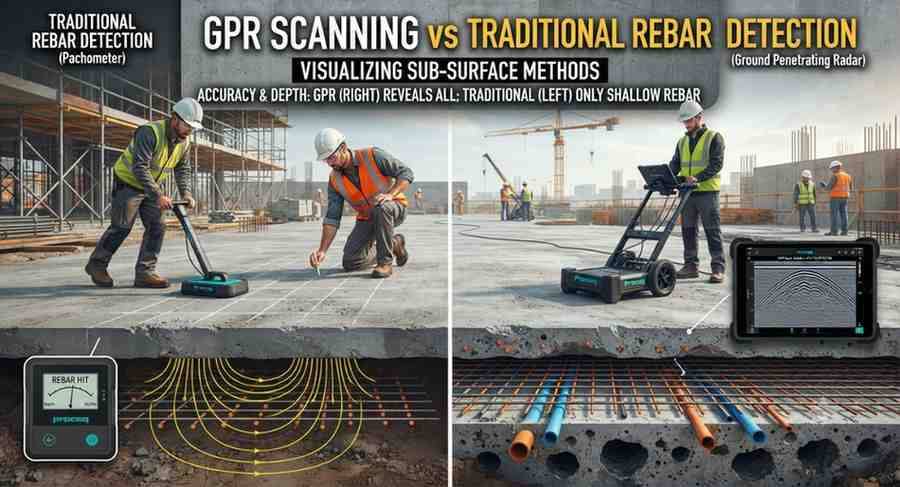
A rebar locator emits a magnetic field and measures the disruption caused when it passes near a metal object. Based on the strength of the signal, it estimates the approximate location and, in some cases, the depth of the rebar.
Limitations of Traditional Detection
While these tools are affordable and easy to use, they come with significant limitations:
- Metal-only detection: They can only detect ferrous metal. Non-metallic hazards like PVC conduits, plastic pipes, or voids remain completely invisible.
- No visualization: The output is usually a beep or a numeric reading, not an image, making it difficult to understand the exact layout of embedded objects.
- Limited depth range: Most traditional detectors are only reliable up to 150–200mm, which is inadequate for thick structural slabs or foundations.
- Reduced accuracy in congested rebar zones: In areas with dense reinforcement, signals overlap, making it hard to distinguish between individual bars.
- No detection of non-conductive utilities: Fiber optic cables, plastic conduits, and water pipes made of non-metallic material go undetected.
What Is GPR Scanning?
Ground Penetrating Radar (GPR) scanning is a non-destructive testing method that uses high-frequency electromagnetic waves to create a real-time subsurface image of concrete structures. Unlike traditional detectors, GPR doesn't just detect metal — it detects any change in material density, which means it can identify rebar, post-tension cables, conduits, voids, pipes, and even moisture pockets.
How GPR Scanning Works
A GPR scanner emits radar pulses into the concrete surface. When these pulses hit an object with a different density than the surrounding concrete (such as steel, plastic, or air), a portion of the wave reflects back to the receiver. The device then processes this reflected data and builds a visual, layered image of what lies beneath the surface — essentially giving contractors an "X-ray" view of the slab.
Advantages of GPR Scanning
- Detects all embedded objects: Metallic and non-metallic materials, including PT cables, plastic conduits, and voids.
- Real-time imaging: Live visual feedback allows technicians to mark exact locations directly on the surface.
- Greater depth capability: GPR can scan effectively up to 300–600mm or more, depending on concrete density and equipment.
- Higher accuracy in congested areas: Advanced signal processing helps distinguish closely spaced rebar and multiple embedded utilities.
- Safer drilling and cutting decisions: Because GPR reveals a complete subsurface picture, contractors can confidently mark safe-cut zones.
- Non-destructive and fast: No damage to the surface, and scanning can usually be completed within minutes per area.
GPR Scanning vs Traditional Rebar Detection: A Side-by-Side Comparison
| Feature | Traditional Rebar Detection | GPR Scanning |
|---|---|---|
| Detects metal (rebar) | Yes | Yes |
| Detects non-metallic utilities | No | Yes |
| Provides visual imaging | No | Yes |
| Maximum reliable depth | ~150-200mm | 300-600mm+ |
| Accuracy in dense rebar zones | Low | High |
| Detects voids/moisture | No | Yes |
| Speed of scanning | Moderate | Fast |
| Equipment cost | Lower | Higher |
| Skill required to interpret | Low | Moderate to High |
| Suitable for critical structures | Limited | Highly suitable |
Accuracy: Why GPR Wins in Complex Structures
Accuracy is where the gap between these two technologies becomes most obvious. Traditional rebar detectors work well for simple, single-layer reinforcement but struggle significantly when:
- Rebar is closely spaced or overlapping in multiple layers
- The slab contains post-tension cables under stress
- Non-metallic utilities are present alongside metallic ones
GPR scanning, on the other hand, generates a continuous cross-sectional image, allowing technicians to differentiate between object types based on shape, depth, and reflection pattern. This is particularly critical in high-rise buildings, bridges, parking structures, and industrial facilities where reinforcement density is high and the cost of an error is severe.
Depth Capability: Going Beyond the Surface
Traditional detectors are designed for shallow to moderate depth scanning, which works fine for residential slabs or thin walls. However, most commercial and industrial structures — foundations, bridge decks, elevated slabs — require deeper scanning capability.
GPR systems, especially those using lower-frequency antennas, can penetrate much deeper into concrete while still maintaining reasonable resolution. This makes GPR the preferred choice for:
- Foundation and footing inspections
- Bridge deck evaluations
- Multi-story building slabs
- Industrial flooring with thick reinforcement
Speed and Project Efficiency
Time is money on any construction site. Traditional rebar detectors require the technician to manually sweep small areas repeatedly and interpret audio or numeric signals, which can slow down large-scale scanning projects.
GPR scanning, especially with modern cart-based or handheld units connected to tablets, allows technicians to cover large surface areas quickly while recording data for later analysis. This means faster mobilization, quicker turnaround, and less downtime for cutting, coring, or drilling crews waiting on scan results.
Cost Considerations
It's true that GPR equipment and trained operators typically cost more upfront than a basic rebar locator. However, when you factor in the potential costs of:
- Damaging post-tension cables (which can cost lakhs to repair and pose safety hazards)
- Cutting through live electrical conduits
- Structural damage from misidentified rebar locations
- Project delays due to inaccurate scanning
...the higher investment in GPR scanning quickly pays for itself. Many contractors now view GPR not as an added expense, but as an insurance policy against far costlier on-site accidents.
Safety: The Most Important Factor
Safety is ultimately the biggest reason the industry has shifted toward GPR. Traditional rebar detectors cannot see non-metallic hazards, meaning a crew could unknowingly drill into a plastic-sheathed cable or a pressurized pipe. GPR's ability to visualize the complete subsurface — regardless of material type — dramatically reduces the risk of:
- Structural weakening from cut rebar or PT cables
- Electrocution from hitting live wiring
- Water damage from ruptured pipes
- Project delays due to on-site accidents
For any project involving core cutting, wall sawing, or floor drilling near existing utilities, GPR scanning should be treated as a mandatory pre-construction step, not an optional add-on.
When Should You Still Consider Traditional Rebar Detection?
Traditional rebar detectors aren't obsolete. They remain a practical, cost-effective choice for:
- Small residential projects with simple, single-layer reinforcement
- Quick spot-checks where depth requirements are shallow
- Budget-constrained projects where non-metallic utilities are known not to be present
- Preliminary checks before a more detailed GPR scan on larger jobs
In many real-world scenarios, a combination of both technologies — a quick rebar detector sweep followed by targeted GPR scanning — offers the best balance of speed and thoroughness.
Choosing the Right Concrete Scanning Partner
Whether you're planning a residential renovation, a commercial fit-out, or an industrial expansion, the technology is only as good as the team operating it. Experienced technicians who understand how to interpret GPR data correctly are just as important as the equipment itself.
At Core Cutting India, our concrete scanning and cutting teams use advanced GPR technology alongside traditional detection methods to give clients complete, reliable subsurface data before any coring, cutting, or drilling begins. Our goal is simple: help you cut, drill, and build with confidence, without unexpected surprises hidden inside the concrete.
Conclusion
The debate between GPR scanning and traditional rebar detection isn't really about which technology is "better" in every situation — it's about matching the right tool to the right project. For small, straightforward jobs, a traditional rebar detector may still get the job done. But for any project involving thick slabs, dense reinforcement, post-tension cables, or nearby utilities, GPR scanning offers a level of accuracy, safety, and efficiency that traditional methods simply cannot match.
As construction projects grow more complex and safety regulations become stricter, GPR scanning is quickly becoming the new industry standard — not just a premium option, but a practical necessity.
If you're planning a coring, cutting, or drilling project and want accurate, reliable subsurface scanning before work begins, reach out to Core Cutting India at [email protected] for a professional GPR scanning consultation.
Frequently Asked Questions (People Also Ask)
Is GPR scanning better than a rebar detector? For most modern construction projects, yes. GPR scanning detects both metallic and non-metallic objects, provides visual imaging, and scans deeper than traditional rebar detectors, making it more reliable for complex or high-risk structures.
How deep can GPR scan into concrete? Depending on the equipment and concrete density, GPR scanning can typically reach depths of 300mm to 600mm or more, compared to 150-200mm with most traditional rebar detectors.
What is the cost of GPR scanning services in India? Costs vary based on project size, scanning area, and site complexity. It's best to request a quote from a professional concrete scanning provider like Core Cutting India based on your specific project requirements.
Can rebar detectors find PT cables and conduits? Basic rebar detectors can sometimes identify metallic PT cables but generally cannot detect non-metallic conduits, plastic pipes, or voids. GPR scanning is far more reliable for these hazards.
How accurate is ground penetrating radar for concrete scanning? GPR scanning offers high accuracy, especially in areas with dense or layered reinforcement, by generating real-time visual data that trained technicians can interpret precisely.
Do I need GPR scanning before core cutting or drilling? Yes. GPR scanning before core cutting or drilling is strongly recommended to avoid damaging embedded rebar, cables, or utility lines, reducing both safety risks and repair costs.
For professional GPR scanning, rebar detection, and concrete cutting services, contact Core Cutting India at [email protected].