
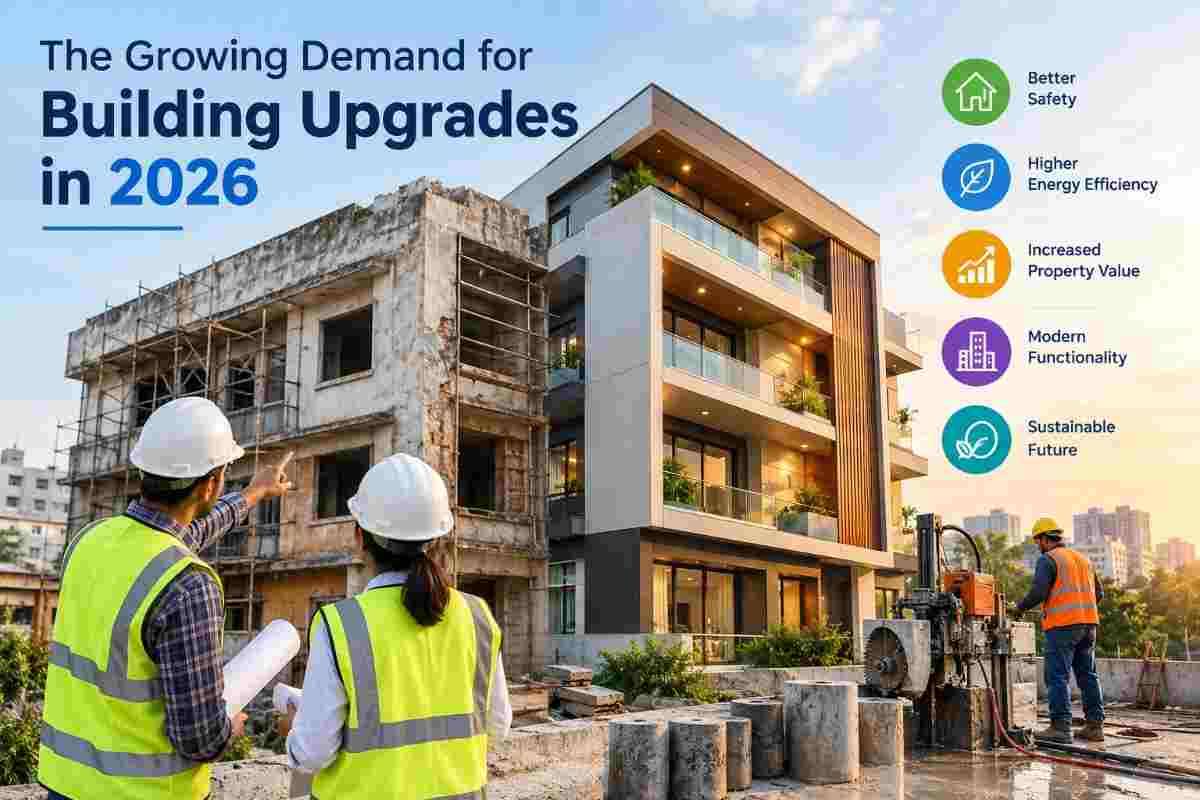
Across India's cities, a quiet transformation is underway. Buildings that were once considered functional and complete are now being reopened, re-engineered, and reimagined. From aging commercial towers in Mumbai to decades-old residential complexes in Delhi, property owners are investing heavily in upgrades rather than tearing structures down and starting fresh. This shift isn't a passing trend — it's a structural change in how India thinks about its built environment, and 2026 is shaping up to be a landmark year for building upgrades.
At CoreCuttingIndia.com, we've watched this demand grow firsthand. As a company specializing in precision core cutting, concrete drilling, and structural modification services, we sit at the intersection of old infrastructure and new possibilities. This blog explores why building upgrades are surging in 2026, what's driving the demand, and how specialized services like core cutting are making these transformations possible.
Why 2026 Is a Turning Point for Building Upgrades
1. Aging Infrastructure Is Reaching a Critical Mass
India's rapid urbanization boom of the 1990s and 2000s produced millions of square feet of commercial and residential real estate. Many of these structures are now 20 to 30 years old — old enough to need significant mechanical, electrical, and plumbing (MEP) upgrades, but structurally sound enough that demolition and rebuilding make little financial or environmental sense. Building owners are increasingly choosing to retrofit rather than replace, extending the lifespan of their assets while modernizing them to meet current standards.
2. Stricter Building Codes and Compliance Requirements
Regulatory bodies across Indian states have tightened building codes related to fire safety, seismic resistance, accessibility, and energy efficiency. Buildings constructed under older codes often fall short of these updated requirements. To remain compliant — and to avoid penalties or insurance complications — property owners are undertaking structural assessments and targeted upgrades, including reinforced concrete work, fire-rated partitions, and updated utility routing.
3. The Rise of Hybrid and Smart Workspaces
The post-pandemic shift toward hybrid work permanently changed what commercial tenants expect from office buildings. Businesses now demand flexible floor plans, improved ventilation systems, smart building technology, and better connectivity infrastructure. Landlords who want to retain tenants or attract new ones are investing in comprehensive upgrades — reconfiguring layouts, running new cabling, and installing modern HVAC systems, all of which require precise structural modifications.
4. Sustainability and Green Building Mandates
Environmental consciousness has moved from a marketing talking point to a regulatory and financial necessity. Green building certifications like IGBC and GRIHA are increasingly tied to tax incentives, higher property valuations, and tenant demand. Retrofitting a building for energy efficiency — through improved insulation, solar panel integration, rainwater harvesting systems, and efficient HVAC — is often more cost-effective and faster than new construction, driving a wave of sustainability-focused upgrades in 2026.
5. Seismic and Structural Safety Concerns
Following several high-profile structural failures and increased public awareness of seismic risk in various regions of India, structural safety audits have become far more common. Where audits reveal vulnerabilities, targeted reinforcement work — including column strengthening, load redistribution, and the careful removal of non-load-bearing sections — is essential. This kind of precision work depends heavily on controlled demolition and cutting techniques that don't compromise the building's overall integrity.
The Role of Core Cutting in Modern Building Upgrades
Building upgrades rarely involve knocking down walls with a sledgehammer. Modern renovation work — especially in occupied buildings — demands precision, minimal disruption, and structural safety. This is where core cutting and concrete drilling services become indispensable.
What Is Core Cutting?
Core cutting is a specialized construction technique that uses diamond-tipped drilling and cutting equipment to create clean, precise holes or openings in concrete, brick, and masonry structures. Unlike traditional breaking methods, core cutting produces minimal vibration, reduced dust, and virtually no damage to surrounding structural elements — making it ideal for occupied buildings undergoing renovation.
Common Applications in Building Upgrades
MEP Installations: Upgrading a building's electrical, plumbing, or HVAC systems almost always requires new pathways through existing concrete slabs and walls. Core cutting allows contractors to create precise openings for pipes, cables, and ducts without disturbing the building's structural integrity.
Elevator and Staircase Modifications: As buildings adapt to accessibility requirements or add new floors, core cutting is used to create shaft openings, staircase modifications, and structural passages with millimeter-level accuracy.
Window and Door Reconfiguration: Adapting older buildings to modern aesthetic and ventilation standards often involves enlarging window openings or adding new entry points — work that demands controlled, vibration-free cutting.
Structural Reinforcement: When engineers need to access rebar for reinforcement or inspection, core cutting provides clean access points without the collateral damage caused by conventional demolition.
Seismic Retrofitting: Strengthening a building against seismic activity often requires the removal of select structural sections for reinforcement — work that must be executed with surgical precision to avoid compromising the building's load-bearing capacity.
Sectors Driving the Demand
Commercial Real Estate
Office buildings, shopping malls, and business parks are undergoing significant upgrades to remain competitive. Owners are investing in modernized lobbies, upgraded fire safety systems, improved HVAC efficiency, and technology infrastructure to meet tenant expectations and regulatory requirements.
Residential Complexes
Older housing societies are pursuing structural audits, waterproofing upgrades, plumbing overhauls, and electrical modernization. As redevelopment regulations evolve in cities like Mumbai and Pune, many housing societies are opting for major structural upgrades instead of full redevelopment, particularly where redevelopment approvals are slow or contested.
Healthcare Facilities
Hospitals and clinics are expanding and modernizing at a rapid pace, often requiring precise structural modifications to accommodate new medical equipment, expanded patient wards, and updated infrastructure — all while maintaining strict hygiene and safety standards during construction.
Industrial and Manufacturing Units
Factories and warehouses are retrofitting facilities to accommodate automation equipment, upgraded power infrastructure, and modern safety systems, often requiring extensive core cutting and structural modification work to integrate new machinery.
Hospitality Sector
Hotels are renovating to meet evolving guest expectations, incorporating updated plumbing, modern electrical systems, and reconfigured spaces — all of which demand precision cutting work that minimizes disruption to ongoing operations.
Benefits of Choosing Professional Building Upgrade Services
Undertaking a building upgrade is a complex, multi-disciplinary process that requires careful planning and expert execution. Here's why professional services matter:
- Structural Safety: Improper cutting or demolition can compromise a building's load-bearing capacity. Professional core cutting services use engineering assessments to ensure structural integrity is preserved throughout the upgrade process.
- Minimal Disruption: Precision techniques reduce noise, dust, and vibration — critical for occupied buildings, hospitals, and commercial spaces where operations must continue during renovation.
- Time and Cost Efficiency: Professional equipment and experienced teams complete work faster and with fewer errors, reducing costly delays and rework.
- Compliance Assurance: Experienced service providers understand local building codes and safety regulations, helping property owners avoid compliance issues down the line.
- Long-Term Value: A well-executed upgrade extends a building's usable life, improves energy efficiency, and increases property value — a strong return on investment compared to the cost and disruption of full redevelopment.
What to Expect From Building Upgrades in the Rest of 2026
Looking ahead, several trends are likely to shape the building upgrade landscape through the remainder of the year:
- Increased Adoption of Smart Building Technology — IoT-enabled sensors, automated climate control, and energy monitoring systems will become standard features in upgraded commercial spaces.
- Greater Emphasis on Water Management — Rainwater harvesting retrofits and water-efficient plumbing systems will see wider adoption as water scarcity concerns grow.
- Faster Turnaround Expectations — Property owners will increasingly demand upgrade projects that minimize downtime, pushing contractors toward more efficient techniques like precision core cutting over traditional demolition.
- Rising Investment in Seismic Retrofitting — As awareness of structural vulnerabilities grows, more building owners will commission structural audits and proactive reinforcement work.
- Integration of Renewable Energy Systems — Solar panel installations and associated structural modifications will continue to rise as energy costs and sustainability mandates push property owners toward cleaner power sources.
Partnering With the Right Experts
Building upgrades are only as successful as the expertise behind them. Whether the project involves creating precise openings for new utility lines, reinforcing a structure for seismic safety, or reconfiguring a building's layout to meet modern demands, the quality of execution determines whether the upgrade delivers long-term value or introduces new risks.
This is where specialized core cutting and concrete drilling contractors play a critical role. At CoreCuttingIndia.com, our team brings the technical expertise, modern equipment, and safety-first approach needed to support building upgrade projects across commercial, residential, industrial, and institutional sectors. From MEP installations to structural reinforcement work, we help property owners and contractors execute upgrades with precision, minimal disruption, and full compliance with safety standards.
Conclusion
The growing demand for building upgrades in 2026 reflects a broader shift in how India approaches its built environment — one that favors smart, sustainable, and safety-conscious modernization over costly demolition and rebuilding. Aging infrastructure, evolving regulations, sustainability mandates, and changing occupant expectations are all converging to drive this trend forward.
For property owners considering an upgrade, success depends on partnering with experienced professionals who understand both the technical and regulatory complexities involved. Precision techniques like core cutting are no longer a niche service — they're a cornerstone of modern building renovation, enabling safer, faster, and more efficient upgrades across every sector.
As the demand for building upgrades continues to rise through 2026 and beyond, companies like CoreCuttingIndia.com are positioned to support this transformation, helping bring outdated structures into a safer, smarter, and more sustainable future.