
Introduction
India's digital economy is expanding at a pace few could have predicted a decade ago. Every online transaction, cloud backup, video stream, and AI query depends on a physical structure most people never think about — the data center. Behind these vast, humming halls of servers lies an equally important layer of construction work: precise concrete openings that make cabling, cooling, plumbing, and structural access possible. As data centers multiply across India to meet the demands of cloud computing, e-commerce, banking, and artificial intelligence, the need for professional concrete cutting and coring services has grown just as quickly. At Core Cutting India ([email protected]), we have witnessed this demand firsthand, working with contractors and data center developers who require speed, precision, and safety in every opening they cut.
This blog explores why concrete openings are becoming such a critical part of data center construction, the techniques involved, and what the future holds for this specialized niche of the construction industry.
Why Data Centers Are Booming in India
Before understanding the demand for concrete openings, it helps to understand why data centers themselves are multiplying. India has become one of the fastest-growing data center markets in the Asia-Pacific region. Government initiatives such as Digital India, the push for data localization, growing 5G adoption, and the explosion of cloud services from global tech giants have all fueled massive investment in data center infrastructure. Cities like Mumbai, Chennai, Hyderabad, Pune, and Noida have emerged as major data center hubs, with new facilities being commissioned almost every quarter.
Each of these facilities, regardless of size, requires an enormous amount of behind-the-scenes construction work. Concrete floors and walls must be engineered not just for strength but for flexibility — because data centers are living, evolving structures. Server racks get added, cooling systems get upgraded, and cabling requirements change as technology advances. This is precisely where concrete opening services come in.
What Are Concrete Openings and Why Do They Matter?
Concrete openings refer to precisely cut holes, slots, or channels made in concrete floors, walls, and ceilings to accommodate essential infrastructure. In a data center environment, these openings typically serve purposes such as:
- Cable routing — Data centers rely on thousands of meters of fiber optic and power cabling that must pass through floors and walls in an organized, protected manner.
- HVAC and cooling ducts — Data centers generate enormous heat, and precise openings are required for ductwork that keeps servers within safe operating temperatures.
- Plumbing and fire suppression systems — Many facilities use liquid cooling or fire suppression systems that require pipe penetrations through concrete structures.
- Structural access — Openings are sometimes needed for elevators, stairwells, maintenance hatches, or equipment installation.
- Electrical conduits — Power distribution units and backup generators need dedicated pathways cut into concrete for safe electrical routing.
Without accurately measured and executed openings, none of these systems can be installed correctly, and the entire data center's efficiency, safety, and uptime could be compromised.
The Role of Core Drilling and Concrete Cutting
Two primary techniques are used to create these openings: core drilling and concrete cutting (also called wall sawing or slab sawing).
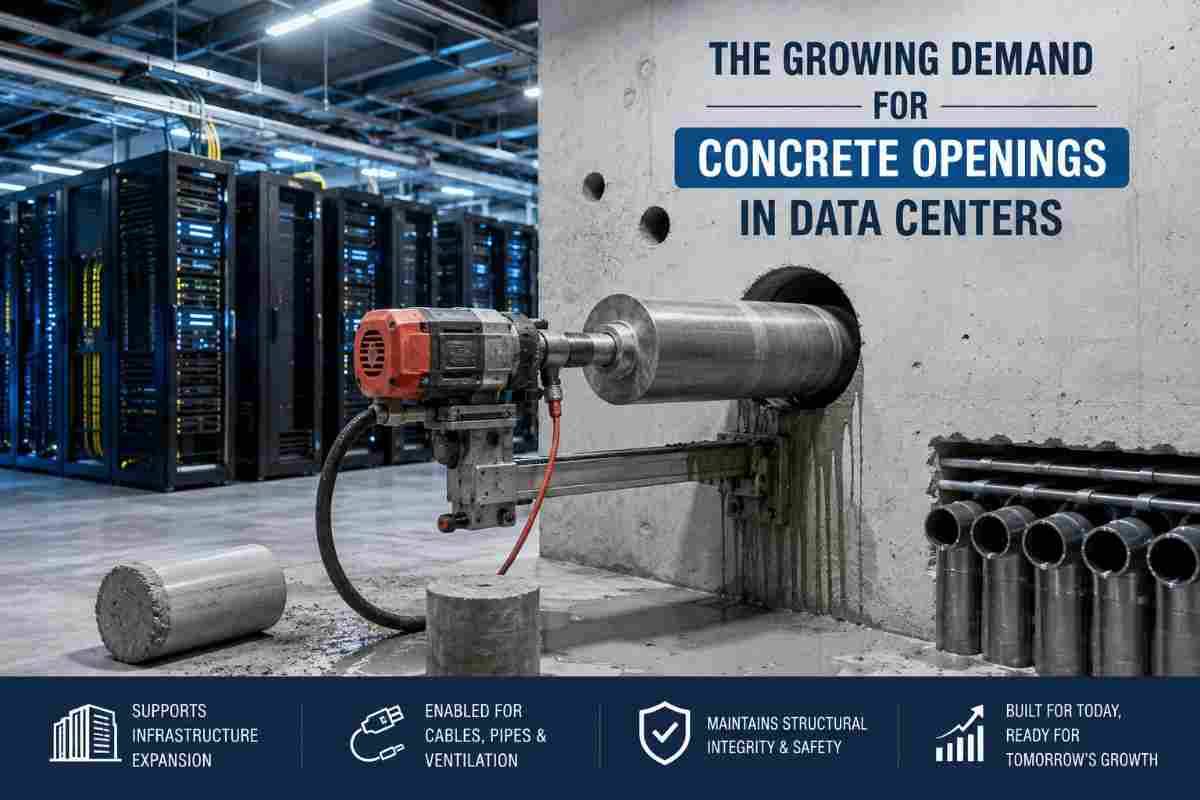
Core drilling uses a diamond-tipped hollow bit to bore precise circular holes through concrete, brick, or masonry. This method is ideal for smaller openings needed for pipes, cables, or bolts, and is prized for its clean, dust-controlled, and vibration-free results — something absolutely essential in a live or partially operational data center where even minor vibrations can affect sensitive server equipment.
Concrete cutting, on the other hand, is used for larger rectangular or irregular openings, such as those needed for HVAC ducts or maintenance access. This process typically involves diamond blade saws that can cut through reinforced concrete with minimal disruption to the surrounding structure.
Both techniques demand technical expertise, high-quality equipment, and strict safety protocols, especially in environments as sensitive as data centers, where structural integrity, dust control, and precision are non-negotiable.
Why Precision Matters More in Data Centers Than Anywhere Else
Unlike residential or standard commercial construction, data centers operate under extremely tight tolerances. A data center's raised flooring system, for instance, is engineered with exact measurements to allow airflow, cable management, and equipment stability. If a concrete opening is even slightly off in size or placement, it can disrupt the entire cooling airflow design, cause cable congestion, or compromise fire-rated barriers between server rooms.
This is why data center developers increasingly turn to specialized firms rather than general contractors for this work. Companies like Core Cutting India bring years of experience specifically suited to the exacting standards of mission-critical facilities. Every opening must be cut according to precise engineering drawings, often verified using ground-penetrating radar (GPR) scanning beforehand to avoid cutting through embedded rebar, electrical conduits, or existing utility lines.
Safety and Structural Considerations
Data centers are often built with post-tensioned concrete slabs or heavily reinforced structural elements to support the weight of server racks, cooling units, and battery backup systems. Cutting into such structures without proper scanning and engineering assessment can be dangerous, potentially damaging tensioning cables or weakening load-bearing elements.
Professional concrete cutting companies follow a structured process:
- Site assessment and scanning — Using GPR or X-ray scanning to detect rebar, conduits, and tensioning cables before any cutting begins.
- Engineering consultation — Reviewing structural drawings to confirm that openings won't compromise load-bearing capacity.
- Dust and debris control — Using wet-cutting methods or vacuum systems to minimize airborne particles, which is critical in environments housing sensitive electronic equipment.
- Vibration control — Selecting methods that minimize vibration to protect nearby operational servers.
- Post-cutting sealing and fire-stopping — Ensuring openings are properly sealed with fire-rated materials once cables or pipes are installed, maintaining compartmentalization for fire safety.
This level of care distinguishes data center concrete work from ordinary construction cutting jobs.
Retrofitting Existing Data Centers
While new data center construction is a major driver of demand, an equally significant portion of concrete opening work comes from retrofitting existing facilities. As technology evolves, older data centers must be upgraded to support higher-density server racks, modern cooling systems like liquid cooling, and expanded fiber optic networks.
Retrofitting is often more complex than new construction because the work must be carried out without disrupting live operations. Uptime is everything in the data center industry — even a few minutes of unplanned downtime can cost businesses significant revenue and damage client trust. This has led to a rise in demand for low-vibration, low-dust, and low-noise cutting techniques that allow technicians to create new openings while adjacent racks remain fully operational.
Sustainability and Efficiency Trends
The construction industry as a whole is moving toward more sustainable practices, and concrete cutting is no exception. Modern core drilling and sawing techniques generate significantly less waste than traditional demolition methods, since only the exact material needed is removed rather than breaking down entire wall or floor sections. This precision reduces landfill waste, lowers material costs, and shortens project timelines.
Additionally, water-based dust suppression systems used during cutting help data center operators maintain cleaner environments, which is important given how sensitive server hardware is to airborne particulates. As data centers increasingly pursue green building certifications and energy efficiency targets, contractors who can demonstrate low-waste, low-emission cutting practices are becoming preferred partners.
The Growing Market for Specialized Concrete Cutting Services
As more global and domestic companies invest in Indian data center infrastructure, the market for specialized concrete cutting and coring services is expanding rapidly. Industry estimates suggest India's data center capacity will continue to grow substantially over the coming years, driven by cloud adoption, AI workloads, and data localization mandates. Every megawatt of new data center capacity translates into extensive construction work, much of which depends on accurate, safe, and efficient concrete openings.
This growth has encouraged specialized firms to invest in advanced equipment such as remote-controlled wall saws, high-precision core drills, and robotic cutting systems capable of working in tight, sensitive environments. It has also raised the bar for technical training, safety certification, and quality assurance across the industry.
Choosing the Right Concrete Cutting Partner
For developers and contractors working on data center projects, choosing the right concrete cutting partner is not a decision to take lightly. Key factors to consider include:
- Experience with mission-critical facilities — Data centers are unlike typical commercial buildings, and contractors need specific experience in this space.
- Scanning and safety protocols — A trustworthy partner will always scan before cutting to avoid damaging embedded utilities or structural elements.
- Equipment quality — Diamond-tipped tools, dust control systems, and vibration-reducing technology all matter for a clean, safe job.
- Turnaround time — Data center construction schedules are often tight, so reliability and speed are essential.
- Compliance and certifications — Proper fire-stopping, sealing, and adherence to local building codes protect the long-term integrity of the facility.
At Core Cutting India, our team specializes in precision core drilling and concrete cutting services tailored to the unique demands of data center construction and retrofitting. From cable routing openings to large-scale HVAC duct cuts, we combine technical expertise with strict safety standards to support developers building the digital backbone of India's economy.
Conclusion
The rapid expansion of India's data center industry is reshaping the demand for specialized construction services, and concrete opening work sits right at the heart of this transformation. Whether it's a brand-new hyperscale facility or a retrofit of an existing server room, precise, safe, and efficient concrete cutting is what allows the physical infrastructure to keep pace with the digital demands placed upon it. As data centers continue to grow in number and complexity across India, the role of expert concrete cutting and coring providers will only become more essential.
For contractors and developers looking for a reliable partner in this space, Core Cutting India offers the experience, equipment, and precision needed to get the job done right. Reach out to us at [email protected] to discuss your next data center project.