
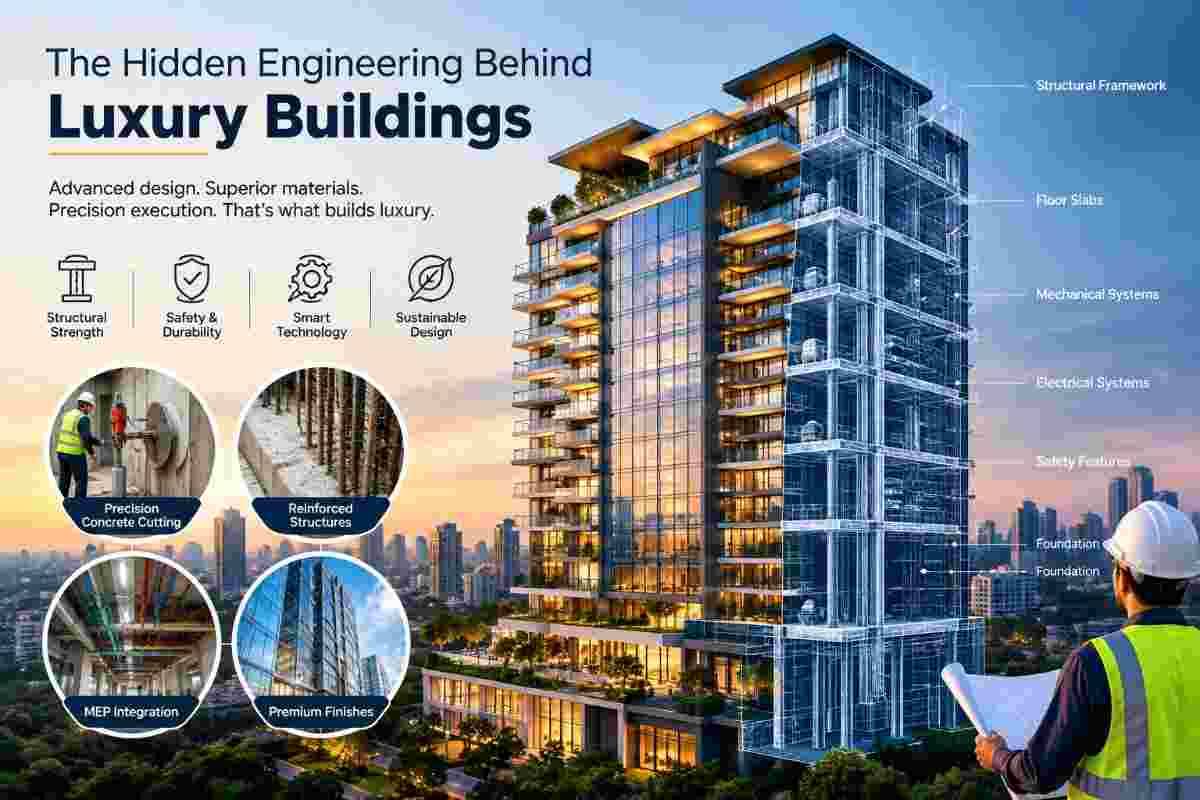
When people walk through the marble-clad lobby of a five-star hotel or admire the floor-to-ceiling glass windows of a luxury penthouse, they rarely think about what lies beneath the polish. Luxury buildings are celebrated for their aesthetics — sweeping staircases, seamless facades, and interiors that feel effortless. But behind every stunning luxury structure is a web of precise, technical, and often invisible engineering work that makes the design possible in the first place.
This hidden engineering is not glamorous. It does not show up in real estate brochures or architectural photography. Yet without it, luxury buildings simply could not exist in their current form. From deep foundation work to precision concrete cutting for utility installations, the true backbone of luxury construction lies in the technical execution that happens long before — and often long after — the finishing touches are applied.
At Core Cutting India, we work at the intersection of structural engineering and precision execution, providing the core cutting, concrete cutting, and drilling services that make complex luxury projects structurally sound and functionally efficient. In this article, we explore the engineering realities that most people never see — but that every architect, contractor, and structural engineer knows are essential.
1. The Foundation: Where Luxury Really Begins
Luxury buildings often push architectural boundaries — cantilevered balconies, underground swimming pools, multi-level basements for parking and wellness centers, and towering heights that require deep foundations. None of this is possible without foundation engineering that accounts for soil conditions, load distribution, and seismic activity.
Structural engineers conduct extensive geotechnical surveys before a single brick is laid. Soil bearing capacity, water table levels, and even nearby vibration sources (like metro lines or highways) are factored into foundation design. For luxury high-rises, pile foundations driven deep into bedrock are common, ensuring that even the tallest, most extravagant structures remain stable for decades.
This is engineering in its purest, most unglamorous form — yet it is what allows architects the freedom to design daring, open-plan luxury spaces above ground.
2. Structural Frameworks That Enable Open, Airy Design
One of the defining features of luxury architecture is spaciousness — expansive open floor plans, double-height ceilings, and walls of glass that blur the line between indoor and outdoor living. Achieving this requires structural systems that can bear heavy loads without relying on traditional load-bearing walls.
Post-tensioned concrete slabs, steel moment frames, and transfer beams are frequently used to eliminate the need for internal columns, giving architects the freedom to create uninterrupted, open interiors. These systems require meticulous calculation, because removing structural elements in one area often means reinforcing elsewhere.
This is also where precision cutting and coring come into play. As luxury interiors are customized — often after the structural shell is complete — walls and slabs frequently need controlled modifications to accommodate elevators, staircases, ductwork, or plumbing risers. This is not something that can be done with a jackhammer; it requires calculated, non-disruptive techniques that preserve the structural integrity of the building.
3. Precision Core Cutting: The Silent Enabler of Modern Luxury
This is where companies like Core Cutting India play a critical, if unseen, role. Core cutting and concrete cutting are essential engineering processes used throughout luxury construction — for installing plumbing, electrical conduits, HVAC ducts, elevator shafts, and structural openings — without compromising the surrounding structure.
Unlike traditional demolition methods, core cutting uses diamond-tipped drilling and cutting equipment to create clean, precise openings in concrete, brick, or stone. This precision is essential in luxury buildings for several reasons:
- Structural safety: Poorly executed cutting can weaken load-bearing elements, leading to long-term structural risk. Precision core cutting ensures openings are made exactly where engineers specify, avoiding rebar damage and structural compromise.
- Noise and vibration control: Luxury developments, especially occupied residential towers or heritage hotel renovations, cannot tolerate the disruption of traditional demolition. Diamond core drilling is significantly quieter and produces minimal vibration.
- Clean finishes: Because luxury interiors demand flawless finishing, the openings created for utilities must be clean-edged and precise, reducing the need for extensive patchwork or repair.
- Speed and efficiency: High-end projects often operate on tight timelines with multiple contractors working in parallel. Precision cutting allows MEP (mechanical, electrical, plumbing) teams to proceed quickly without waiting for messy, imprecise openings to be fixed.
Whether it's floor sawing for a new staircase opening, wall sawing to create a doorway between two suites, or wire sawing to remove a large structural section for a service shaft, this specialized engineering work directly enables the seamless, high-end finish that luxury clients expect.
4. Structural Retrofitting: Preserving Heritage While Building Modern Luxury
A growing segment of luxury real estate involves restoring heritage buildings — colonial-era mansions, historic hotels, and century-old structures — and transforming them into modern luxury spaces. This presents a unique engineering challenge: how do you modernize a building's infrastructure (elevators, HVAC, fire safety systems) without damaging its historic structure or character?
Structural retrofitting relies heavily on precision cutting and coring techniques. Engineers must often cut through thick, old masonry walls or aging concrete slabs to introduce new utility pathways, reinforce weakened structural elements, or install modern safety systems, all while preserving the original architectural fabric. This delicate balance between old and new is one of the most technically demanding aspects of luxury construction — and one that depends entirely on precision, not brute force.
5. Waterproofing and Basement Engineering for Wellness Amenities
Luxury developments increasingly include underground amenities — spas, wine cellars, home theaters, and multi-level basement parking. These spaces present significant engineering challenges related to waterproofing, drainage, and structural load management.
Basement construction requires careful excavation planning, retaining wall design, and waterproofing membranes that prevent water ingress over decades. Any penetration through these waterproofed structures — for plumbing, drainage, or electrical conduits — must be executed with extreme precision to avoid compromising the waterproofing system. This is another area where controlled core drilling is essential; a poorly placed or oversized opening can create long-term leakage issues that are costly and disruptive to repair once finishes are complete.
6. MEP Integration: The Invisible Network Behind Every Luxury Amenity
Luxury buildings are defined not just by their appearance, but by their amenities: smart home automation, centralized air conditioning, high-speed elevators, integrated sound systems, and advanced security infrastructure. All of these systems require an extensive network of cabling, piping, and ductwork running through walls, floors, and ceilings.
Coordinating this MEP (Mechanical, Electrical, Plumbing) integration is one of the most complex parts of luxury construction. Engineers must plan cutting and coring work with millimeter precision to avoid clashing with structural reinforcement, existing utilities, or other trades' work. This is typically mapped out using Building Information Modeling (BIM) software, which allows structural, architectural, and MEP teams to visualize potential clashes before any physical cutting begins.
Once the plan is finalized, precision cutting teams execute the openings exactly as modeled, ensuring that every luxury amenity — from underfloor heating to home cinema wiring — can be installed without unnecessary rework or structural compromise.
7. Acoustic and Vibration Engineering for Peaceful Luxury Living
High-end residential and hospitality projects place enormous emphasis on acoustic comfort. Nobody wants to hear their neighbor's footsteps or a nearby elevator shaft while relaxing in a luxury suite. Achieving this requires acoustic engineering — specialized insulation, floating floor systems, and vibration-dampening materials integrated into the structure.
Installing these systems often requires cutting through existing slabs or walls to introduce isolation joints or specialized mounts. Precision is critical here too, since any structural weakness introduced during this process could undermine both safety and the very acoustic performance the system is designed to achieve.
8. Safety Compliance and Structural Inspections
Behind every luxury tower is a rigorous framework of safety compliance. Structural engineers conduct ongoing inspections throughout construction, verifying that concrete strength, rebar placement, and load paths align with approved designs. Any modification — including cutting or coring work — must be reviewed and approved to ensure it doesn't compromise the building's structural integrity or violate local building codes.
This is why professional core cutting and concrete cutting companies work closely with structural engineers and site supervisors. Every cut, no matter how small, is planned with an understanding of the building's structural drawings, ensuring that convenience never comes at the cost of safety.
9. Sustainability Engineering in Modern Luxury
Today's luxury buyers increasingly value sustainability alongside opulence. Green building certifications, energy-efficient systems, rainwater harvesting, and solar integration are now common features in luxury developments. Implementing these systems often requires additional structural modifications — conduit pathways for solar wiring, openings for greywater recycling systems, or ventilation pathways for energy-efficient HVAC systems.
Precision cutting plays a role here as well, enabling sustainable retrofits without undermining the structural or aesthetic integrity of the building.
Conclusion: The Craftsmanship You Don't See
Luxury buildings are often judged by what's visible — the marble, the glass, the sweeping views. But the true engineering excellence lies in what remains hidden: the foundations engineered to last generations, the structural systems that enable open, airy design, and the precision cutting and coring work that quietly makes every utility, amenity, and safety system possible.
This is the world Core Cutting India operates in. We provide the precision core cutting, concrete cutting, wall sawing, and diamond drilling services that structural engineers and contractors rely on to bring luxury projects to life — safely, cleanly, and efficiently. Our work may not appear in the final photographs of a finished luxury property, but it is embedded in every wall, floor, and structural element that makes those spaces possible.
The next time you admire the seamless design of a luxury building, remember: behind that beauty is an invisible layer of engineering precision — and companies like Core Cutting India are proud to be part of that hidden craftsmanship.
Looking for professional core cutting and concrete cutting services for your next luxury or commercial project? Visit Core Cutting India to learn more about our precision engineering solutions.