
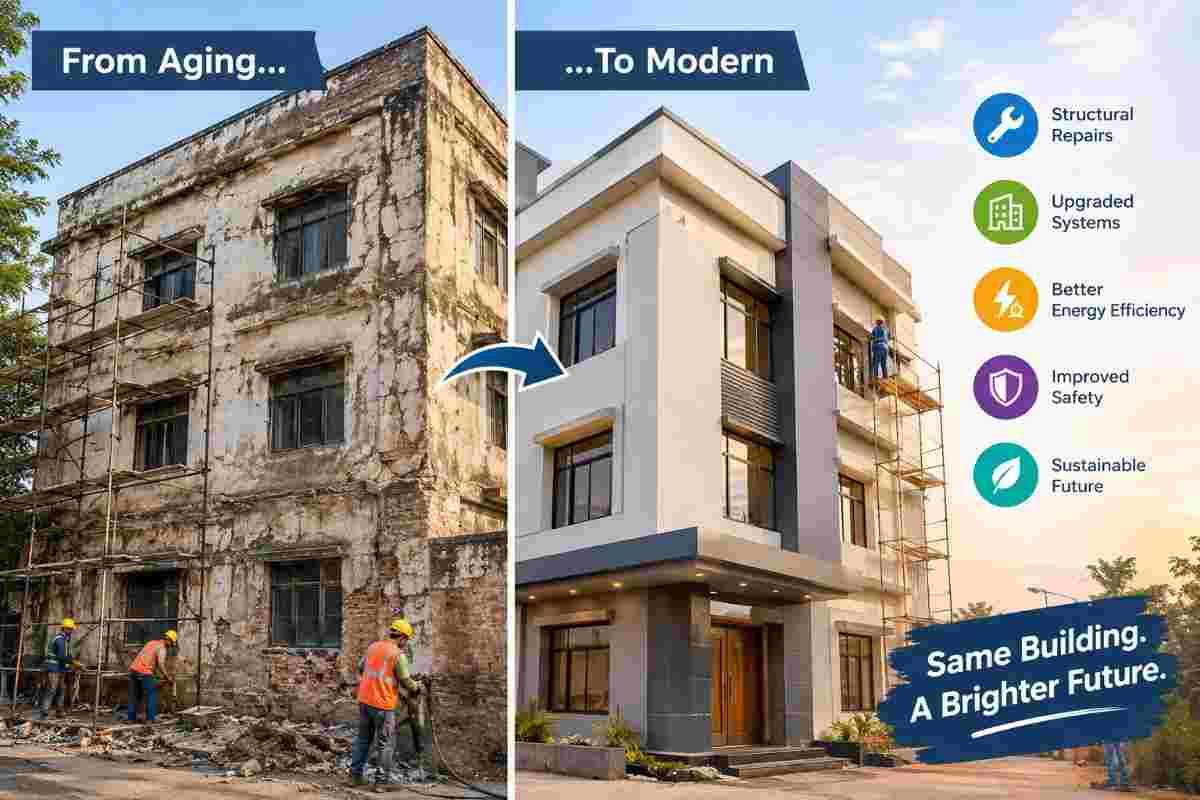
Walk through any major Indian city today, and you'll notice something interesting: buildings that look decades old on the outside often house strikingly modern interiors — fibre-optic wiring, centralized air conditioning, reinforced structural cores, and updated plumbing systems. This isn't an illusion. It's the result of a growing shift in the construction and real estate industry — one where aging buildings are being modernized rather than torn down and rebuilt from scratch.
For decades, demolition and reconstruction were the default answer to an aging structure. But as costs rise, sustainability becomes non-negotiable, and cities run out of space to expand, engineers, architects, and developers are turning to a smarter alternative: structural retrofitting and modernization. At the heart of this transformation lies a set of specialized construction techniques — including precision core cutting, concrete drilling, and structural reinforcement — that make it possible to upgrade a building's bones without demolishing it.
At Core Cutting India (https://corecuttingindia.com/), we've seen this shift firsthand. Our teams are increasingly called in not for demolition, but for precision cutting and drilling work that allows old buildings to be reborn — stronger, safer, and more efficient than before.
This blog explores why modernization is replacing rebuilding as the go-to solution for aging structures, the techniques driving this change, and what it means for the future of urban infrastructure.
Why Rebuilding Is No Longer the Default Choice
1. The Rising Cost of Demolition and Reconstruction
Demolishing a building and constructing a new one from the ground up is an expensive, time-consuming process. Beyond material and labor costs, there are also expenses tied to debris removal, environmental clearances, and temporary relocation of occupants. In dense urban areas, these costs multiply further due to limited access, safety regulations, and the need for specialized machinery.
Retrofitting, by comparison, often costs a fraction of a full rebuild — sometimes as little as 30-50% of the total expense — while achieving comparable improvements in safety, functionality, and aesthetics.
2. Sustainability and Environmental Responsibility
The construction industry is one of the largest contributors to carbon emissions globally, largely due to cement and steel production. Demolishing a structurally sound building and building a new one generates enormous embodied carbon waste — quite literally throwing away decades of environmental investment.
Modernizing an existing structure preserves that embodied energy. It reduces landfill waste from demolition debris and minimizes the need for virgin raw materials. For companies and city planners focused on sustainability goals, retrofitting has become not just a cost-saving measure but an environmental imperative.
3. Regulatory and Heritage Constraints
Many aging buildings, particularly in city centers, fall under heritage protection laws or urban planning restrictions that prohibit demolition. In such cases, modernization is the only viable path forward. Structural upgrades allow these buildings to meet modern safety codes while preserving their historical or architectural significance.
4. Faster Turnaround Times
Rebuilding a structure from scratch can take years, factoring in demolition, approvals, foundation work, and full construction. Retrofitting projects, especially when handled by experienced teams, can often be completed in a fraction of that time — minimizing disruption to residents, businesses, or institutions occupying the building.
The Techniques Powering Building Modernization
Modernizing an aging building isn't as simple as a fresh coat of paint or new fixtures. It requires precise structural intervention to ensure the building can safely support new systems, meet current safety codes, and function efficiently for decades to come. Here are the core techniques driving this transformation.
Core Cutting and Concrete Drilling
One of the most critical — yet often overlooked — aspects of building modernization is core cutting. As buildings age, they frequently need new openings for plumbing risers, electrical conduits, HVAC ducts, elevator shafts, or structural reinforcement bars. Traditional demolition methods using jackhammers are not just slow, but they also risk damaging the surrounding structure.
Precision core cutting uses diamond-tipped drilling equipment to create clean, accurate openings through concrete, brick, or masonry without disturbing the structural integrity of the surrounding area. This method is dust-controlled, vibration-free, and far more precise than conventional breaking methods — making it ideal for occupied buildings where noise and structural stress must be minimized.
At Core Cutting India, this is where our expertise plays a central role. Whether it's cutting through reinforced concrete slabs for a new staircase, creating openings for retrofitted elevators, or drilling precise holes for utility routing, core cutting enables renovation work that would otherwise require significant structural demolition.
Seismic Retrofitting
In earthquake-prone regions, many older buildings were constructed before modern seismic codes were established. Seismic retrofitting involves reinforcing a building's structural framework — often through steel bracing, base isolation systems, or additional shear walls — to help it withstand seismic activity.
This process frequently requires precision cutting to insert new reinforcement elements into existing concrete or masonry structures without compromising the building's overall stability during the retrofit process.
Facade and Envelope Upgrades
An aging building's exterior often bears the most visible signs of wear — cracked plaster, outdated glazing, or poor insulation. Facade modernization involves replacing or upgrading the building envelope with energy-efficient materials, improved insulation, and modern glazing systems, significantly improving energy performance without altering the building's core structure.
MEP (Mechanical, Electrical, Plumbing) System Overhauls
Older buildings were rarely designed for the electrical loads and connectivity demands of modern life. Upgrading MEP systems often requires cutting through existing floors, walls, and ceilings to route new wiring, plumbing, and HVAC ductwork. Precision cutting tools ensure these upgrades happen with minimal structural disruption, preserving load-bearing elements while creating pathways for new infrastructure.
Structural Strengthening
Where a building's load-bearing capacity needs improvement — whether to support additional floors, heavier equipment, or updated safety standards — engineers use techniques like column jacketing, beam strengthening, and the addition of steel or fiber-reinforced polymer (FRP) elements. These interventions extend a building's usable lifespan by decades without the need for a rebuild.
Real-World Applications: Where Modernization Makes the Biggest Impact
Commercial and Office Buildings
Many commercial properties built in the 1970s, 80s, and 90s were not designed for today's technology infrastructure or energy efficiency standards. Rather than demolishing these structures — often located in prime business districts — owners are retrofitting them with modern HVAC systems, updated fire safety measures, and smart building technology, dramatically extending their commercial viability.
Residential Complexes
Older residential buildings frequently require structural reinforcement, updated plumbing, and improved fire safety systems to meet current building codes. Modernization allows residents to stay in their homes throughout much of the renovation process, avoiding the displacement that a full rebuild would require.
Heritage and Institutional Buildings
Museums, government buildings, and educational institutions often occupy structures with significant historical value. Modernization techniques allow these buildings to gain modern amenities — accessibility features, updated electrical systems, climate control — while preserving their architectural character.
Industrial Facilities
Factories and warehouses built decades ago often need structural modifications to accommodate new machinery, safety systems, or expanded utility infrastructure. Precision cutting and structural reinforcement make it possible to adapt these spaces for modern industrial use without a costly rebuild.
The Role of Precision and Expertise
Building modernization is not a task for generalist contractors. It requires specialized equipment, trained technicians, and a deep understanding of structural engineering principles. A single miscalculated cut or drill can compromise a building's structural integrity, leading to costly repairs or safety hazards.
This is why companies specializing in precision core cutting and structural drilling play such a critical role in the modernization process. The right technique, equipment, and expertise ensure that every cut, drill, or reinforcement is executed with millimeter-level accuracy — protecting both the building's structure and the safety of everyone working on or occupying it.
Looking Ahead: The Future of Urban Renewal
As cities continue to grow denser and land becomes scarcer, the pressure to modernize rather than rebuild will only increase. Combined with rising sustainability expectations and stricter building codes, the demand for skilled retrofitting and structural modification services is expected to grow significantly in the coming years.
Technologies like 3D laser scanning, Building Information Modeling (BIM), and advanced diamond cutting equipment are making it easier than ever to plan and execute precise modernization projects with minimal risk and disruption. This convergence of technology and engineering expertise is what allows aging buildings to be transformed into safe, efficient, and modern spaces — without the environmental and financial cost of starting from scratch.
Conclusion
The shift from demolition to modernization represents more than just a cost-saving trend — it's a fundamental change in how we think about our built environment. Aging buildings, once considered liabilities to be torn down, are now being recognized as valuable assets that can be upgraded, strengthened, and reimagined for modern use.
At the center of this transformation is precision construction work — particularly core cutting and structural drilling — that makes it possible to modify existing structures safely and efficiently. As this approach continues to gain momentum across residential, commercial, and institutional buildings, the expertise behind these techniques becomes increasingly valuable.
If you're planning a renovation, retrofit, or structural modification project, working with experienced professionals is essential to ensure safety, precision, and long-term structural integrity. Visit Core Cutting India to learn more about how our core cutting and structural modification services can support your building modernization project.