
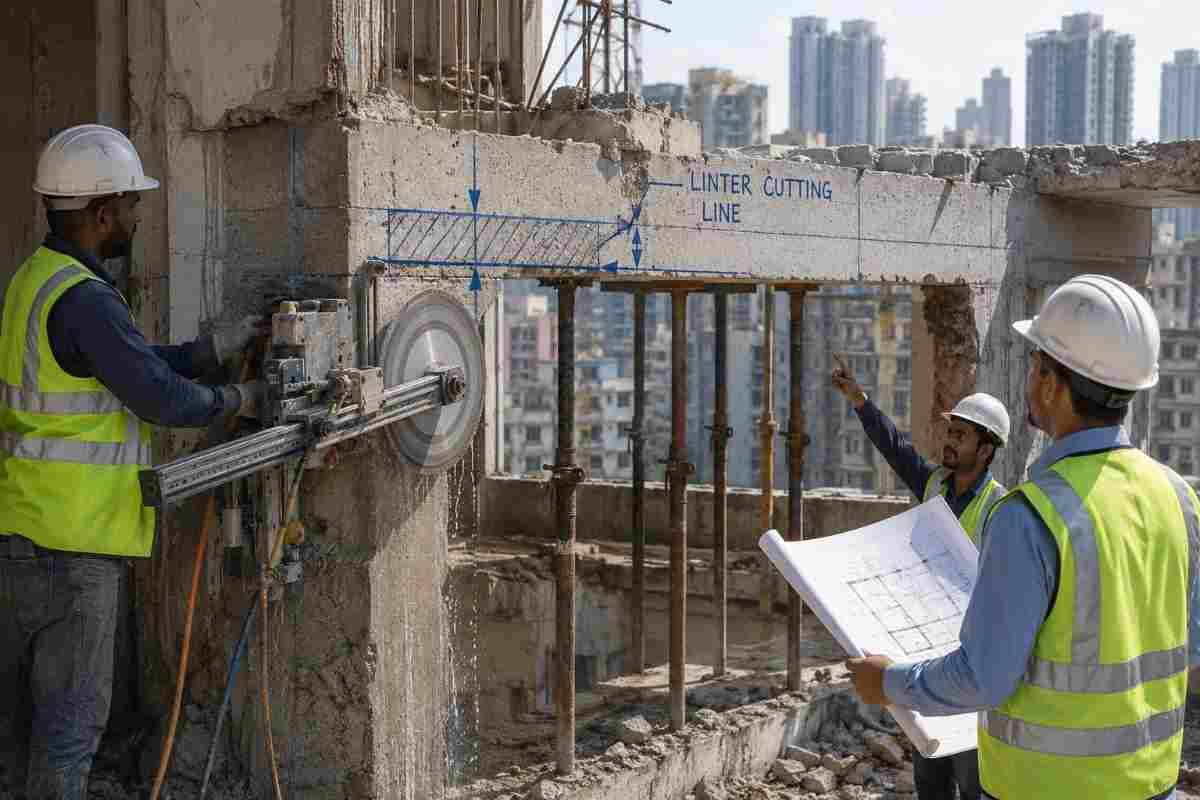
Mumbai’s urban skyline is undergoing a monumental shift. Driven by revised Development Control and Promotion Regulations (DCPR 2034), redevelopment projects across coastal hubs like Worli and Bandra to bustling suburban corridors in Andheri, Borivali, and Ghatkopar are replacing aging 3-to-4-story housing societies with modern high-rises.
However, redevelopment in Mumbai is rarely a clean-slate demolition project from day one. Many brownfield redevelopments involve phase-wise modifications, vertical extensions, structural repairs, basement additions, and structural retrofitting of existing RCC (Reinforced Cement Concrete) frames before or during structural alteration. One critical, highly precise structural operation in this workflow is linter (lintel) cutting.
Cutting concrete lintels, load-bearing headers, or RC tie beams requires surgical precision. A minor oversight can trigger micro-fissures in adjoining structural columns or violate Brihanmumbai Municipal Corporation (BMC) safety norms.
This comprehensive guide breaks down how builders, civil engineering teams, and project managers can plan, execute, and streamline linter cutting during Mumbai redevelopment projects safely and cost-effectively.
1. Understanding Linter Cutting in Mumbai Redevelopment Context
In Indian civil construction nomenclature, the term "linter" (phonetically used alongside lintel) refers to the horizontal reinforced concrete beams cast over openings like doors, windows, corridors, and ventilation shafts to support the masonry load above them.
Why Redevelopment Projects Require Linter Cutting
During Mumbai redevelopment projects, structural layouts are completely overhauled to accommodate modern architectural demands:
-
Window and Balcony Expansion: Modern high-rises feature floor-to-ceiling French windows, wide aluminum sliders, and cantilevered balconies, requiring the removal or re-dimensioning of old low-height lintels.
-
Services & MEP Passages: High-efficiency Firefighting systems, central HVAC ducting, plumbing stacks, and electrical conduit lines require precise openings through existing concrete lintels and tie beams.
-
Structural Layout Realignment: Merging smaller flat units or repurposing old ground-floor commercial spaces into podiums, parking spaces, or high-clearance lobbies requires targeted removal of load-bearing lintels.
-
Retrofitting and Column Jacketing: When existing structures are retrofitted, original lintels often interfere with column enlargement (jacketing) or sheer wall installation, necessitating precise structural trimming.
2. Pre-Execution Phase: Structural Assessment & BMC Compliance
Planning must precede execution. Attempting to chop reinforced concrete lintels using manual impact tools like hammers or pneumatics can destabilize neighboring structural elements.
+-------------------------------------------------------------------------------+
|                      LINTER CUTTING PLANNING WORKFLOW                         |
+-------------------------------------------------------------------------------+
|  1. Structural Audit & Rebar Scanning (GPR Analysis)                          |
|  2. BMC Safety Compliance & Structural Engineer Sign-off                      |
|  3. Load Redistribution & Temporary Shoring Setup                             |
|  4. Diamond Cutting Equipment Selection (Core / Wire / Saw)                   |
|  5. Controlled Vibration-Free Execution by Experts                            |
|  6. Debris Containment & Waste Management                                     |
+-------------------------------------------------------------------------------+
Step 1: Structural Audit and Non-Destructive Testing (NDT)
Before cutting any RCC lintel, builders must engage structural auditors.
-
Ground-Penetrating Radar (GPR) & Rebar Scanners: Identify internal steel rebar locations, tendon stress cables, and conduit pipes hidden within the lintel.
-
Concrete Core Testing: Check the compressive strength ($M25, M30, M40$, etc.) of the old concrete matrix to select the correct diamond blade grit.
Step 2: Temporary Load Transfer Systems
Lintels carry brick masonry loads or share stress with adjoining tie-beams. Before cutting:
-
Install heavy-duty acrow props and H-beams directly under the upper masonry wall or floor slab.
-
Ensure load distribution spreads evenly across lower floors to prevent localized deflection.
Step 3: Regulatory Approvals & BMC Guidelines
Under the Mumbai Building Bye-laws and IS Codes (specifically IS 456 for structural concrete and IS 13920 for ductile detailing):
-
Any structural alteration affecting RCC load distribution requires an endorsement from a BMC-licensed Structural Engineer.
-
Noise abatement rules apply in dense residential neighborhoods (e.g., Dadar, Chembur, Vile Parle). Dust and noise mitigation plans must be logged prior to commencement.
3. Technology Selection: Vibration-Free Diamond Linter Cutting
Traditional demolition using jackhammers and sledgehammers creates violent micro-cracks that propagate through the concrete matrix, compromising the structural longevity of the surrounding building. Modern Mumbai redevelopments demand vibration-free, dust-controlled cutting technology.
At Core Cutting India, advanced diamond cutting solutions ensure zero structural shock during lintel, beam, and wall modifications.
                      +-----------------------------------+
                      |   DIAMOND LINTER CUTTING METHODS  |
                      +-----------------------------------+
                                        |
      +---------------------------------+---------------------------------+
      |                                 |                                 |
      v                                 v                                 v
+-------------------+         +-------------------+             +-------------------+
| Diamond Wire      |         | Wall Sawing       |             | Core Drilling     |
| Sawing            |         | Technique         |             | Stitching         |
+-------------------+         +-------------------+             +-------------------+
| Ideal for heavy,  |         | Ideal for linear, |             | Ideal for circular|
| deep M50+ lintels |         | sharp window/door |             | openings & corner |
| and thick beams.  |         | openings.         |             | cuts.             |
+-------------------+         +-------------------+             +-------------------+
1. Diamond Wall Sawing
-
How it works: A track-mounted machine equipped with a circular diamond-tipped blade travels along a precise line.
-
Best suited for: Cutting lintels flush with walls or resizing window and door openings up to 500 mm depth.
-
Advantages: Produces glass-smooth edges with zero over-cuts, reducing plaster touch-up costs.
2. Diamond Wire Sawing
-
How it works: A diamond-beaded steel cable wraps around the RCC lintel, continuously pulled at high speed by a hydraulic or electric drive unit.
-
Best suited for: Extra-thick, heavily reinforced structural lintels, bridge girders, or deeply embedded tie beams.
-
Advantages: No depth limitation; capable of cutting complex geometries cleanly.
3. Core Drilling (Stitching Method)
-
How it works: Overlapping core holes (stitch drilling) are drilled along the perimeter of the lintel using diamond core bits.
-
Best suited for: Confined indoor areas with limited track-mounting space.
-
Advantages: Highly versatile for small-scale lintel adjustments or MEP duct passes.
4. Step-by-Step Linter Cutting Execution Strategy for Builders
To ensure safety, speed, and cost-efficiency on-site, project managers should adhere to this standardized field execution protocol:
Phase 1: Site Preparation & Protection
-
Safety Enclosures: Mask floor openings with heavy-duty tarpaulins and debris containment screens to contain slurry and dust.
-
Utilities Check: Shut off and re-route electrical cables or plumbing pipes running through or adjacent to the target lintel.
-
Slurry Management: Attach wet-vacuum collection rings to core drillers and track saws to keep slurry off existing floors.
Phase 2: Equipment Setup & Rigging
-
Anchor Mounting: Securely anchor saw tracks directly into structural concrete using industrial expansion anchors.
-
Rigging Large Blocks: Attach crane hoists or chain blocks to the lintel section before making the final cut. Heavy concrete blocks (often weighing 200 kg to 1.5 tons) must never drop freely.
Phase 3: The Cutting Operation
-
Primary Track Cuts: Perform horizontal bottom cuts first, followed by vertical side cuts.
-
Cooling Water Flow: Maintain constant water flow across diamond blades to cool the matrix, flush out concrete swarf, and suppress silica dust.
-
Final Severing: Execute the top cut while supporting the weight of the lintel segment via mechanical rigging.
Phase 4: Block Removal & Edge Finishing
-
Section Handling: Lower cut lintel blocks safely using gantry cranes or mechanical trolleys for transport to waste collection zones.
-
Rebar Dressing: Grind exposed internal rebar flush with the concrete surface and apply anti-corrosive zinc-rich primer to prevent rust propagation.
5. Overcoming Challenges Specific to Mumbai Redevelopment
Mumbai’s micro-climate, regulatory framework, and high urban density pose unique challenges during structural alteration:
| Challenge in Mumbai | Root Cause | Engineering Solution |
| Monsoon Humidity & Corrosion | High saline air accelerates rebar rust when concrete is cut open. | Treat newly exposed concrete/steel edges immediately with epoxy mortars and anti-rust coatings. |
| High Density & Close Proximity | Zero-lot-line neighboring structures in areas like Girgaon or Bhendi Bazaar. | Use diamond wire sawing to eliminate vibration transfer to adjoining shared walls. |
| Strict Noise Restrictions | BMC guidelines restrict noisy construction activities during morning and late evening hours. | Deploy high-frequency electric diamond tools operating below 75 dB instead of diesel air compressors. |
| Slurry Management in High-Rises | Wet cutting produces cementitious slurry that clogs municipal drains. | Implement closed-loop slurry recycling units with filter presses on site. |
6. Cost Estimation Matrix for Linter & Concrete Cutting in Mumbai
Budgeting for linter cutting depends on concrete compressive strength, rebar density, depth of cut, accessibility, and total volume.
To calculate accurate project budgets, builders can use the automated digital rate calculator on Core Cutting India. Below is an estimated cost benchmark for planning purposes across Mumbai:
| Service Type | Unit of Measurement | Estimated Price Range (INR)* | Key Cost Drivers |
| RCC Lintel Wall Sawing | Running Feet (RFT) / Sq. Inch | ₹350 – ₹850 per RFT | Thickness (100mm–300mm), Steel Diameter |
| Core Drilling Opening | Per Hole / Inch Diameter | ₹150 – ₹450 per Inch-Dia | Depth, Rebar Density, Angle |
| Diamond Wire Sawing | Sq. Meter / Sq. Feet | ₹1,200 – ₹2,500 per Sq. Ft | Cross-sectional area, M-grade concrete |
| Site Slurry & Handling | Lump Sum / Project Basis | Depends on project scale | Floor height, crane availability |
*Note: Rates vary based on site accessibility, height level, emergency timelines, and total scope of work. Consult Core Cutting India directly for tailored industrial estimates.
7. Safety, Structural Retrofitting & Risk Management Checklist
To maintain a zero-incident safety record on site, builders must mandate compliance with the following safety protocols:
Structural Risk Mitigation
-
[ ] Never cut lintels connected to primary structural columns without structural engineer clearance.
-
[ ] Install mechanical shores (acrow jacks) capable of holding 1.5x the dead load of the upper slab or wall.
-
[ ] Verify that structural retrofitting jackets (if planned) are cured before removing old tie-lintels.
Worker Safety & Environmental Protection
-
[ ] PPE Mandate: Workers must wear hard hats, steel-toe boots, ear defenders, high-visibility vests, and N95/FFP3 respirators.
-
[ ] Electrical Safety: All cutting units must run through Earth Leakage Circuit Breakers (ELCB/RCCB) to prevent shocks in wet-cutting conditions.
-
[ ] Material Handling: Secure lintel blocks using certified webbing slings or wire ropes before final severing cuts are completed.
Why Builders Choose Core Cutting India for Mumbai Projects
Executing lintel cutting, concrete wall modifications, slab removal, and heavy structural core drilling requires specialized machinery and skilled engineering talent.
Core Cutting India provides high-precision concrete cutting services across Mumbai, Navi Mumbai, and Thane.
Core Capabilities:
-
Advanced Fleet: High-frequency diamond wall saws, hydraulic wire saws, and heavy-duty core drill rigs.
-
Vibration-Free Technology: Guarantees zero structural micro-cracks in neighboring beams or columns.
-
Certified Operators: Highly trained engineering crews experienced in complex redevelopment layouts.
-
Full Compliance: Operates strictly within BMC safety, noise, and environmental guidelines.
Whether you are expanding window openings in Bandra, removing lintels for lobby expansion in Lower Parel, or conducting structural modifications in Thane, partner with Core Cutting India for reliable, safe, and efficient project completion.
Frequently Asked Questions (PAA)
Q1: Is linter cutting safe during building redevelopment in Mumbai?
Yes, linter cutting is completely safe provided it is executed using vibration-free diamond cutting technology (like wall sawing or wire sawing) under the supervision of a licensed structural engineer. Traditional manual breaking with hammers should be avoided as it damages surrounding concrete.
Q2: Do builders need BMC approval for lintel and slab cutting?
Modifications that alter the structural RCC framework, load paths, or exterior facade layouts require approval from a BMC-registered structural engineer and endorsement under the relevant building modification plans.
Q3: What is the best equipment for cutting heavily reinforced RCC lintels?
Diamond track-mounted wall saws are ideal for linear lintel cuts up to 500mm depth. For thicker sections or deeply embedded structural tie-beams, diamond wire sawing is the safest and most efficient choice.
Q4: How can builders estimate linter cutting costs for large projects?
Cost is determined by concrete thickness, reinforcement density, total running feet, and floor height. You can generate transparent estimates using the online rate calculator on Core Cutting India.
Q5: How do you control dust and slurry during linter cutting on indoor sites?
Diamond wet-cutting uses continuous water flow to catch dust at the blade interface. Professional contractors deploy slurry rings attached to industrial wet-vacuums to collect wastewater instantly, keeping the surrounding site clean.
Conclusion
Linter cutting is an indispensable engineering operation in modern Mumbai building redevelopment projects. By combining thorough structural audits, proper temporary shoring, and advanced vibration-free diamond cutting equipment, real estate builders can modify layouts smoothly, stay within strict timelines, and protect structural integrity.
Plan your next structural modification with confidence. Contact the engineering experts at Core Cutting India to request a site survey or obtain an instant quote.
-
Website: https://corecuttingindia.com/
-
Direct Line & WhatsApp: +91 70096 79903
-
Email Inquiries: [email protected]