
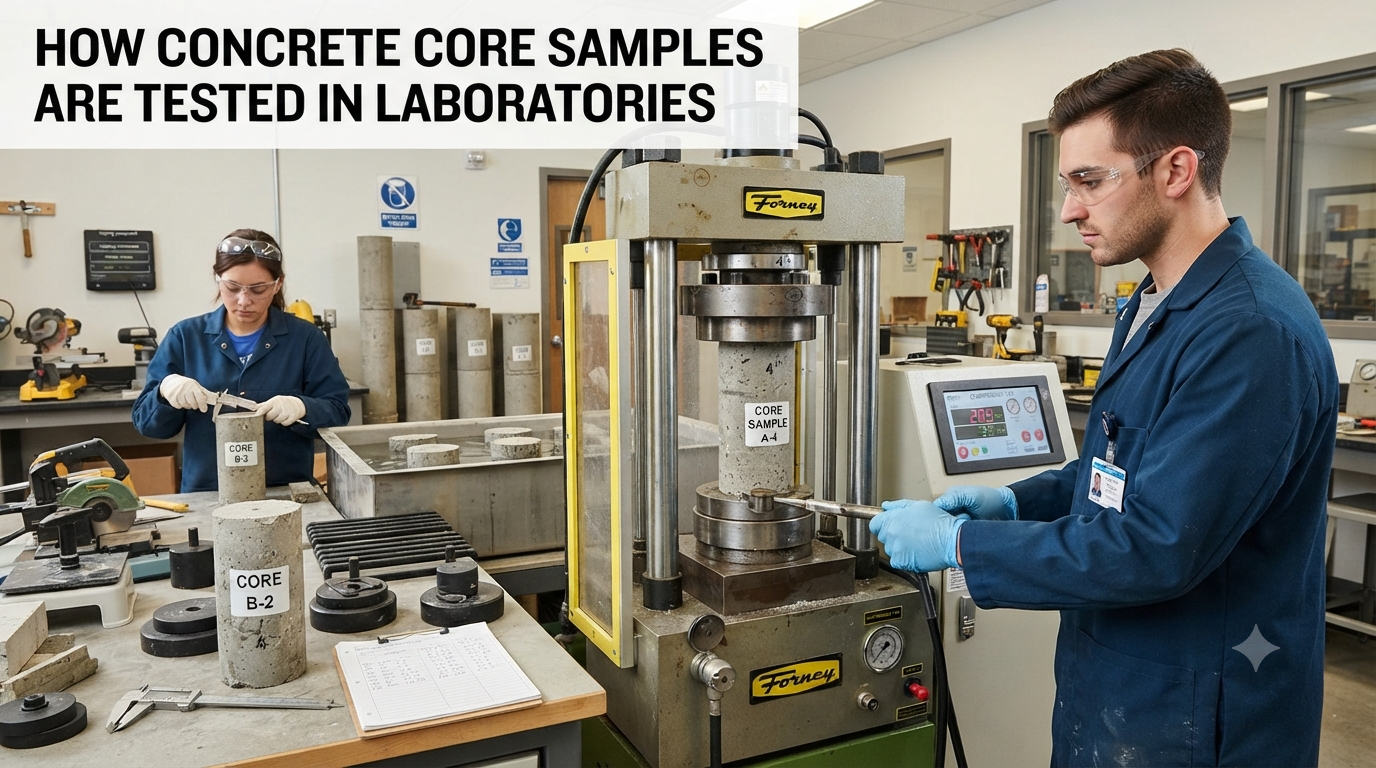
When a high-rise residential tower in Mumbai, a massive metro tunnel in Delhi, or a multi-span highway bridge across a river in Bihar undergoes structural auditing, engineers rely heavily on concrete core testing. While non-destructive testing (NDT) methods like Rebound Hammer and Ultrasonic Pulse Velocity (UPV) offer quick surface insights, they remain qualitative indicators. To truly understand the internal health, actual compressive strength, and structural integrity of hardened concrete, laboratories perform destructive testing on extracted cylindrical specimens.
This comprehensive guide explores the step-by-step laboratory testing procedure for concrete core samples, highlighting relevant Indian Standard (IS) codes, practical Indian case contexts, and why rigorous testing matters for safety.
Target-Related Searches
-
Concrete core testing procedure in laboratory
-
IS 516 part 4 for concrete core strength
-
Compressive strength of core sample calculation
-
Core cutting and testing services India
-
Structural audit concrete testing cost and methods
People Also Ask (PAA) Questions
-
How are concrete core samples prepared for laboratory testing?
-
What is the Indian Standard code for testing concrete cores?
-
How is the equivalent cube strength calculated from a core sample?
-
Why is core drilling necessary if NDT tests are already done?
1. Why Core Sampling is the Gold Standard for Structural Health
In India’s fast-paced construction landscape, structures face severe environmental challenges—ranging from high humidity and heavy coastal monsoons in Mumbai and Chennai to extreme thermal variations in Delhi and Rajasthan. Over time, factors like substandard initial curing, honeycombing during casting, carbonation, or accidental overloading raise concerns about structural capacity.
When Non-Destructive Testing (NDT) points toward anomalous low-strength zones or structural distress, project engineers order core cutting and extraction. A specialized diamond core drill rig extracts cylindrical concrete plugs from structural members like columns, beams, or bridge piers without compromising the surrounding reinforcement matrix (typically utilizing 50mm, 75mm, or 100mm diameter bits). These samples are then safely transported to an authorized material testing laboratory for quantitative evaluation.
2. Step-by-Step Laboratory Procedure for Testing Concrete Cores
Once the cylindrical core samples arrive at the laboratory, technicians follow strict protocols laid down by standard institutions to ensure accurate, repeatable, and unbiased results.
Step A: Visual Inspection and Logging
Upon receipt, technicians log each core sample with details such as the exact site location (e.g., "Basement Column C4 of Pune commercial complex"), extraction depth, diameter, and visible condition. The core is examined for:
-
Presence of embedded steel reinforcement bars (rebar).
-
Voids, honeycombing, or aggregate segregation.
-
Micro-cracks caused during improper extraction.
Step B: Trimming and Dimensional Measurement
Drilled cores often have irregular, jagged ends. To ensure uniform load distribution during compression, the sample must be accurately measured and prepared.
-
Length-to-Diameter (L/D) Ratio: The ideal core specimen should have an L/D ratio of 2.0. If the extracted core is too long or too short, it is trimmed using a diamond masonry saw.
-
Measurement: Technicians measure the diameter at multiple points using vernier calipers and record the exact length to calculate cross-sectional areas.
Step C: End Preparation (Capping or Grinding)
Uneven ends can cause stress concentrations and premature localized failure under heavy hydraulic loads. Laboratories choose between two primary end-preparation methods:
-
Grinding: Using a precision surface grinder to make the top and bottom faces completely flat and parallel to each other.
-
Capping: Capping both ends using a high-strength sulfur compound or high-strength gypsum plaster paste to create smooth, parallel loading surfaces in compliance with testing standards (Agrawal & Deulkar, 2024).
Step D: Moisture Conditioning
The moisture state of concrete dramatically affects its measured compressive strength—wet concrete typically yields lower compressive strength values than dry concrete.
-
According to standard specifications (such as IS 516 Part 4), cores are generally saturated by soaking them in water at $27 \pm 2^\circ\text{C}$ for 48 hours prior to testing, or tested in an air-dry state depending on the specific structural evaluation requirements and client specifications.
Step E: Compression Testing in a CTM
The prepared core is placed centrally in a heavy-duty Compression Testing Machine (CTM).
-
A uniform, continuous compressive load is applied at a specified rate (typically within the range of $0.2\text{ MPa/s}$ to $0.4\text{ MPa/s}$) until the specimen undergoes structural failure.
-
The ultimate breaking load ($P$) in kilonewtons (kN) is recorded automatically by the machine's digital readout system.
3. Relevant Indian Standards (IS Codes) Governing Core Testing
In India, material testing and structural evaluations are strictly bound by Bureau of Indian Standards (BIS) guidelines:
-
IS 456:2000: Code of practice for plain and reinforced concrete, which outlines acceptance criteria when in-situ core tests are evaluated.
-
IS 516 (Part 4): 2018 / Relevant Sections: Details the exact methodology for securing, preparing, and testing concrete cores to determine compressive strength.
-
IS 1199: Methods of sampling and analysis of concrete.
4. Calculating Equivalent Cube Strength and Corrections
A common misconception is that the raw crushing strength of a core equals the characteristic strength of standard site cubes. Because core samples are cylindrical, smaller in diameter than standard cubes, and subject to drilling disturbances, mathematical corrections must be applied.
The Equivalent Cube Strength is derived using correction factors that account for:
-
The Length-to-Diameter (L/D) Ratio: If the core's L/D ratio is less than 2.0, a standard multiplying factor is applied to normalize the strength.
-
Diameter Effect: Standard corrections adjust values depending on whether 50mm or 100mm core cutters were utilized.
-
Presence of Reinforcement: If a steel bar runs transversely through the core, a correction factor is applied to compensate for the steel's contribution to load resistance.
Formula Insight:
$\text{Equivalent Cube Strength} = \text{Measured Core Strength} \times \text{Correction Factors (for L/D ratio, diameter, and rebar presence)}$.
According to IS 456, concrete in a member represented by a core test is considered acceptable if the average equivalent cube strength of the cores is at least 85% of the specified grade strength, with no single core falling below 75%.
5. Real-World Indian Scenarios and Case Applications
Case 1: Infrastructure Audits of Aging Dams
Major infrastructure assets across India, such as decades-old gravity dams (e.g., historical hydro projects examined by researchers like Patel, 2021), undergo routine core drilling to assess long-term structural aging, Alkali-Aggregate Reaction (AAR), and internal degradation. Laboratory testing of these deep core samples helps asset managers decide whether retrofitting or grouting is required.
Case 2: Post-Fire Structural Safety in Industrial Hubs
In manufacturing belts across Gujarat, Maharashtra, and Tamil Nadu, industrial units occasionally suffer accidental fires. Post-fire structural assessments utilize core sampling to measure residual compressive strength loss. Laboratory findings help engineers determine if concrete properties degraded due to high temperatures exceeding $400^\circ\text{C}$ to $500^\circ\text{C}$ (Gesoglu et al., 2026), guiding safe rebuilding or retrofitting decisions.
Summary: Ensuring Safety Through Precision
Laboratory testing of concrete core samples bridges the gap between theoretical mix designs and real-world structural performance. By translating raw crushing loads into accurate equivalent strengths using established IS standards, structural consultants can make informed, safe, and cost-effective decisions regarding building rehabilitation.
For professional core cutting, sampling, and advanced structural diagnostic services across India, reach out to trusted experts at [email protected] to ensure your projects meet the highest benchmarks of structural safety and compliance.